
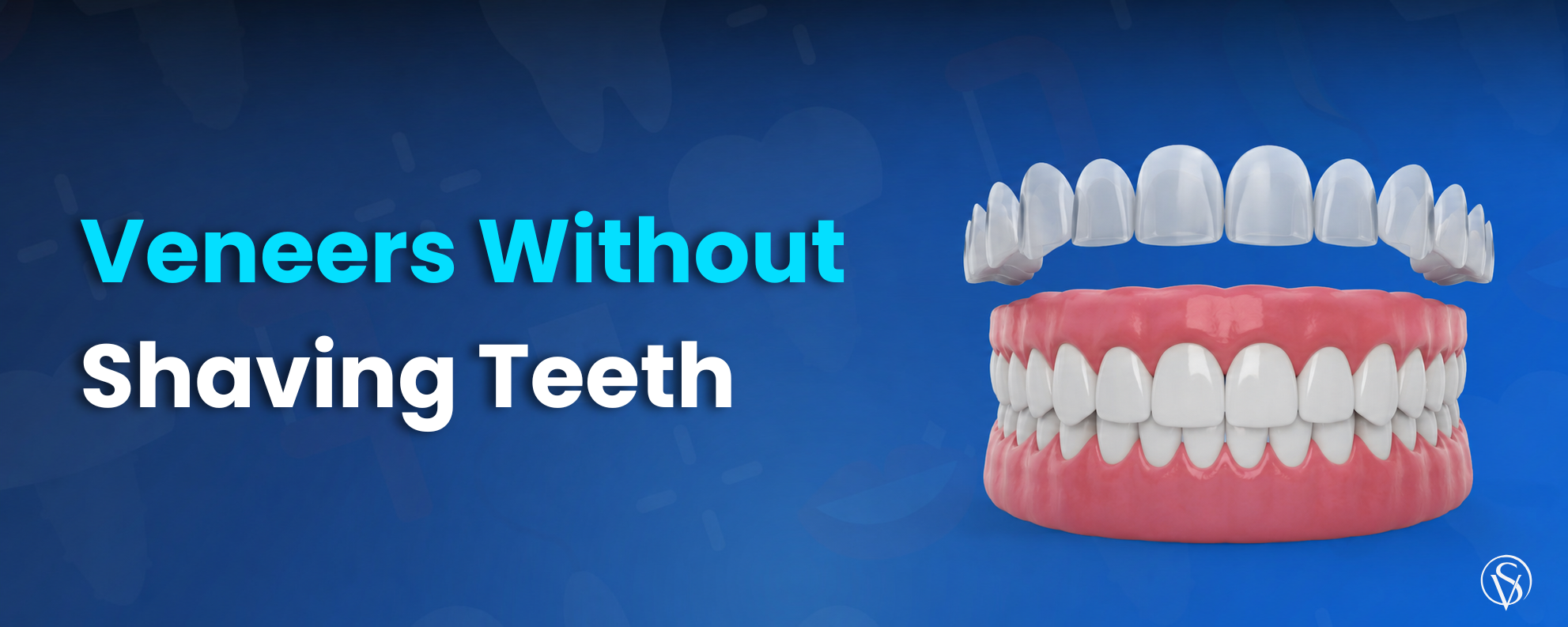
Veneers without shaving teeth use ultra-thin porcelain (0.2 to 0.5 mm), layered composite resin, or removable snap-on appliances bonded on top of natural enamel.
No-prep porcelain lasts 10 to 20 years and costs €260 to €420 per tooth in Turkey, Istanbul, $1,200 to $2,500 in the USA, £700 to £1,500 in the UK, and CAD $1,200 to $2,500 in Canada. Composite veneers last 4 to 8 years. Snap-on veneers are removable and last 1 to 3 years. Candidacy depends on enamel thickness, bite balance, and how much colour or shape correction is needed.
We treat international patients at Vera Smile in Istanbul under Slow Dentistry Global Network protocols, and we have placed thousands of these restorations.
What Does Veneers Without Shaving Teeth Actually Mean?
Veneers without shaving teeth means restorations placed with 0 to 0.2 mm of enamel removal at most, often using only a polishing disc rather than a bur. The clinical term for “shaving” is enamel reduction. Traditional porcelain dental veneers require 0.5 to 0.7 mm of enamel removal so the veneer sits flush with the gumline. No-prep options stay above the enamel and bond on top without changing the tooth profile. Three categories qualify under that promise:
- No-Prep Porcelain Veneers: 0.2 to 0.5 mm shells made from feldspathic porcelain or pressed lithium disilicate, bonded with hydrofluoric acid etch and resin cement.
- Composite Veneers: Light-cured resin sculpted directly on the tooth in one visit, with only an enamel etch and no lab fabrication.
- Snap-On Veneers: Removable acrylic shell that clips over the teeth like a thin retainer, with no bonding involved.
Only the first two are bonded restorations. The third is a cosmetic appliance.
A small honesty footnote: clinical literature shows that around 20% of prepless cases still need a few microns of enamel polished off to remove a sharp line angle or a deep fissure.
What Are the Three Options for Veneers Without Shaving Teeth?
The three options for veneers without shaving teeth are no-prep porcelain veneers, composite veneers, and snap-on veneers. Each differs in material, thickness, lifespan, and cosmetic ceiling. The comparison table below covers the operational differences at a glance, and the sections that follow break down each option in clinical detail.
| Feature | No-Prep Porcelain | Composite Veneers | Snap-On Veneers |
| Material | Feldspathic porcelain or pressed lithium disilicate | Light-cured composite resin | Acrylic or PMMA |
| Thickness | 0.2 to 0.5 mm | 0.3 to 0.8 mm | 1.0 to 1.5 mm shell |
| Tooth reduction | 0 to 0.2 mm (selective polish) | 0 mm (etch only) | 0 mm |
| Visits | 2 (scan + bond) | 1 | 1 fitting + shell delivery |
| Lifespan | 10 to 20 years | 4 to 8 years | 1 to 3 years |
| Reversibility | Mostly reversible | Mostly reversible | Fully reversible |
| Cost per tooth USA | $1,200 to $2,500 | $300 to $1,200 | $60 to $150 (full set $300 to $1,200) |
| Cost per tooth Turkey (Vera Smile) | €260 to €420 | €120 to €200 | €90 to €150 (full set) |
| Stain resistance | Excellent | Moderate (stains in 12 to 24 months) | Low |
| Best for | Mild to moderate cosmetic case | Budget, single tooth, fast turnaround | Special event, photo, podcast |
The three options serve different patient profiles. No-prep porcelain is the long-term cosmetic restoration. Composite is the budget and fast-turnaround option. Snap-on is the event-only appliance.
No-Prep Porcelain Veneers (Lumineers)
No-prep porcelain veneers are 0.2 to 0.5 mm ceramic shells bonded to enamel without any tooth reduction in 80% of cases, making them the longest-lasting option in the no-shave category and the only one with peer-reviewed 10-year survival data above 95%. Lumineers are made from Cerinate, a leucite-reinforced ceramic averaging 0.3 mm thickness, and are the most-searched option in the category. They bond to enamel using a well-established protocol, but the sequence is operator-sensitive and survival depends entirely on whether the bond is to enamel rather than dentin: pooled clinical reviews put 10-year enamel-bonded survival at 99% (range 98% to 100%), dropping to 91% (range 84% to 98%) when bonded to dentin, as summarised in the systematic review at PMC8184312. The chairside workflow is straightforward, visit one covers a digital scan with an intraoral scanner, photographs in five angles, a smile design wax-up, and approval of the digital mock-up, with the lab taking 7 to 14 days. Visit two is the bonding appointment, where the dentist isolates the teeth with a rubber dam, etches the enamel with 37% phosphoric acid for 30 seconds, primes, places the cement, seats the veneer, and light-cures for 40 seconds per surface. Total chair time for 8 to 10 units is 2 to 3 hours, and no anaesthesia is needed in 80% of cases because no enamel is being cut.
No-prep porcelain wins on mild discoloration, small chips, narrow gaps under 1 mm, and slightly uneven incisal edges. It fails when the underlying tooth is too dark, when the lateral incisors are rotated more than 15 degrees, when the patient grinds at night without a guard, or when the case asks the veneer to add 1 mm of bulk to push the smile forward; in that last scenario the smile reads bulky and the lip support changes. We turn down roughly 12% of consult cases at Vera Smile and recommend orthodontics or a different plan instead.
Composite (Direct) Veneers
Composite veneers are single-visit restorations sculpted directly on the tooth from nano-hybrid composite resin, with no lab involvement and no enamel removal beyond a 15 to 30 second phosphoric acid etch. The chairside sequence is simple: the cosmetic dentist photographs the case, places a rubber dam, etches the enamel for 15 to 30 seconds with 37% phosphoric acid, applies a bonding agent, then layers two to four shades of composite resin to mimic enamel’s polychromatic look, curing each layer with a 1,200 mW/cm² LED light for 20 seconds. A final polish with fine diamond burs and silicone wheels delivers a glass-smooth surface. A single tooth takes 30 to 45 minutes, while a full smile of 8 to 10 teeth runs 3 to 5 hours in one chair session.
The trade-off is in the wear and stain profile. Composite costs less than half of porcelain and looks excellent at handover, but the surface wears 4 to 5 times faster than enamel: it micro-roughens within 12 to 24 months and starts picking up coffee, red wine, and turmeric stains, requiring a polish or partial repair every 18 to 24 months and full replacement every 4 to 8 years depending on bite force and diet. The upside is that the tooth underneath is mostly untouched, so removal is fast and the enamel surface returns to baseline after a light polish. Composite veneers share the same resin family as direct teeth bonding.
Snap-On Veneers (Clip-On / Press-On)
Snap-on veneers are removable acrylic shells that slide over the upper or lower arch like an ultra-thin retainer with teeth printed on the front, fabricated by a dental lab from a putty impression or digital scan and priced at €90 to €150 per arch in Türkiye and $300 to $1,200 per arch in the USA. Their ceiling is narrow: they can mask discoloration and small gaps for a podcast, wedding, or photoshoot, but they cannot fix bite issues, restore chewing function, or correct severe misalignment, and they are not built for steak or any tough food. They feel bulky for the first few days, speech adapts within a week, and the gum-health caveat most of the SERP skips is that acrylic traps plaque and saliva against the gum line, raising gingival bleeding scores within six weeks of full-time wear in case-report data. For that reason, we tell patients to keep wear under 8 hours per day, rinse after meals, and brush the inside surface twice daily with a soft brush, treating them as an event tool rather than a daily replacement for teeth.
How Much Do Veneers Without Shaving Teeth Cost in Turkey, USA, UK, and Canada in 2026?
Veneers without shaving teeth cost €260 to €420 per tooth in Türkiye, $1,200 to $2,500 in the USA, £700 to £1,500 in the UK, and CAD $1,200 to $2,500 in Canada for no-prep porcelain. Composite and snap-on options sit at lower price brackets.
| Option | USA | UK | Canada | Turkey (Vera Smile) |
| No-prep porcelain (Lumineers, DURAthin, MAC) | $1,200 to $2,500 | £700 to £1,500 | CAD $1,200 to $2,500 | €260 to €420 |
| Composite (direct) | $300 to $1,200 | £250 to £650 | CAD $300 to $1,000 | €90–€180 |
| Snap-on (full arch) | $300 to $1,200 | £250 to £900 | CAD $400 to $1,200 | €90 to €150 |
| 10-unit no-prep porcelain smile | $12,000 to $25,000 | £7,000 to £15,000 | CAD $12,000 to $25,000 | €2,800 to €4,200 |
Pricing pulled from clinic price lists in May 2026. USA averages reflect private cosmetic dental practices in Los Angeles, New York, Miami, and Houston. UK averages reflect private practices in London, Manchester, and Birmingham. Canada reflects Toronto and Vancouver. Türkiye reflects Republic of Türkiye Ministry of Health licensed clinics in Istanbul. Vera Smile prices are quoted in euros and include digital scan, anaesthesia (when needed), bonded provisional, and one occlusal night guard.
A few hidden US costs are often left off the consult quote: occlusal night guard ($200 to $400), bite-photography fee ($150 to $300), retainer ($300 to $600), and a possible gingivectomy charge if the gum line needs a millimetre of contouring before bonding ($300 to $600 per tooth). Before booking treatment abroad, patients should also weigh the operational realities covered in our Turkey teeth guide.
Who Is a Candidate for Veneers Without Shaving Teeth?
A candidate for veneers is a patient with healthy enamel, balanced bite, and mild to moderate cosmetic concerns such as discoloration, small gaps, or minor edge wear. Three patient profiles fit the no-prep porcelain category cleanly:
- Mild Generalised Discoloration: Patients whose teeth have plateaued after professional whitening but still want a brighter, more uniform shade.
- Diastema Under 1 mm: Patients with a small midline gap or interproximal spacing that does not require orthodontic closure.
- Slight Incisal Edge Wear: Patients with edge chipping or flattening from decades of chewing, where length restoration is the primary goal.
- Post-Whitening Plateau: Patients who have completed whitening cycles and want to lock in the result with stain-resistant porcelain.
Patients who fall outside these profiles; heavy grinders, severely rotated teeth, dark tetracycline staining, or cases needing more than 1 mm of bulk to push the smile forward, are better served by a different plan, and we say so at consult rather than force the case. For international patients researching veneers in Turkey, the candidacy screen is the single most important conversation to have before booking travel; a clear yes or no at the photo and scan stage prevents the costly mistake of flying in for a treatment that was never the right fit in the first place.
Who Cannot Get Veneers Without Shaving Teeth?
Outside these profiles the case gets harder. The following conditions disqualify a patient from no-shave veneers:
- Active Gum Disease: Periodontitis or gingivitis must be treated and stabilised before bonding any restoration.
- Untreated Bruxism Without a Night Guard: Grinding produces shear forces that ultra-thin porcelain cannot absorb, raising debonding rates 4 times within 5 years.
- Severe Tetracycline Staining: The colour pushes through ultra-thin porcelain, so traditional veneers with masking opacity are needed instead.
- Severe Crowding or Rotation: Cases with rotation greater than 15 degrees require orthodontic alignment first.
- Heavy Enamel Loss With Exposed Dentin: When the labial surface already shows dentin, bonding survival drops from 99% to 91%, and traditional veneers or crowns are the better plan.
A patient can also do a rough at-home check before booking a consultation. Two visual signs suggest the enamel is thin enough that no-prep is risky: the front teeth look slightly translucent at the incisal edge, almost grey; or the cervical third of the tooth shows a clear yellow tint, indicating dentin showing through. If either is present, a periapical X-ray and a CBCT scan before committing are essential. We run the imaging in-house.
What Is the Clinical Evidence on Enamel Preservation and Survival for Veneers Without Shaving?
The clinical evidence on enamel preservation and survival shows that veneers bonded entirely to enamel survive at 99% over 10 years, while those bonded partly to dentin drop to 91%. The single biggest predictor of long-term veneer success is whether the bond is to enamel, not to dentin.
The Gurel 2013 study published in the Journal of Prosthetic Dentistry compared 580 porcelain laminate veneers across 12 years. Veneers with preparations confined to enamel survived at 99%. Veneers where the preparation exposed dentin failed roughly 10 times more often. A 2014 PubMed-indexed two-year clinical trial replicated the finding for partial dentin exposure, with success rates dropping from 99% (enamel only) to 74% (severe dentin exposure).
A 10-year cumulative survival of 95.5% has been confirmed for porcelain laminate veneers in general, with the enamel-bonded subgroup reaching 99% according to a pooled systematic review on PMC8184312. Composite veneers do not have an equivalent dataset, but narrative reviews indexed on PMC11122289 estimate 5-year survival at 65 to 80% depending on operator skill and diet. Snap-on veneers are not in the peer-reviewed survival literature because they are a removable cosmetic appliance, not a restoration.
The clinical implication is direct. No-prep veneers, by design, bond entirely to enamel. That is why they survive at 99%. The clinician’s job is to refuse the case when the enamel is not there, which is why Vera Smile declines roughly 12% of consultations rather than placing a veneer at compromised survival odds.
How Does Veneers Without Shaving Procedure Run in Turkey?
The Vera Smile no-shave veneer procedure runs across 5 to 7 days in three clinical visits: consultation and imaging on day one, digital smile design preview on day two, and bonding on day three. The entire workflow runs in-house, with the ceramics lab on-site to eliminate courier delays and lab-clinic miscommunication.
- Day One Consultation: Intraoral scan with iTero or Trios, periapical X-rays, CBCT cone-beam scan, full photographic documentation, and shade matching against a brightened baseline.
- Day Two Digital Smile Design: A 3D mock-up using DSD protocol previews the new smile shape, length, and shade before any bonding; the patient approves or adjusts the design at this stage.
- Day Three Bonding Visit: Lithium disilicate or feldspathic porcelain veneers are seated under rubber-dam isolation, etched with hydrofluoric acid, treated with silane, and bonded with dual-cure resin cement.
- Aftercare Handover: Each patient leaves with a custom occlusal night guard, an aftercare kit, written maintenance instructions, and recall scheduling for 6-month and 12-month follow-ups.
Vera Smile is licensed by the Republic of Türkiye Ministry of Health and operates under Slow Dentistry Global Network protocols, which mandate minimum chair time per procedure to protect bonding quality. The clinic is an IDA Design Award recipient and the official dental partner of the Houston Rockets. The operational version of “scientific excellence” is straightforward: enough chair time, enough imaging, enough rehearsal to get the bond right the first time.
What Are the Risks and Side Effects of Veneers Without Shaving Teeth?
The main risks of veneers without shaving teeth are microleakage at the cervical margin, debonding under bite stress, and gingival irritation from snap-on appliances. Each risk has a known frequency and a clinical mitigation.
- Microleakage at the Cervical Margin: Reported at 2 to 3% over 10 years for porcelain laminate veneers, caused by a contaminated bond surface or moisture under the rubber dam, and resolved by rebonding the affected unit.
- Debonding Under Bite Stress: Edge-to-edge bites and untreated nighttime grinding produce shear forces that ultra-thin porcelain cannot absorb, and patients who skip the night guard see roughly a 4 times higher rate of debonding within 5 years.
- Gingival Irritation From Snap-On Wear: Long-term snap-on wear without rigorous cleaning increases gingival bleeding within six weeks, because the acrylic shell traps plaque against the gum line.
- Sensitivity After Bonding: Mild thermal sensitivity is reported in 5 to 8% of no-prep cases for the first 7 to 14 days, resolving spontaneously without intervention.
- Shade Mismatch Over Time: Composite veneers drift in shade after 12 to 24 months as the resin surface picks up pigment, while porcelain holds its shade for the lifespan of the restoration.
A common industry shortcut Vera Smile rejects: some clinics quote “prepless” veneers and then reduce 0.3 to 0.5 mm of enamel chairside without informing the patient. Every micron of polish or reduction at Vera Smile is disclosed on the consent form before bonding begins.
How Are Veneers Without Shaving Teeth Maintained?
Veneers without shaving teeth are maintained through twice-daily soft-bristle brushing, daily floss, and a non-abrasive fluoride toothpaste, with the exact care routine varying by material. Daily maintenance is what separates a veneer that lasts its full clinical lifespan from one that fails years early, and most failures we see at follow-up are linked to a small handful of avoidable habits rather than material defects.
- No-Prep Porcelain Maintenance: Twice-daily brushing with a soft-bristle brush, daily floss, non-abrasive fluoride toothpaste, professional polish every 6 months, recall X-ray every 12 to 18 months, and a night guard if the patient grinds.
- Composite Veneer Maintenance: Polish every 12 to 18 months, possible touch-up if colour drifts, and avoidance of staining foods within 48 hours of placement.
- Snap-On Veneer Maintenance: Daily removal and rinse, twice-daily brushing of the inner surface, storage in water when not worn, and replacement of the case fluid every 48 hours.
Skip the charcoal whitening pastes regardless of material, as they micro-scratch the porcelain glaze and accelerate composite surface wear. The single biggest swing factor across all three is a night guard for grinders; protecting the bonded interface adds years to porcelain and composite alike.
How Often Do They Need Replacement?
Replacement intervals range from 1 to 3 years for snap-on, 4 to 8 years for composite, and 10 to 20 years for no-prep porcelain, with material choice being the strongest predictor of lifespan. The triggers for replacement also differ: porcelain is usually swapped for cosmetic reasons rather than failure, composite is replaced because the surface has worn or stained, and snap-on is replaced because the acrylic itself distorts.
- No-Prep Porcelain Replacement: Realistic lifespan of 10 to 20 years when bonded to enamel, with replacement triggered by margin staining, chipping, or aesthetic update rather than functional failure.
- Composite Veneer Replacement: Full replacement at 4 to 8 years on average, with partial repair often extending lifespan between major replacements.
- Snap-On Veneer Replacement: Every 1 to 3 years before the acrylic distorts, with sooner replacement if the patient grinds or wears the appliance for extended periods.
The figures above assume good daily maintenance and a night guard where indicated; bite force, diet, and homecare can push a case to the short end or the long end of each range. At the consult stage we plan the replacement cycle into the cost conversation upfront so patients aren’t surprised at year four or year ten.
Frequently Asked Questions
Are no-shave veneers worth it?
No-shave veneers are worth it for mild to moderate cosmetic cases on healthy enamel where the patient values reversibility and longevity. They are not worth it for severely discoloured, severely misaligned, or heavily worn teeth, because the result will look bulky or the porcelain will not mask the underlying colour.
Do veneers without shaving look bulky?
Veneers without shaving look bulky in roughly 18% of cases, typically when the patient’s tooth shape is already convex or the lab adds extra ceramic to mask underlying colour. A digital mock-up before bonding catches this, which is why Vera Smile previews every case with a temporary mock-up before any cement is mixed.
Can I whiten my teeth before no-shave veneers?
Yes, and patients usually should. Whitening the natural teeth first allows the veneer shade to match a brighter baseline, which prevents the lateral incisors from looking yellow next to the centrals. A 14-day wait after whitening is required before bonding so the bond strength returns to normal.
Can no-shave veneers fix crooked teeth?
No-shave veneers can correct mild rotation under 10 to 15 degrees, but not moderate to severe crowding. Alignment is treated with clear aligners first, then veneers are placed on a stable, well-aligned arch. The threshold and case selection criteria are covered in detail on veneers for crooked teeth.
Are snap-on veneers safe for daily wear?
Snap-on veneers are safe for short, controlled wear of under 8 hours per day, but full-time wear without rigorous cleaning raises gingival bleeding scores within six weeks. Treat them like an aligner: remove at night, clean twice daily, store in water, and replace every 1 to 3 years.
Why won’t my dentist offer no-shave veneers?
A dentist may decline no-shave veneers for three reasons: lack of training in the operator-sensitive bonding protocol, an unsuitable case where the patient’s enamel is thin or the tooth shape too convex, or a preference for traditional veneers because the prep makes shape control easier. A second opinion at a clinic that runs digital smile design is the standard next step.