
Zygomatic implants are a specialized solution for patients with severe upper jaw bone loss where conventional implants cannot be placed safely. Instead of anchoring into the maxilla, these longer implants are fixed into the zygomatic bone, known for its dense and stable structure. By engaging this strong cheekbone, dentists restore function and aesthetics without the need for extensive grafting or sinus lift procedures.
This approach is preferred in advanced cases of bone resorption, long-term denture wearers, or individuals seeking a fixed solution when standard implants are not possible. Zygomatic implants provide a secure foundation for full-arch restorations, offering stability, durability, and improved quality of life for patients who previously had limited treatment options.
What Are Zygomatic Implants?
Zygomatic implants are extra-long titanium fixtures designed to anchor directly into the zygomatic bone, a strong and dense structure of the cheek. Their length ranges from 30 mm to 55 mm, far longer than standard dental implants, which allows them to bypass areas of weak or resorbed upper jawbone. Instead of relying on the maxilla, which may not provide enough stability, these dental implants gain firm support from the zygoma, ensuring a secure foundation for full-arch prosthetic teeth.
By engaging this alternative anchorage point, zygomatic implants eliminate the need for bone grafting or sinus lift procedures in patients with severe maxillary bone loss. This makes them a reliable option for individuals who would otherwise be considered unsuitable for conventional implants.
How Do Zygomatic Implants Support Full-Arch Restorations?
Zygomatic implants support full-arch restorations by anchoring into the zygomatic bone (cheekbone), a dense and highly stable structure that provides exceptional support when the upper jaw has experienced severe bone loss. Because the zygomatic bone offers far greater stability than a resorbed maxilla, these long implants can securely hold a full arch of prosthetic teeth without needing bone grafting or sinus lift surgery.
In many advanced cases, zygomatic implants are used in combination with conventional implants as part of a hybrid full-arch solution, such as an adapted All-on-4 approach. When the front part of the maxilla still has enough bone, traditional implants are placed there, while zygomatic implants are angled into the cheekbone to support the posterior area. Together, they create a stable, immediate-load foundation, allowing patients with even minimal bone to receive a fixed full-arch bridge on the same day.
This approach restores full function, facial support, and aesthetics, offering long-term reliability for patients who would otherwise be limited to removable dentures or extensive grafting procedures.
How Is the Zygomatic Implant Procedure Performed Step by Step?
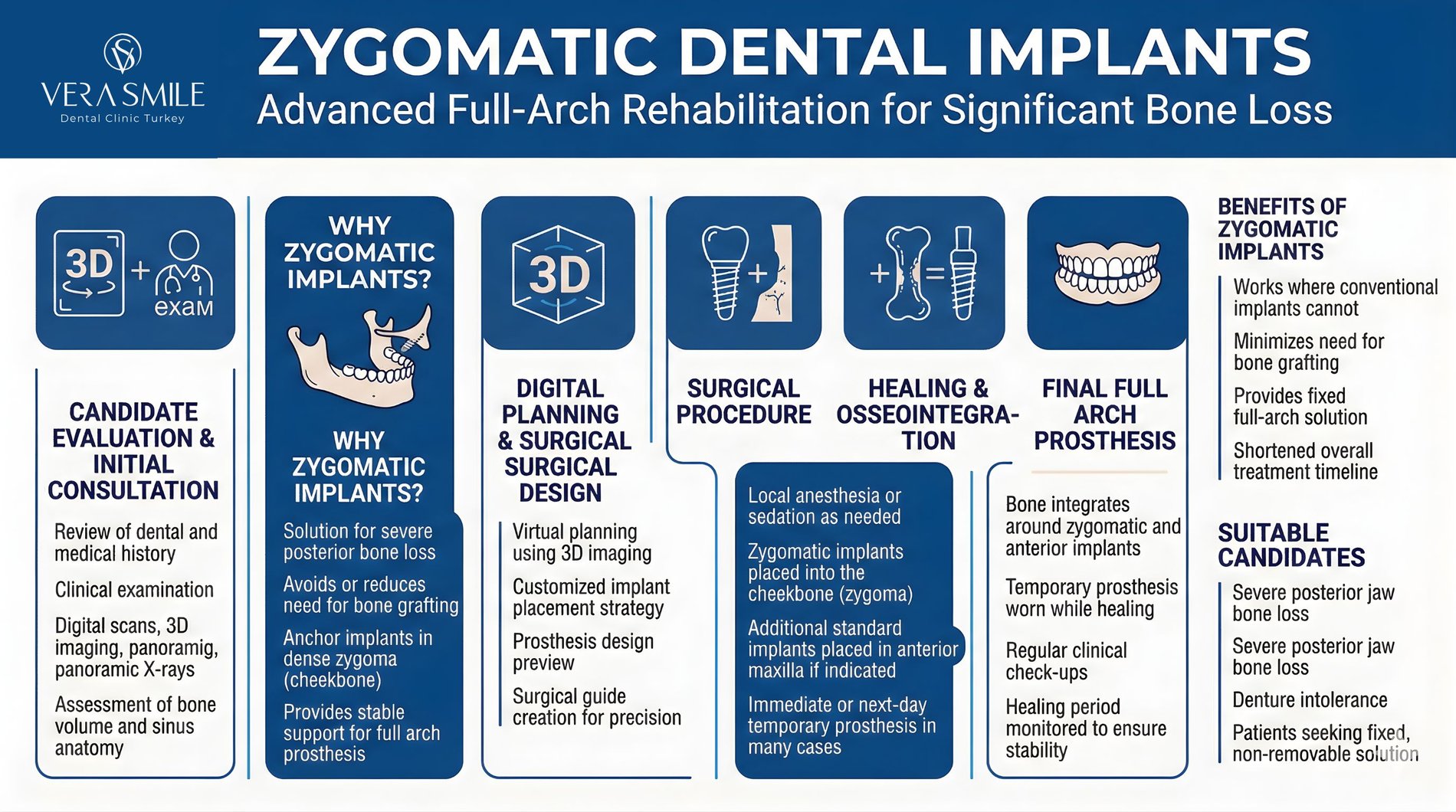
The zygomatic implant procedure follows a carefully structured process that ensures safety, precision, and predictable results. Each stage, from the first consultation to final recovery, is planned with advanced imaging and digital design to secure stable anchorage in the cheekbone while restoring full-arch function. The treatment journey includes thorough diagnostics, surgical placement, immediate prosthetic support when possible, and a structured healing period that leads to long-term success.
- Consultation: Comprehensive assessment with medical history, clinical exam, photographs, and CBCT imaging to evaluate bone and sinus anatomy.
- Digital Planning: Virtual implant positioning, prosthetic planning, and surgical guide preparation.
- Surgery: Placement of long implants into the zygomatic bone with advanced techniques for maximum stability.
- Abutment Connection: Multi-unit abutments ensure proper angulation and prosthetic fit.
- Provisional Restoration: Delivery of a fixed full-arch bridge, often within the same day or a few days.
- Healing & Follow-Up: Osseointegration, soft tissue adaptation, dietary guidelines, and scheduled check-ups leading to the final prosthesis.
How Long Does the Zygomatic Implant Procedure Take?
On average, the surgical phase lasts 2 to 4 hours, during which the implants are placed and abutments connected. The duration of a zygomatic implant procedure depends on the complexity of the case and whether it is combined with conventional implants for a full-arch restoration.
When immediate loading is possible, a provisional fixed bridge is fitted within the same day or within 24 to 72 hours, significantly shortening the treatment timeline compared to bone grafting procedures that require months of healing.
How Do Zygomatic Implants Differ from Traditional Implants?
While both zygomatic and traditional implants serve the same purpose, restoring missing teeth with a stable foundation, their design and placement vary significantly. Zygomatic implants are developed for patients with severe upper jawbone loss, providing anchorage in the cheekbone rather than the maxilla. This unique approach influences implant length, surgical technique, and overall treatment planning.
| Feature | Zygomatic Implants | Traditional Implants |
| Placement Site | Anchored into the zygomatic bone (cheekbone) | Anchored into the maxilla (upper jawbone) |
| Implant Length and Design | Extra-long fixtures (30–55 mm) designed to reach dense cheekbone | Standard length fixtures (8–15 mm) for placement in available jawbone |
| Treatment Complexity | Requires advanced surgical expertise and specialized planning | Routine surgical procedure performed in most implant cases |
What Are the Benefits of Zygomatic Implants?
Zygomatic implants offer life-changing advantages for patients with severe upper jawbone loss, providing a stable and predictable solution when conventional implants are not possible. By securing into the cheekbone rather than the maxilla, they eliminate the need for complex bone reconstruction and allow patients to regain full oral function more quickly.
- No Bone Graft Needed: Zygomatic implants bypass weak or resorbed maxillary bone, eliminating the need for sinus lift or bone grafting procedures.
- Faster Recovery: The dense zygomatic bone provides strong anchorage, allowing shorter healing times and earlier functional use.
- Full-Arch Restoration Capability: These implants enable immediate or early loading of a full fixed bridge, even in cases of advanced bone loss.
- Solution for Failed Implants: Ideal for patients who have experienced multiple implant failures or cannot receive traditional implants.
- Improved Quality of Life: Restores stable chewing, clear speech, and natural aesthetics with a durable, fixed full-mouth solution.
What Are the Risks of Zygomatic Implants?
Zygomatic implants are a highly advanced treatment option, but like all surgical procedures, they involve certain challenges and potential complications. Their placement requires precise planning and exceptional surgical skill, as the implants pass close to critical anatomical structures. Awareness of the possible risks helps patients understand why choosing an experienced specialist is essential for predictable and safe results.
- Sinus-Related Issues: The proximity of the implants to the sinus cavity may lead to irritation, inflammation, or sinusitis in some cases.
- Higher Surgical Complexity: The greater length and angulation of zygomatic implants make the procedure more technically demanding than standard implant placement.
- Requirement for Highly Skilled Surgeons: Successful outcomes rely on specialists with advanced training in oral and maxillofacial surgery due to the intricate anatomy involved.
General Implant Complications: As with any implant procedure, there is a possibility of infection, implant failure, or delayed osseointegration, especially if oral hygiene and aftercare are not properly maintained.
Is the Zygomatic Implant Procedure Painful?
No, the zygomatic implant procedure is not typically painful, because it’s performed under local anesthesia with sedation or, when needed, general anesthesia. Patients stay comfortable during the entire surgery and usually feel pressure rather than pain.After the procedure, it’s normal to have mild swelling, bruising, or tenderness for a few days, but these symptoms are easily managed with prescribed pain medication and proper aftercare. Overall, discomfort is short-term, and recovery is generally smoother than bone graft–based treatments.
What Is the Success Rate of Zygomatic Implants?
Zygomatic implants demonstrate a consistently high success rate, even in patients with severe upper jawbone loss. Approximately 96% survival after more than six years of follow-up, with long-term research showing success rates around 95–96%. Large-scale reviews involving thousands of implants indicate a cumulative success rate of about 95% after three years. Outcomes are even stronger when zygomatic implants are integrated into full-arch systems such as All-on-4, where survival rates often exceed 97%. Most complications occur in the early healing stage, while long-term stability remains excellent when the procedure is performed by experienced surgeons using precise planning and high-quality prosthetic protocols.
How Durable Are Zygomatic Implants?
Zygomatic implants are engineered for long-term performance, with survival rates that remain stable well beyond a decade when placed by experienced specialists. Their anchorage in the dense zygomatic bone provides exceptional stability, even in cases of severe maxillary bone loss.
Over 10–15 years, showing that once osseointegration is achieved, these implants function as a permanent solution for full-arch restorations. Durability is further enhanced by proper prosthetic design, patient compliance with oral hygiene, and regular maintenance visits. For many patients, zygomatic implants represent not only an alternative to grafting but a lifelong foundation for restored function and aesthetics.
Who Are the Specialists Performing Zygomatic Implants?
Zygomatic implants are placed by highly qualified experts such as oral and maxillofacial surgeons or implant surgeons with advanced training in complex full-arch rehabilitation. These specialists hold formal surgical residencies and certifications, often supported by additional courses focused on zygomatic and pterygoid implant techniques. Their experience includes managing severe bone loss, handling failed implant cases, and restoring patients who were previously considered untreatable with conventional methods.
Skilled in CBCT-based planning, digital guide use, and sinus management, they combine surgical precision with prosthetic expertise to deliver predictable full-arch restorations. Choosing a surgeon with proven experience, international certifications, and a strong clinical track record is essential for minimizing risks and ensuring long-term success with zygomatic implants.
Who Can Get Zygomatic Implants?
Zygomatic implants are designed for patients who have severe upper jawbone loss and are not suitable candidates for bone grafting or sinus lift procedures. They are an ideal solution for people who cannot receive conventional implants because the maxillary bone is too thin, too soft, or has already failed to support previous implants. They also work well for patients who struggle with loose or uncomfortable dentures and want a fixed full-arch restoration.
These implants anchor into the cheekbone, allowing treatment even when the upper jawbone is too weak for standard implants. They are not suitable for everyone. Patients with uncontrolled medical conditions, active infections, or untreated gum disease must be evaluated and stabilised before treatment. When used for the right candidates, zygomatic implants offer a strong, reliable, graft-free alternative for restoring function and aesthetics.
Can Zygomatic Implants Be Placed If I Have Extremely Thin Upper Jaw Bone?
Yes, zygomatic implants can be placed even if you have an extremely thin upper jaw bone. These implants are specifically designed for patients whose maxillary bone lacks the density or volume to support conventional implants. Instead of relying on the weak upper jaw, zygomatic implants anchor securely into the cheekbone (zygomatic bone), which is naturally dense and strong. This allows patients with severe bone loss to receive a stable, long-lasting full-arch restoration without the need for bone grafting or sinus lift procedures, making them an ideal solution for challenging cases.
Can Zygomatic Implants Be Used in Both Upper Jaws Simultaneously?
Yes, zygomatic implants can be placed in both upper jaws if needed, often as part of a full-arch restoration. The placement strategy depends on bone availability and prosthetic planning.
Are Zygomatic Implants Suitable for Patients With Osteoporosis?
Yes, patients with mild to moderate osteoporosis can often receive zygomatic implants, provided their bone density and overall health are carefully evaluated to ensure proper osseointegration.
Are Zygomatic Implants Safe for Patients With Sinus Issues?
Yes, zygomatic implants can be safely placed in patients with sinus issues. With thorough preoperative planning and advanced imaging, surgeons carefully evaluate the sinus anatomy and adjust the implant’s angulation and position to avoid complications, ensuring a secure and stable placement while minimizing the risk of sinus irritation or infection.
Can Patients With Severe Gum Disease Still Get Zygomatic Implants?
No, patients with severe gum disease cannot receive zygomatic implants until the condition is treated and stabilized. Healthy gums are essential for proper healing and long-term success, so periodontal therapy is required before implant placement.
How Much Do Zygomatic Implants Cost?
The cost of zygomatic implants depends on country, clinic standards, number of implants required, and whether the treatment includes a full-arch restoration.
| Treatment Type | Turkey | India | United Kingdom | United States / Western Europe |
| Single Zygomatic Implant | €2,300 – €4,600 | €1,100 – €1,400 | €4,500 – €7,000 | €7,000 – €10,000+ |
| Full Arch (All-on-4 + Zygomatic Combination) | €6,500 – €11,600 per jaw | €9,200 – €12,900 per jaw | €11,700 – €20,400 per jaw | €28,000 – €35,500+ per jaw |
| Average Package (diagnostics + surgery + provisional restoration) | €4,800 | €5,500 – €7,500 | €12,000+ | €25,000 – €30,000+ |
Turkey has become a leading destination for zygomatic implants, offering high-quality care, internationally recognized implant brands, and advanced technology at significantly lower dental implants costs compared to the UK or the USA. Patients benefit from transparent pricing, comprehensive packages, and shorter waiting times, making it a cost-effective and efficient choice for complex full-arch restorations.
Do Zygomatic Implants Come With International Warranties?
Yes, many clinics in Turkey offer international warranties for zygomatic implants. These warranties typically cover both the implant fixtures and prosthetic components, providing patients with added confidence and reassurance when undergoing treatment abroad. This ensures that, in case of complications or defects, patients have access to support and service even after returning to their home country.
What Is the Recovery Process After Zygomatic Implants?
The recovery process after zygomatic implant surgery is generally shorter compared to traditional bone grafting procedures, though it still requires careful attention. In the first 24 to 48 hours, patients usually experience mild swelling, bruising, and tenderness around the cheeks and sinus area. These symptoms are normal and controlled with prescribed medication, ice application, and rest.
During the first week, soft foods are recommended to avoid pressure on the new implants, while strict oral hygiene instructions are given to maintain a clean surgical environment. Follow-up visits allow the surgeon to monitor healing, check sutures, and ensure there are no signs of infection or sinus irritation.
By the end of the first month, most discomfort subsides, and patients adapt to the provisional fixed prosthesis placed on the implants. Osseointegration continues over the following 3 to 6 months, during which bone and soft tissues stabilize around the implants. Once full healing is confirmed, the permanent prosthesis, often made of zirconia or titanium-reinforced materials, is delivered for long-term function and aesthetics.
What Is the Immediate Care After Zygomatic Implant Surgery?
In the first hours following zygomatic implant surgery, patients are advised to rest with the head elevated to minimize swelling and bleeding. Cold compresses applied intermittently to the cheeks help reduce discomfort and bruising. Medications prescribed by the surgeon, pain relief and antibiotics, should be taken exactly as directed to support healing and prevent infection.
During this period, it is important to avoid touching the surgical area with the tongue or fingers, and patients are instructed not to smoke or consume alcohol, as both impair recovery. A soft diet is recommended for the initial days, and rinsing the mouth should only be done with approved antiseptic solutions rather than vigorous water swishing. Careful attention to these early steps ensures that the implants remain stable and the healing process progresses without complications.
What to Eat After Zygomatic Implants Surgery
Nutrition plays an important role in recovery after zygomatic implant surgery. In the first days, a soft-food diet is essential to avoid pressure on the surgical sites while still providing the body with the nutrients needed for healing. Foods such as yogurt, smoothies, pureed soups, mashed potatoes, scrambled eggs, and soft fruits are ideal during this stage. As comfort improves, patients can gradually introduce slightly firmer textures like pasta, steamed vegetables, and soft fish, always avoiding hard, crunchy, or sticky foods that could disturb the implants or sutures.
Hot and spicy foods should be avoided in the first week, as they irritate healing tissues. Hydration is equally important, with plenty of water encouraged throughout the day, while carbonated drinks and alcohol are best avoided. Following these dietary guidelines supports implant stability, reduces discomfort, and promotes faster recovery, making the transition to a permanent prosthesis smoother and more predictable.
Can Zygomatic Implants Fail If I Don’t Follow Proper Oral Hygiene?
Yes, zygomatic implants can fail if proper oral hygiene is not maintained. Neglecting daily cleaning and routine professional check-ups may lead to infections such as peri-implantitis, which can compromise the stability and longevity of the implants. Consistent oral care, including brushing, flossing, and periodic clinic maintenance, is essential to ensure long-term success and preserve both function and aesthetics.
How Often Do Zygomatic Implants Need Cleaning at the Clinic?
Zygomatic implants typically require professional cleaning every 6–12 months, depending on the patient’s oral health and hygiene habits. Regular maintenance at the clinic helps ensure the long-term stability of the implants, prevents infection, and supports overall oral health. This professional care should be combined with diligent at-home oral hygiene practices, including proper brushing, flossing, and the use of antiseptic mouth rinses, to maximize the success and longevity of the implants.
Why Choose Turkey for Zygomatic Implant Treatment?
Turkey has become one of the world’s leading destinations for advanced dental implantology, including complex procedures such as zygomatic implants. The country offers a rare combination of internationally trained oral and maxillofacial surgeons, state-of-the-art clinics equipped with CBCT imaging and CAD/CAM technologies, and a patient-first approach supported by English-speaking staff. This ensures that even challenging full-arch restorations are performed with high precision and predictable outcomes.
Another key advantage is cost-effectiveness. Compared to the UK, US, and most of Western Europe, dental implant treatment in Turkey is significantly more affordable while maintaining strict hygiene standards and internationally certified implant systems. For patients who might otherwise face prohibitive costs or limited access to advanced surgical expertise, Turkey provides high-quality care at transparent and accessible prices.
Is It Safe to Travel to Turkey for Zygomatic Implant Treatment If I Have a Medical Condition?
Yes, patients with controlled medical conditions can generally undergo zygomatic implant treatment safely in Turkey. A thorough medical assessment is conducted beforehand, and many clinics coordinate with your personal physician to ensure both safe travel and surgery. Proper planning helps minimize risks and ensures that your treatment proceeds smoothly.