
Full mouth dental implants are the most advanced and permanent solution for patients who have lost all or most of their teeth. Unlike removable dentures that can slip or cause discomfort, this treatment replaces every missing tooth in an arch with a fixed, implant-supported bridge securely anchored into the jawbone. Using modern techniques such as All-on-4 and All-on-6 dental implants, patients can restore full chewing ability, facial support, and a natural-looking smile with long-term stability.
These restorations are planned through 3D guided surgery, CAD/CAM technology, and high-quality implant systems like Straumann and Nobel Biocare, ensuring precision and durability. Depending on bone structure and clinical needs, options include All-on-4, All-on-6, zygomatic, and implant-supported denture systems, each designed to deliver predictable function and aesthetics.
For patients seeking a permanent, comfortable, and natural alternative to dentures, full mouth dental implants provide a life-changing solution that restores both confidence and oral health. brands, and transparent care, making it a trusted destination for complete smile restoration.
What Are Full Mouth Dental Implants?
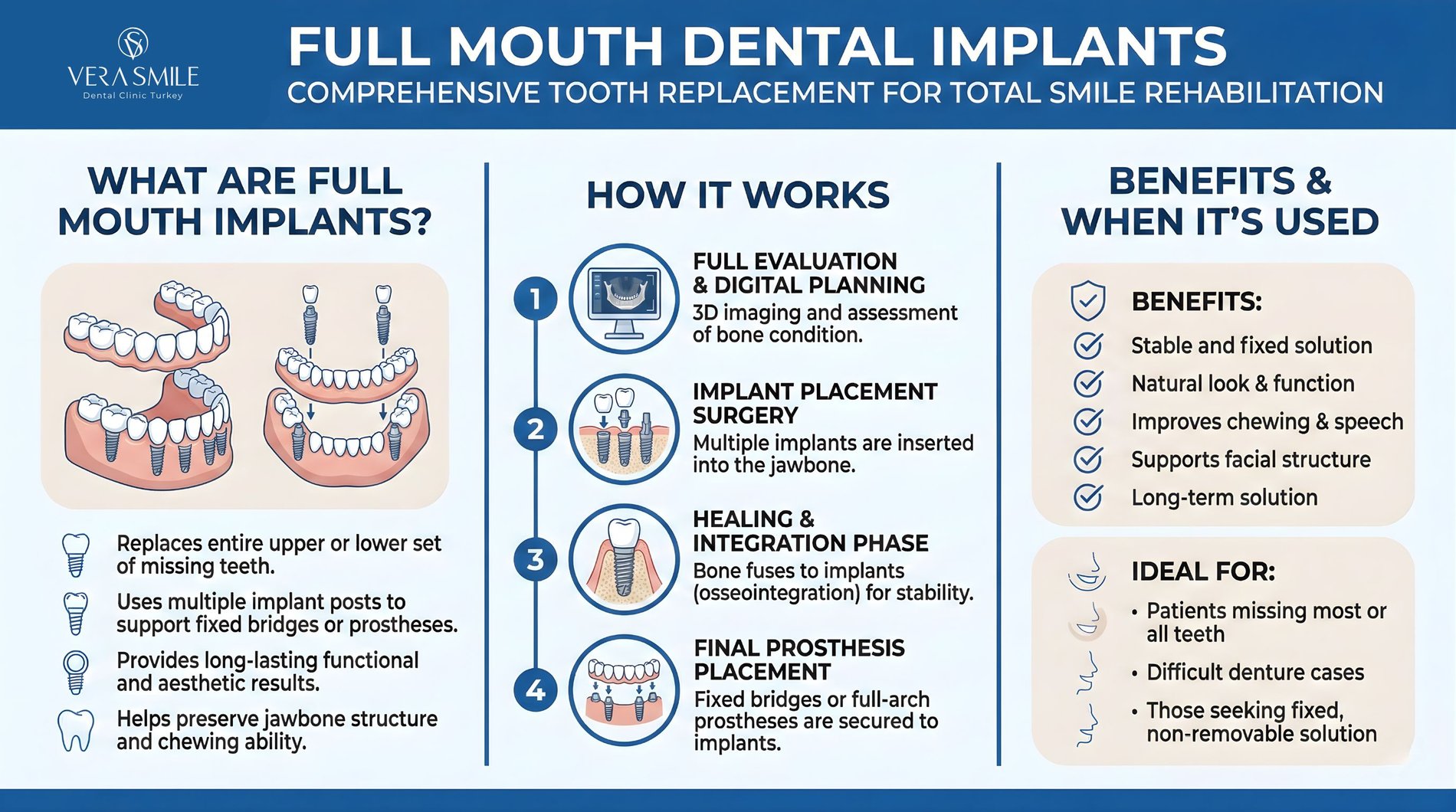
Full mouth dental implants are advanced restorations designed to replace all missing teeth in an arch with fixed, implant-supported prosthetics. Instead of relying on removable dentures, implants are surgically placed into the jawbone, acting as dental posts that provide stability and preserve bone health. This approach restores both chewing function and aesthetics, making it the preferred solution for patients who require a complete smile transformation.
One of the most recognized methods is the All on 4 titanium bar technique, where four strategically placed implants support a full arch of teeth. Compared with traditional removable prostheses, these implant-supported restorations offer superior stability, natural appearance, and long-term durability. While conventional dentures often slip or cause discomfort, full mouth implants eliminate these issues and maintain jawbone density.
Other variations exist, such as mini dental implants for cases with limited bone volume or multiple teeth replacements using fixed bridges anchored on implants. The right approach depends on bone structure, aesthetic needs, and overall health, with digital planning ensuring precision.
What Are the Types of Full Mouth Dental Implants?
There are several approaches to restoring a full arch with implants, and the right choice depends on bone density, health condition, and patient expectations. Options include fixed solutions like All-on-4 and All-on-6 dental implants, removable systems such as implant-supported dentures, and advanced methods like zygomatic implants for patients with severe bone loss. Each comes with unique advantages, limitations, and cost considerations.
- All-on-X Dental Implants: Uses four, six, or eight implants per jaw to support a full arch of teeth. Ideal for patients with moderate bone loss and allows for faster, often same-day restoration.
- Implant-Supported Dentures: Removable dentures that attach securely to implants, offering improved comfort and chewing ability compared to traditional dentures.
- Zygomatic Implants: Placed into the cheekbone instead of the jawbone, ideal for patients with severe upper jaw bone loss who cannot undergo bone grafting.
All-on-X Dental Implants
The All-on-X dental implants technique restores an entire arch of teeth with just four implants. Two are placed vertically in the front of the jaw, and two at an angle in the back, anchored into areas with stronger bones. This positioning avoids the need for bone grafting in many cases and allows for immediate loading of a fixed bridge.
All-on-4 dental implants are the most popular among these full arch implants and maintain survival rates above 95% over ten years, proving long-term reliability for full-arch rehabilitation. This outcome was reported in A Long-Term Prospective Clinical Follow-Up Study of the All-on-4 Treatment Concept With Brånemark System Implants in the Edentulous Mandible and Maxilla, published in Clinical Implant Dentistry and Related Research (Malo et al., 2011).
What Is the Difference Between All-on-4 and Full Mouth Implants?
The main difference between All-on-4 and full mouth dental implants is the number of implants used and the level of stability they provide. The All-on-4 technique relies on four strategically placed implants per arch, two positioned vertically in the front and two angled at the back, which eliminates the need for bone grafting and reduces both cost and treatment time.
In contrast, a full mouth restoration with conventional implants usually requires six to eight implants per arch, offering greater support, better distribution of chewing forces, and a more natural bite function. While All-on-4 is ideal for patients seeking a quicker, less invasive, and more affordable solution, traditional full mouth implants deliver enhanced durability and long-term stability, though with higher costs and longer healing.
Implant-Supported Dentures
Implant-supported dentures combine the affordability of removable prosthetics with the stability of dental implants. Instead of resting directly on the gums like traditional dentures, these prostheses are anchored onto two to four implants, which act as secure dental posts. The result is improved retention, reduced slipping, and greater comfort while speaking or eating.
Implant-retained overdentures improve patient satisfaction and oral function significantly compared with conventional dentures. This conclusion was reported in Patient Satisfaction and Chewing Ability With Implant-Supported Mandibular Overdentures Compared to Conventional Complete Dentures, published in the Journal of Oral Implantology (Misch et al., 2016).
Advantages include lower cost, easier maintenance, and enhanced chewing efficiency. Disadvantages include the need for occasional relining, the fact that the denture remains removable, and less stability compared with full-arch fixed restorations.
What Are Full-Mouth Dental Implants and Dentures?
Full-mouth dental implants and dentures combine the stability of implants with the practicality of a removable prosthesis. Several implants are placed in the jaw to act as anchors, and the denture is then designed to attach securely to them. This prevents slipping, improves chewing function, and provides greater comfort compared with traditional full dentures.
While the prosthesis remains removable, it delivers a strong balance between affordability and function. Patients benefit from improved stability in daily life, easier maintenance, and a more natural look, making this solution an accessible alternative to fixed systems like All-on-X dental implants. Implant supported dentures also refer to All-on-X implants.
Zygomatic Implants
Zygomatic implants are designed for patients with severe bone deficiency in the upper jaw, where conventional implants are not possible. These longer fixtures are anchored in the zygomatic (cheek) bone, providing strong support without the need for bone grafting or a sinus lift. This makes it possible to restore a full arch even in advanced bone resorption cases. Survival rates above 96% over five years have been achieved with zygomatic implants, confirming their long-term reliability. This outcome was reported in Zygomatic Implants for the Rehabilitation of the Atrophic Maxilla: A Systematic Review and Meta-Analysis, published in Periodontology 2000 (Esposito et al., 2018).
What Are the Differences Between Prosthetic Dentures, Removable Dentures, and Full Mouth Dental Implants?
When restoring a full arch, patients can choose between removable and fixed options. Removable dentures rest on the gums and can be taken out for cleaning, offering an affordable solution but sometimes slipping or causing discomfort. Full mouth dental implants, on the other hand, are permanently anchored into the jawbone, providing stability, improved chewing function, and a natural feel. Implant-supported options, such as implant-retained over dentures, combine the benefits of both approaches, offering removable convenience with added support and comfort. Understanding the differences helps patients select the solution that best fits their functional needs, aesthetic goals, and budget.
How Full Mouth Dental Implants Are Done?
A full mouth dental implant procedure is a multi-stage clinical and laboratory workflow designed to rebuild the entire set of upper and/or lower teeth with optimal function, aesthetics, and long-term stability. The process combines digital planning, precise surgical techniques, and advanced laboratory fabrication of prosthetics, including the artificial gums (pink ceramics or composite gingiva) that mimic natural soft tissues.
- Initial Consultation & 3D Scan: The procedure begins with a detailed clinical examination supported by a CBCT/3D scan. This imaging allows the surgeon to evaluate bone volume, gum condition, anatomical structures, and bite alignment. Using digital planning software, the implant positions are designed with millimetric precision, and the prosthetic plan is coordinated with the dental laboratory to ensure the final teeth and artificial gums match the patient’s facial aesthetics.
- Bone Grafting / Sinus Lift (If Needed: If the scan shows insufficient bone height or density, additional procedures such as bone grafting or a sinus lift are performed. These steps create a stable foundation for the implants and ensure long-term durability. The goal is to rebuild lost bone enough to place implants in optimal positions without compromising aesthetics or function.
- Implant Placement: Once adequate bone structure is confirmed, titanium or zirconia implants are surgically inserted into the jaw following the digital guide. Depending on the clinical situation, four to eight implants per arch are used, or in cases of severe bone deficiency, zygomatic implants are placed. The gums are shaped during surgery to support the future prosthetic design and ensure a natural-looking gum line.
- Temporary Prosthesis: Immediately after implant placement, a temporary full-arch prosthesis is attached. This allows the patient to smile confidently, speak normally, and eat soft foods right away. The temporary helps guide and shape the gums during healing so the final prosthesis fits more naturally and comfortably.
- Healing & Osseointegration: Over the next three to six months, the implants gradually fuse with the jawbone in a process called osseointegration. During this healing period, follow-up visits ensure that bite forces, soft tissue health, and implant stability are progressing as expected. Once healing is sufficient, digital impressions are taken to begin fabrication of the final prosthesis in the laboratory.
How Natural Does It Feel To Smile or Speak with A Fixed Full Arch?
Patients with a fixed full-arch prosthesis often report that smiling, speaking, and chewing feel very natural. Because the implants are securely anchored into the jawbone and the prosthesis is precisely designed to match the bite and facial contours, the teeth move and function similarly to natural teeth. Initially, some patients may notice slight differences in sensation compared with their original teeth, but over time, the muscles, tongue, and jaw adapt, and most people regain confidence in speaking and smiling without any discomfort or awareness of the prosthesis.
What Do Full Mouth Dental Implants Feel Like?
Full mouth dental implants are designed to feel stable, strong, and natural in daily use. Because they are anchored directly into the jawbone, they provide a firm chewing experience similar to natural teeth. Patients often describe the feeling as “natural but less sensitive,” since implants do not have nerves like real tooth roots. Once healed, speaking, chewing, and smiling feel completely normal, and the prosthesis becomes a seamless part of everyday function.
Do Full Mouth Implants Feel Pressure or Temperature Like Real Teeth?
Implants do not feel temperature changes (hot or cold) the way natural teeth do, because they have no nerves. Patients still sense pressure through the bone when biting or chewing. This means you can feel force, vibration, and contact, but you will not feel sharp sensitivity or temperature shocks. Overall, full mouth implants offer a secure, comfortable sensation, very similar to natural teeth but with noticeably less sensitivity and more stability
Which Materials Are Used for Full Mouth Dental Implants?
Full mouth dental implants use materials designed for maximum strength and longevity. The implant posts are typically made from titanium, known for its excellent bone integration, or zirconia, a metal-free alternative that offers high strength and superior soft-tissue aesthetics. For the final implant-supported full arch bridge, materials such as monolithic zirconia, titanium or PEEK frameworks, and hybrid zirconia–composite designs are preferred because they can handle strong chewing forces and allow the creation of natural-looking artificial gums.
In contrast, normal (tooth-supported) bridges rely on the patient’s natural teeth for support and therefore use different materials. These include porcelain-fused-to-metal, E-max ceramics, and conventional zirconia, which provide good aesthetics and function but do not offer the same strength or durability required for a full implant-supported restoration.
Advanced digital technologies such as 3D guided surgery, CAD/CAM design, and Digital Smile Design ensure that whichever material is used, the final result is precise, aesthetic, and functionally stable.
What’s the Expected Wear Rate of Acrylic vs. Zirconia Full-Arch Prostheses?
Acrylic and zirconia prosthetic materials wear at different rates over time. Acrylic teeth are softer and more prone to surface wear, chipping, or minor fractures, especially under heavy biting forces, but they are easier and less expensive to repair or replace. Zirconia, on the other hand, is extremely durable and highly resistant to wear, maintaining its shape and color for many years. While zirconia offers superior long-term performance, it can be slightly more brittle in rare cases, so careful design and occlusion adjustment are essential. Overall, zirconia prostheses typically last longer with minimal maintenance, whereas acrylic prostheses may require periodic refinishing or replacement depending on chewing habits and oral care.
Can I Choose Between Titanium and Zirconia for My Full Arch Restoration?
Yes, in most cases, you can choose between titanium and zirconia materials for your full arch dental implant restoration, depending on your clinical needs, aesthetic preferences, and budget. Both materials are biocompatible and highly durable, but they differ in appearance, performance, and suitability for certain situations.
What Are the Benefits of Full Mouth Dental Implants?
Full mouth dental implants offer a transformative solution for patients with extensive tooth loss, providing more than just an improved smile. Beyond aesthetics, they restore full oral function, support facial structure, and offer long-term stability that traditional dentures or bridges cannot match. Understanding their benefits can help patients make informed decisions about this comprehensive restorative treatment.
- Permanent Stability: Full mouth dental implants provide a fixed, non-removable solution that eliminates slipping, wobbling, and the discomfort associated with traditional dentures.
- Improved Chewing & Speech: By restoring strong biting function and proper tongue–tooth contact, implants enhance chewing efficiency and speech clarity, making everyday eating and communication more comfortable.
- Natural Smile & Facial Support: The restorations are designed to replicate natural teeth and gums, supporting facial contours, preventing a collapsed appearance, and boosting overall confidence.
- Healthy Bite Force Distribution: Systems like All-on-4 and All-on-6 use strategically angled implants or titanium bars to distribute bite forces evenly, helping preserve the jawbone and reduce long-term deterioration.
- High Long-Term Success: Survival rates above 94% over ten years, demonstrating the reliability and predictability of full mouth implant restorations.
- Long-Term Cost Efficiency: Although the initial investment is higher, implants last significantly longer than dentures or bridges, reducing the need for frequent replacements or major repairs.
- Predictable Outcomes With Proper Care: When supported by good oral hygiene, professional aftercare, and routine maintenance visits, full mouth implants offer stable, consistent, and long-lasting clinical results.
Can Full Mouth Dental Implants Stop Further Bone Loss or Reverse Existing Resorption?
Yes, full mouth dental implants can effectively stop further bone loss and, to a certain extent, reverse the effects of bone resorption by restoring stimulation to the jawbone.
When natural teeth are lost, the jawbone no longer receives mechanical stimulation from chewing forces transmitted through the tooth roots. As a result, the bone begins to shrink (resorb) over time, a process that can lead to facial collapse, loosened dentures, and changes in facial appearance.
What Are the Risks of Full Mouth Dental Implants?
Although full mouth dental implants achieve very high success rates, the procedure is not free of risks. Careful patient selection and planning are essential to ensure safe and predictable outcomes. Key risk factors include:
- Age and healing capacity: Implants are appropriate only for adults with fully developed jawbones. Older patients are often suitable if their overall health and bone quality are stable, while younger individuals with developing jaws are not candidates.
- Gum health: Healthy gums are critical for implant stability. Untreated periodontal disease increases the risk of infection, dental implant complications, and eventual implant loss, so gum conditions must be treated before surgery.
- Bone condition: Adequate bone density and volume are required to anchor implants securely. In cases of insufficient bone volume, additional procedures such as grafting or a sinus lift are necessary.
- Chronic illnesses: Conditions such as uncontrolled diabetes, osteoporosis, or immune disorders reduce healing capacity and increase the likelihood of implant failure. A thorough medical evaluation and collaboration with a physician are mandatory in these cases.
- Lifestyle factors: Smoking and poor oral hygiene significantly raise complication rates. Long-term success depends on patient commitment to professional dental implants aftercare and regular follow-ups.
With precise diagnosis, digital planning, and adherence to strict clinical protocols, these risks are minimized, making full mouth dental implants a safe and effective solution for the right candidates.
What Happens to the Sinus Cavity When Upper Implants Are Placed?
When upper dental implants are placed, they sit close to the maxillary sinus cavity, especially in the back molar region. If the existing bone height is too low, the sinus membrane is gently lifted through a sinus lift procedure, and bone graft material is added beneath it to create a solid base for the implant; this process does not damage the sinus but simply raises its floor slightly to make enough room for stable implant placement.
In cases where the sinus is not approached directly, dentists may use short or angled implants to avoid the sinus cavity entirely, meaning no modification is needed. Under correct technique, the implant never enters the sinus itself, and the elevated membrane heals normally, allowing the sinus to retain its natural function without affecting breathing, drainage, or overall sinus health.
What Is the Aftercare for Full Mouth Dental Implants?
Proper aftercare is crucial for the long-term success and comfort of full mouth dental implants. Following a consistent hygiene routine, attending regular dental check-ups, and being mindful of diet during the healing period can help maintain implant stability, support gum health, and ensure that your new teeth function effectively for years to come.
- Oral Hygiene: Maintain meticulous oral care by gently brushing around the implant sites and cleaning under bridges or prosthetic teeth using interdental brushes or water flossers.
- Regular Check-Ups: Schedule professional dental visits every 3–6 months to monitor implant stability, gum health, and overall oral condition.
- Dietary Considerations: Avoid extremely hard, sticky, or chewy foods during the initial healing period to protect the implants and prosthesis from damage.
- Professional Cleaning: Undergo routine professional cleanings to remove plaque and tartar in areas that are difficult to reach at home, ensuring long-term implant success.
- Chewing Sensation: Expect that food may feel slightly different at first, as implants lack the natural cushioning of teeth. Over time, the jaw adapts, and patients typically regain comfortable and efficient chewing comparable to natural teeth.
How Often Do Full Mouth Implants Need Maintenance or Cleaning at the Clinic?
Full mouth dental implants require regular professional check-ups to ensure long-term health and function. Most patients are advised to visit the clinic every 3–6 months for a thorough cleaning, examination of the implants, assessment of gum health, and evaluation of the prosthesis. During these visits, dentists remove any plaque or tartar that cannot be reached at home, check for early signs of complications, and make any necessary adjustments to maintain optimal bite and comfort. Adhering to this schedule significantly increases the longevity of the implants and helps prevent future problems.
Do Full Mouth Implants Affect How Food Feels When Chewing?
Full mouth dental implants can slightly change how food feels when chewing, especially during the first few weeks after placement. Unlike natural teeth, implants are anchored directly to the jawbone and lack the cushioning provided by the periodontal ligament, so food may feel firmer or more “direct” at first. Over time, the jaw and muscles adapt, and patients typically regain comfortable, efficient chewing. With properly designed implant-supported prostheses, most people can eat a wide range of foods with a sensation that closely resembles natural teeth.
How Much Is the Cost of Full Mouth Dental Implants in Turkey?
The cost of full mouth dental implants in Turkey ranges between €4,000 and €8,500 per arch, depending on the number of implants placed, the brand used, and whether additional procedures such as a sinus lift or bone grafting are required. This makes Turkey one of the most affordable destinations compared with the UK, EU, or US, without compromising on safety or quality.
| Country / Region | Average Cost (€) | Notes |
| Turkey | €4,000 – €8,500 | Includes premium brands, 3D guided surgery, and digital planning. Lower prices with international standards. |
| India | €5,000 – €9,000 | Affordable option, though implant brands and clinic certifications vary widely. |
| UK | €15,000 – €20,000 | Higher cost due to clinic overhead, lab fees, and brand pricing. |
| EU (Germany, Spain, Italy) | €14,000 – €22,000 | Strict regulations and premium lab costs drive up pricing. |
| USA | €18,000 – €25,000 | Among the highest worldwide, with advanced care but significant cost differences between states. |
Patients researching all-on-4 dental implant cost in Turkey often compare total package value rather than price alone, as treatment commonly includes advanced digital planning, internationally recognized implant systems, and coordinated care designed for long-term stability.
Which Factors Affect the Cost of Full Mouth Dental Implants?
The cost of full mouth dental implants can vary significantly depending on multiple factors that influence both the quality and longevity of the treatment. Understanding these key elements helps patients make informed decisions and plan their investment wisely. Factors such as the choice of implant brand, the surgeon’s experience, the materials used, and the transparency of the treatment plan all play a critical role in determining the final cost while ensuring optimal outcomes.
- Implant Brand: Premium brands such as Straumann and Nobel Biocare increase the overall cost due to their advanced surface technology, extensive clinical research, higher durability, and proven long-term success rates.
- Surgeon’s Experience: Highly trained oral and maxillofacial surgeons or experienced implantologists typically charge more, but their expertise reduces surgical risks, prevents implant complications, and ensures precise placement with techniques like 3D guided surgery.
- Implant and Prosthetic Materials: Titanium remains the gold standard for strength and reliability, while zirconia is preferred for superior aesthetics and excellent gum compatibility, though it is generally more expensive than titanium.
- Treatment Planning Transparency: Clinics that provide detailed, written treatment plans help patients understand the factors affecting cost, including brands, materials, surgical needs, and prosthetic options, allowing for informed decision-making.
Why Choose Turkey for Full Mouth Dental Implants?
Turkey has become one of the world’s leading destinations for full mouth dental implants, combining internationally recognized standards with competitive prices.
Clinics providing dental implant in Turkey treatments operate in modern facilities with ISO certifications and advanced technologies such as 3D guided surgery, CAD/CAM systems, and Digital Smile Design, ensuring both functional and aesthetic results meet global expectations.
Experienced oral and maxillofacial surgeons perform thousands of implant procedures each year, supported by specialized teams and premium systems like Straumann and Nobel Biocare. This high level of expertise significantly reduces the risk of dental implant complications and ensures predictable, long-term outcomes.
The cost advantage is another strong reason to choose Turkey. Patients often save up to 70% compared with prices in the UK, EU, or US, while still receiving top-quality care and long-term warranties. Transparent clinics avoid hidden costs and provide itemized treatment plans, ensuring patients know exactly what they are paying for.
In addition to clinical benefits, Turkey offers unique dental tourism advantages. Patients enjoy seamless treatment experiences that include VIP transfers, interpreter services, and the opportunity to combine dental care with cultural or leisure travel in destinations such as Istanbul, Antalya, or Izmir.