
Clear aligners, referred to as invisible aligners, represent one of the most advanced developments in modern orthodontics. Unlike traditional braces that rely on metal brackets and wires, aligners use a series of transparent trays that fit snugly over the teeth. Each set of trays applies gentle, targeted pressure, guiding teeth into better alignment with precision over time.
The appeal of clear aligners extends beyond their discreet appearance. They are removable, which allows patients to maintain normal oral hygiene routines and enjoy a more flexible lifestyle during treatment. From correcting crowding, spacing, and bite problems, aligners provide a versatile and effective alternative to fixed orthodontic appliances. Their growing popularity reflects the demand for treatments that combine proven clinical outcomes with comfort, aesthetics, and convenience.
What Are Clear Aligners?
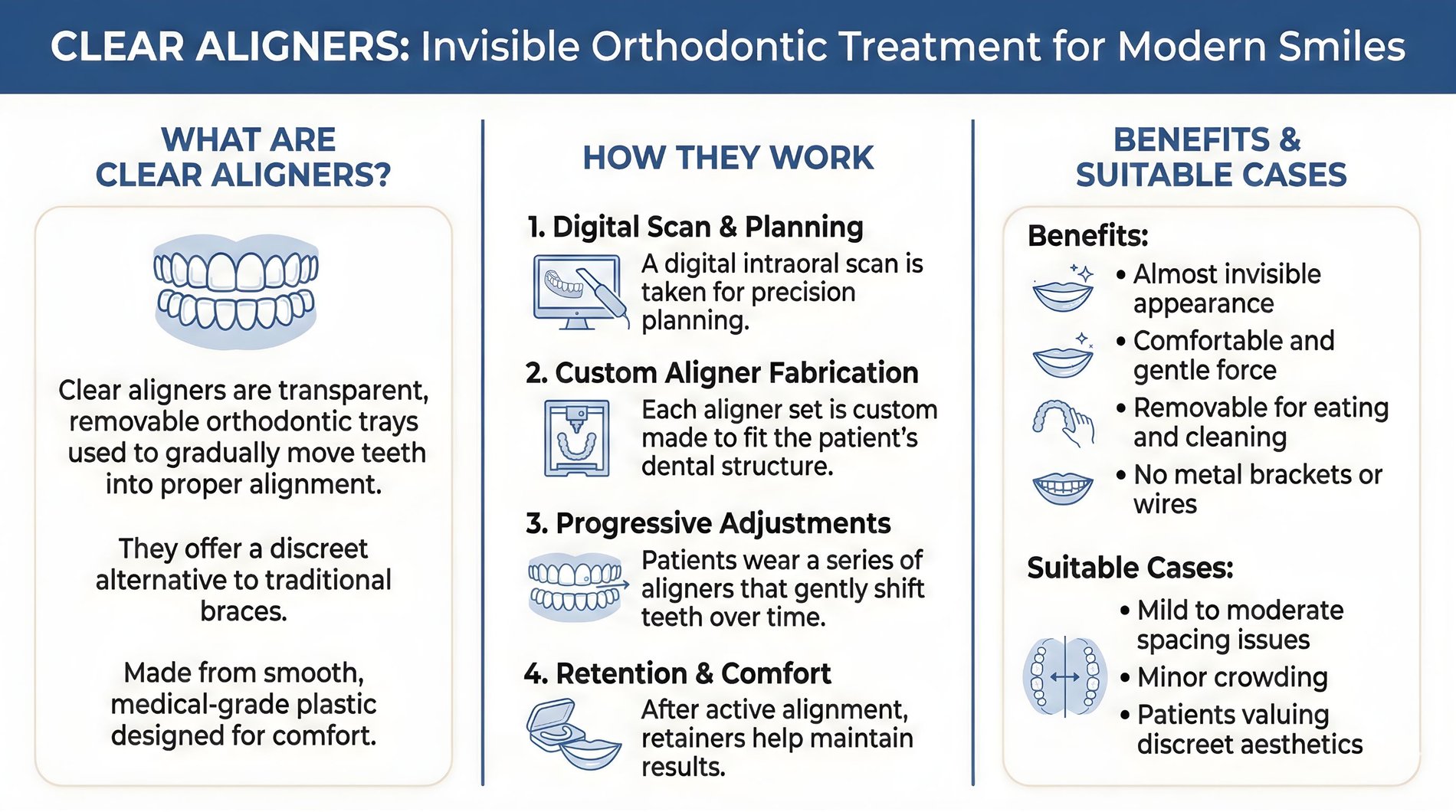
Clear aligners are custom-made, transparent trays designed to gradually reposition teeth without the use of brackets or wires. They are created from advanced medical-grade thermoplastic materials, molded to fit snugly over each patient’s teeth. Treatment involves a sequence of aligner sets, with each tray engineered to move the teeth slightly closer to their final, ideal position.
Unlike metal braces, clear aligners are virtually invisible, making them a discreet choice for orthodontic care. They are worn throughout the day and removed only for eating, drinking, brushing, and flossing. This design provides patients with both aesthetic appeal and practical convenience, while maintaining consistent, controlled tooth movement.
The concept is backed by decades of research in digital and orthodontics dentistry, with clinical studies demonstrating that aligners deliver predictable results for a wide range of alignment problems when used under professional supervision.
How Do Clear Aligners Work?
Clear aligners work through a series of custom-fitted trays that apply gentle, controlled forces to the teeth. Each set of aligners is worn for one to two weeks before being replaced with the next in the sequence, gradually shifting the teeth toward their final position.
The process begins with a digital 3D scan or impression of the patient’s teeth. Using computer-aided design (CAD/CAM) and sometimes artificial intelligence in orthodontics, specialists create a precise treatment plan that maps out every stage of tooth movement. This allows patients to preview the expected outcome before treatment even starts.
Each aligner is engineered to move teeth in small increments, usually 0.25 to 0.3 millimeters per stage, to ensure accuracy and minimize discomfort. Attachments, which are small tooth-colored buttons bonded to certain teeth, are sometimes used to improve grip and guide more complex movements.
Aligners effectively control tooth movement when patients adhere to the recommended daily wear time of around 20–22 hours. “Effectiveness of Clear Aligners in Controlling Tooth Movement” (Angle Orthodontist) demonstrated that aligners achieve high accuracy in planned movements such as tipping and bodily shifts, while being less efficient for rotations and extrusions without additional attachments.
What Are Clear Aligners Used For?
Clear aligners are designed to treat a wide spectrum of orthodontic problems, offering a discreet alternative to braces while maintaining clinical effectiveness. They are most frequently prescribed for:
- Crowding: When teeth overlap due to lack of space in the jaw.
- Spacing: Gaps between teeth caused by missing teeth or natural spacing patterns.
- Overbite: Upper teeth extending too far over the lower teeth.
- Underbite: Lower teeth positioned ahead of the upper teeth.
- Crossbite: Misalignment where upper and lower teeth do not meet correctly.
- Open bite: Vertical gaps between upper and lower teeth when the mouth is closed.
Can Clear Aligners Fix All Types of Bite Problems?
No, clear aligners are effective for many common bite problems, but they cannot correct all types of malocclusion. They work best for mild to moderate crowding, spacing, overbites, underbites, and minor crossbites or open bites, gradually repositioning teeth with the help of attachments, elastics, or precision cuts for more complex movements.
Severe malocclusions, extreme tooth rotations or extrusions, and skeletal discrepancies that require jaw surgery may not be fully corrected with aligners alone. Teenagers achieve better results due to ongoing jaw growth, while adults need longer treatment durations for complex bite corrections. Compliance is crucial, as aligners must be worn 20–22 hours daily to ensure predictable results.
What Age Is Best for Clear Aligners? (Teens vs. Adults)
Clear aligners are effective for both teenagers and adults, but the ideal timing depends on dental development and treatment goals.
For teenagers, aligners are often introduced once most permanent teeth have erupted, usually between ages 12 and 16. At this stage, the jaw is still developing, which allows orthodontists to guide growth while correcting misalignment. Teen aligner systems are designed with compliance indicators that change color to monitor wear time, ensuring that younger patients follow the treatment plan.
For adults, aligners provide a discreet solution that integrates smoothly into professional and social lives. They are particularly appealing for patients who missed orthodontic treatment in adolescence or experienced relapse after braces. Since adult bone density is higher, treatment takes slightly longer, but predictable results are achievable with consistent use.
Clear aligners demonstrate high success rates in both age groups, with teenagers benefiting from growth adaptability and adults benefiting from treatment discretion. This is supported by “Orthodontic Treatment Needs in Different Age Groups” (American Journal of Orthodontics and Dentofacial Orthopedics).
What Are the Types of Clear Aligners?
Clear aligners come in different types to suit a variety of dental needs, age groups, and treatment goals. While all aligners work on the principle of gradually moving teeth with custom-made, transparent trays, certain systems are designed for specific patient profiles or treatment complexities.
- At-Home/Direct-to-Consumer Aligners: These aligners are best for very mild cases and offer convenience, but lack in-office supervision, which may limit effectiveness for complex bite correction.
- Teen-Specific Aligners: Designed for patients ages 12–16, teen aligners include compliance indicators and are adapted to accommodate jaw growth and eruption of permanent teeth. They combine aesthetics with guidance to ensure proper treatment adherence.
What Is the Difference Between Clear Aligners and Braces?
Clear aligners and traditional braces both correct misaligned teeth, but they differ significantly in design, comfort, and appearance. Braces use metal brackets and wires that are fixed to the teeth, while aligners consist of removable transparent trays. Aligners allow easier oral hygiene, fewer food restrictions, and a more discreet appearance, making them popular among adults and professionals.
Dental braces remain more effective for severe misalignments, complex tooth rotations, and cases requiring vertical adjustments. Aligners deliver predictable results for mild to moderate cases, especially crowding, spacing, and bite correction. Evidence shows that aligners are less efficient than braces in certain movements such as extrusion and rotation without attachments. This has been highlighted in “Effectiveness of Clear Aligners in Controlling Tooth Movement” (Angle Orthodontist).
Are Clear Aligners Painful Compared to Braces?
No, clear aligners are generally less painful than braces. They cause mild, temporary soreness when a new set is worn, but discomfort is short-lived. In contrast, braces cause more intense and persistent pain due to metal brackets and wires. Overall, clear aligners provide a more comfortable orthodontic experience while still effectively moving teeth.
What Is the Difference Between Clear Aligners and Retainers?
While clear aligners and retainers look similar, their functions are entirely different. Aligners are active orthodontic devices that move teeth gradually, while retainers are passive appliances designed to keep teeth in place after treatment.
Retainers are used once braces or aligners have finished their work, ensuring that teeth remain stable and do not shift back to their original positions. They are worn at night or part-time, depending on the orthodontist’s recommendation. Aligners, in contrast, require full-time wear (20–22 hours per day) during active treatment to achieve planned results.
This distinction is supported by “Retention Protocols After Orthodontic Treatment” (Journal of Clinical Orthodontics), which emphasizes that retainers are for maintenance, while aligners are for movement and correction.
What Is the Procedure for Getting Clear Aligners?
The clear aligner process combines digital planning, custom manufacturing, and professional supervision to ensure precise and comfortable treatment.
- Consultation and 3D Scanning: The orthodontist evaluates dental health, bite, and alignment, then takes a 3D scan or impression. Using CAD/CAM software, a personalized treatment plan is created, allowing patients to preview expected results.
- Receiving Custom Trays: A series of medical-grade thermoplastic aligners are fabricated to fit the patient’s teeth. Each tray applies controlled pressure to gradually shift teeth, with instructions on when to switch to the next set.
- Wearing Schedule and Checkups: Aligners must be worn 20–22 hours per day, changing every 1–2 weeks. Checkups every 6–8 weeks ensure progress, adjustments, and new tray delivery. Consistent wear is essential for predictable results.
How to Prepare Before Getting Clear Aligners
Successful treatment with clear aligners begins with careful preparation, ensuring that the teeth and gums are in optimal condition before trays are fitted. Patients should take the following steps to maximize outcomes:
- Comprehensive Dental Checkup: A full examination helps identify and address existing issues such as cavities, gum disease, or tooth decay. Treating these conditions first prevents complications during aligner therapy.
- Professional Cleaning: A deep cleaning removes plaque and tartar, creating a healthier environment for aligner wear and reducing the risk of irritation.
- X-Rays and Digital Records: Orthodontists collect radiographs and 3D scans to evaluate bone structure and tooth roots, ensuring that aligner movements are safe and predictable.
- Oral Hygiene Routine: Establishing a strict routine of brushing twice daily and flossing prepares patients for the discipline required during treatment.
- Lifestyle Adjustments: Patients are advised to reduce habits that interfere with aligner success, such as frequent snacking, excessive sugary drinks, or poor compliance with wear schedules.
What to Expect When Living With Clear Aligners?
Living with clear aligners requires daily discipline, but the treatment is designed to fit smoothly into most lifestyles. Patients must follow specific habits to protect their trays and ensure consistent progress.
- Daily Wear: Aligners must be worn for 20–22 hours per day, removed only during meals, drinking (anything other than water), and oral hygiene. Skipping wear time disrupts treatment and prolongs the process. Compliance is the single most important factor influencing aligner success. This is supported by “Efficiency of Clear Aligners in Orthodontic Treatment: A Systematic Review and Meta-Analysis” (Journal of Orthodontics).
- Eating and Drinking: Since aligners are removable, there are no dietary restrictions like those with braces. Trays must always be taken out before meals or sugary drinks to prevent staining and warping.
- Oral Hygiene: Patients are expected to brush and floss after every meal before reinserting their aligners. This prevents trapped food particles and lowers the risk of cavities and gum irritation.
- Cleaning the Aligners: Trays should be cleaned daily with specialized cleaning crystals or mild soap, never with hot water, which distorts the material.
- Speech and Comfort: Some patients notice a temporary lisp when starting aligner therapy, but this resolves as the tongue adapts. Speech difficulties with aligners are minimal and short-term compared to traditional braces. This has been confirmed by “Impact of Clear Aligners on Oral Health and Quality of Life” (Progress in Orthodontics).
How Should Aftercare Be Managed With Clear Aligners?
Proper aftercare is crucial to maintain results after completing clear aligner treatment. Key steps include:
- Wearing Retainers Consistently: Retainers are custom-made appliances that keep teeth in their new positions. Start with full-time wear for the first few months, then transition to night-time use as recommended by your orthodontist. Lifelong retention is often necessary to prevent relapse.
- Scheduling Regular Checkups: Periodic visits allow your orthodontist to monitor stability and address any minor shifts early.
- Maintaining Strict Oral Hygiene: Continue brushing and flossing daily to prevent cavities, gum disease, and other dental issues.
- Replacing Retainers Periodically: Retainers wear over time, and replacing them ensures they continue to maintain tooth positions effectively.
Consistent follow-up and disciplined retainer use significantly improve the long-term stability of aligner results, protecting your orthodontic investment.
What Is the Best Way to Care for Your Teeth During Clear Aligner Treatment?
Maintaining excellent oral hygiene is critical during clear aligner treatment. Since aligners fit snugly over the teeth, any food particles or plaque left behind become trapped, increasing the risk of tooth decay, gum inflammation, and bad breath. Patients should follow strict routines:
- Brushing and Flossing: Brush after every meal and floss daily before reinserting aligners. This ensures that no debris remains under the trays.
- Cleaning Aligners: Rinse trays with lukewarm water and clean with mild soap or specialized cleaning crystals. Avoid hot water, which distorts the material.
- Avoiding Sugary Drinks: Only water should be consumed while wearing aligners to prevent staining and bacterial buildup.
- Regular Dental Visits: Professional cleanings and checkups ensure that oral health stays stable throughout treatment.
Patients wearing aligners who maintain strict hygiene routines experience fewer decalcification and gum problems compared to those with fixed braces. This is supported by “Impact of Clear Aligners on Oral Health: A Systematic Review” (Progress in Orthodontics).
What to Eat and Drink With Clear Aligners
Clear aligners are removable, which means patients enjoy far more freedom with their diet compared to traditional braces. Specific rules must be followed to protect both the trays and oral health.
- Remove Aligners Before Eating: Trays should always be taken out before meals. Chewing with aligners in place damages the plastic and reduces treatment accuracy.
- Water Only: While aligners are worn, the only safe drink is plain water. Colored or sugary beverages stain trays, promote bacterial growth, and increase the risk of cavities.
- Avoid Hot Drinks: Heat warps aligner material, compromising fit and effectiveness.
- Mind Snacks: Since aligners must be worn for 20–22 hours daily, frequent snacking shortens wear time and reduces treatment efficiency.
- Resume With Clean Teeth: After meals, patients should brush or rinse before reinserting trays to prevent food trapping.
Removable aligners allow patients to avoid the dietary restrictions of braces, but compliance with removal and cleaning protocols is essential for success. This is supported by “Nutritional and Lifestyle Considerations in Orthodontic Patients” (Journal of Dental Research).
Foods and Drinks to What Foods and Drinks Should You Avoid While Using Clear Aligners?
During clear aligner treatment, certain foods and beverages should be limited or avoided to protect both the trays and dental health:
- Hot beverages: Coffee, tea, and other hot drinks distort aligner material and lead to poor fit.
- Sugary or acidic drinks: Sodas, energy drinks, fruit juices, and alcohol increase the risk of cavities, staining, and enamel erosion when consumed with aligners in place.
- Sticky foods: Chewing gum, caramel, or toffee clings to teeth and complicates cleaning before trays are reinserted.
- Hard foods: Ice, hard candies, and uncut raw vegetables are safe if eaten without aligners, but reinsertion without brushing leaves behind harmful particles.
- Frequent snacking: Reduces the required daily wear time and increases exposure to plaque-forming sugars.
Dietary discipline improves both oral health and treatment predictability for aligner patients. This has been highlighted in “Dietary Guidelines During Orthodontic Treatment” (International Journal of Orthodontics).
What Are the Common Issues With Clear Aligners? (Discomfort, Speech, Compliance)
While clear aligners provide a discreet and effective alternative to braces, patients encounter a few challenges during treatment.
- Discomfort: Each new set of trays applies controlled pressure on the teeth, which causes temporary soreness, especially during the first days of wear. This mild discomfort signals that the aligners are actively moving the teeth. Aligner-related discomfort is generally less severe and shorter in duration compared to traditional braces. This is supported by “Pain and Discomfort During Orthodontic Treatment” (American Journal of Orthodontics and Dentofacial Orthopedics).
- Speech Difficulties: Some patients notice a slight lisp or altered pronunciation when they first start wearing aligners. The tongue adapts within a few days, and speech returns to normal. Speech issues with aligners are temporary and less pronounced than with braces. This has been demonstrated in “Impact of Clear Aligners on Oral Health and Quality of Life” (Progress in Orthodontics).
- Compliance: Aligners require strict discipline, with 20–22 hours of daily wear necessary for predictable results. Skipping wear time disrupts planned tooth movement and prolongs treatment. Patient compliance is the single most important factor in determining treatment success. Evidence for this comes from “Efficiency of Clear Aligners in Orthodontic Treatment: A Systematic Review and Meta-Analysis” (Journal of Orthodontics).
How Long Do You Need to Wear Clear Aligners?
The length of clear aligner treatment depends on the complexity of the case, but most patients complete therapy within 6 to 18 months. Simple cases such as mild crowding or spacing usually require a shorter duration, while more complex bite corrections extend treatment time.
Daily compliance is just as important as overall treatment length. Aligners must be worn for 20–22 hours per day, removed only for meals and oral hygiene. Failing to meet wear-time guidelines slows down progress and requires additional trays.
Treatment with clear aligners is generally shorter than with fixed braces for mild to moderate malocclusions, but equally effective when patients adhere to prescribed wear schedules. This has been confirmed by “Treatment Duration and Effectiveness of Clear Aligners vs. Braces” (Angle Orthodontist).
On average, patients should expect to change to a new set of aligners every 1–2 weeks, attending checkups every 6–8 weeks to monitor progress and receive the next stage of trays.
How Long Does It Take to See Results With Clear Aligners?
Most patients begin to notice visible changes within 4 to 8 weeks of starting clear aligner treatment, though the total treatment duration depends on the complexity of the case. Mild crowding or spacing may be corrected in 6 to 12 months, while more complex bite issues or adult cases take 12 to 18 months.
How to Maintain Results After Clear Aligners
Completing clear aligner treatment does not mark the end of orthodontic care, since teeth have a natural tendency to shift back toward their original positions, a process known as orthodontic relapse. To preserve results, patients are required to wear retainers, which are custom-made appliances that hold teeth in their corrected alignment. Retainer use begins with full-time wear and gradually transitions to night-time wear under the orthodontist’s guidance.
Alongside retainers, patients must schedule regular dental checkups, maintain strong oral hygiene, and replace retainers when they show signs of wear. Avoiding harmful habits such as teeth grinding or nail biting further reduces the risk of relapse.
How Much Do Clear Aligners Cost?
The cost of clear aligner treatment depends on case complexity, treatment length, and geographic location. On average, aligners range between €2,000 and €6,000 in most European countries, with the final price determined by the number of trays required and whether additional orthodontic procedures are needed.
In the United States, clear aligners cost between €3,500 and €7,000, while in the United Kingdom and wider Europe, the price is €2,500 to €5,000. In Turkey, high-quality aligner treatment is more affordable, ranging from €1,500 to €3,000, making it a popular destination for dental tourism. By contrast, countries such as India or Mexico offer aligners from €1,200 to €2,500, though patients prioritize clinics with international accreditation when traveling abroad.
Aligner therapy is generally more expensive than traditional braces, but patients consider the additional investment worthwhile due to the comfort, discretion, and flexibility of removable trays.
When considering price, patients should factor in not only the initial cost but follow-up visits, retainer fees, and replacement trays if compliance is an issue. Transparent pricing and professional monitoring are key to long-term satisfaction with aligner treatment. This conclusion is supported by “Economic Evaluation of Orthodontic Treatment Options” (European Journal of Orthodontics).
| Country | Average Cost Range (€) | Notes |
| United States | €3,500 – €7,000 | Higher due to clinic overheads and insurance variations |
| United Kingdom & Europe | €2,500 – €5,000 | Prices vary by region and clinic reputation |
| Turkey | €1,500 – €3,000 | More affordable with internationally accredited clinics and advanced digital dentistry |
| India | €1,200 – €2,500 | Lower costs, but patients prioritize quality and safety standards |
| Mexico | €1,200 – €2,500 | Popular for dental tourism, but outcomes depend on provider expertise |
Does Insurance Cover Clear Aligners?
Insurance coverage for clear aligners varies depending on the provider, the patient’s age, and the medical necessity of treatment. In most cases, insurance treats clear aligners the same way as traditional braces, offering partial reimbursement rather than full coverage. In the USA, many dental insurance plans cover a percentage of orthodontic costs for patients under 18, which includes clear aligners, while adult coverage is often limited.
In Europe, public health systems rarely cover clear aligners since they are considered an aesthetic alternative rather than a medical necessity. Coverage is reserved for severe orthodontic cases treated with fixed appliances. Adults seeking aligners generally pay out of pocket or rely on supplemental private insurance.
Are Clear Aligners Free for Children or in Special Cases?
No, clear aligners are not free for children, even in special cases. Public insurance systems typically fund only medically necessary orthodontic treatments, traditional metal or fixed braces, not clear aligners. In the USA, some private insurance plans cover part of the cost for children under 18, but full coverage is extremely rare. In Europe and Turkey, clear aligners are generally classified as an aesthetic option and must be paid for privately, even when a child has a severe orthodontic condition.
When Were Clear Aligners Invented?
The concept of clear aligners emerged in the late 20th century as an alternative to traditional braces. In 1997, Zia Chishti and Kelsey Wirth developed the first digitally designed aligner system, which later became known as Invisalign. By using 3D computer imaging and custom-made transparent trays, they introduced a new orthodontic method that allowed teeth to be repositioned without brackets or wires.
Clear aligners were officially launched to the public in 1999, quickly gaining popularity for their discreet appearance and removable design, which improved comfort and oral hygiene compared to fixed braces.