
Teeth scaling and polishing is a professional cleaning that removes plaque and calculus/tartar above and just below the gumline, then smooths the enamel surface to slow new biofilm build-up. Home brushing and flossing disrupt soft plaque; hardened tartar adheres to enamel and cementum and requires clinical instruments to remove. Fresher breath, a brighter smile, and healthier gums follow when biofilm and deposits no longer irritate the tissues.
It’s important to distinguish routine scaling & polishing (for healthy gums or gingivitis) from deep cleaning, scaling and root planing (SRP), which targets periodontal pockets and rough root surfaces in periodontitis. Evidence-based guidelines position SRP as the cornerstone of active periodontal therapy and risk-based supportive care thereafter (“Treatment of stage I–III periodontitis, The EFP S3 level clinical practice guideline,” Journal of Clinical Periodontology, 2020).
Vera Smile delivers this service using digital diagnostics (intraoral photos, 3D scans), doctor-led protocols, Slow Dentistry Global Network standards, and transparent pricing, with English-speaking patient care, VIP transfers, and clear consent at each step.
What Is Teeth Scaling & Polishing?
Teeth scaling and polishing, clinically known as dental prophylaxis, is a professional cleaning procedure that removes plaque and calculus (tartar) deposits from the teeth’s surfaces, particularly around and just below the gumline, using a combination of ultrasonic scalers and fine hand instruments.
During scaling, ultrasonic vibrations gently dislodge hardened deposits without damaging the enamel, while water irrigation flushes out bacterial biofilm from periodontal pockets. Once all buildup is removed, polishing follows using a mildly abrasive paste to smooth the enamel. This finishing step reduces the microscopic roughness where new plaque tends to adhere, keeping teeth cleaner for longer and leaving them naturally glossy.
Although some surface stains from coffee, tea, or smoking are lifted during polishing, scaling and polishing are not whitening treatments. Their purpose is clinical, to prevent gum inflammation, decay, and bad breath, rather than cosmetic bleaching. However, as stains are removed and enamel is freshly polished, the smile appears brighter and cleaner, giving a naturally rejuvenated look.
Professional scaling has been shown to reduce bacterial load, minimize gingival bleeding, and lower inflammatory markers, making it a proven foundation of preventive oral care. Journal of Clinical Periodontology (2023).
Post-polishing enamel demonstrates smoother surface morphology that significantly limits new plaque adhesion for several weeks, prolonging oral cleanliness between visits. Journal of Dentistry (2022).
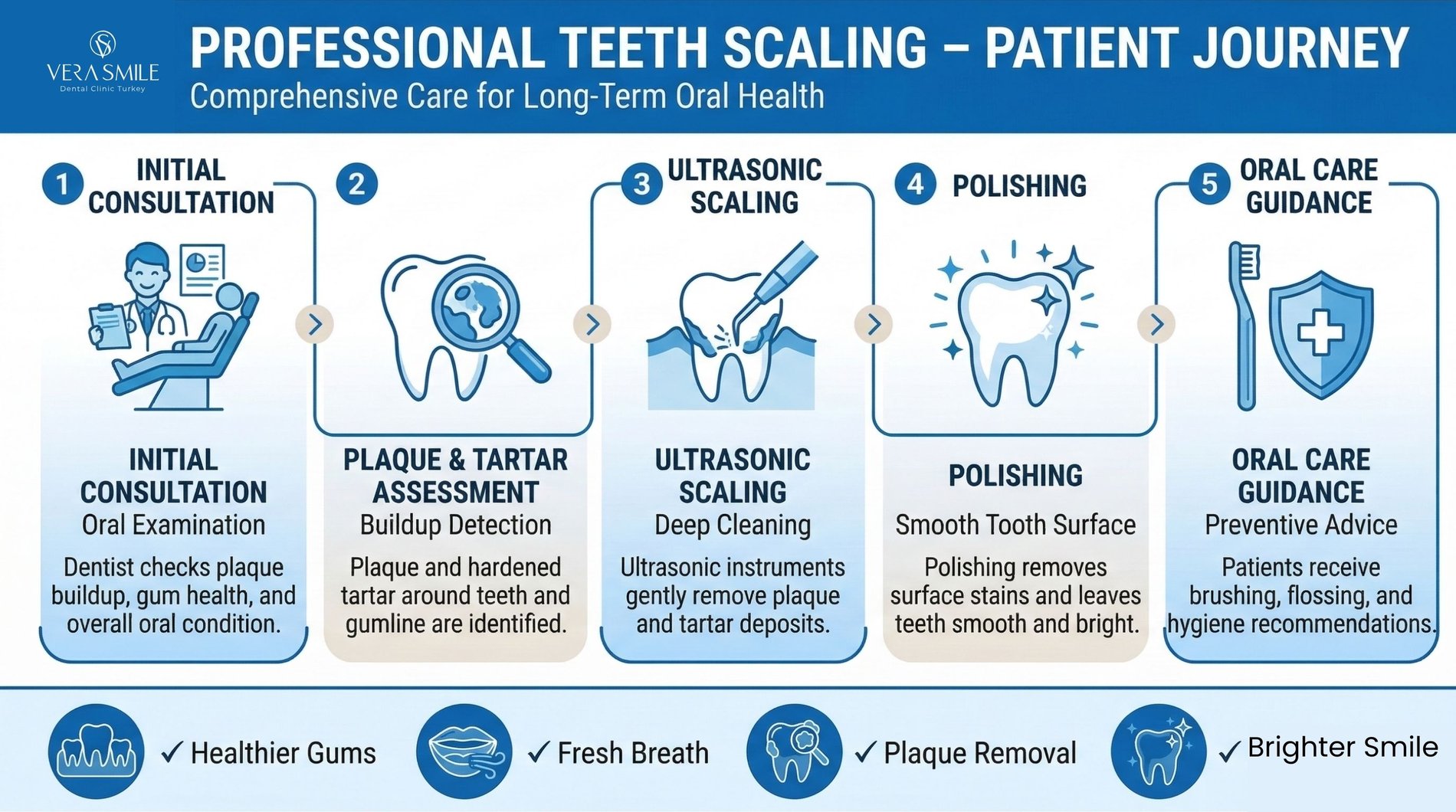
How Does Teeth Scaling Work Step by Step?
A precise, clinician-led dental scaling and polishing sequence protects gum health, lifts extrinsic stains, and leaves enamel smooth so new plaque struggles to stick. Here’s the chairside flow your readers expect.
- Assessment and Imaging: Risk review, periodontal screening, and a digital assessment. Baseline records include digital plaque score and intraoral camera snapshots for “before” documentation. Indicators such as bleeding points, pocket depths, and recession guide the scope of prophylaxis.
- Plaque Disclosure: A selective disclosing gel reveals biofilm on enamel and along the gingival margin. Fresh intraoral photos log missed areas and educate the patient.
- Ultrasonic Debridement: Ultrasonic scaling (piezo or magnetostrictive) disrupts calculus and biofilm above and just below the gumline. Irrigation flushes the field while cavitation breaks up deposits. High-volume suction maintains visibility and comfort.
- Hand Instrumentation for Residual Calculus: Fine scalers and curettes target residual specks the ultrasonic tip doesn’t reach, refining around line angles, grooves, and the cervical region. This step in routine prophylaxis removes deposits without root planing (SRP is reserved for periodontitis).
- Interproximal Finishing: Dental tape/floss verifies contact integrity and removes remnants. Finishing strips smooth overhangs or rough composite margins that trap plaque.
- Polishing (Prophy Paste or AirFlow):
- Rubber cup/brush + fine-grit prophy paste: smooths enamel and lifts extrinsic stains from coffee, tea, tobacco.
- AirFlow (glycine/erythritol powder): a low-abrasion air-polishing option that sweeps biofilm from pits/fissures, around orthodontic brackets, and along the gingival margin with warm, pressurized water.
Result: a glossy surface that reduces new plaque adhesion and looks brighter as stains lift (prophylaxis is not a whitening treatment).
- Fluoride/Varnish: 5% sodium fluoride varnish strengthens enamel and helps settle sensitive teeth after scaling. Brief post-op guidelines follow (no hot drinks or brushing for a few hours, avoid sticky foods).
- Home-Care Coaching: Personalized instruction covers brush technique, interdental brush sizing, tongue hygiene, and stain-management tips for smokers or heavy tea/coffee users. Recall interval set at 3, 4, or 6 months based on risk.
Is Scaling the Same as Deep Cleaning (Root Planing)?
No, scaling and polishing is a preventive hygiene visit for healthy gums or gingivitis, removing plaque and tartar above and just below the gumline, then polishing enamel to reduce new plaque adhesion; deep cleaning (scaling & root planing, SRP) is periodontal therapy for established periodontitis with pockets ≥ 4 mm or attachment loss, delivered under local anesthesia in quadrant-based sessions to debride deep subgingival deposits and smooth root surfaces. Choose SRP when exams show bleeding on probing, radiographic bone loss, or persistent inflammation despite routine hygiene; otherwise, stick to risk-based prophylaxis intervals for gum disease prevention.
| Feature | Scaling & Polishing (Prophylaxis) | Scaling & Root Planing (SRP, “Deep Cleaning”) |
| Goal | Remove plaque, calculus (tartar), and surface stains; smooth enamel to reduce new plaque adhesion. | Treat periodontitis by removing subgingival deposits and smoothing root surfaces to disrupt pathogenic bacteria. |
| Indication | Healthy gums or gingivitis (no attachment loss). | Periodontal pockets ≥ 4 mm, clinical attachment loss, bleeding on probing, radiographic bone loss. |
| Area Treated | Supragingival and shallow subgingival debridement. | Deep subgingival scaling with root planing along exposed root surfaces. |
| Instrument Set | Ultrasonic scaler + hand instruments; optional AirFlow for biofilm/stain removal. | Ultrasonic scaler + specialized curettes for root planing; meticulous subgingival instrumentation. |
| Anesthesia | Not required in most cases. | Local anesthesia for comfort. |
| Scheduling | Often completed in one visit. | Staged, quadrant-based (e.g., UL/UR/LL/LR) across multiple appointments. |
| Outcome Focus | Fresher breath, cleaner teeth, smoother enamel, gum disease prevention. | Pocket depth reduction, inflammation control, stabilization of periodontal tissues. |
| Follow-up | 6-month recalls (or risk-based). | Periodontal maintenance at ~3-month intervals after SRP. |
Who Needs Teeth Scaling?
Everyone with natural teeth benefits from professional scaling and polishing, with the interval set by the dentist after a risk assessment. Low-risk adults attend every 6 months. Higher-risk profiles, periodontitis under maintenance, fixed orthodontic appliances or active aligners, smokers, and people with diabetes, warrant every 3–4 months. Risk scoring weighs bleeding on probing, pocket depths, radiographs, plaque record (digital plaque score), and lifestyle. Intervals shorten when plaque accumulates rapidly due to crowded teeth, reduced salivary flow or altered saliva, or a high-acid/high-sugar diet; orthodontic brackets, attachments, and bonded retainers trap biofilm; smoking amplifies inflammatory burden. The schedule extends only when repeated examinations document stable gums and low plaque levels.
What Are the Benefits of Scaling & Polishing?
Teeth scaling and polishing (prophylaxis) delivers measurable oral-health and quality-of-life gains, beyond a “clean feeling,” it reduces inflammation, freshens breath, lowers caries risk, improves appearance, and supports systemic health.
- Gum Inflammation Reduction: Bleeding decreases and periodontal stability improves when biofilm and calculus are removed through professionally delivered therapy. EFP/AAP consensus & updates.
- Breath Freshness: Volatile sulfur compounds (VSCs) drop after professional tooth cleaning or non-surgical periodontal therapy, leading to fresher breath. JADA review 2018; Wiley systematic review 2018; clinical study 2013.
- Lower Caries Risk: Removing plaque mass and finishing with fluoride varnish/gel reduces caries incidence, including root-caries in adults. Peer-reviewed summaries and reviews.
- Aesthetic Clean: Extrinsic stains lift and enamel feels smoother after selective polishing or AirFlow, which helps new plaque adhere less readily. Tooth polishing evidence overview.
- Systemic Link: uuBetter periodontal status aligns with healthier cardiometabolic signals; periodontitis is independently associated with cardiovascular disease and diabetes, and treatment shows systemic improvements. EFP/WONCA summaries and expert consensus (2020–2024).
Is Scaling Painful?
No, scaling is generally not painful. Most patients feel vibrations and light pressure rather than pain. Sensitive or inflamed areas may feel slightly tender, but numbing gel or local anesthesia can be used if needed. Any mild discomfort after cleaning usually settles within 24–48 hours..
What Does Scaling Feel?
In the chair, expect a soft buzzing sound from the ultrasonic tip, a cool water spray, and the whoosh of suction. The clinician works in short, light passes; you’ll feel vibration and pressure, not drilling. Where gums are inflamed, brief bleeding and tenderness occur, then settle. The moment the deposits lift, your tongue notices the change: teeth feel glass-smooth, floss glides, breath smells fresher, and the gum edges look less puffy and red. Right after polishing (prophy paste or AirFlow), surfaces look brighter because surface stains are gone, even though this isn’t whitening.
What Are Common Side Effects After Scaling?
Scaling and polishing is safe and straightforward, yet a few short-lived effects are normal as gums and freshly cleaned surfaces settle. The most common experiences include brief sensitivity to temperature or sweets, mild gum soreness with spot bleeding, and a “slimmer teeth” sensation after bulky calculus is removed.
At Vera Smile, comfort steps, fine ultrasonic settings, water cooling, and in-clinic fluoride/desensitizing varnish, keep symptoms minimal, while simple home care (warm saline rinses, soft brushing, potassium-nitrate toothpaste) eases the first 24–48 hours. If bleeding, swelling, or pain persists or worsens, contact the clinic for a prompt review.
Can Scaling Whiten Teeth on Its Own?
No, scaling and polishing do not whiten teeth. Scaling removes plaque and calculus; polishing lifts extrinsic stains (coffee, tea, tobacco), so teeth look cleaner and brighter. The intrinsic shade of enamel/dentin stays the same.
Ultrasonic vs Manual Scaling: Which Is Better?
A hybrid approach outperforms either method alone. Ultrasonic instruments clear bulk biofilm and calculus fast with continuous irrigation, while manual curettes deliver precision finishing on delicate root surfaces, interproximals, and around margins or implants.
| Aspect | Ultrasonic Scaling | Manual Curettes |
| Mechanism | High-frequency vibrations disrupt calculus and biofilm; lavage flushes debris and toxins. | Sharp, anatomically contoured blades provide tactile, controlled strokes. |
| Strengths | Speed and efficiency, improved access into shallow subgingival areas, reduced operator fatigue, effective disruption of biofilm matrix. | Fine finishing on line angles, root concavities, furcations; enhanced tactile feedback; selective deposit removal without over-instrumentation. |
| Chair Time & Comfort | Shorter appointments in routine prophylaxis; water cooling improves comfort on sensitive sites. | Meticulous detail work; helpful where water spray or vibration would irritate specific areas. |
| Delicate/Complex Sites | Good for initial debridement; adjunct powders with AirFlow assist stain/biofilm removal on smooth surfaces. | Preferred for implants (with implant-safe tips), exposed roots, cervical areas, and tight interproximals; ideal for residual specks after ultrasonic passes. |
| Limitations | Less precise on micro-deposits; water spray reduces visibility in tight spots. | Slower for heavy deposits; operator fatigue increases in full-mouth debridement. |
What’s the Difference Between AirFlow Polishing and Conventional Polishing?
AirFlow uses low-abrasion glycine or erythritol powders with a controlled air-water spray to strip biofilm and lift surface stains with minimal enamel and dentine wear. It excels around orthodontic brackets (digital orthodontics), around implants (with implant-safe nozzles), and for sensitive patients. Traditional polishing uses a rubber cup or brush with abrasive prophy paste to smooth enamel and remove localized extrinsic stains; it works best as a finishing step after calculus removal.
- Choose AirFlow for full-mouth biofilm management, stain on smooth surfaces, under fixed retainers, around brackets/attachments, and peri-implant maintenance where a gentle, efficient pass is needed.
- Choose Traditional Polishing to finish after ultrasonic/manual debridement, refine texture on localized areas, and achieve a high-gloss surface with a fine-grit paste.
- Hybrid protocol: AirFlow first for rapid biofilm/stain removal, then selective fine-grit paste to finalize gloss, shorter chair time, smoother surfaces, better comfort.
Is Teeth Scaling Safe?
Yes, teeth scaling is safe in all three situations. It simply requires adjusted techniques: gentler care during pregnancy (best in the second trimester), specialized cleaning around braces, and more frequent maintenance for smokers.
Is Scaling Safe During Pregnancy?
Yes. Professional scaling and polishing is safe during pregnancy, with the second trimester preferred for non-urgent care. Hygiene matters more than ever because hormonal shifts intensify gum inflammation. Appointments stay short, with comfortable positioning and topical or local anesthesia when indicated. AirFlow with low-abrasion powders supports gentle biofilm removal. Whitening and elective cosmetic work waits until after birth; routine prophylaxis proceeds to protect maternal oral health.
How Does Scaling Work with Braces or Aligners?
Fixed brackets and aligner attachments trap biofilm and stains, so recalls run every 3–4 months. The sequence follows your standard protocol, then adds AirFlow around brackets/attachments, interproximal finishing, and targeted coaching: interdental brushes sized to each contact, floss threaders or water-jet flossing for bridges and bonded retainers, and stain-control advice for tea/coffee. Precision around archwires keeps gingival margins calm and breath fresh. For clear aligners and dental braces, teeth scaling works fine and it is safe.
Why Do Smokers Need More Frequent Scaling?
Smoke exposure drives heavier calculus and stain, alters saliva, and masks bleeding through nicotine-related vasoconstriction, which hides active inflammation. Quarterly maintenance (≈3 months) helps control pathogenic biofilm and lowers periodontal breakdown risk. Sessions emphasize AirFlow for stain, meticulous subgingival debridement, and coaching on tongue hygiene and interdental cleaning. Smoking-cessation support strengthens outcomes and stabilizes gums.
What Aftercare Should You Follow After Teeth Scaling and Polishing?
Freshly scaled and polished teeth need gentle care to lock in results and keep gums calm. Use these scaling aftercare instructions to reduce sensitivity, protect enamel, and speed comfort: brush softly the night of treatment, resume interdental cleaning once numbness wears off, use a fluoride rinse, and do warm or cool saline rinses for 24–48 hours.
Skip hard brushing the same day, very hot or very cold foods for 24 hours, and smoking or alcohol on the day; if a fluoride/desensitizing varnish was applied, avoid hot drinks and brushing for 2–4 hours so it sets fully.
| Do’s | Don’ts |
| Gentle brushing the night of treatment with a soft brush along the gumline. | Hard brushing the same day or scrubbing the gum edge. |
| Floss or interdental brushes once the numbness wears off. | Very hot or very cold foods/drinks for 24 hours. |
| Fluoride mouth rinse in the evening to support enamel. | Smoking or alcohol on the day of treatment. |
| Cool or warm saline rinses (¼ tsp salt in a cup of water) 2–3× for 24–48 hours. | — |
What Are the Risks and Contraindications of Teeth Scaling and Polishing?
Teeth scaling and polishing are low-risk procedures, yet certain rare complications and temporary contraindications must be acknowledged to ensure safety.
- Enamel micro-abrasion: Overly abrasive paste, heavy pressure, or incorrect cup or brush angle scuff enamel or exposed cementum.
- Soft-tissue irritation: Lips, cheeks, or gingiva become irritated from prolonged spray, heat, or powder overshoot during air-polishing.
- Transient bacteremia: Manipulating inflamed gums release bacteria into the bloodstream. Patients with prosthetic heart valves, a history of infective endocarditis, or specific congenital heart defects are screened through medical history review; antibiotic prophylaxis is prescribed only when indicated by the dentist in accordance with cardiology guidance.
- Uncontrolled bleeding disorders: Procedures are postponed until coagulation stability is achieved to prevent excessive bleeding.
- Acute herpetic lesions: Active viral or ulcerative lesions necessitate rescheduling until full healing occurs.
- Barrier and isolation protocols: Use of suction isolation, rubber dams, and disposable barriers protects soft tissues, restorations, and the clinical environment throughout treatment.
What Is the Cost of Teeth Scaling & Polishing?
The cost of professional teeth scaling and polishing varies by country, clinic standards, and whether the session is preventive or part of periodontal therapy. Prices below reflect a single standard adult prophylaxis session, excluding deep cleaning or root planing procedures. At Vera Smile’s transparent pricing, patients receive ultrasonic scaling, air-polishing, and digital pre- and post-treatment photos within a doctor-supervised setting that follows Slow Dentistry protocols.
| Country / Region | Cost (€) | Notes |
| Turkey | €60–120 | Vera Smile transparent pricing; ultrasonic + polish; digital photos included |
| UK | €80–180 | Private clinics; London premiums increase upper range |
| USA | €90–220 | Wide range; dental insurance coverage affects out-of-pocket cost |
| EU (Germany / France) | €80–160 | Costs vary with national insurance frameworks |
| UAE | €100–220 | Price influenced by city and clinic reputation |
How Long Does Teeth Scaling Take?
A professional teeth scaling and polishing session generally takes 20 to 45 minutes, depending on the amount of plaque, calculus, and surface stains present. Patients with minimal buildup or good home hygiene require less chair time, while heavy tartar or staining from smoking or coffee demands a more thorough approach.
How Often Should Scaling Be Repeated?
For long-term gum health and stain control, most patients benefit from regular recall visits every 3 to 6 months. Those with a history of gum disease, smoking, or orthodontic appliances are advised to schedule more frequent cleanings, while low-risk individuals safely maintain a 6-month interval. At Vera Smile, recall frequency is customized through digital diagnostic assessments and doctor-led maintenance plans, ensuring consistent oral wellness and prevention of periodontal relapse.
When Should You See a Periodontist Instead?
Routine scaling and polishing maintain gum health for most patients, yet certain symptoms signal the need for specialist care. Persistent gum bleeding or swelling, pockets measuring 4 mm or deeper, tooth mobility, or bad breath that persists despite proper hygiene suggest underlying periodontal disease.
Similarly, gum recession accompanied by root sensitivity often indicates bone or tissue loss beneath the surface. When these red flags appear, a referral to a periodontist, a specialist in gum and bone health, is essential for comprehensive evaluation and treatment.
What’s the Difference Between Scaling and Teeth Cleaning at Home?
Daily home care, brushing, flossing, and using mouthwash, is essential for controlling plaque, the soft biofilm that constantly forms on tooth surfaces. Once plaque hardens into tartar (calculus), it adheres firmly to the enamel and root surfaces and cannot be removed with a toothbrush or floss.
Only a professional dental scaling procedure safely detaches these mineralized deposits using ultrasonic or hand instruments calibrated to protect enamel and gums. Attempting to remove tartar with DIY scraping tools risks injuring the gum tissue, scratching enamel, and introducing infection. Regular professional scaling complements at-home hygiene by addressing buildup beyond reach and maintaining the smooth, clean surfaces that prevent new plaque formation.
Can Scaling Be Done on Dental Implants, Veneers, or Crowns?
Yes. Professional scaling and polishing are entirely safe for dental implants, dental veneers, and dental crowns when performed with the correct instruments and techniques.
At Vera Smile, clinicians use implant-safe ultrasonic tips and glycine or erythritol-based powders that gently remove biofilm without scratching titanium or ceramic surfaces.
For patients with dental implants, special non-metal tips preserve the implant’s surface integrity and protect surrounding gum tissue. When working around dental veneers and dental crowns, dentists apply non-abrasive polishing pastes and meticulously clean along the restoration margins to prevent plaque accumulation while maintaining shine and smoothness. This precision-based approach ensures every surface, natural or restored, remains healthy, stain-free, and fully protected.