
Yes, dentists in Turkey are good, and three separate bodies of evidence support it. Regulation sets the floor, because every dentist completes a five-year Doctor of Dental Surgery degree at a YÖK-accredited faculty and registers with the Turkish Dental Association before treating anyone, while clinics accepting patients from abroad hold a second Ministry of Health authorisation. Patient-reported data points the same way, since 82% of dental tourists named trust in the dentist as a reason for choosing Türkiye in a 2026 survey at an Istanbul hospital. Official statistics confirm the scale, with 1,398,580 international health patients recorded in 2025 in TÜİK data published by USHAŞ.
The honest qualification is that quality varies between clinics rather than between countries. Türkiye graduates more than 11,000 dentists a year, so a 2024 graduate and a prosthodontist with fifteen years of full-arch cases hold the same legal title. Four checks separate a predictable result from a failed one, and every section below tests one of them against data.
Key Factors
- Credential depth determines how complex a case a dentist can safely take, because a five-year degree is the legal floor while specialists add 4 to 6 years of residency in surgery, prosthodontics or periodontics.
- Verifiability turns a marketing claim into a checkable fact, since the TDB registration number, the clinic licence and the health tourism authorisation can each be confirmed before a deposit is paid.
- Case-to-clinician matching explains most poor results, as full-arch and aesthetic rehabilitation work performed by a general dentist fails far more often than Turkish training standards would predict.
- Continuity of care separates a treatment plan from a package, because a documented follow-up route after the flight home is what makes a warranty usable.
What Qualifications Do Dentists in Turkey Have?
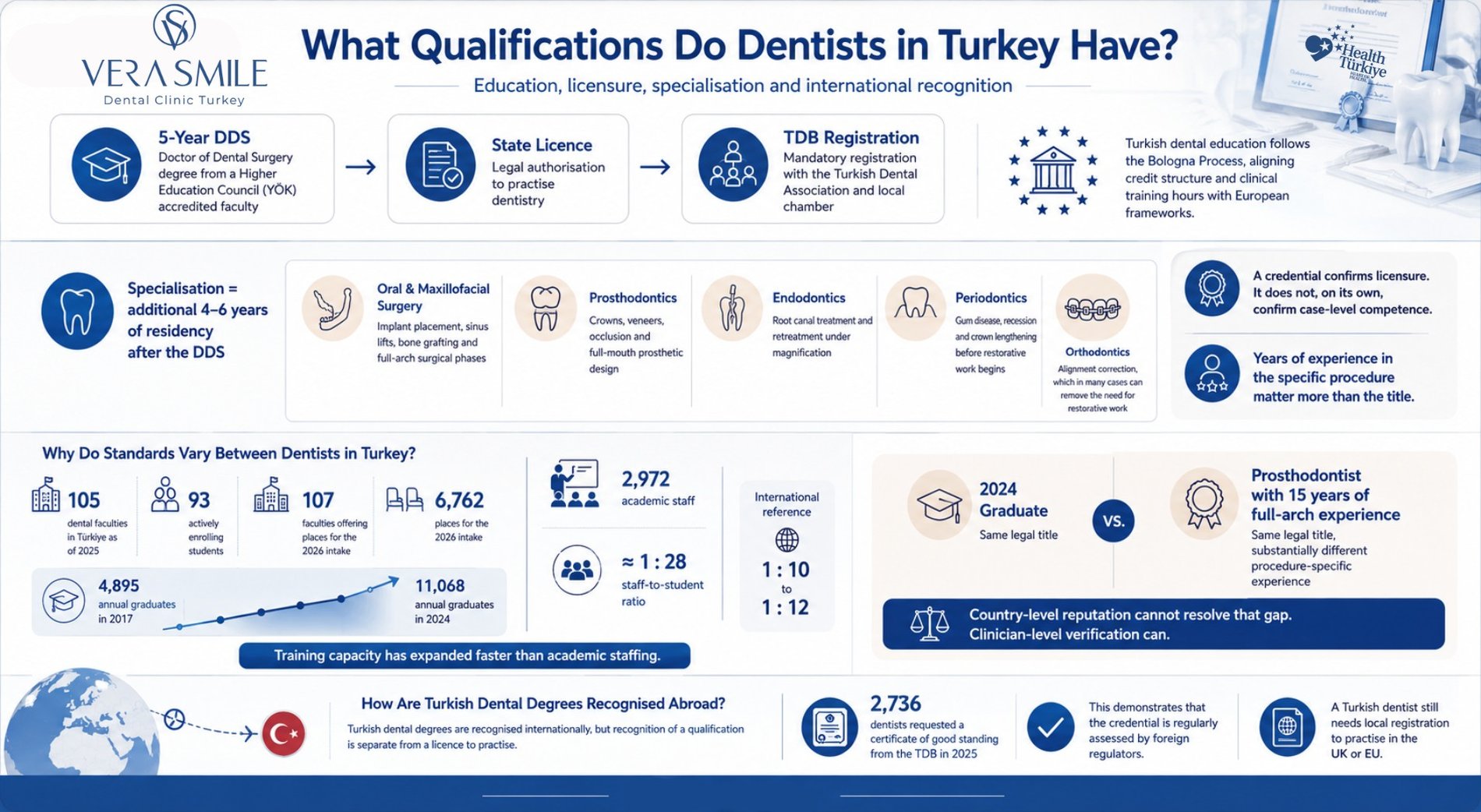
Dentists in Turkey hold a five-year Doctor of Dental Surgery (DDS) degree from a Higher Education Council (YÖK) accredited faculty, a state licence to practise, and mandatory registration with the Turkish Dental Association (TDB) and its local chamber. Turkish dental education follows the Bologna Process, so credit structure and clinical training hours align with European frameworks.
Specialisation is a separate qualification and adds 4 to 6 years of residency after the DDS.
- Oral and maxillofacial surgery: The specialty responsible for implant placement, sinus lifts, bone grafting and full-arch surgical phases.
- Prosthodontics: The specialty responsible for crowns, veneers, occlusion and full-mouth prosthetic design.
- Endodontics: The specialty handling root canal treatment and retreatment under magnification.
- Periodontics: The specialty treating gum disease, recession and crown lengthening before restorative work begins.
- Orthodontics: The specialty correcting alignment, which in many cases removes the need for restorative work altogether.
The credential confirms licensure. It does not, on its own, confirm case-level competence, which is why the number of years in the specific procedure matters more than the title.
Why Do Standards Vary Between Dentists in Turkey?
Standards vary because training capacity has expanded faster than academic staffing. Türkiye had 105 dental faculties as of 2025, of which 93 actively enrolled students, and 107 faculties offered 6,762 places for the 2026 intake according to Turkish Dental Association figures drawn from YÖK data. Annual graduate volume rose from 4,895 in 2017 to 11,068 in 2024, while academic staff stood at 2,972, producing a staff-to-student ratio near 1 to 28 against an international reference of 1 to 10 or 1 to 12.
The practical consequence is that a 2024 graduate and a prosthodontist with fifteen years of full-arch cases hold the same legal title. Country-level reputation cannot resolve that gap, and clinician-level verification can.
How Are Turkish Dental Degrees Recognised Abroad?
Turkish dental degrees are recognised internationally, though recognition of a qualification is separate from a licence to practise in another country. Dentists relocating abroad request a certificate of good standing from the TDB, and 2,736 dentists did so in 2025, which shows the credential is regularly assessed and accepted by foreign regulators. A Turkish dentist still needs local registration to work in the UK or the EU.
How Is Dentistry Regulated in Turkey?
Dentistry in Türkiye is regulated at two separate levels, the clinician and the facility, and both carry documentation a patient can request before travelling.
- Ministry of Health facility licence: The baseline legal permit for any dental clinic, covering floor plan, equipment, sterilisation protocol, emergency setup and medical waste handling.
- TDB chamber registration: The individual clinician licence, held with the local dental chamber and searchable through the association’s public practitioner lookup.
- International Health Tourism Authorisation: A separate Ministry of Health authorisation required of every facility treating patients from abroad, recorded in the ministry’s international health services listings.
- Ongoing inspection: Authorisation is renewable and audited rather than granted once, covering sterilisation, staffing qualifications and international patient coordination.
- Material traceability: Implant systems, abutments and ceramic systems are recorded on the treatment file, which is what allows any dentist worldwide to service the work later.
The regime exists because of volume. Türkiye received approximately 1.5 million international health patients in 2024, generating around 2.8 billion euros, against roughly 300,000 patients and 900 million euros in 2015 according to USHAŞ and Ministry of Health figures, with dentistry among the leading treatment categories for European visitors.
What Is the International Health Tourism Authorisation Certificate?
The International Health Tourism Authorisation Certificate is an official document issued by the Turkish Ministry of Health permitting a healthcare facility to treat international patients. It confirms compliance on patient safety, infrastructure, international patient coordination and aftercare systems. A standard clinic licence does not substitute for it, and a clinic treating foreign patients without it is operating outside the authorised system.
Which Dental Treatments in Turkey Are Performed by Specialists?
Full-arch surgery, aesthetic rehabilitation, grafting and retreatment cases are performed by specialists rather than by general dentists. A general dentist in Türkiye is legally permitted to place single implants and carry out restorative work, but legal permission and clinical indication are different questions. The table matches each demanding case type to the specialty that handles it:
| Treatment | Why the case is demanding | Specialist responsible |
| All-on-4 and full-arch cases | Implant angulation and final occlusion are planned as one decision, not two | Oral and maxillofacial surgeon for the surgical phase, prosthodontist for the prosthetic phase |
| Sinus lift and bone grafting | Bone height and sinus anatomy cannot be measured reliably in two dimensions, so a CBCT scan replaces the panoramic film | Oral and maxillofacial surgeon |
| Veneers, crowns and full-mouth aesthetics | Preparation depth and occlusal scheme decide whether the restoration lasts five years or twenty | Prosthodontist |
| Root canal retreatment | Retreatment of a failed canal requires magnification and instrument retrieval skills outside routine practice | Endodontist |
| Gum recession and crown lengthening | Gum work must be completed and healed before any restoration is fitted | Periodontist |
| Alignment cases | Correcting position with aligners or braces often removes the need to prepare sound teeth at all | Orthodontist |
The practical test is the same for every row. Ask which named clinician performs which stage, and get the answer in writing before payment.
What Risks Can You Check Before Dental Treatment in Turkey?
The risks in dental treatment abroad are procedural rather than clinical, which is the good news, because every one of them is visible before surgery and preventable at the planning stage. Turkish regulation already covers the facility side through the Ministry of Health licensing and the International Health Tourism Authorisation, so the remaining variable is how the individual case is planned. The 2026 Istanbul survey of dental tourists shows where the gap opens, since 77.4% of patients reached their clinic through an agency and 84.6% researched on social media, while far fewer verified the treating clinician directly. Six checks close that gap.
- Confirm the restoration type before preparation. Reducing healthy enamel for crowns is irreversible, so ask whether veneers, bonding or alignment achieves the same result, and expect a written justification either way.
- Ask for a CBCT scan before the surgical quote is final. Bone volume cannot be measured from a photograph or a panoramic film, and a scan-led plan is the single strongest predictor of a stable implant result.
- Have the diagnosis lead the tooth count. A plan built around a fixed number of units is a price list; a plan built around findings is a treatment plan.
- Protect the healing intervals. Extraction, grafting and loading each need their own window, and a clinic that keeps a three-month interval is protecting the outcome rather than slowing it down.
- Get the treating clinician named in writing. A named clinician with a TDB registration number gives you both accountability and a credential you can verify in minutes.
- Agree the aftercare route before you travel. A scheduled review calendar, a records pack and a written revision policy turn a warranty into something usable from home.
The value of these checks is measurable on both sides. A British Dental Association survey of 1,000 UK dentists found that 94% had examined patients treated abroad, and of those, 86% saw treatment that had failed or was failing, with crowns the treatment most likely to need follow-up work at 87% and implants at 85%. Remedial costs reached at least 575 euros in 65% of cases and more than 1,150 euros in 51%, converted here from the sterling figures the survey reported. These findings describe treatment abroad in general and are not a Turkish complication rate, and the survey did not separate verified clinics from unverified ones.
The clinical literature shows what the same treatments deliver when they are planned properly. Pooled 10-year implant survival is 96.4% at implant level (95% CI 95.2 to 97.5), holding at 93.2% in a sensitivity analysis that accounts for loss to follow-up. Monolithic lithium disilicate crowns reach 98.5% five-year survival and monolithic zirconia 96.8%. Türkiye works with the same implant and ceramic systems that produced those figures, which places the difference in outcome squarely in planning rather than in materials, and planning is the part a patient can verify in advance.
How to Verify a Dentist in Turkey Before You Book
Verification takes one afternoon and costs nothing. Work through it before paying a deposit or booking flights.
- Request the treating dentist’s full name, specialty and TDB registration number.
- Check that number against the Turkish Dental Association practitioner registry.
- Ask for the clinic’s Ministry of Health licence number and its International Health Tourism Authorisation certificate number.
- Require a CBCT scan before any surgical quote is treated as final, and expect the plan to change if the scan changes the findings.
- Demand an itemised written plan naming the implant system, the abutment and the restoration material for every unit.
- Confirm what documentation you leave with, meaning the implant passport, the material records and the CBCT files.
- Confirm in writing which clinician performs each stage, including who places implants and who fits the final restoration.
- Compare two quotes on identical materials rather than on headline price, because exclusions are where quote comparisons break down.
A clinic that declines to give a registration number or a licence number has failed the only check that costs the patient nothing.
How Do Dentists in Turkey Compare With Dentists in the UK and Europe?
Training length and specialist routes are broadly identical across Türkiye, the UK and Germany, and the differences lie in waiting time and how aftercare is delivered. All figures below are given in euros.
| Aspect | Türkiye | United Kingdom | Germany |
|---|---|---|---|
| Undergraduate training | 5-year DDS, YÖK accredited | 5-year BDS | 5-year Zahnmedizin |
| Specialist route | 4 to 6 year residency | 3 to 5 year specialty training | 3 to 5 year Weiterbildung |
| Regulator | Ministry of Health and TDB | General Dental Council | State dental chambers |
| Public practitioner registry | Yes, TDB lookup | Yes, GDC register | Yes, chamber register |
| International patient licence | Required, separate authorisation | Not applicable | Not applicable |
| Aftercare access | Scheduled remote review plus return visit | In person locally | In person locally |
The cost gap is a labour, laboratory and volume gap rather than a materials gap, since clinics in Türkiye work with the same Straumann, Nobel Biocare and Ivoclar systems used across Europe. The trade-off is geography, because the saving is real and so is the fact that a review appointment requires either a flight or a remote consultation.
What Aftercare Do Dentists in Turkey Provide After You Fly Home?
Aftercare is delivered remotely on a fixed schedule, with a return visit built into staged cases. The six items below are what a documented aftercare route contains.
- Scheduled remote review: Fixed review points rather than contact on request, with photographs or a local X-ray reviewed by the treating clinician.
- Implant and material passport: A record naming the implant system, diameter, length and ceramic system, so any dentist worldwide can identify and service the work.
- Written warranty terms: Cover stated per treatment type, with the conditions that void it written down rather than described verbally.
- Revision policy: A statement of who bears the cost of a revision and on what clinical finding, agreed before treatment starts.
- Escalation route: A named contact for the case when a local dentist raises a concern, so the two clinicians communicate directly.
- Records pack: CBCT files, treatment notes, laboratory records and prescriptions handed over at discharge.
Crowns and implants are the two treatments most likely to require follow-up work after treatment abroad, at 87% and 85% in the BDA survey. That makes the aftercare route the item to check before booking rather than after.
Who Is Not a Good Candidate for Dental Treatment in Turkey?
Some cases should be deferred or declined rather than compressed into a travel window, and a clinic that declines a case is demonstrating planning discipline rather than losing a patient.
- Uncontrolled systemic conditions: Unmanaged diabetes or uncontrolled autoimmune conditions impair osseointegration, so treatment waits until the condition is stabilised and documented.
- Active periodontal disease: Restoring teeth in an inflamed periodontium fails predictably, so gum treatment is completed and reassessed before any crown or implant work.
- Insufficient bone volume with a short window: Where grafting needs 4 to 6 months of consolidation, a single-trip plan is not clinically deliverable.
- Cosmetic requests on sound teeth: Preparing healthy enamel for crowns to change colour or shape is refused where whitening, bonding or alignment achieves the result.
- Heavy smokers: Implant failure risk rises measurably with smoking, so cessation targets are agreed before surgical planning.
- Single-trip expectations for staged cases: Full-arch and grafting cases need two visits, and a patient who cannot return should be planned differently from the start.
FAQ
Yes. Severa examples of global implant brands such as Straumann, Nobel Biocare and Osstem implant systems and Ivoclar E-max and zirconia ceramics are in routine use in Türkiye, and they are the same products placed in UK and German practices.
The treating clinic in Türkiye remains responsible under Turkish law and under the terms of its written warranty, and complaints can be raised with the local dental chamber and the Ministry of Health. A dentist in your home country has no obligation to correct another clinician’s work, and remedial treatment there is charged privately. This is why the revision policy and the escalation route are agreed in writing before treatment starts.
Many dentists treating international patients speak English directly, and clinics holding health tourism authorisation are required to provide language support. Ask whether the clinical consultation itself is in English or routed through a coordinator, since the treatment plan discussion is the conversation where translation errors matter most.
Yes, when the condition is controlled and documented. Well-controlled diabetes is not a barrier to implant treatment, and anticoagulant therapy is managed with a written protocol agreed with your prescribing doctor rather than stopped independently. Send your HbA1c result, current medication list and medical history before the plan is finalised, because a plan built without them is not a plan.
Implant treatment requires two visits of 3 to 5 days each, separated by a healing interval of about three months. Crown and veneer cases are completed in a single visit of 5 to 7 days. A clinic offering full-arch implants with final restorations inside one week is compressing a healing stage that cannot be compressed.