
A low smile line means that less than 75% of the upper front teeth are visible during a full smile, with no gum on show at any point. It is one of three recognised smile patterns and it appears in around 20% of adults, which places it inside the range of normal anatomy rather than on the list of dental faults (Tjan et al., 1984). Upper lip length and lip mobility explain most cases, while worn incisal edges, a deep bite, and naturally short crowns explain the rest.
The distinction decides everything that follows, because a lip-driven low smile line stays stable for decades while a wear-driven one keeps getting worse every year. Assessment begins with measuring tooth display at rest, crown height, and bite depth, not with choosing a treatment. That measurement also separates a normal smile pattern from the dental problems that shorten front teeth over time, which is where treatment becomes worthwhile.
Key Factors
- A low smile line shows less than 75% of the upper front teeth on a full smile and no gum tissue at all, which is the exact opposite of a gummy smile.
- Around 20% of adults have this pattern, 69% have an average smile line, and only 11% have a high smile line (Tjan et al., 1984).
- Low smile lines are more common in men, and women show almost twice as much upper tooth at rest, 3.4 mm against 1.9 mm (Vig & Brundo, 1978).
- Tooth display drops with age, and upper incisor exposure falls by roughly 3.4 mm between the ages of 30 and 60 as the upper lip lengthens.
- The cause decides the treatment, so lip anatomy needs no dental work while shortened crowns need added incisal length through bonding, veneers, or crowns.
- A low smile line carries a restorative advantage, since a low lip line hides crown margins and gum transitions that would be exposed in a high smile.
What Is a Low Smile Line?
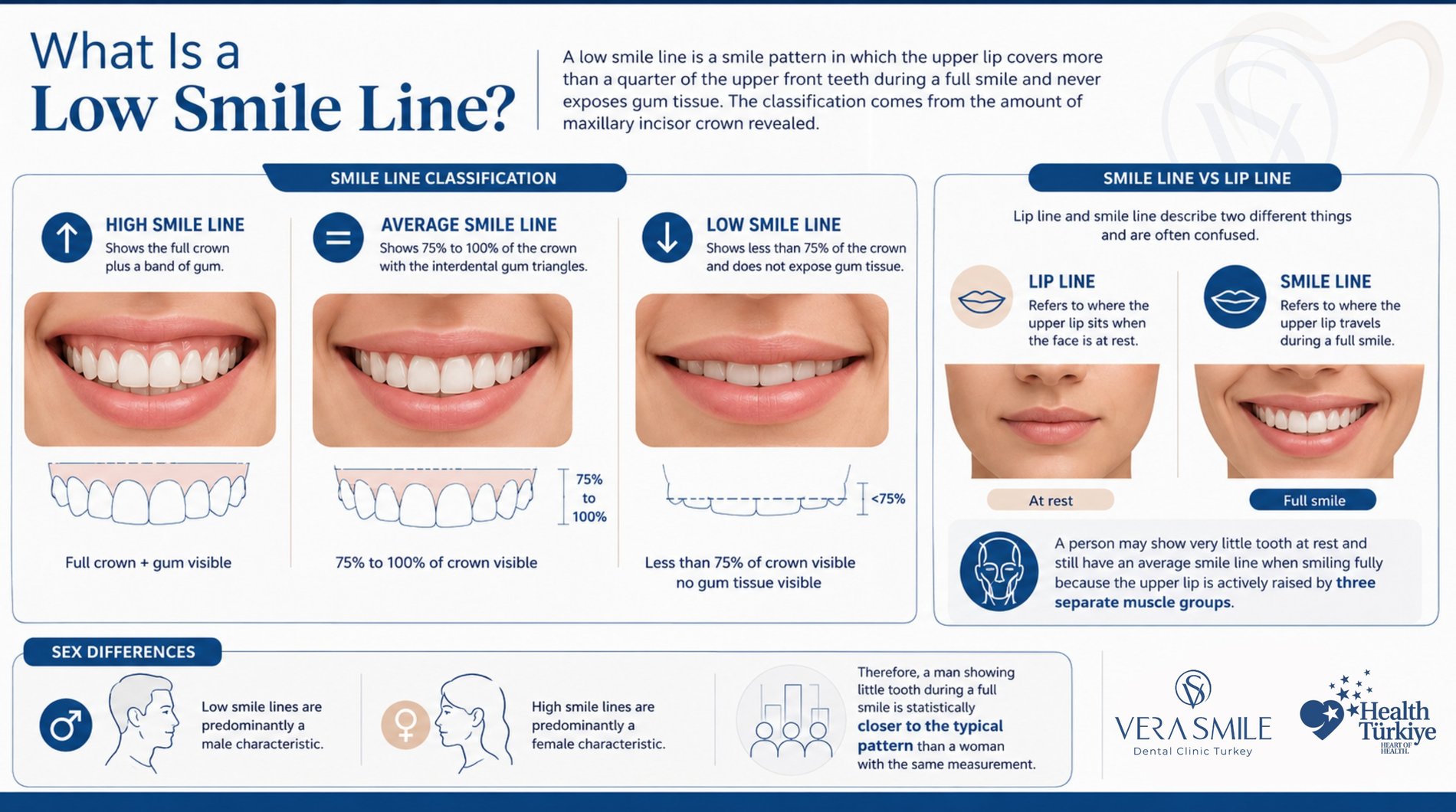
A low smile line is a smile pattern in which the upper lip covers more than a quarter of the upper front teeth during a full smile and never exposes gum tissue. The classification comes from the amount of maxillary incisor crown revealed. A high smile line shows the full crown plus a band of gum, an average smile line shows 75% to 100% of the crown with the interdental gum triangles, and a low smile line shows less than 75% (Tjan et al., 1984).
The smile line and lip line describe two different things and are often confused. Lip line refers to where the upper lip sits when the face is at rest, while smile line refers to where that lip travels when the smile muscles fire. Someone can show almost no tooth at rest and still reach an average smile line when smiling fully, because the upper lip is raised actively by three separate muscle groups.
The pattern also splits by sex. Low smile lines are predominantly a male characteristic and high smile lines predominantly female, which is why a man showing little tooth on smiling is closer to the statistical norm than a woman with the same measurement (Peck et al., 1992).
How Much Tooth Should Show When You Smile?
Adults show between 1.9 mm and 3.4 mm of upper central incisor with the lips relaxed, and between 75% and 100% of the crown on a full smile (Vig & Brundo, 1978). These figures are reference points for treatment planning rather than targets every patient should reach, since normal display shifts with sex, age, and lip length. The reference values used when tooth display is assessed are:
| Position and group | Upper front tooth display | Lower front tooth display | What it indicates |
| Lips at rest, adult women | 3.4 mm | 0.5 mm | Standard female display pattern |
| Lips at rest, adult men | 1.9 mm | 1.2 mm | Standard male display pattern |
| Lips at rest, age 60 and over | Close to 0 mm | Around 3 mm | Age-related reversal of display |
| Full smile, average smile line | 75% to 100% of crown | Not visible | Most common pattern, 69% |
| Full smile, low smile line | Less than 75% of crown | Not visible | Low smile line, 20% |
| Full smile, high smile line | Full crown plus gum band | Not visible | High smile line, 11% |
Measurement is taken twice, once with the lips relaxed and once during a genuine smile, because a posed smile in the dental chair rarely matches the smile a person produces in conversation. A patient who is self-conscious about tooth display often restrains the smile without realising it, which makes video assessment more reliable than a single photograph.
What Causes Teeth Not to Show When You Smile?
The causes split into two groups, the ones involving soft tissue and the ones involving the teeth themselves. Soft tissue causes are anatomical and stable, while dental causes are progressive and worth intercepting. The main causes are defined as:
- Long Upper Lip: Upper lip length is the strongest single predictor of how much tooth shows at rest, and every additional millimetre of lip covers a corresponding portion of the incisal edge.
- Limited Lip Elevation: Some people raise the upper lip only a few millimetres when smiling, so the crown stays covered even though its length and position are entirely normal.
- Worn Incisal Edges: Attrition shortens the crown from the biting edge upwards, and worn upper central incisors average 10.67 mm against 11.69 mm for unworn teeth (Magne et al., 2003).
- Night-Time Grinding: Clenching and grinding during sleep remove structure from the front teeth without the patient noticing, which makes bruxism the most common preventable cause of a shrinking smile.
- Acid Exposure: Diet, reflux, and frequent vomiting thin the enamel and round off the incisal edges, a pattern recorded as dental erosion.
- Deep Bite: Excessive vertical overlap of the upper incisors by the lower ones keeps the crowns high in the face, one of the display-limiting forms of malocclusion.
- Retroclined Upper Incisors: Front teeth angled backwards carry their incisal edges further up and back behind the lip, which reduces display without any loss of tooth structure.
- Vertical Maxillary Deficiency: A short upper jaw positions the entire dental arch too high relative to the lip, and this skeletal pattern cannot be corrected with restorations.
- Naturally Short Crowns: Some patients never had long clinical crowns, so the low display dates from the day the adult teeth erupted and belongs with small teeth rather than with wear.
Sorting these causes apart is the whole diagnostic task, because three of them respond to restorative work, two respond to orthodontics, one needs surgery, and two need nothing at all. Grinding and acid exposure carry the most weight of the group, since both keep removing structure for as long as they go untreated, and patients rarely connect the change in their smile with what happens overnight or at the dinner table.
Does Tooth Display Decrease With Age?
Yes. Upper incisor exposure at rest falls by approximately 3.4 mm between the ages of 30 and 60, and mandibular display rises by a similar amount over the same period (Vig & Brundo, 1978). The upper lip lengthens, perioral tissue loses elasticity, and the incisal edges wear down, so the visible portion of the smile migrates from the upper arch to the lower one. Display of the lower teeth during speech is one of the clearest soft tissue markers of aging, and the reduction is more pronounced in men than in women (Desai et al., 2009). The change is far more visible at rest and during speech than during a full smile, because active lip elevation compensates for much of it.
Is a Low Smile Line a Problem?
No. A low smile line is a normal anatomical variant present in one adult in five, and it carries no functional consequence on its own. It becomes clinically relevant only when the cause is progressive, which means tooth wear, bite collapse, or an occlusion that keeps removing structure from the incisal edges.
There is also a restorative advantage that rarely gets mentioned. A low lip line hides crown margins, gum transitions, and small asymmetries in the gum line, so anterior crowns, veneers, and implant restorations blend more easily than they do in patients with a high smile line. The margin that would be exposed in a gummy smile stays permanently covered by the lip.
Clinic Note: At Vera Smile, a low smile line with intact crown height and a stable bite is documented and left alone. Treatment is planned only when measurement shows crown height loss, an unstable occlusion, or a patient goal that restorative lengthening can actually deliver.
What Is the Difference Between a Low Smile Line and a Gummy Smile?
A low smile line shows too little upper tooth and no gum, while a gummy smile shows the full crown plus 3 mm or more of gum tissue. The two conditions sit at opposite ends of the same measurement scale, and their treatments move in opposite directions, since one adds tooth length and the other removes or repositions gum. The points that matter to a patient deciding whether either applies are compared in the table.
| Aspect | Low smile line | Gummy smile |
| Upper tooth display | Less than 75% of crown | Full crown visible |
| Gum display | None | 3 mm or more |
| Common cause | Long lip, low lip mobility, worn or short crowns | Short lip, hypermobile lip, altered passive eruption, excess gum |
| Treatment direction | Add crown length | Reduce or reposition gum |
| Surgery involved | Only in skeletal cases | Frequently, through gum contouring or gum reduction |
| Prevalence in adults | Around 20% | Around 11% of adults have a high smile line with gum display |
Patients often arrive convinced they have the more severe of the two problems, when the measurement puts them in the normal range for both. Correct classification prevents the most damaging error in aesthetic dentistry, which is treating a pattern that was never outside normal limits, and it also decides whether the case is planned as a lengthening case or as a gummy smile case with a completely different surgical pathway.
How Can You Tell If It Is Your Lip or Your Teeth?
The answer comes from crown height, not from how the smile looks in the mirror. If the upper central incisors still measure close to 11 mm and the width-to-length ratio sits near 78%, the crowns are intact and the lip is the limiting factor. If the ratio has climbed towards 87%, the teeth have worn shorter and the smile changed because of tooth loss rather than lip position (Magne et al., 2003). The two versions are compared in the table.
| Aspect | Lip-driven low smile line | Tooth-driven low smile line |
| Crown height of upper central incisor | Intact, close to 11 mm | Reduced, often under 10 mm |
| Width-to-length ratio | Around 78%, rectangular crown | Towards 87%, square crown |
| Main mechanism | Long upper lip, limited lip elevation | Attrition, grinding, acid exposure, deep bite |
| Behaviour over time | Stable across decades | Progressive, reduces each year |
| Old photographs | Smile looks the same as today | Teeth were visibly longer before |
| Gain from lengthening | None, the lip covers whatever is added | Direct, added length restores lost display |
| First step | Documentation and monitoring | Control the cause, then rebuild length |
The practical value of the distinction is that it decides whether treatment is worth doing at all. A lip-driven case treated with veneers produces enamel loss and no visible change, while a tooth-driven case left alone keeps losing structure until the restorative option becomes a crown rather than a bonding.
Tips for Patients: Record a 10 second video of yourself talking and laughing with the camera at eye level, then pause it at the widest point of the smile. Bring that video, plus one photograph from at least a decade ago, to the consultation. Both give more diagnostic information than a posed smile taken in the clinic.
Which Checks Confirm the Cause of Low Smile Line?
Six assessments separate the two versions, and none of them relies on the patient’s own impression of the smile. The checks are defined as:
- Crown Height Measurement: The clinician measures the upper central incisor from gum margin to incisal edge and compares it against the adult mean of roughly 10 mm to 11.7 mm.
- Width-to-Length Ratio: A central incisor that looks square rather than rectangular has lost height, since worn teeth reach ratios near 87% while unworn teeth sit around 78%.
- Rest Position Check: Tooth display is recorded with the lips relaxed and compared against the age and sex reference values, which shows whether the limitation is soft tissue or dental.
- Phonetic Testing: The F and V sounds place the incisal edge against the wet line of the lower lip and reveal where the edge should sit for both speech and appearance.
- Old Photograph Comparison: Photographs from ten or fifteen years earlier show whether the smile changed over time, which points to wear, or stayed the same, which points to anatomy.
- Video Smile Analysis: Recorded conversation captures the genuine smile and the true range of lip elevation, which a posed photograph in the chair does not.
The two markers that carry the most weight are crown height and the old photographs, because together they establish whether anything has actually been lost. Patients whose crowns were short from the day they erupted fall outside both groups and are treated to a different threshold, since nothing has been lost and the decision is purely aesthetic.
How Can a Low Smile Line Be Treated?
Treatment adds length to the upper front teeth, changes their angle, or does nothing at all, depending on which cause the assessment identified. There is no procedure that lengthens the upper lip or increases lip mobility in a predictable way, so patients whose display is limited purely by soft tissue gain nothing from restorative work. The options that do change display are defined as:
- Composite Bonding: Tooth-coloured resin is added directly to the incisal edges in one visit and restores 1 mm to 2 mm of lost length without removing enamel, which makes composite bonding the only fully reversible option in the list.
- Dental Veneers: Thin ceramic shells rebuild length, shape, and colour across the anterior teeth, and dental veneers remove 0.3 mm to 0.8 mm of enamel depending on the design.
- Crowns With Occlusal Rebuild: Extensive structural loss needs full coverage, so dental crowns are combined with a controlled increase in the vertical dimension of the bite.
- Orthodontic Correction: Fixed appliances and clear aligners correct deep bite and incisor inclination, which brings the incisal edges down and forward into the smile frame.
- Occlusal Stabilisation: A night guard and bite adjustment protect new restorations in grinding patients and are completed before, not after, the aesthetic work.
- Orthognathic Referral: Vertical maxillary deficiency is a skeletal problem, and only jaw surgery moves the whole arch into a position where the teeth can show.
Lengthening always has an upper limit set by the bite, since new incisal edges have to clear the lower teeth in every excursive movement. Adding 1 mm to 2 mm is straightforward in most cases, while anything beyond that becomes an occlusal decision rather than a cosmetic one. The sequence matters as much as the material, because resin can be trialled and removed while ceramic and full coverage commit the tooth permanently, which is why the conservative option is tested first whenever the measurement leaves room for either.
Which Low Smile Line Treatment Suits Which Cause?
Matching cause to treatment prevents the two most common failures, which are lengthening teeth that were never short and bonding onto an unstable bite. Each cause is paired with its first-line option, the named material or technique, and the display gain that is realistic in the table.
| Cause | First-line treatment and material | Added upper display | Time in Istanbul | Reversible |
| Mild incisal wear | Direct nanohybrid composite bonding, Dahl concept where space is limited | 1 to 2 mm | 1 to 2 days | Yes |
| Moderate to severe wear | IPS e.max lithium disilicate laminate veneers | 1 to 3 mm | 5 to 7 days | No |
| Extensive structural loss | Monolithic zirconia crowns with a raised vertical dimension of occlusion | 2 to 4 mm | 7 to 10 days | No |
| Deep bite or retroclined incisors | Invisalign or fixed appliance incisor intrusion and torque control | 1 to 3 mm | 2 short visits over 6 to 18 months | Yes |
| Vertical maxillary deficiency | Le Fort I osteotomy referral to maxillofacial surgery | Above 4 mm | Hospital-based pathway | No |
| Long or low-mobility lip only | No restorative treatment, photographic and cephalometric records only | 0 mm | Consultation only | Not applicable |
Bite correction is the slowest route and the only one that changes tooth position rather than tooth shape, which makes it the more conservative choice for younger patients whose display is limited by a deep bite. Where wear is localised to the upper incisors and there is no room to add length, the Dahl concept creates that space by allowing the posterior teeth to re-establish contact instead of preparing the front teeth further. Planning for every route runs through an intraoral scan, a digital smile design mock-up, and a wax-up tried in the mouth, so the incisal edge position is confirmed against speech and lip dynamics before the material is chosen.
What Are the Risks of Lengthening Teeth for a Low Smile Line?
The main risk is over-lengthening, since incisal edges extended beyond what the bite and lip can accommodate cause speech changes, chipping, and a smile that reads as artificial. Every millimetre added to the front teeth enters the functional path of the lower incisors, so the aesthetic decision and the occlusal decision cannot be separated. The specific risks are defined as:
- Speech Interference: Edges extended past the wet line of the lower lip disturb F and V sounds and produce a lisp after veneers that persists until the length is adjusted.
- Chipping and Fracture: Lengthened composite and ceramic sit at the point of highest stress in the mouth, and unprotected grinding shortens their service life sharply.
- Occlusal Interference: New incisal edges that contact the lower teeth during protrusive or lateral movement transfer load onto the restorations instead of the natural guidance.
- Irreversible Enamel Loss: Prepared veneers remove 0.3 mm to 0.8 mm of enamel permanently, which commits the tooth to restoration for the rest of its life.
- Relapse Through Continued Wear: Restorations placed without treating the underlying grinding or acid exposure wear down again on the same timeline as the natural teeth did.
- Unnatural Display: Lengths chosen from population averages rather than from the patient’s own lip dynamics produce a smile that looks correct on a model and wrong on a face.
Every one of these risks is a planning failure rather than a material failure, which is why the incisal edge position is decided at the mock-up stage and tested in the mouth before anything permanent is bonded. Composite is the safer first step in borderline cases, since it can be removed without cost to the tooth.
Warning: Incisal lengthening in an untreated grinding patient fails predictably. Bruxism assessment and a night guard come first, and any clinic that offers to lengthen worn front teeth without examining the bite is treating the symptom and leaving the cause in place.
Who Is a Good Candidate for Smile Line Correction?
The strongest candidates are patients whose upper front teeth have measurably shortened, whose gums are healthy, and whose bite can accommodate added incisal length. Candidacy rests on measurement rather than on how much the patient dislikes their smile, because a normal display that gets lengthened produces a worse outcome than no treatment at all. The suitable profiles are defined as:
- Documented Crown Height Loss: Central incisors measuring shorter than the adult range, with a width-to-length ratio that has moved towards the worn end.
- Stable Periodontal Health: No active gum inflammation, no bleeding on probing, and gum margins that will hold their position after restorations are placed.
- Adequate Remaining Enamel: Enough sound enamel for adhesive bonding, since resin and ceramic bonded to dentine hold far less reliably.
- Controlled Grinding: A patient whose bruxism has been assessed and managed, with a night guard in place before the aesthetic work begins.
- Mild to Moderate Deep Bite: An overbite that orthodontics can reduce within a reasonable timeframe, rather than one driven by jaw position.
- Realistic Display Goals: An understanding that the target is the patient’s own age and sex reference range, not the tooth display of someone twenty years younger.
Four groups are postponed or referred rather than treated. Active grinding is controlled first and the aesthetic work follows, active periodontal disease is treated and reassessed, skeletal vertical maxillary deficiency is referred to maxillofacial surgery because restorations cannot move a jaw, and patients with intact crown height whose display is limited purely by a long or low-mobility lip are advised against lengthening, since the lip will continue to cover whatever length is added.
Why Choose Vera Smile for Smile Line Correction?
Vera Smile treats tooth display as a measurement before it treats it as an aesthetic preference. Every anterior case begins with rest position and smile records, crown height measurement, and a digital plan, so the incisal edge position is agreed before any enamel is touched. Patients see the proposed length as a mock-up in their own mouth and can speak and smile with it in place, which turns an irreversible decision into a reversible one.
For international patients, the whole sequence is compressed into a single trip, with bonding cases completed in 1 to 2 days and ceramic cases in 5 to 7 days. Follow-up continues remotely after the patient returns home, with photograph reviews at set intervals and coordination with a local dentist where a check is needed in person. Every lengthening plan starts from a digital smile design mock-up, so the new incisal edge is agreed on screen and tested in the mouth before a single tooth is prepared.
FAQ
Your teeth do not show because either your upper lip covers them or your front teeth have grown shorter. A long upper lip or limited lip elevation hides crowns that are perfectly normal in length, while worn incisal edges, a deep bite, and backward-angled incisors reduce the tooth available to show. Crown height settles which one applies. Upper central incisors close to 11 mm mean the lip is the limiting factor and nothing has been lost, while shorter measurements mean tooth structure went missing and the cause is worth treating.
Yes. Composite bonding adds 1 mm to 2 mm of length directly onto the incisal edges in a single visit without removing enamel, and it can be reshaped or removed later. It suits mild wear and patients who want to test a new length before committing to ceramic. The trade-off is service life, since composite needs replacement every 4 to 7 years while ceramic lasts considerably longer.
Yes, but only when the cause is a deep bite or backward-angled upper incisors. Braces and aligners intrude and torque the front teeth, which moves the incisal edges downward and forward into the smile frame and adds 1 mm to 3 mm of display. They change nothing when the limitation is a long upper lip or limited lip mobility, since tooth position is not the restricting factor in those cases. The bite assessment decides which group a patient falls into, not the smile photograph.
No. Filler adds volume to the lip body and can evert the vermillion slightly, but it does not shorten the lip or increase how far the smile muscles lift it. In some cases added volume increases coverage of the upper teeth rather than reducing it. Lip procedures are not a treatment for low tooth display.
Yes, after a certain age. Seeing mainly lower teeth at rest and during speech is a recognised age-related pattern, and after the age of 60 lower incisor display approaches the level of upper display seen before 30 (Vig & Brundo, 1978). It becomes a concern when it appears decades earlier than expected, which points to incisal wear or a deep bite rather than aging. Measurement against the age reference range settles which of the two applies.
Yes, and it works in the patient’s favour. A low lip line keeps the implant crown margin and the gum transition permanently hidden, which reduces the aesthetic risk that dominates anterior implant planning in high smile line patients. Soft tissue contouring around the implant remains important for hygiene and long-term stability, but the visible margin of error is wider.
Yes, when the original cause remains active. Restorations placed on teeth that are still being ground down or exposed to dietary acid wear at a similar rate to the natural teeth they replaced, so display reduces again over several years. Cases where grinding is controlled and the bite is stable hold their display for the service life of the material.
Desai, S., Upadhyay, M., & Nanda, R. (2009). Dynamic smile analysis: Changes with age. American Journal of Orthodontics and Dentofacial Orthopedics, 136(3), 310.e1–310.e10.
Magne, P., Gallucci, G. O., & Belser, U. C. (2003). Anatomic crown width/length ratios of unworn and worn maxillary teeth in white subjects. The Journal of Prosthetic Dentistry, 89(5), 453–461.
Orozco-Varo, A., Arroyo-Cruz, G., Martínez-de-Fuentes, R., & Jiménez-Castellanos, E. (2015). Biometric analysis of the clinical crown and the width/length ratio in the maxillary anterior region. The Journal of Prosthetic Dentistry, 113(6), 565–570.
Peck, S., Peck, L., & Kataja, M. (1992). The gingival smile line. The Angle Orthodontist, 62(2), 91–100.
Tjan, A. H. L., Miller, G. D., & The, J. G. P. (1984). Some esthetic factors in a smile. The Journal of Prosthetic Dentistry, 51(1), 24–28.
Vig, R. G., & Brundo, G. C. (1978). The kinetics of anterior tooth display. The Journal of Prosthetic Dentistry, 39(5), 502–504.