
The fundamental distinction between bonding and veneers is defined by the way each procedure engages with the natural enamel structure. This distinction is mechanical rather than cosmetic, and it directly influences durability, reversibility, and long-term maintenance.
Bonding is an additive procedure. Composite resin is placed directly onto the existing enamel after controlled etching and adhesive preparation. The natural tooth structure remains largely intact, and the material bonds microscopically to the enamel surface rather than replacing it.
Veneers follow a subtractive protocol. A thin layer of enamel is reduced to create space for a laboratory-fabricated ceramic shell. The veneer becomes the new visible surface of the tooth, replacing the outer enamel layer in that area. This alteration is permanent.
The contrast is clear: bonding adds material to enamel, while veneers replace enamel with ceramic. That structural difference shapes every comparison that follows, from longevity to biological impact.
What Is the Structural Difference Between Bonding and Veneers?
The structural difference between bonding and veneers lies in how each treatment interacts with the enamel surface and how much of that surface is altered. Bonding follows an additive approach, where composite resin is applied directly onto etched enamel and bonded in place without removing significant tooth structure. The original enamel remains largely intact beneath the material. Veneers follow a subtractive protocol, requiring a thin layer of enamel to be reduced so a laboratory-fabricated ceramic shell can be bonded onto the tooth. In this process, the veneer becomes the new external surface. In structural terms, bonding adds material to existing enamel, while veneers replace part of the enamel with ceramic, and this distinction shapes differences in longevity, reversibility, and maintenance.
How Does Composite Bonding Adhere to Enamel?
Composite bonding adheres to enamel through a controlled adhesive protocol that creates both micromechanical retention and chemical bonding. The enamel surface is first treated with phosphoric acid etchant. This process creates microscopic porosities by dissolving mineral content at the outer layer. These micro-irregularities increase surface energy and allow the bonding agent to penetrate the enamel structure.
A resin-based adhesive is then applied. This bonding layer flows into the etched micro-porosities and polymerises under curing light, forming a hybrid layer that locks into the enamel surface. Composite resin is placed in increments over this bonded layer, shaped directly on the tooth, and light-cured to achieve structural stability.
The result is a restoration that is fused to enamel at a microscopic level rather than mechanically clipped onto the tooth. The strength of this bond depends on isolation, surface preparation quality, and incremental layering technique.
How Do Porcelain Veneers Replace the Visible Enamel Surface?
Porcelain veneers replace the visible facial enamel through a controlled reduction process followed by adhesive bonding of a ceramic shell. A thin layer of enamel, generally between 0.3 mm and 0.7 mm, is removed to create space for the veneer. This reduction ensures the final restoration sits flush with adjacent teeth rather than appearing over-contoured.
An impression or digital scan is taken after preparation and sent to a laboratory, where the ceramic veneer is fabricated with precise control over thickness, contour, and translucency. At placement, the inner surface of the veneer is treated and bonded to the prepared enamel using resin cement. Once secured, the ceramic layer becomes the new external surface of the tooth.
This structural replacement is the key distinction in composite bonding vs veneers. Bonding adds material onto intact enamel, whereas porcelain veneers substitute part of the enamel with ceramic. In comparisons of porcelain veneers vs bonding, this enamel replacement explains the difference in optical depth and long-term surface stability. When evaluating dental bonding vs veneers, the central question is whether preserving untouched enamel or replacing it with a laboratory-fabricated ceramic surface better aligns with the patient’s long-term goals.
Does Bonding Damage Teeth Less Than Veneers?
Yes. Composite bonding preserves nearly all existing tooth structure. The procedure involves surface etching to create microscopic retention, yet it does not require measurable reduction of enamel thickness in standard cases. The enamel remains structurally intact beneath the composite layer.
Porcelain veneers require controlled enamel reduction to create space for the ceramic shell. This preparation permanently alters the external enamel surface, and once reduced, the tooth depends on a restoration for coverage.
From a structural standpoint, bonding involves minimal alteration, while veneers require irreversible enamel modification. The trade-off is that veneers offer greater long-term stability, while bonding prioritizes enamel preservation.
Is Bonding Easier to Reverse Than Veneers?
Yes. Composite bonding does not require enamel reduction in standard cases, so the material can be removed and the tooth remains close to its original structure. Veneers require enamel reduction, which is permanent. Once prepared, the tooth will always need a restoration.
What Does Enamel Reduction Mean and Why Is It Irreversible?
Enamel reduction refers to the controlled removal of the outer tooth surface to create space for a restoration. In veneer treatment, a thin layer of enamel is reduced so the ceramic shell sits flush with adjacent teeth and maintains proper contour.
Enamel is acellular tissue. The body does not regenerate it. Once removed, it cannot be restored to its original state. This makes veneer preparation a permanent structural change.
Bonding requires surface etching for adhesion but does not involve measurable reduction of enamel thickness in standard cases. The difference between surface conditioning and structural reduction defines the issue of irreversibility.
What Is Microleakage and What Is the Long-Term Biological Cost?
Microleakage refers to the microscopic penetration of bacteria and oral fluids at the margin between a restoration and the tooth surface. Over time, this infiltration affects marginal integrity and increases the risk of secondary decay.
In bonding, marginal breakdown occurs as composite resin undergoes wear and material fatigue. Small gaps form at the interface, which require refinishing or repair. With veneers, the ceramic-to-enamel bond provides a more stable marginal seal when placed under proper isolation and adhesive control.
When comparing veneers vs crowns vs bonding, the biological cost increases with the level of tooth alteration. Bonding preserves the most enamel, veneers involve moderate enamel reduction, and crowns require circumferential tooth preparation. The greater the structural change, the greater the long-term restorative dependency.
Do Veneers Feel or Look Different From Bonding?
Yes. Veneers and bonding differ in both tactile perception and optical behaviour. Veneers are fabricated in a laboratory with controlled thickness and contour, which allows precise replication of natural enamel anatomy. When preparation depth is accurate, the restoration integrates with the existing tooth profile and feels consistent with adjacent teeth.
Bonding is sculpted directly onto the enamel surface. Since it is additive, changes in volume or edge length are more noticeable if contouring is not carefully controlled. The final feel depends on surface finishing and occlusal adjustment.
From a visual standpoint, porcelain transmits and reflects light in a way that more closely resembles natural enamel. Composite resin reflects light differently, which influences depth, translucency, and brightness under varying lighting conditions.
Do Veneers Feel Thicker Than Bonding?
No, when prepared correctly. Veneers require enamel reduction before placement, which creates space for the ceramic shell. When this preparation is measured accurately, the final thickness mirrors the original tooth contour. The result feels balanced within the bite and against the tongue.
Bonding adds composite resin onto the existing enamel surface. In cases involving lengthening or widening, the added volume becomes perceptible if contouring is not precise.
Perceived thickness is therefore linked to preparation accuracy and shaping technique rather than the material itself.
Does Bonding Look Bulky Under Strong Light?
Yes, in certain lighting conditions. Composite resin reflects light primarily at the surface level. Under strong overhead lighting or direct sunlight, this reflection reduces visual depth and creates a flatter appearance. The restoration can appear more opaque compared to surrounding enamel.
Porcelain transmits and scatters light through its internal structure. This creates depth and a more enamel-like glow across different lighting environments.
Bulk perception under strong light is therefore linked to optical behaviour rather than physical thickness. Surface finishing quality and material grade influence how noticeable this difference becomes.
Are Veneers Too White for Natural Smiles?
No. Veneers are not inherently too white; appearance depends on shade selection, translucency control, and light behaviour.
Porcelain possesses internal crystalline structure that allows light transmission beneath the surface. Natural enamel reflects and refracts light at specific angles, creating depth rather than flat brightness. When a veneer is fabricated with appropriate translucency and value, it integrates with surrounding teeth and facial tone.
An overly bright result stems from choosing a high-value shade without balancing chroma and translucency. Light refraction angle influences perception: if the ceramic blocks light instead of transmitting it, the tooth appears opaque. When translucency gradients and incisal edge characterisation are calibrated correctly, veneers produce a natural appearance under varied lighting conditions.
Which Option Maintains Its Color and Shape Longer?
Porcelain veneers maintain color and surface form longer than composite bonding. Composite resin contains a matrix that absorbs pigments over time. Exposure to coffee, tea, wine, and tobacco alters shade stability. Surface wear reduces gloss, and minor edge breakdown changes contour.
Porcelain is non-porous and resistant to pigment absorption. Its glazed surface preserves brightness and translucency for extended periods. Structural rigidity maintains edge definition and facial contour when occlusal forces are balanced.
The difference in longevity reflects material composition: resin is flexible and prone to surface change, while ceramic retains optical clarity and shape with greater stability.
Does Bonding Stain Faster Than Porcelain?
Yes. Composite resin has a porous microstructure that absorbs pigments from coffee, tea, red wine, and tobacco. Over time, these chromogens penetrate the resin matrix and alter its shade. Surface polishing removes superficial discoloration, yet deeper staining requires refinishing or replacement.
Porcelain is non-porous and resistant to pigment absorption. Its glazed ceramic surface preserves color stability for extended periods, with discoloration limited primarily to exposed cement margins rather than the ceramic itself.
Does Bonding Chip More on Lower Teeth?
Yes. Lower incisors are exposed to significant shear forces during speech and chewing. In patients with edge-to-edge bite relationships or bruxism, these forces increase stress at the composite margin. Resin material has lower fracture resistance than ceramic, which raises the likelihood of edge chipping in this region.
Bonding on lower teeth remains conservative in terms of enamel preservation, yet it carries a higher maintenance expectation when occlusal load is elevated.
How Do Material Fatigue and Surface Gloss Retention Compare Over Time?
Composite resin undergoes gradual material fatigue under functional load. Repeated flexion, thermal cycling from hot and cold exposure, and marginal stress reduce surface integrity. Gloss diminishes as the outer layer wears, and micro-fractures develop along the margin. This affects brightness, contour sharpness, and overall polish retention.
Porcelain demonstrates greater structural stability under normal occlusal forces. Its glazed surface maintains gloss and light reflection with minimal change in contour. The ceramic structure resists pigment penetration and surface wear more effectively than resin.
Internal 5-year follow-up data (612 patients across UK, US, EU, and Asia) reflects this performance gap:
- Bonding revision rate at 5 years: 38%
- Veneer revision rate at 5 years: 9%
- Stain return within 24 months (bonding): 41%
- Patient satisfaction at year 3: Veneers 92% | Bonding 68%
Revision in bonding cases included refinishing, edge repair, and partial replacement. Veneer revisions were largely linked to fracture or debonding rather than surface degradation.
The performance difference aligns with material composition. Resin is flexible and susceptible to surface change under stress, while ceramic maintains structural integrity and optical stability over extended periods.
Is Bonding vs Veneers Cost a Short-Term Saving or a Long-Term Investment?
It depends on the time horizon. Bonding carries a lower upfront fee in nearly every market. The procedure is completed in one visit without laboratory fabrication, which reduces immediate expense. For patients focused on entry-level cosmetic improvement, this creates an accessible starting point.
Veneers require enamel preparation, laboratory production, and a second appointment for placement. The initial fee is higher due to material cost and fabrication precision.
The financial difference shifts when evaluated over several years. Bonding carries a higher probability of refinishing, repair, or partial replacement. Veneers show lower revision frequency within the same timeframe. When cost is measured per year of service rather than per procedure, the gap narrows.
Short-term budgeting favors bonding. Long-term stability favors veneers. The decision rests on whether the priority is immediate affordability or reduced maintenance over time.
How Do Initial Costs Compare for Bonding vs Veneers Cost?
Initial pricing for bonding and veneers varies significantly by country, reflecting differences in laboratory fees, clinician experience, and healthcare market structure. Composite bonding is consistently priced lower per tooth than porcelain veneers because it is completed chairside without external fabrication.
| Country | Bonding (Per Tooth, €) | Veneers (Per Tooth, €) |
| UK | €175–€470 | €585–€1,400 |
| US | €185–€555 | €830–€2,300 |
| Germany | €180–€450 | €600–€1,500 |
| Spain | €120–€350 | €400–€1,100 |
| Thailand | €75–€185 | €275–€650 |
| India | €35–€110 | €140–€420 |
| Mexico | €75–€165 | €230–€560 |
How Does Bonding vs Veneers Cost Compare Over a 5-Year Maintenance Period?
A five-year projection provides clearer insight than initial pricing alone. When assessing bonding vs veneers cost, maintenance frequency plays a decisive role. Composite restorations carry higher probabilities of refinishing or partial replacement within five years, while porcelain restorations show lower intervention rates under stable occlusion.
Below is a simplified five-year projection per tooth, assuming one revision cycle for bonding and no revision for veneers within that period.
| Country | 5-Year Bonding Cost (€) | 5-Year Veneer Cost (€) | Cost Dental Bonding vs Veneers Outcome |
| UK | €350–€900 | €585–€1,400 | Veneers approach breakeven by year 4–5 |
| US | €370–€1,100 | €830–€2,300 | Veneers stronger long-term value above mid-range |
| Germany | €360–€900 | €600–€1,500 | Near breakeven in moderate cases |
| Spain | €240–€700 | €400–€1,100 | Veneers gain value after revision cycle |
| Thailand | €150–€370 | €275–€650 | Bonding retains lower total cost |
| India | €70–€220 | €140–€420 | Bonding remains lower overall |
| Mexico | €150–€330 | €230–€560 | Close comparison by year 5 |
Can You Switch From Bonding to Veneers Later?
Yes. Transitioning from composite bonding to porcelain veneers is clinically straightforward in most cases. The existing composite material is removed, the enamel surface is evaluated, and conventional veneer preparation proceeds based on remaining tooth structure. If the original bonding was placed without enamel reduction, sufficient enamel is retained for predictable adhesive bonding of the veneer.
The key factor is documentation of the initial treatment. Knowledge of prior etching depth and restoration boundaries supports precise preparation planning. When executed with controlled isolation and enamel preservation, the transition from bonding to veneers maintains structural integrity and allows staged cosmetic treatment.
How Is the Tooth Prepared After Previous Bonding?
Transitioning from composite bonding to porcelain veneers requires controlled removal of the existing material and a reassessment of the underlying enamel. The goal is to preserve sound tooth structure while creating a stable foundation for ceramic bonding. Preparation planning depends on how the original bonding was placed and whether any enamel was previously altered.
- Composite Removal: Existing bonding material is completely removed using polishing discs, fine burs, or air abrasion. The objective is to expose clean enamel without unnecessary reduction.
- Enamel Assessment: The clinician evaluates enamel thickness, surface integrity, and any prior contour changes caused by earlier treatment.
- Preparation Recalibration: If the initial bonding was additive, standard veneer preparation proceeds with preserved enamel. If previous adjustments altered tooth shape, reduction depth is recalculated to achieve uniform ceramic thickness.
- Isolation and Adhesive Planning: Strict moisture control and clear documentation of the pre-bonding condition guide the bonding protocol for predictable veneer placement.
Why Do Some Dentists Prefer Bonding First?
Bonding is sometimes selected as the first phase in a staged cosmetic plan. This approach prioritizes flexibility before committing to irreversible enamel reduction.
- Younger Patients: In patients under 25, enamel and bite relationships continue to adapt with functional wear. Bonding preserves structure during this period. Veneer placement is deferred until occlusion and tooth position stabilize.
- Trial Smile Approach: Bonding serves as a prototype for changes in shape, length, and shade. The patient lives with the modified contours before approving a ceramic prescription. Feedback from daily function informs final veneer design.
- Budget Planning: Bonding allows aesthetic improvement without immediate laboratory expense. A documented long-term plan outlines the transition to veneers when financial conditions align with permanent treatment goals.
Which Option Works Better for Small or Front Teeth?
The ideal treatment for small or front teeth depends on the extent of the size discrepancy, structural condition, and aesthetic objective. In cases involving minor width adjustments or limited enamel wear, bonding provides a conservative solution that builds volume without altering underlying tooth structure.
When significant reshaping, uniform symmetry across multiple anterior teeth, or permanent shade change is required, veneers deliver greater dimensional control. Laboratory fabrication allows precise contouring of incisal edges, contact points, and facial curvature.
For front teeth in the aesthetic zone, treatment selection should reflect the number of teeth involved, desired longevity, and willingness to accept enamel modification. Bonding prioritizes preservation, while veneers prioritize structural stability and long-term optical consistency.
Is Bonding or a Veneer Better for a Chipped Tooth?
Yes, bonding is better in most single-tooth chip cases. A small incisal chip affects a limited surface area. Composite resin bonds directly to the exposed enamel and restores contour without reducing unaffected tooth structure. The repair is completed in one visit and preserves the natural enamel.
A veneer requires preparation of the broader facial surface, extending beyond the chipped region. This commits the tooth to permanent coverage. Veneer placement is appropriate when the chip is combined with discoloration, structural cracks, or multiple surface defects.
The treatment choice follows a conservative principle: restore the damaged area without altering healthy enamel.
Is Bonding or Veneers Better for Front Teeth?
It depends on the extent of change required. When evaluating bonding vs veneers for front teeth, the key variables are the number of teeth involved, the severity of discoloration, structural condition, and long-term stability expectations.
For isolated concerns, such as minor reshaping or a single edge defect, chipped tooth bonding vs veneers comparisons strongly favor bonding. Composite restores the damaged area without preparing the entire facial surface, preserving enamel and maintaining flexibility for future adjustments.
For comprehensive smile changes involving multiple upper incisors, uniform shade correction, or significant contour modification, veneers provide greater precision. Laboratory fabrication allows consistent symmetry, defined incisal edges, and stable color across the aesthetic zone.
In the front teeth region, bonding prioritizes conservation and adaptability, while veneers prioritize structural consistency and long-term optical stability.
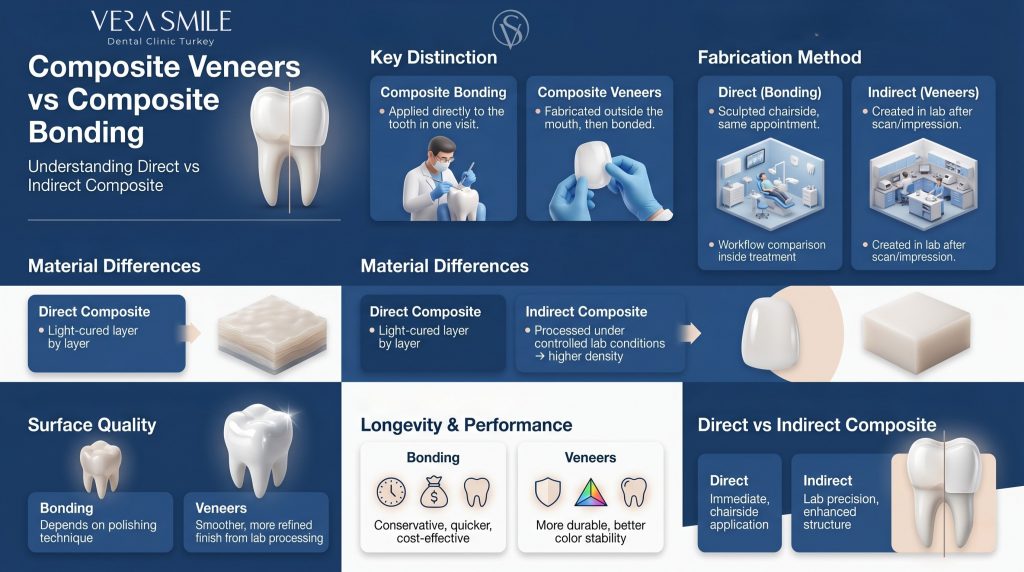
What Is the Real Difference Between Composite Veneers and Composite Bonding?
Composite veneers and composite bonding use similar resin materials, yet they differ in fabrication method, structural control, and longevity expectations.
- Fabrication Method: Direct composite bonding is sculpted directly onto the tooth in a single appointment. Composite veneers are fabricated outside the mouth under controlled laboratory conditions before being bonded to the tooth.
- Material Processing: Chairside composite is light-cured incrementally during placement. Laboratory-fabricated composite undergoes enhanced curing conditions, resulting in greater density and surface refinement.
- Surface Finish and Gloss Retention: Direct bonding depends on polishing technique at the time of placement. Indirect composite veneers exhibit smoother surface texture due to external fabrication and controlled finishing.
- Durability Profile: Direct bonding prioritizes conservation and lower initial cost. Composite veneers offer improved structural consistency and color stability compared to chairside resin.
The distinction is procedural rather than purely material: bonding is immediate and additive, while composite veneers introduce laboratory precision within the composite category.
What Is the Difference Between Direct and Indirect Composite?
Composite restorations fall into two categories based on how they are fabricated and placed. The distinction between direct and indirect composite affects surface quality, structural density, and long-term performance. While both use resin-based material, the processing environment and placement protocol create measurable differences.
- Placement Method: Direct composite is sculpted and cured directly on the tooth during one appointment. Indirect composite is fabricated outside the mouth after an impression or digital scan, then bonded in a separate visit.
- Material Processing: Direct composite is light-cured incrementally at chairside. Indirect composite is processed under controlled laboratory conditions, producing higher material density.
- Surface Quality: Direct composite relies on chairside polishing for texture and gloss. Indirect composite benefits from laboratory finishing, resulting in smoother surface refinement.
- Durability Expectation: Direct composite prioritizes conservation and immediacy. Indirect composite emphasizes structural consistency and improved long-term surface stability.
How Does Laboratory Fabrication Compare to Chairside Fabrication?
The difference between laboratory and chairside fabrication defines the practical gap in composite veneers vs bonding comparisons. While both rely on resin-based materials, the processing environment influences density, surface quality, and longevity.
- Processing Environment: Chairside composite bonding is placed and cured directly on the tooth under clinical lighting conditions. Laboratory-fabricated composite veneers are processed outside the mouth with controlled temperature and pressure, increasing material density.
- Precision and Contour Control: Chairside sculpting depends entirely on the clinician’s technique. Laboratory fabrication allows detailed contour refinement before bonding, improving symmetry in multi-tooth cases.
- Surface Finish and Stability: In discussions of composite veneers vs composite bonding, indirect composite veneers exhibit improved gloss retention and reduced surface wear due to enhanced curing conditions. Direct bonding relies on polishing quality at placement and periodic refinishing over time.
The distinction between laboratory and chairside fabrication clarifies the structural middle ground within the composite category: bonding prioritizes immediacy and conservation, while composite veneers introduce controlled fabrication and improved surface stability.