
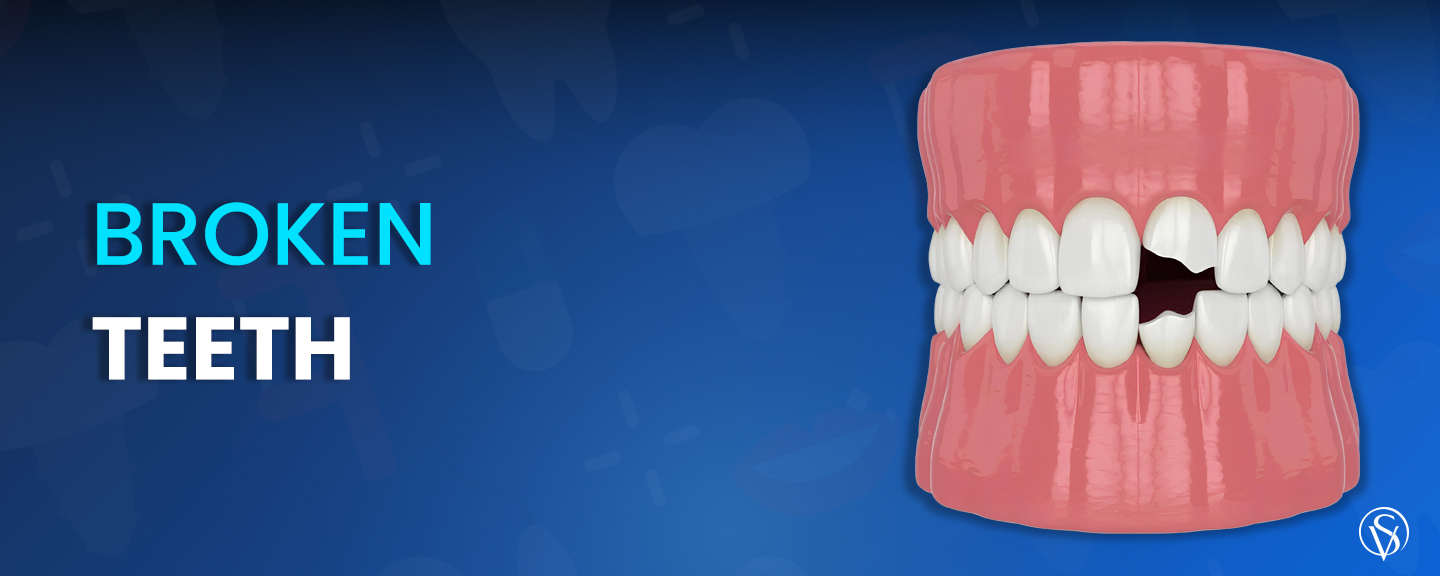
A broken tooth is any structural damage to the tooth, from a minor enamel chip to a fracture reaching the pulp or root, and how serious it is depends on depth, not appearance. Chipped teeth make up the largest share of dental injuries, and most are repairable when treated promptly. The right fix ranges from a few minutes of polishing to bonding, veneers, a crown, root canal followed by a crown, or extraction with implant replacement.
Cost in Turkey varies by treatment and severity, and minor cases are often resolved in a single visit while crowns and implants involve lab work or healing time. The signs that turn a broken tooth into an emergency are pain on biting, swelling, and a crack reaching the gumline. Severity, not the visible size of the damage, decides whether a tooth needs a quick polish or full restoration, which is why even a minor-looking break warrants prompt professional assessment.
What Are Broken Teeth?
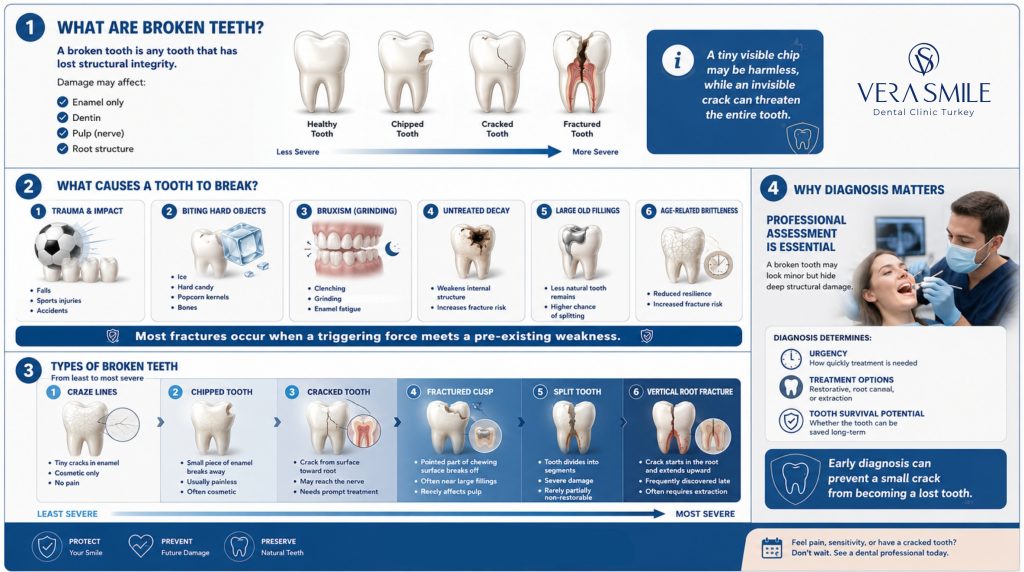
A broken tooth is any tooth that has lost structural integrity, whether the damage affects only the outer enamel or extends through the dentin into the pulp and root. “Broken teeth” is an umbrella term that covers chips, cracks, and full fractures, each differing in depth and urgency. The visible size of the damage is a poor guide to its seriousness: a small surface chip may be purely cosmetic, while a hairline crack invisible to the eye can reach the nerve and threaten the tooth. Severity is what determines both urgency and treatment, which is why a professional assessment matters even when a break looks minor.
What Causes a Tooth to Break?
Most broken teeth result from sudden force or from gradual weakening that leaves the tooth unable to handle normal pressure. The causes below explain why teeth break and which situations carry the highest risk.
- Trauma and impact: A blow to the face, a fall, or a sports injury can fracture an otherwise healthy tooth in an instant.
- Biting hard objects: Crunching ice, hard candy, popcorn kernels, or bones concentrates force on a small area and can crack enamel.
- Bruxism: Habitual grinding and clenching, often during sleep, wears enamel thin and creates fatigue cracks over time.
- Untreated decay: Cavities hollow out the tooth from within, leaving brittle walls that fracture under chewing pressure.
- Large old fillings: Teeth with extensive fillings have less natural structure remaining, so the surrounding enamel is more prone to splitting.
- Age-related brittleness: Enamel and dentin become less resilient with age, increasing fracture risk even without trauma.
A break often combines a trigger with a pre-existing weakness: decay or a large filling sets the stage, and a hard bite finishes the job.
What Are the Types of Broken Teeth?
Broken teeth are classified by how deep the damage runs and whether the pulp is at risk. The categories below move from least to most serious.
- Craze lines: Tiny cracks in the surface enamel only, causing no pain and needing no treatment beyond cosmetic polishing if desired.
- Chipped tooth: A small piece of enamel breaks away, usually painless and often a cosmetic concern rather than a structural one.
- Cracked tooth: A crack runs from the chewing surface toward the root; the pulp is at risk, and early treatment can prevent the crack from spreading.
- Fractured cusp: A pointed part of the chewing surface breaks off, frequently around a large filling, and rarely reaches the pulp.
- Split tooth: The tooth divides into distinct segments, a severe break that often means part or all of the tooth cannot be saved.
- Vertical root fracture: A crack starts at the root and extends upward, often discovered late and usually requiring extraction.
Identifying which type is present is the first step in deciding whether a tooth can be restored or must be removed.
How Do You Know If a Broken Tooth Is Serious?
A broken tooth is serious when it causes pain, sensitivity, swelling, or reaches the gumline, because these signs indicate the damage has gone beyond the enamel. The warning signs below separate a cosmetic chip from a case that needs urgent care.
- Pain when biting: Sharp pain on chewing suggests the crack moves under pressure and the pulp is irritated.
- Temperature sensitivity: Lingering discomfort with hot or cold points to exposed dentin or pulp involvement.
- Spontaneous pain: A tooth that aches on its own often signals the pulp is damaged and may be infected.
- Visible crack to the gumline: A crack reaching the gum indicates a deep fracture that may compromise the whole tooth.
- Swelling or bleeding: Swelling of the gum or face and persistent bleeding are signs of infection or significant trauma.
If swelling, severe pain, or bleeding accompanies a broken tooth, the situation is a dental emergency that needs same-day attention rather than a routine appointment.
How Are Broken Teeth Repaired?
Broken teeth are repaired according to how deep the damage runs, with options ranging from simple polishing to extraction and implant replacement. The treatments below are listed from least to most extensive, with the severity each one addresses.
- Polishing and contouring: Smooths minor chips and craze lines in a single visit, used when damage is cosmetic and limited to the enamel surface.
- Dental bonding: Dental bonding applies tooth-colored composite resin to rebuild small chips and minor cracks, shaped and cured in one appointment without removing healthy tooth structure.
- Dental veneers: Thin porcelain or composite shells cover the front surface of a visible tooth, and dental veneers suit chips on front teeth where appearance is the priority.
- Dental crowns: A full cap restores a tooth with extensive damage; at Vera Smile, dental crowns in zirconia and E-max ceramic are selected by case, with zirconia favored for posterior load-bearing teeth and E-max where front-tooth translucency matters.
- Root canal followed by a crown: When a crack reaches the pulp, the infected tissue is removed and the tooth is sealed and capped to restore strength.
- Extraction and implant replacement: Reserved for split teeth and vertical root fractures that cannot be saved, the tooth is removed and replaced with dental implants to restore function.
Choosing among bonding, veneers, crowns, root canal treatment, and implants depends on the depth of the break and how much healthy tooth remains.
What Should You Do When You Break a Tooth?
When you break a tooth, act quickly to control pain, protect the tooth, and reach a dentist as soon as possible. The steps below cover what to do in the first hours.
- Rinse with warm water: Clean the area gently to remove debris and assess the damage.
- Control bleeding: Apply gentle pressure with clean gauze if the gum or lip is bleeding.
- Reduce swelling: Hold a cold compress against the cheek to limit swelling and ease discomfort.
- Save any fragment: Keep a broken piece in milk or saline, as it may help the dentist in some cases.
- Cover sharp edges: Use dental wax or sugarless gum over a jagged edge to protect the tongue and cheek.
- Manage pain: Take an over-the-counter pain reliever such as acetaminophen if the tooth hurts.
- Avoid chewing on that side: Eat soft foods and keep pressure off the damaged tooth until it is treated.
- Contact the clinic: Arrange an assessment promptly; Vera Smile offers same-day evaluation, which matters for international patients who need treatment scheduled efficiently.
Prompt action reduces the risk of infection and improves the chance the tooth can be saved.
How Much Does It Cost to Fix a Broken Tooth in Turkey?
The cost of fixing a broken tooth in Turkey depends on the treatment the damage requires, from low-cost bonding to implant replacement. The table below sets out average prices in Turkey for each option and what they include.
| Treatment | Average Price (Turkey) | What It Includes |
| Polishing / contouring | €50–€150 | Assessment, smoothing and polishing of minor chips, single visit |
| Dental bonding | €75–€250 per tooth | Composite resin application, shaping, curing, single visit |
| Dental veneers (per tooth) | €175–€500 | Preparation, custom porcelain or composite shell, fitting |
| Dental crown (per tooth) | €100–€400 | Preparation, zirconia or E-max crown, fitting |
| Root canal + crown | €220–€700 | Pulp removal and sealing (from ~€120) plus crown (€100–€400) |
| Extraction + implant | €450–€1,400 | Extraction (€70–€100), implant, abutment, and crown |
These are average Turkey ranges; the exact figure depends on the depth and type of the break and is confirmed after an in-person or photo assessment. Vera Smile provides a fixed quote at consultation.
How Long Does Broken Tooth Treatment Take?
Broken tooth treatment takes anywhere from a single visit to several months, depending on whether lab work or healing time is involved. The table below sets out the timeline by treatment type.
| Treatment | Visits | Total Timeline |
| Polishing / contouring | 1 visit | Under an hour, same day |
| Dental bonding | 1 visit | Around an hour, same day |
| Dental veneers | 2–3 visits | A few days to two weeks |
| Dental crown | 2–3 visits | A few days to two weeks |
| Root canal + crown | 2 or more visits | One to three weeks |
| Extraction + implant | 2 stages | Several months, including healing before the final crown |
For international patients, single-visit and short-course treatments can be arranged within one trip to Turkey, while implant cases are planned around the healing window. around the healing window.
Can a Broken Tooth Be Prevented?
Yes, many broken teeth can be prevented by protecting the teeth from excess force and treating weaknesses before they fail. A custom nightguard shields the teeth from grinding and clenching during sleep, while a fitted mouthguard absorbs impact during contact sports. Treating decay early preserves the tooth structure that resists fracture, and avoiding hard foods such as ice, hard candy, and bones reduces sudden stress on enamel. Routine check-ups catch small cracks before they spread, making consistent prevention far less costly and disruptive than repairing a tooth after it breaks.
Why Choose Vera Smile for Broken Tooth Treatment?
Vera Smile offers same-day assessment, a full range of restorative and cosmetic treatments under one roof, and a patient journey built around international visitors to Turkey. Whether a broken tooth needs simple bonding or a crown, veneer, or implant, the clinic matches the material and protocol to each case, using zirconia and E-max ceramics selected by tooth position and function. For patients travelling to Turkey, treatment is scheduled to fit within the time available, and follow-up support continues after the visit. This combination of fast assessment, tailored materials, and dedicated international coordination makes Vera Smile a strong choice for restoring a broken tooth and more dental treatment in Turkey.
FAQ
No, a broken tooth cannot heal on its own because enamel and dentin do not regenerate. Any chip, crack, or fracture needs professional repair to restore the tooth and prevent further damage.
A broken tooth is a dental emergency when it is accompanied by severe pain, swelling, heavy bleeding, or a crack reaching the gumline. Minor chips without pain are not emergencies but should still be assessed promptly.
An untreated broken tooth can worsen, allowing bacteria to reach the pulp and cause infection, pain, and abscess. Over time, the damage can spread to the surrounding bone and gum and lead to loss of the tooth.
A tooth broken at the gum line can sometimes be saved if enough healthy structure remains, often with a root canal and crown. When the break extends below the gum or into the root, extraction and implant replacement may be necessary.
No, a broken tooth does not always need a crown. Minor chips are treated with polishing or bonding, while crowns are reserved for teeth with extensive damage or those weakened after a root canal.
Fixing a broken tooth is generally not painful, as local anesthesia is used for procedures such as crowns and root canals. Minor repairs like polishing and bonding often need no anesthesia at all.