
Yes, you must floss dental implants daily, but the technique and floss type matter more than they do for natural teeth. Use implant-specific PTFE floss or super floss, wrap it in a C-shape around the implant crown, and clean 1–2 mm below the gumline with a gentle shoeshine motion.
Regular waxed floss is unsafe on exposed implant surfaces; clinical research has documented cases where torn floss fibers triggered peri-implant inflammation and bone loss. Water flossers are a safe supplement when set to a low pressure (settings 1–3 on most devices). All-on-4 prostheses require a different protocol focused on the subprosthetic space rather than the contact points.
Daily mechanical interdental cleaning is the single most important variable in long-term dental implant survival, and it cannot be replaced by toothbrushing or mouthwash alone.
How Is Flossing a Dental Implant Different From a Natural Tooth?
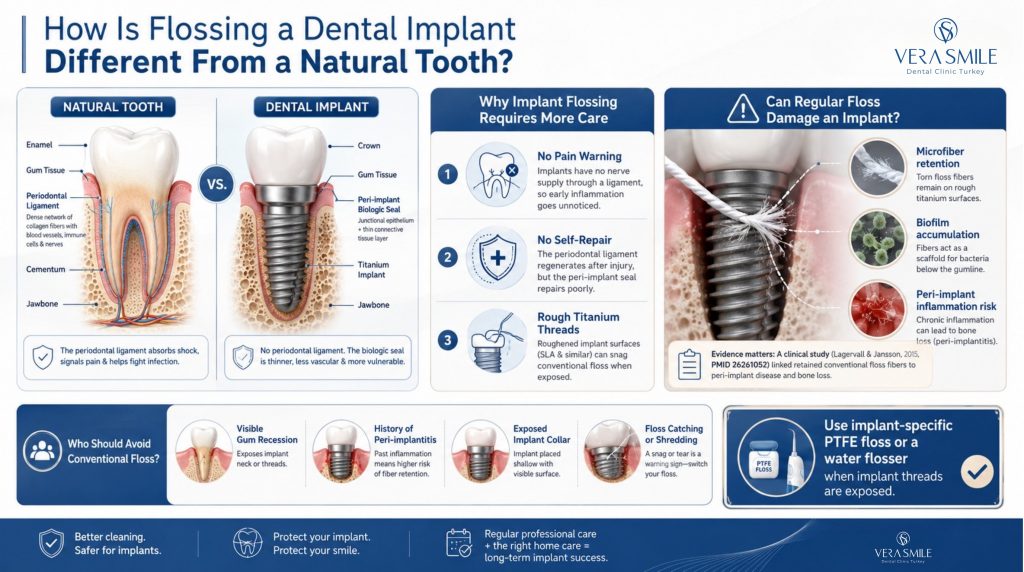
Flossing an implant is different because implants lack a periodontal ligament and rely instead on a thinner, less resilient biological seal that disrupts more easily than the tissue around a natural tooth.
A natural tooth is attached to the jawbone through a periodontal ligament, a dense network of collagen fibers threaded with blood vessels, immune cells, and sensory nerve endings. This ligament absorbs shock, signals pain when tissue is inflamed, and recruits immune cells to fight infection. A dental implant has none of this. The implant relies on a peri-implant biologic seal: a junctional epithelium attached to the titanium surface via hemidesmosomes, combined with a thin connective tissue layer. The 2025 AO/AAP consensus (Wang IC et al.) confirms that this seal is structurally weaker and lacks the vascular density of the periodontal ligament, making it more vulnerable to bacterial infiltration.
What Are the Practical Flossing Consequences of This Anatomical Difference?
This anatomical difference has three practical consequences for flossing:
- No pain warning: Implants have no nerve supply through a ligament, so patients cannot feel early peri-implant inflammation the way they feel tooth pain.
- No self-repair: The periodontal ligament regenerates after injury, but the peri-implant seal has limited capacity to repair itself once chronically disrupted.
- Rough threaded surfaces: Modern titanium implants are deliberately roughened (SLA and similar surface treatments) to promote osseointegration, and the same roughness can snag conventional floss when any portion of the implant body is exposed.
The result is that flossing an implant is a more deliberate procedure than flossing a natural tooth, with less margin for error.
Can Regular Floss Damage a Dental Implant?
Yes, regular waxed or braided floss can damage the tissue around an implant when it tears on an exposed rough titanium surface and leaves microfibers behind.
A peer-reviewed observational study published in the Swedish Dental Journal (Lagervall & Jansson, 2015, PMID 26261052) documented 10 patients who developed peri-implant disease attributable to retained conventional floss fibers on exposed implant surfaces. The torn fibers acted as a scaffold for bacterial biofilm accumulation below the gumline, triggering progressive bone loss. The 2024 AO/AAP consensus on peri-implant disease identifies poor biofilm control as one of the principal modifiable risk factors for peri-implantitis, which reinforces that how an implant is cleaned matters as much as whether it is cleaned.
Who Should Avoid Conventional Floss?
The following patient profiles should avoid conventional floss and use implant-specific PTFE floss or a water flosser instead:
- Visible gum recession: Any recession that exposes the implant neck or threads creates a surface where conventional floss can shred.
- History of peri-implant mucositis or peri-implantitis: Previous inflammation indicates a compromised soft tissue seal and a higher risk of fiber retention.
- Shallow implant placement: Implants placed with a visible collar above the gum margin have exposed surface area at the flossing zone.
- Catching sensation during flossing: A noticeable snag or tear during use is a direct warning that the floss is contacting a rough surface.
If any of these apply, the dental floss type should be changed before the next cleaning, not after a problem is detected.
What Is the Best Floss for Dental Implants?
The best floss for a dental implant depends on the prosthetic design and whether any part of the implant surface is exposed. The table below compares the most clinically appropriate options:
| Floss Type | Best For | Safe on Exposed Surfaces | All-on-4 Compatible | Notes |
| Super floss | Single implants, bridges | Yes (spongy section) | Yes (with threader) | Best all-around choice with a 3-section design |
| PTFE floss | Single implants, tight contacts | Yes | With threader | Slides without tearing, preferred for exposed surfaces |
| Tufted floss | Under bridges, All-on-4 | Yes | Yes | Thicker spongy section, strong under prosthetics |
| Bridge and implant floss | Implant bridges | Yes | Yes | Stiff entry end paired with a soft cleaning body |
| Regular waxed or unwaxed floss | Natural teeth only | No | No | Fiber fragmentation risk on rough surfaces (PMID 26261052) |
| Water flosser | All implant types | Yes (settings 1–3) | Yes | Adjunct, not a replacement for mechanical flossing |
Choosing the right floss is a one-time decision that protects the implant for its functional lifespan, and the cost difference between conventional and implant-specific dental floss is negligible.
How Do You Floss Dental Implants?
Flossing technique for dental implants depends on the prosthetic design, and the three main scenarios (single crown, single crown with super floss, and full-arch All-on-4) each require a different protocol.
| Implant Scenario | Primary Tool | Secondary Tool | Cleaning Target | Daily Time |
| Single implant crown | PTFE floss or super floss | Floss threader if needed | Mesial and distal contact points, 1–2 mm subgingival | 1–2 minutes |
| Single crown or bridge (super floss protocol) | Oral-B Super Floss | None (self-threading) | Contact points plus adjacent tooth surface in one pass | 1–2 minutes |
| All-on-4 full-arch bridge | Tufted floss with threader | Tuftbrush plus water flosser (1–3) | Subprosthetic space across full arch | 4–6 minutes |
| Implant-supported bridge (3+ units) | Tufted floss or super floss with threader | Tuftbrush at each abutment | Underside of pontic plus implant emergence profiles | 3–5 minutes |
A single crown is flossed at the contact points like a natural tooth, but with implant-specific floss and gentler subgingival movement. Super floss is a specific tool used on single crowns and bridges where its three-section design replaces the need for a separate threader. An All-on-4 prosthesis has no contact points to floss between, so the dental hygiene protocol shifts to cleaning the subprosthetic space with a combination of threaded floss, a tuftbrush, and a water flosser.
How Do You Floss a Single Dental Implant?
Flossing a single dental implant follows a six-step technique using super floss or PTFE floss, never regular waxed floss. The single dental implant crown sits between adjacent natural teeth or implant crowns, and both proximal surfaces must be cleaned individually.
- Thread the floss: Use the stiff end of super floss (or a floss threader with PTFE floss) to pass the floss through the contact point from cheek-side to tongue-side, positioning the spongy section at the gumline.
- Wrap in a C-shape: Curl the floss around the implant crown in a C-shape, pressing gently against the crown surface to mirror the contour of the gingival margin.
- Slide below the gumline: Move the floss 1–2 mm subgingivally using a shoeshine motion on the mesial side of the implant, without forcing or snapping.
- Repeat on the distal side: Re-wrap the floss in the opposite C-direction to address the distal surface, since each side of the implant must be cleaned separately.
- Lift out without snapping: Slide the floss back out the same way it came in, because snapping upward can temporarily displace the gingival margin and introduce bacteria subgingivally.
- Rinse with an alcohol-free mouthwash: Follow with chlorhexidine 0.12% for the first months post-surgery, then a non-alcohol antimicrobial rinse long-term.
Flossing once daily before bed is the standard recommendation, because the anaerobic bacteria that drive peri-implantitis colonize undisturbed biofilm over a 24-hour cycle.
How Do You Use Super Floss on a Dental Implant?
Super floss is used on a dental implant by threading the stiff end through the contact point, positioning the spongy segment against the implant crown, and pulling the regular floss segment through to clean the adjacent tooth. The super floss design has three distinct sections, each addressing a specific aspect of implant hygiene:
- Stiffened entry end: Acts as a self-threading needle, allowing navigation through tight embrasure spaces without a separate threader.
- Spongy segment: A 3–4 cm section of soft, expanded material that conforms to the implant crown surface and absorbs bacteria-laden fluid from the subgingival sulcus, and it does not tear on exposed implant surfaces.
- Regular floss segment: Cleans the proximal surface of the adjacent natural tooth at the same time, completing the contact point cleaning in one pass.
The correct motion is slow and rotational rather than back-and-forth sawing, and the floss is always pulled out from the side rather than snapped upward.
How Do You Floss All-on-4 Dental Implants?
Flossing All-on-4 dental implants requires a three-tool protocol focused on the subprosthetic space, the area between the underside of the fixed bridge and the gum tissue. Because the bridge is fixed and continuous, there are no individual contact points to floss between teeth. The bacteria colonizing this space are predominantly anaerobic, the same species responsible for aggressive peri-implantitis, and biofilm reforms within 48 hours when undisturbed.
- Floss threader with super floss or tufted floss under the bridge: Thread the floss under the full-arch bridge from one distal end to the other, working section by section so the spongy portion passes across each implant emergence profile and the undersurface of the prosthesis.
- Single-tufted brush at each implant collar: Reach the tuftbrush under the bridge and angle it 45° to the gumline at each individual implant, using small circular strokes to disrupt biofilm at the emergence profile, which is the most vulnerable site for peri-implantitis.
- Water flosser at settings 1–3 along the subprosthetic space: After mechanical cleaning, trace the full arch slowly with the tip held parallel to the gumline, never perpendicular, which flushes residual debris from the posterior implant sites where manual access is limited.
The full all-on-4 dental implant flossing protocol takes 4–6 minutes daily, and skipping any of the three steps leaves a portion of the subprosthetic space uncleaned.
How Do You Clean Under a Dental Implant?
Cleaning under a dental implant means cleaning the gingival margin and any subprosthetic space, and the approach depends on whether the implant has a single crown or supports a bridge. The tools used for cleaning under implants are consistent across both scenarios:
- Floss threader: Allows conventional or PTFE floss to be passed under bridges or through tight contact points.
- Super floss or tufted floss: The spongy section conforms to the implant surface and cleans the emergence profile without fragmenting.
- Single-tufted brush: Reaches the implant collar at a 45° angle, which a standard toothbrush cannot do effectively.
- Interdental brush: Effective where wider proximal spaces exist between an implant and an adjacent tooth, and the 2024 AO/AAP consensus identifies interdental brushes as preferred over regular floss when implant surfaces are exposed.
- Water flosser: Set to 1–3 only, used as a supplement after mechanical cleaning to flush loosened debris.
The correct combination of tools depends on the prosthetic design, and a dental hygienist can specify the protocol for an individual case at the post-placement review appointment.
Can a Water Flosser Damage Dental Implants?
A water flosser does not damage dental implants when used at the correct pressure setting, but it can disrupt the peri-implant soft tissue seal if used at high pressure or too soon after surgery. The pulsed water jet itself does not harm titanium, but it can mechanically stress the junctional epithelial attachment around the implant collar, particularly when the mucosal thickness is below 2 mm.
At settings 1–3 on most standard water flossers (approximately 40–60 psi), clinical studies support their adjunctive use for implant maintenance because they remove loosely attached biofilm without disrupting soft tissue. At settings 7–10 (above 90–120 psi), the pulsed jet can displace the junctional epithelial seal, especially where the soft tissue phenotype is thin, which chronically irritates the peri-implant mucosa and impairs the biological seal over time. For implants within 3 months of surgical placement, water flossers should be avoided entirely while the peri-implant soft tissue is still maturing, and gentle hand technique with super floss is the only safe option during that window.
What Should Flossing a Dental Implant Feel Like?
Flossing a properly placed dental implant should feel similar to flossing a natural tooth, with floss sliding through the contact point and conforming to the crown surface without resistance or tearing. Specific sensations indicate specific problems:
- Floss cannot pass at all: The crown is over-contoured or the interproximal contact is too tight, which traps plaque and is a modifiable peri-implantitis risk factor that needs crown adjustment.
- Floss catches or tears: The implant surface is partially exposed and conventional floss is fragmenting on the rough titanium, so the floss type must be changed to PTFE floss or a water flosser before the next cleaning.
- Pain that does not resolve in seconds: Active peri-implant mucositis or peri-implantitis may be present, and flossing should stop until a professional evaluation is completed.
- Bleeding beyond 30 seconds: Healthy peri-implant tissue should not bleed heavily during gentle flossing, and persistent bleeding is an early sign of peri-implant mucositis.
None of these sensations should be ignored, because the peri-implant tissue does not produce pain signals the way a natural tooth does and early warning signs are mechanical rather than sensory.
How Long Do Dental Implants Last with Proper Flossing?
Dental implants last 20 years or longer in the majority of patients who maintain consistent daily flossing and professional hygiene visits every 3–6 months. Long-term survival data from foundational Bränemark studies and subsequent cohort reviews shows the following:
Dental implant failure at 20 years is rarely caused by the implant itself, and prosthetic replacement is the most common long-term maintenance event rather than implant loss.
What Should You Know About Implant Hygiene Before Treatment?
Patients considering dental implants should understand that daily implant-specific flossing is non-negotiable, that peri-implantitis is largely silent until advanced, and that the prosthetic crown will likely need replacement before the implant itself does. The following points are the realities most patients wish they had understood before their procedure:
- Regular floss may not be the right choice: Implant-specific products exist because conventional floss can actively cause harm on exposed implant surfaces, and the cost difference is minimal.
- Flossing takes longer with implants: Budget an extra 2–3 minutes daily for thorough implant hygiene, since implant crowns require more deliberate technique than natural teeth.
- Peri-implantitis is silent until it is advanced: Early signs (bleeding on probing, slight pocket depth increases, early radiographic bone loss) are only detected at professional check-ups, which is why 3–6 month maintenance visits are not optional.
- Smoking is a long-term maintenance risk: The 2024 AO/AAP consensus identifies smoking as a primary systemic risk factor at every stage of implant life because nicotine impairs the microvascular perfusion of the peri-implant mucosa.
- The implant rarely fails, the surrounding tissue does: Titanium osseointegration failure rates after the initial healing phase are very low, and most late-stage implant loss results from peri-implantitis caused by inadequate hygiene.
- The crown will likely need replacing before the implant: The titanium post can last a lifetime with proper care, but the ceramic crown is subject to normal wear and may need replacement around the 10–15 year mark.
Understanding these realities before treatment changes how patients approach dental implant aftercare routine, their daily hygiene routine from day one of the implant lifespan.
FAQ
How often should you floss dental implants?
Floss dental implants once daily, ideally before bed, because the anaerobic bacteria that drive peri-implantitis colonize undisturbed biofilm over a 24-hour cycle. More frequent flossing is acceptable but not required, and over-flossing with aggressive technique can disrupt the peri-implant seal.
Can you use a Waterfloss instead of flossing dental implants?
No, a Waterfloss does not replace mechanical flossing for dental implants because it flushes loose debris but does not disrupt the adherent biofilm at the implant-gum junction. Clinical guidance positions water flossers as a supplement to super floss or PTFE floss, not as a substitute.
Why does my dental implant bleed when I floss?
A dental implant may bleed when flossing because of early peri-implant mucositis, aggressive technique, or recent professional cleaning, and bleeding that persists beyond 30 seconds or recurs daily warrants a professional evaluation. Healthy peri-implant tissue does not bleed during gentle flossing.
Can you floss a dental implant immediately after surgery?
No, do not floss the implant site for the first 7–14 days after surgical placement or as directed by the surgeon, and avoid water flossers entirely for the first 3 months while the peri-implant soft tissue is still maturing. Gentle saline rinses and a soft toothbrush are the standard hygiene measures during this window.
What happens if you do not floss dental implants?
Failure to floss dental implants leads to biofilm accumulation at the implant-gum junction, progressing through peri-implant mucositis (reversible) to peri-implantitis (often irreversible bone loss) over months to years. The 2024 AO/AAP consensus identifies inadequate biofilm control as a principal modifiable risk factor for late-stage implant failure.