
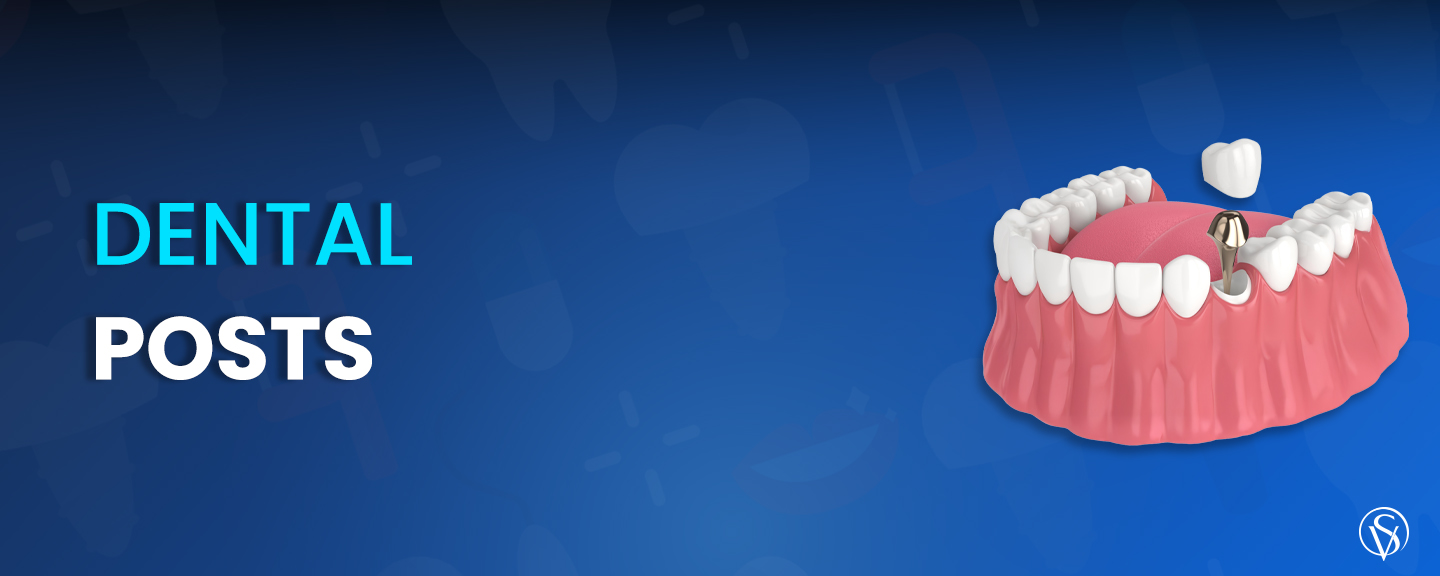
Dental posts are small, sturdy structures placed inside a tooth or dental implant to provide support for restorations such as crowns, bridges, or dentures. They act as internal anchors, reinforcing weakened teeth or supporting prosthetic components in areas where natural tooth structure is insufficient. Posts are especially important in teeth that have undergone root canal treatment, as the procedure can leave the tooth fragile and unable to hold a crown on its own.
In implant dentistry, dental implant posts serve as connectors between the implant fixture and the visible prosthetic tooth. This ensures stability, proper alignment, and long-term durability of the restoration. In denture procedures, post-retained dentures use posts to improve retention and reduce movement, offering better chewing efficiency and comfort.
Materials used for dental posts vary, including metal, fiber-reinforced composite, or gold-plated screws, chosen based on strength, aesthetics, and compatibility with the surrounding tooth or implant structure.
What Are the Types of Dental Posts?
Dental posts are essential tools in restorative dentistry, providing structural support for teeth that have undergone root canal treatment or significant damage. Choosing the right type of post depends on the tooth’s location, remaining structure, and the intended restoration, such as crowns, dentures, or implant-supported prosthetics. Understanding the different types of dental posts helps dentists achieve optimal strength, durability, and aesthetics in restorative procedures.
- Metal Posts: Metal posts are typically made from stainless steel, titanium, or gold alloys. They are used in teeth with significant structural loss to provide maximum support. Their main advantage is strength and durability, making them suitable for posterior teeth under heavy chewing forces.
- Fiber-Reinforced Composite Posts: These posts are made from glass or carbon fibers embedded in resin. They are preferred for anterior teeth where aesthetics matter. The tooth-colored material blends naturally, and its flexibility helps reduce stress on the remaining tooth structure, lowering the risk of fractures.
- Prefabricated Posts: Prefabricated posts come in standardized sizes and shapes for general use. They are used in routine restorative procedures because they are cost-effective and allow fast, consistent placement.
- Custom Cast Posts: Custom cast posts are made from an impression of the specific tooth. They are ideal for teeth with irregular root canals or extensive structural damage, providing a precise fit and superior retention for crowns or other restorations.
- Endodontic Posts for Implants: Endodontic posts designed for implants serve to connect implant fixtures to crowns. They provide proper alignment, stability, and functional support, ensuring long-term success of the restoration.
How Do You Choose the Right Type of Dental Post?
Selecting the appropriate dental post requires a structured clinical assessment focused on strength, stability, and long-term restoration success. Each case presents different anatomical and functional demands, making post selection a balance between tooth preservation, load control, and restorative compatibility. A well-matched dental post supports the crown or prosthesis while protecting the remaining root structure.
- Remaining Tooth Structure: The amount of healthy tooth left determines the level of reinforcement required. Teeth with extensive structural loss require stronger post support to retain the final restoration.
- Tooth Location: Front teeth demand aesthetic integration, while posterior teeth require higher resistance to biting forces. Post selection reflects these functional differences.
- Root Canal Shape and Length: Canal anatomy influences post design and fit. Irregular or wide canals favor customized post solutions that adapt precisely to internal contours.
- Occlusal Load: Bite force affects material choice. Teeth exposed to heavy chewing pressure require posts with higher mechanical strength and fatigue resistance.
- Planned Restoration Type: The type of restoration, such as a crown or implant-supported prosthesis, guides post compatibility and retention requirements.
- Post Material Properties: Material flexibility, color, and stress distribution influence long-term stability and visual outcome. Balanced elasticity protects the root from excessive stress.
- Clinical Imaging and Planning: Radiographic assessment supports accurate sizing and placement, ensuring the selected dental post aligns with structural and functional demands.
Are Some Dental Posts Stronger Than Others?
Yes. Dental post strength varies by material composition, structural design, and load resistance. Metal posts, including titanium and gold alloys, deliver the highest mechanical strength and withstand heavy chewing forces. Fiber-reinforced composite posts provide lower absolute strength yet distribute stress more evenly along the root, reducing fracture risk. Custom cast posts achieve high stability through precise adaptation to canal anatomy, improving load transfer. Strength selection depends on bite force, tooth position, and remaining root structure, ensuring durability without overstressing the tooth.
How Are Dental Posts Placed and Restored?
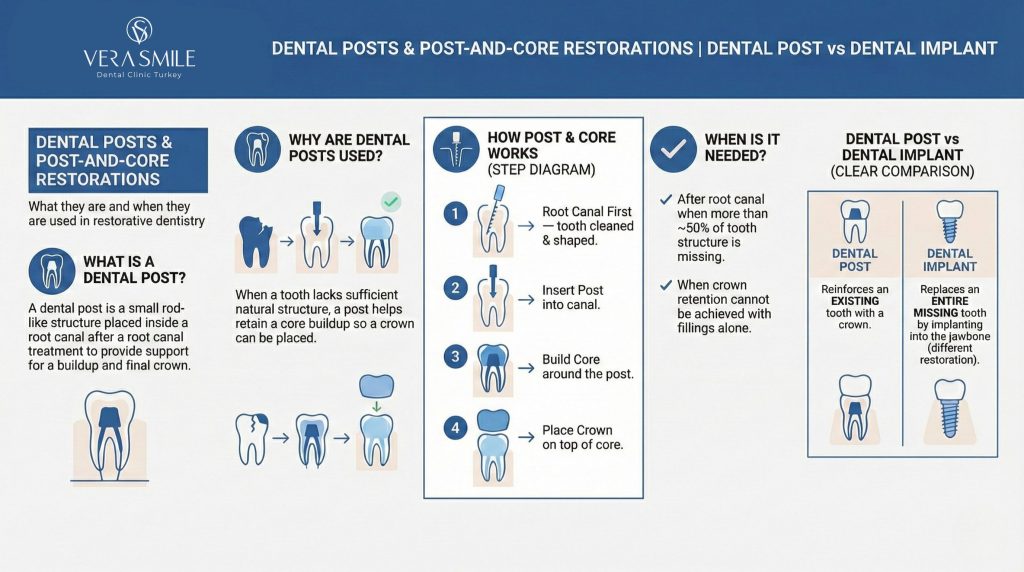
Dental post placement follows a controlled restorative sequence designed to stabilize the tooth and support a long-term crown or prosthesis. The dental post procedure begins after root canal treatment, once infection control and canal sealing are complete. The canal space is prepared to receive the post while preserving surrounding dentin for structural integrity.
The selected dental post for crowns is fitted into the prepared canal using dental cement to achieve firm retention. Proper alignment ensures even load distribution and prevents root stress. After post stabilization, a core build-up reconstructs the missing tooth structure, creating a solid foundation for the final crown.
The restoration phase concludes with crown preparation, impression capture, and crown placement. This step restores function, strength, and aesthetics, allowing the treated tooth to integrate seamlessly into the bite while maintaining long-term stability.
What Is the Procedure for Placing a Dental Post?
Dental post placement follows a structured restorative protocol designed to reinforce a tooth after root canal treatment. Each step focuses on preserving root integrity while creating a stable foundation for a crown or prosthetic restoration. Accurate execution ensures long-term strength, retention, and functional balance.
- Root Canal Completion: Dental post placement begins after root canal treatment, once the canal is sealed and infection control is confirmed.
- Canal Space Preparation: A portion of the root filling is removed to create space for the post while preserving the apical seal and surrounding dentin.
- Post Selection and Fitting: The dental post is chosen based on canal dimensions, tooth position, and restorative needs. Trial fitting ensures proper length and alignment.
- Post Cementation: The post is secured inside the canal using dental cement, creating stable retention and controlled load distribution.
- Core Build-Up: A core material is placed over the post to reconstruct missing tooth structure and form a stable base for the crown.
- Crown Preparation: The rebuilt tooth is shaped to receive the final crown, restoring strength, function, and structural continuity.
How Does a Dental Post Support a Crown or Denture?
A dental post provides internal reinforcement by anchoring deep within the treated root, creating a stable foundation for restorative structures. The post transfers biting forces from the crown or denture into the root, reducing stress on weakened tooth walls. This internal support improves retention, alignment, and load distribution, allowing the restoration to function under daily chewing forces. By stabilizing the core build-up, the dental post maintains crown or denture position and protects the remaining tooth structure from collapse or displacement.
What Cement or Adhesive Is Used With Dental Posts?
The choice of dental cement for crowns with posts depends on post material, canal conditions, and restorative demands. Resin-based cements are widely used due to high bond strength and controlled retention within the root canal. They create a strong adhesive interface between the dental post, dentin, and core material.
Glass ionomer cements serve cases requiring chemical bonding to tooth structure and moisture tolerance. They support stable fixation with simplified handling. Resin-modified glass ionomer cements combine adhesion strength with improved durability, offering balanced performance for post-supported crowns.
Cement selection focuses on bond stability, load transfer, and long-term retention, ensuring the dental post functions as a secure foundation for the final restoration.
Does Placing a Dental Post Hurt?
No. Dental post placement does not cause pain during the procedure because the tooth has already undergone root canal treatment and local anesthesia is used. Patients experience pressure or vibration rather than discomfort. After placement, mild soreness around the treated area is expected due to tissue manipulation. This sensation resolves as the surrounding structures stabilize and the restoration progresses.
Are There Allergic Reactions to Dental Posts?
Yes. Allergic reactions to dental posts occur in rare cases and are linked to metal sensitivity, particularly with nickel-containing alloys. Symptoms include localized inflammation, gum irritation, or persistent discomfort around the restored tooth. Titanium and fiber-reinforced posts present high biocompatibility and minimal allergy risk. Material selection based on medical history and sensitivity screening reduces adverse reactions and supports safe long-term restoration.
How Are Dental Posts Used in Implant Treatment?
Dental implant posts serve as the structural link between the implant fixture and the visible restoration. After the implant integrates with the jawbone, the post is positioned to extend above the gum line, creating a stable connection point for crowns, bridges, or dentures. These posts for dental implants ensure correct alignment, load transfer, and bite balance.
Implant posts support restorative precision by maintaining crown position and preventing movement under chewing forces. Their design accommodates soft tissue shaping around the implant, supporting gum contour and hygiene access. Material selection and placement accuracy directly influence long-term implant stability and functional success.
How Do Implant Posts Support Prosthetic Teeth?
Implant posts act as the load-bearing connector between the implant fixture and the prosthetic tooth. They transfer chewing forces directly into the implant body and surrounding bone, maintaining structural balance. By securing crowns, bridges, or dentures in a fixed position, implant posts preserve alignment, retention, and bite accuracy, supporting stable daily function.
Can Posts Be Used With All Implant Types?
No. Post use depends on the implant system, prosthetic design, and clinical plan. Some implant systems rely on integrated abutments, while others require separate posts to support restorations. Bone level, soft tissue height, and restoration type determine post selection. Proper system compatibility ensures mechanical stability and long-term implant performance.
Are Implant Posts Removable?
Yes. Many implant posts are designed for removal and replacement during restorative procedures. Screw-retained posts allow adjustment, repair, or crown replacement without affecting the implant fixture. Some posts are permanently cemented and remain fixed once placed. Post design selection depends on restoration type, maintenance strategy, and long-term treatment planning.
Dental Posts for Dentures: How Do They Work?
Dental posts for dentures function as anchoring elements that connect removable dentures to underlying implants, creating a stable and reliable support system. In snap on dental implants, posts extend from the implant fixtures and engage attachment mechanisms inside the denture base. This connection limits denture movement during chewing and speaking while maintaining comfort and ease of daily use. Post-supported dentures reduce gum pressure, improve bite efficiency, and enhance overall oral stability.
What Are Post-Retained Dentures?
Post-retained dentures are removable prosthetics stabilized through implant-supported posts rather than relying on suction or adhesives. Each post interfaces with a matching attachment inside the denture, locking it into position during function. This structure improves retention, chewing control, and speech clarity. Patients benefit from a secure fit that remains removable for hygiene and maintenance without compromising stability.
How Are Posts Placed for Removable Dentures?
Post placement begins after dental implants achieve full integration with the jawbone. The posts are attached to the implants and adjusted to ensure proper height and alignment. Accurate positioning supports balanced force transfer and prevents uneven pressure on the implants. Once the posts are secured, the denture is fitted with compatible attachments that snap onto the posts, creating a stable yet removable restoration designed for long-term function and comfort.
Do Posts Improve Denture Stability?
Yes. Dental posts significantly improve denture stability by anchoring the denture to implant-supported attachments rather than relying on gum contact alone. Posts reduce movement during chewing and speaking, enhance bite control, and distribute forces evenly across the implants. This stability improves comfort, confidence, and functional performance while maintaining removable convenience for daily hygiene.
How Often Do Denture Posts Need Adjustment?
Denture posts require adjustment based on wear of attachment components, bite changes, and soft tissue adaptation. Minor adjustments are typically addressed during routine dental checkups, where retention inserts or caps are replaced to maintain secure fit. Post positioning remains stable, while attachment elements experience gradual wear. Regular follow-up ensures consistent retention, comfort, and long-term prosthetic performance.
How Much Do Dental Posts Cost?
Dental post pricing varies based on clinical purpose, material type, and restorative complexity. Posts used to support crowns after root canal treatment differ in cost from implant-related posts, which require precise engineering and system compatibility. Understanding cost ranges helps clarify treatment planning and expected investment before restorative procedures.
| Dental Post Type | Purpose | Estimated Cost Range |
| Fiber-Reinforced Post | Crown support after root canal | €80 – €200 |
| Metal Dental Post | High-load crown support | €100 – €250 |
| Custom Cast Post | Complex canal anatomy | €200 – €450 |
| Dental Implant Post (Abutment) | Crown or bridge on implant | €150 – €500 |
| Posts for Implant-Supported Dentures | Snap-on denture retention | €250 – €700 |
Cost differences reflect material selection, restorative complexity, and post design precision. Implant-related posts carry higher pricing due to system-specific engineering, while standard dental posts remain more accessible for crown-supported restorations.
What Factors Affect the Cost of Dental Posts?
The cost of dental posts reflects multiple clinical and technical variables tied to restorative planning. Pricing differences arise from material selection, design requirements, and the role the post plays within the overall treatment. Each factor influences durability, precision, and long-term restorative success.
- Post Material: Material type influences pricing due to strength, biocompatibility, and manufacturing process. Metal, fiber-reinforced, and custom-cast posts carry different production values.
- Post Design and Customization: Prefabricated posts cost less than custom-designed posts. Personalized shaping and laboratory fabrication increase overall expense.
- Clinical Complexity: Teeth with limited remaining structure or complex canal anatomy require advanced preparation and precision, raising treatment cost.
- Restoration Type: Posts used for crowns differ in cost from implant-supported posts or denture-retention posts due to functional demands.
- Implant System Compatibility: Implant posts must match specific implant systems, increasing cost through proprietary design and precision engineering.
- Imaging and Planning: Radiographic evaluation and restorative planning contribute to total cost through diagnostic accuracy and risk control.
Why Does Pricing Vary Between Post Types and Procedures?
Pricing differences between dental post types and procedures reflect material engineering, procedural demand, and restorative purpose. Posts designed for simple crown support require less fabrication and chair time than implant-related or denture-retention posts. Custom fabrication, laboratory involvement, and precision fitting increase production and clinical costs.Procedural variation influences pricing through surgical complexity, planning depth, and system compatibility. Implant posts involve proprietary components and exact tolerances, raising overall expense. Each post type carries a different functional role, which directly shapes its cost structure and treatment value.