
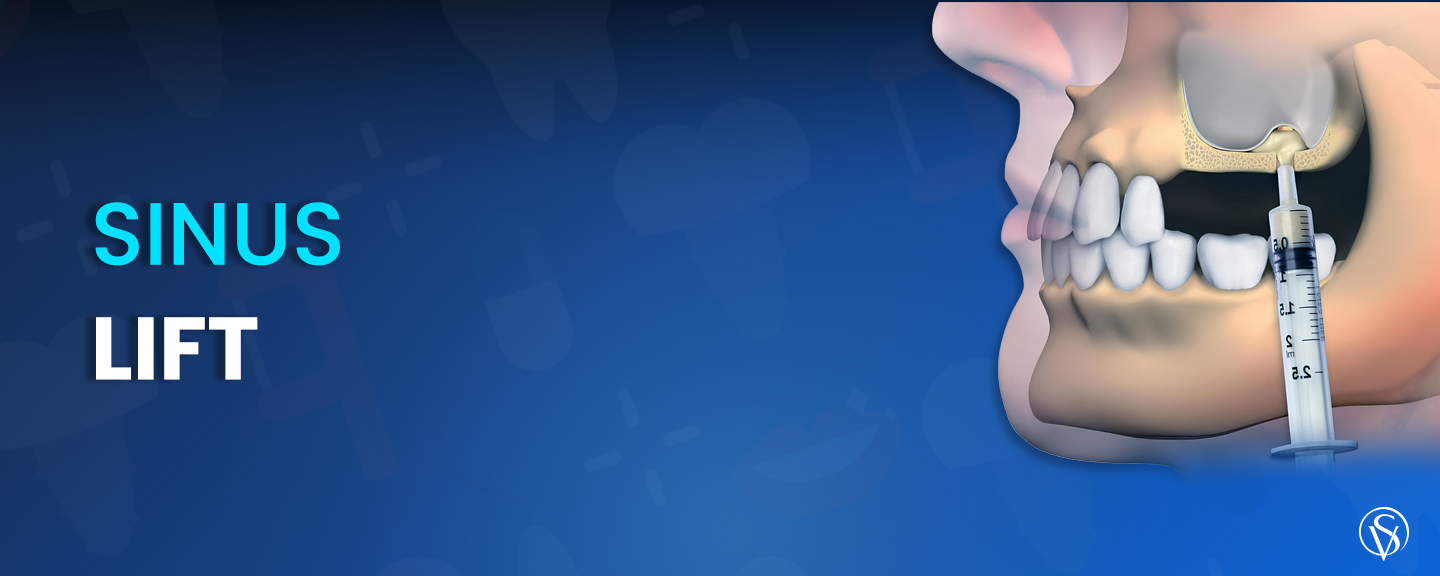
A sinus lift is a surgical technique used in implant dentistry to increase bone height in the upper jaw when natural bone volume no longer supports secure dental implants. The procedure focuses on the anatomical relationship between the upper back teeth and the maxillary sinus, an air-filled cavity located above the molars and premolars.
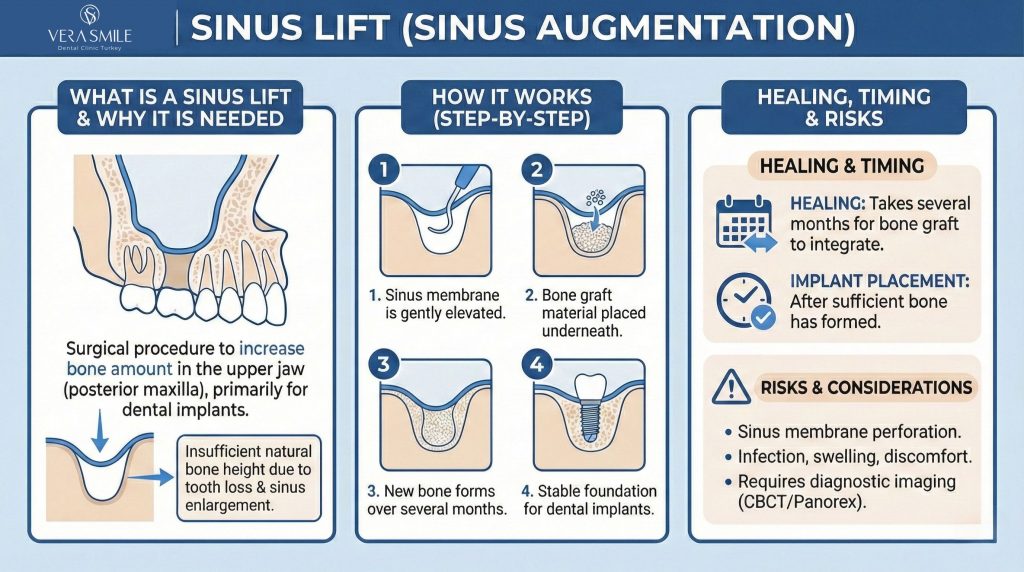
Following tooth loss in the upper jaw, two structural changes occur in parallel: alveolar bone resorption and downward expansion of the sinus floor. As bone volume decreases, the remaining distance between the oral cavity and the sinus becomes inadequate for implant anchorage. Sinus lift surgery corrects this limitation by elevating the sinus membrane and creating a protected space where new bone develops.
A dental sinus lift exists to restore vertical bone volume required for predictable implant stability and osseointegration. Without sufficient bone height, implants lack mechanical support and long-term reliability in the posterior maxilla. The procedure rebuilds the anatomical foundation needed for load-bearing implant placement rather than relying on compromised positioning.
By reconstructing bone beneath the sinus cavity, a sinus lift converts anatomically unsuitable areas into stable implant sites designed for permanent tooth replacement.
What Is a Sinus Lift in Dentistry?
In dentistry, what is a sinus lift refers to a surgical procedure that increases bone volume in the upper jaw beneath the maxillary sinus to support dental implant placement. The treatment targets areas where natural bone height no longer provides structural stability for implants.
What is sinus lift surgery in a dental context centers on the elevation of the sinus membrane rather than removal of sinus tissue. During the procedure, the membrane lining the sinus cavity is gently repositioned upward, creating a compartment where bone graft material is placed. Over time, this graft integrates with existing bone, forming a dense foundation suitable for implants.
When asked what is a sinus lift in dentistry, the clinical definition focuses on restoring lost vertical bone height in the posterior maxilla rather than treating sinus disease. The procedure functions as a preparatory step for implant therapy, addressing anatomical limitations created by tooth loss and sinus expansion. Its role remains structural, surgical, and restorative rather than cosmetic or sinus-related.
What Is a Sinus Lift and How Does It Increase Bone Height?
A sinus lift is a surgical method that increases vertical bone height in the upper jaw by repositioning the maxillary sinus membrane and introducing bone material beneath it. The procedure creates new structural space between the sinus cavity and the jawbone, allowing controlled bone formation.
Bone height increases through a biological process triggered by bone graft placement. Once the sinus membrane is elevated, graft material occupies the newly created space. This material serves as a scaffold that supports bone regeneration and integration with existing maxillary bone. As healing progresses, the grafted area transforms into dense, load-bearing bone capable of supporting dental implants.
The increase in bone height results from deliberate anatomical reconstruction rather than compression or reshaping of existing bone. By relocating the sinus lining upward and stabilizing the grafted region, a sinus lift restores the vertical dimension required for secure implant anchorage in the posterior upper jaw.
Is a Sinus Lift the Same as a Bone Graft?
A sinus lift and a bone graft are related procedures, though they serve different surgical roles. A sinus lift describes the anatomical technique used to elevate the maxillary sinus membrane, while a bone graft refers to the material placed to rebuild lost bone.
During sinus lift surgery, a bone graft becomes part of the process, yet the two terms are not interchangeable. The sinus lift defines the method of accessing and preparing the sinus floor, whereas the bone graft provides the biological framework that enables new bone formation. Without sinus membrane elevation, graft material lacks the vertical space required for bone development beneath the sinus cavity.
In dental implant planning, a sinus lift represents a site-specific augmentation procedure, while bone grafting functions as the regenerative component. Together, they restore bone volume in the upper jaw, though each fulfills a distinct clinical purpose.
Which Upper Teeth Commonly Require a Sinus Lift?
A sinus lift is most frequently associated with dental implant placement in the upper posterior jaw, where natural bone height is limited by the maxillary sinus. The teeth involved sit directly beneath the sinus cavity, creating anatomical constraints after tooth loss.
The upper first and second molars represent the most common teeth linked to sinus lift surgery. These molars occupy the deepest sinus-adjacent region of the maxilla, where bone resorption progresses rapidly following extraction. Upper premolars, particularly the second premolar, present similar requirements when bone height falls below implant stability thresholds.
Anterior teeth rarely require a dental sinus lift due to greater native bone density and distance from the sinus floor. Sinus lift procedures focus on restoring implant-ready bone in areas where posterior tooth loss and sinus expansion intersect.
Why Is a Sinus Lift Required for Dental Implants?
A sinus lift for dental implants is required when the upper jaw lacks sufficient bone height to secure an implant safely. After tooth loss, the posterior maxilla undergoes bone resorption while the maxillary sinus expands downward, reducing the vertical space needed for implant anchorage.
A dental implant sinus lift restores this lost dimension by creating bone volume between the sinus cavity and the jaw. Implants placed without adequate bone support face instability, poor load distribution, and long-term failure risk. The implant sinus lift addresses these structural limitations before implant placement begins.
Sinus lift surgery establishes a stable foundation by reconstructing the implant site rather than adapting the implant to compromised anatomy. This approach ensures predictable osseointegration and preserves the functional integrity of implants placed in the upper posterior region.
When Is a Sinus Lift Necessary Before Implant Surgery?
A sinus lift becomes necessary before implant surgery when upper jaw bone height falls below implant stability requirements. This situation develops after tooth extraction, long-term edentulism, or advanced periodontal bone loss in the posterior maxilla.
Insufficient vertical bone between the alveolar ridge and the maxillary sinus floor prevents safe implant placement at functional lengths. Radiographic evaluation reveals reduced bone volume, sinus pneumatization, or irregular sinus floor anatomy that limits surgical depth.
Sinus lift planning takes place before implant insertion when structural support cannot sustain primary implant fixation. By restoring bone height prior to surgery, the implant site meets biomechanical demands required for long-term success.
How Much Bone Height Is Needed to Avoid a Sinus Lift?
Avoiding a sinus lift depends on the amount of existing vertical bone height in the upper posterior jaw. Dental implant planning relies on measurable thresholds rather than approximation.
A minimum of 8–10 mm of native bone height supports standard-length implant placement without sinus floor elevation. Measurements below this range limit implant stability and increase risk during drilling near the maxillary sinus.
Cone beam CT imaging provides precise assessment of bone volume and sinus position. When available bone height meets structural requirements, implant placement proceeds without sinus augmentation.
Does Every Patient Getting Upper Implants Need a Sinus Lift?
No. Not every patient receiving upper dental implants requires a sinus lift. The indication depends on existing bone height, sinus floor position, and overall maxillary anatomy rather than implant location alone.
Patients with sufficient vertical bone between the alveolar crest and the maxillary sinus proceed with implant placement without sinus elevation. Preserved bone volume following recent tooth loss and favorable sinus anatomy remove the need for augmentation.
A sinus lift enters the treatment plan only when bone height fails to meet structural requirements for stable implant fixation.
How Is a Sinus Lift Procedure Performed Step by Step?
A sinus lift procedure follows a structured surgical sequence designed to increase upper jaw bone height beneath the maxillary sinus. Each stage focuses on precision, anatomical control, and predictable bone regeneration.
- Step 1: Diagnostic Imaging and Surgical Planning: Cone beam CT imaging identifies existing bone height, sinus boundaries, and membrane position. This evaluation determines the sinus lift surgery approach and graft volume.
- Step 2: Surgical Access to the Sinus Floor: A small incision exposes the lateral or crestal sinus wall. The surgeon creates a controlled window to reach the sinus membrane without damaging surrounding structures.
- Step 3: Sinus Membrane Elevation: The Schneiderian membrane is gently lifted upward, forming a protected space between the sinus cavity and the jawbone.
- Step 4: Bone Graft Placement: Graft material fills the newly created space beneath the elevated membrane. This step initiates bone regeneration and structural height increase.
- Step 5: Site Closure and Healing Phase: The surgical area is closed and stabilized. Healing allows the grafted region to mature into implant-supporting bone before implant placement or integration.
Why Is a CBCT Scan Required Before a Sinus Lift?
A CBCT scan is required before a sinus lift because it delivers three-dimensional evaluation of bone height, sinus anatomy, and membrane position. Precise imaging defines surgical boundaries and prevents blind intervention near the sinus cavity.
CBCT data reveals sinus floor contours, septa presence, and residual alveolar bone thickness. This information guides selection of the sinus lift procedure type and determines graft volume with anatomical accuracy.
Without CBCT assessment, sinus lift surgery lacks spatial predictability. Advanced imaging establishes a controlled surgical plan that protects the sinus membrane and supports consistent clinical outcomes.
What Is a Lateral Window Sinus Lift?
A lateral window sinus lift is a sinus augmentation technique that increases bone height by accessing the maxillary sinus through the side wall of the upper jaw. This approach targets cases with pronounced vertical bone deficiency in the posterior maxilla.
During the procedure, a small bony window is created on the lateral sinus wall to expose the sinus membrane. The membrane is elevated upward, forming a protected compartment between the sinus cavity and the jawbone. Bone graft material is then placed into this space to restore lost vertical dimension.
The lateral window sinus lift provides direct visibility and controlled membrane elevation. This method supports substantial bone reconstruction in implant sites where residual bone height falls below standard implant requirements.
When Is a Lateral Sinus Lift Preferred Over Other Techniques?
A lateral sinus lift is preferred when residual bone height measures severely reduced, below implant stability thresholds. This condition limits the use of less invasive sinus elevation techniques.
Cases involving advanced sinus pneumatization, irregular sinus floor anatomy, or large vertical deficiencies favor the lateral approach due to direct surgical access and enhanced visual control. The technique supports placement of greater graft volume while maintaining membrane integrity.
Lateral sinus lift selection aligns with complex posterior maxillary reconstruction where predictable bone height restoration defines implant success.
How Much Bone Can Be Gained With a Lateral Sinus Lift?
A lateral sinus lift achieves a vertical bone height gain of up to 8–10 mm, depending on sinus anatomy and graft volume. This increase supports placement of standard-length dental implants in the posterior upper jaw.
Bone gain results from controlled sinus membrane elevation and stable graft containment beneath the sinus floor. The regenerated bone integrates with existing maxillary structure, creating a load-bearing foundation for implant placement.
The lateral approach delivers predictable height restoration in cases with severe preoperative bone deficiency.
What Is an Indirect (Crestal) Sinus Lift?
An indirect sinus lift, known as a crestal sinus lift, is a minimally invasive technique that increases bone height through the implant osteotomy site rather than a lateral access window. This method targets mild to moderate bone height deficiency in the upper posterior jaw.
The procedure begins from the crest of the alveolar ridge, where the sinus floor is gently elevated using specialized instruments. The sinus membrane is lifted upward through controlled pressure, creating limited vertical space for bone graft placement.
Indirect sinus lift procedures support modest bone height enhancement and align with implant placement in cases where residual bone height approaches stability requirements.
Is an Indirect Sinus Lift Less Invasive Than a Lateral One?
Yes. An indirect sinus lift involves access through the implant site rather than the lateral sinus wall, resulting in reduced surgical exposure. The technique limits soft tissue disruption and preserves surrounding bone structures.
This approach suits cases with sufficient residual bone that supports controlled sinus membrane elevation without extensive reconstruction. Surgical trauma remains minimal due to the crestal entry point and limited graft volume.
Can Dental Implants Be Placed Immediately With a Crestal Sinus Lift?
Yes. Dental implants are placed during the same surgical session when primary stability is achieved following a crestal sinus lift. This protocol depends on existing bone height and implant anchorage quality.
Immediate placement integrates sinus elevation and implant insertion into a single procedure. This strategy maintains treatment efficiency while preserving structural integrity at the implant site.
What Is the Difference Between Vertical and Lateral Sinus Lift Techniques?
The following table outlines the key clinical differences between vertical and lateral sinus lift techniques, focusing on surgical access, bone height gain, and treatment indication. This comparison supports precise technique selection based on existing bone volume and implant stability requirements rather than procedural preference.
| Criteria | Vertical Sinus Lift | Lateral Sinus Lift |
| Surgical access | Through the crest of the alveolar ridge | Through the lateral wall of the maxilla |
| Alternative name | Indirect or crestal approach | Lateral window approach |
| Bone height gain | Limited vertical increase | Significant vertical increase |
| Residual bone requirement | Moderate existing bone height | Severe bone height deficiency |
| Graft volume | Small, localized graft | Larger graft volume |
| Implant placement timing | Same-session placement when stability is achieved | Delayed placement in most cases |
| Indication severity | Mild to moderate bone loss | Advanced posterior maxillary bone loss |
| Surgical visibility | Limited direct visualization | Full visual control of sinus membrane |
This comparison highlights how vertical sinus lift techniques focus on conservative augmentation, while lateral sinus lift procedures address complex bone reconstruction needs in the upper posterior jaw.
What Bone Graft Materials Are Used in Sinus Lift Surgery?
Sinus lift surgery relies on bone graft materials that create stable volume beneath the elevated sinus membrane and support new bone formation. Each graft type serves a defined clinical purpose based on biological behavior and structural needs.
- Autogenous Bone grafts: Bone harvested from the patient’s own body, commonly from the jaw or intraoral sites. This material integrates rapidly due to living bone cells and growth factors, making it a strong option for predictable regeneration.
- Allogeneic Bone Grafts: Processed human donor bone sourced from tissue banks. These grafts provide a natural bone matrix that supports regeneration without requiring a second surgical site.
- Xenogeneic Bone Grafts: Bone derived from animal sources, most commonly bovine. Xenografts maintain volume stability over time and act as long-lasting scaffolds within the sinus cavity.
- Synthetic Bone Substitutes:Laboratory-produced materials such as calcium phosphate or hydroxyapatite. These grafts deliver controlled resorption rates and structural consistency for sinus lift and bone graft procedures.
Material selection during a sinus lift bone graft aligns with bone volume needs, healing dynamics, and implant planning objectives rather than a single universal standard.
What Types of Bone Grafts Are Used for a Sinus Lift?
Bone grafts used for a sinus lift fall into defined biological categories based on origin and regenerative behavior. Each type supports bone height restoration beneath the elevated sinus membrane.
- Autografts: Bone taken from the patient’s own body. Autografts provide living bone cells and natural growth factors that promote direct bone formation.
- Allografts: Human donor bone processed for medical use. Allografts act as a natural scaffold that supports new bone growth without a secondary harvest site.
- Xenografts: Animal-derived bone, commonly bovine in origin. Xenografts maintain structural volume and support gradual bone replacement within the sinus cavity.
- Alloplasts: Synthetic graft materials such as calcium phosphate or hydroxyapatite. Alloplasts deliver consistent structure and controlled integration for sinus augmentation procedures.
Selection of graft type during sinus lift surgery aligns with anatomical conditions, regeneration goals, and implant stability requirements.
How Does Bone Heal and Integrate After a Sinus Lift?
Bone healing after a sinus lift follows a structured biological sequence that transforms graft material into a functional jawbone. Once placed beneath the elevated sinus membrane, the graft stabilizes the space and supports cellular activity from surrounding bone.
Blood supply from the native maxilla delivers osteogenic cells that migrate into the grafted area. These cells deposit a new bone matrix, gradually replacing or integrating with the graft scaffold. As mineralization progresses, the augmented region gains density and load-bearing strength suitable for dental implant support.
Successful integration depends on graft stability, membrane integrity, and controlled healing conditions rather than rapid remodeling.
How Long Does Bone Graft Take to Heal After a Sinus Lift?
Bone graft healing after a sinus lift requires 4 to 9 months, depending on graft material type and initial bone volume. This period allows mineralized bone formation and structural maturation within the sinus floor.
Radiographic evaluation confirms graft consolidation before implant placement. Healing completion ensures the augmented bone withstands functional forces and supports long-term implant stability.
What Is the Sinus Lift Recovery Timeline?
The sinus lift recovery timeline progresses through defined healing phases that reflect soft tissue repair and bone regeneration beneath the sinus membrane. Each stage carries distinct clinical expectations.
- First 72 hours: Swelling and pressure sensations appear around the upper jaw and cheek region. The surgical site remains protected while early tissue sealing begins.
- First 2 weeks: Soft tissue healing stabilizes the incision area. Discomfort reduces, and normal daily activity resumes without strain on the sinus region.
- Weeks 3 to 8: Bone regeneration accelerates within the grafted sinus floor. External symptoms diminish while internal healing continues.
- Months 4 to 9: Grafted bone matures into dense, load-bearing structure. This phase defines readiness for implant placement based on radiographic assessment.
The sinus lift surgery recovery experience follows biological healing rather than subjective comfort, with bone integration marking the final milestone.
What Is Normal During the First 72 Hours After Sinus Lift Surgery?
The first 72 hours after sinus lift surgery involve predictable post-surgical responses related to tissue manipulation and sinus membrane elevation. Patients experience facial pressure, mild discomfort in the upper jaw, and limited nasal sensitivity as the surgical site stabilizes.
Localized swelling, minor bruising near the cheek area, and a sensation of fullness beneath the sinus floor reflect normal inflammatory response. The grafted region remains protected while early soft tissue healing begins. Nasal congestion without discharge aligns with sinus membrane repositioning rather than infection.
Is Swelling Normal After a Sinus Lift?
Yes. Sinus lift swelling represents a normal response to surgical elevation of the sinus membrane and bone graft placement. Sinus lift surgery swelling appears in the cheek and upper jaw region, reaching peak intensity within the first two to three days.
Swelling reflects increased blood flow and tissue response at the surgical site. Gradual reduction signals progression toward stable healing.
Can You Sleep Flat After Sinus Lift Surgery?
No. Sleeping flat after sinus lift surgery increases pressure in the sinus region and intensifies swelling. An elevated head position supports fluid drainage and reduces postoperative discomfort. Elevation during rest protects the grafted area and promotes controlled healing during the early recovery phase.
What Should You Expect Two Weeks After a Sinus Lift?
At 2 weeks after a sinus lift, soft tissue healing reaches a stable phase and visible facial changes subside. The surgical incision closes fully, and tenderness in the upper jaw decreases significantly.
The grafted sinus area remains in active internal healing, though external symptoms no longer dominate daily comfort. Sinus pressure sensations reduce, and chewing returns to normal within non-stress limits.
When Does Swelling Peak After Sinus Lift Surgery?
Swelling peaks 48 to 72 hours after sinus lift surgery. This period reflects the height of inflammatory response following sinus membrane elevation and bone graft placement. After the peak, swelling declines steadily as tissue repair advances and fluid accumulation resolves.
When Can Normal Activities Resume After a Sinus Lift?
Light daily activities resume within 7 to 10 days after surgery once swelling and discomfort diminish. Physical exertion involving bending or heavy lifting resumes after soft tissue stabilization and clinical clearance. Activity progression aligns with healing status rather than subjective comfort, ensuring protection of the grafted sinus region.
How Long After a Sinus Lift Can Dental Implants Be Placed?
Dental implants are placed 4 to 9 months after a sinus lift, depending on graft material integration and initial bone volume. This interval allows the grafted region to transform into dense, implant-supporting bone. Radiographic assessment confirms bone maturity before implant insertion. Adequate mineralization and structural stability define the timing rather than elapsed weeks alone.In selected cases with sufficient residual bone and strong primary stability, implant placement occurs during the same surgical session as sinus elevation.
Does a Sinus Lift Cause Swelling, Pain, or Facial Changes?
A sinus lift leads to temporary swelling after sinus lift surgery due to surgical manipulation of the upper jaw and sinus membrane. Swelling concentrates around the cheeks and upper facial area, reflecting localized inflammatory response rather than permanent structural alteration. Pain levels remain controlled and short-lived, linked to soft tissue response rather than bone remodeling. As healing advances, facial contours return to baseline while internal bone regeneration continues.
Does a Sinus Lift Change Facial Appearance?
No. A sinus lift does not alter facial structure or shape. The procedure increases bone volume inside the upper jaw beneath the sinus floor, leaving external facial anatomy unchanged. Any visible difference following surgery reflects sinus lift swelling rather than skeletal modification. Once swelling resolves, facial appearance matches the preoperative state.
Why Do Sinus Lift Before and After Face Photos Look Different?
Sinus lift before and after face photos show differences due to postoperative swelling, camera angle, and lighting variation rather than facial transformation. Early images capture soft tissue response in the cheek region during the healing phase. As swelling subsides, sinus lift before and after face comparisons align closely, confirming that the procedure affects internal bone volume without influencing facial aesthetics.
Are Facial Changes After Sinus Lift Permanent?
No. Facial changes observed after a sinus lift are temporary and linked to postoperative swelling rather than bone or facial structure alteration. The procedure modifies bone volume inside the upper jaw beneath the sinus floor, not the external facial framework. As swelling resolves during recovery, facial appearance returns to baseline. Long-term facial contours remain unchanged once healing stabilizes and internal bone integration completes.
What Are the Possible Sinus Lift Complications?
Sinus lift surgery carries defined risks related to sinus anatomy and healing dynamics. Each complication category reflects a specific surgical or biological factor rather than procedural failure.
- Sinus Membrane Perforation: Tearing of the Schneiderian membrane during elevation. This event affects graft containment and requires immediate surgical management.
- Postoperative Infection: Bacterial contamination within the grafted sinus space. Symptoms include persistent swelling, pressure, or discharge beyond expected healing patterns.
- Prolonged Swelling or Discomfort: Extended inflammatory response in the cheek and upper jaw region. This condition reflects delayed tissue resolution rather than structural damage.
- Graft Integration Delay: Slower bone formation within the augmented sinus floor. Radiographic monitoring identifies integration progress before implant placement.
- Sinus Irritation or Congestion: Temporary sinus sensitivity linked to membrane elevation and internal pressure changes. Resolution follows stabilization of the grafted area.
These sinus lift complications remain infrequent under controlled surgical planning, with long-term side effects limited when healing progresses as expected.
What Are the Signs of Infection After a Sinus Lift?
Identifying signs of infection after sinus lift surgery depends on recognizing deviations from normal healing patterns rather than temporary discomfort.
- Persistent Facial Swelling: Swelling that intensifies or remains unchanged after the initial recovery phase signals inflammatory imbalance.
- Escalating Pain Levels: Pain that increases instead of diminishing suggests bacterial involvement rather than routine healing.
- Purulent Nasal Discharge: Thick, discolored drainage from the nasal passage on the treated side indicates infection within the sinus space.
- Unpleasant Odor or Taste: Noticeable smell or taste changes reflect microbial activity in the grafted region.
- Sustained Fever: Elevated body temperature that persists beyond early healing requires immediate clinical assessment.
When Should You Contact a Dentist After Sinus Lift Surgery?
You should contact a dentist after sinus lift surgery when recovery signs move outside expected healing patterns. Early communication protects the grafted sinus area and prevents complication progression.
- Increasing Facial Swelling: Swelling that intensifies after the initial recovery phase or fails to reduce.
- Rising Pain Intensity: Pain that escalates rather than declines over time.
- Nasal Discharge with Odor or Discoloration: Drainage from the nasal passage on the treated side that signals infection.
- Persistent Fever: Body temperature that remains elevated beyond normal postoperative response.
- Sudden Pressure or Fluid Movement Sensation: Unusual sinus pressure changes that suggest membrane disruption.
Prompt evaluation ensures surgical stability and preserves long-term implant outcomes.
What Are the Symptoms of a Failed Sinus Lift?
The symptoms of a failed sinus lift reflect instability of the grafted area or loss of sinus membrane integrity rather than routine healing responses.
- Persistent Graft-Site Pain: Pain that continues beyond the expected recovery phase or increases over time.
- Chronic Sinus Pressure: Ongoing fullness or heaviness beneath the cheekbone that does not subside.
- Recurrent Nasal Drainage: Fluid passage through the nose on the treated side, linked to graft migration or membrane disruption.
- Delayed Bone Formation on Imaging: Radiographic scans showing insufficient bone density within the lifted sinus floor.
- Implant Instability or Non-Placement: Lack of structural support that prevents implant anchorage at the planned site.
Can a Failed Sinus Lift Be Treated or Repeated?
Yes. A failed sinus lift can be treated or repeated once the underlying cause is clearly identified. Management begins with a cause-based reassessment that examines sinus membrane integrity, graft integration status, and overall sinus health through clinical evaluation and imaging.
A defined healing interval before retreatment allows inflammation to resolve and soft tissues to stabilize, creating a safer surgical environment. Re-grafting with an adjusted technique follows, using refined surgical access or alternative graft materials to improve structural predictability. Staged implant planning ensures implant placement occurs only after confirmed bone regeneration, supporting long-term stability and functional success.
How Much Does a Sinus Lift Cost?
Below is a structured cost overview to clarify how much a sinus lift costs based on procedure type and clinical scope.
| Sinus Lift Type | Typical Cost Range | What the Cost Reflects |
| Indirect (Crestal) Sinus Lift | €300 – €800 | Limited bone elevation, smaller graft volume, shorter surgical time |
| Lateral Window Sinus Lift | €800 – €2,000 | Advanced surgical access, larger graft volume, complex membrane elevation |
| Sinus Lift With Bone Graft | €900 – €2,500 | Graft material type, regeneration period, surgical precision |
| CBCT Imaging & Planning | €100 – €300 | 3D sinus assessment, bone height measurement, risk evaluation |
| Sinus Lift as Implant Preparation | Case-dependent | Pre-implant surgical stage, calculated separately from implant placement |
This table answers how much is a sinus lift by separating procedural components rather than presenting a single bundled figure, which improves cost transparency and treatment accuracy.
What Factors Affect the Cost of Sinus Lift Surgery?
The cost of a sinus lift surgery depends on multiple clinical and procedural variables rather than a fixed price. Understanding these factors helps patients anticipate expenses, compare treatment plans, and make informed decisions about dental sinus lift procedures. Each element of the surgery, from anatomy to graft materials, directly influences the overall cost and complexity.
- Sinus Anatomy and Membrane Thickness: Influences the surgical approach and the time required for safe membrane elevation.
- Existing Bone Height: Determines the volume of graft material needed and the complexity of the technique.
- Type of Sinus Lift Procedure: Crestal or lateral window approaches affect operative difficulty and resource use.
- Bone Graft Material Choice: Different materials vary in sourcing, processing, and biological performance, impacting cost.
- Pre-Surgical Imaging and Planning: CBCT scans and detailed planning ensure precision and reduce surgical risks, adding to the procedure cost.
- Postoperative Monitoring: Follow-up visits and imaging to verify healing and graft integration contribute to total cost.
Why Does Sinus Lift Pricing Vary Between Patients?
The cost of a sinus lift is not uniform because every patient’s anatomy, bone condition, and overall health create unique surgical requirements. Understanding why sinus lift pricing differs helps patients anticipate expenses, compare treatment options, and select a plan that matches both clinical needs and financial expectations. Factors from bone height to clinic standards all contribute to the variation in cost.
- Individual Sinus Anatomy: Differences in sinus cavity size, shape, and membrane condition influence surgical planning and resource needs.
- Residual Bone Height: Patients with minimal existing bone require larger graft volumes or more complex procedures, increasing cost.
- Health and Healing Factors: Systemic health, bone density, and healing capacity affect the choice of graft material and treatment staging.
- Treatment Staging: Some patients need a staged approach, with grafting first and implant placement later, which increases overall expenses.
- Clinical Expertise and Technology: Clinics with advanced imaging, precision tools, and highly experienced surgeons may charge more due to higher quality standards.
- Customized Treatment Planning: Personalized surgical approaches, including preoperative CBCT assessment and tailored graft selection, create variability in pricing between patients.
What Is the ADA Dental Code for Sinus Lift Surgery?
The ADA dental code for a sinus lift surgery is D7952, which refers to a surgical procedure that elevates the sinus membrane and places bone graft material to increase bone height for dental implant support. Understanding the proper sinus lift ADA code ensures accurate documentation, billing, and insurance processing.
What Is the Difference Between ADA Codes D7951 and D7952?
Understanding the difference between ADA codes D7951 and D7952 is essential for accurate dental documentation, billing, and insurance claims related to sinus lift surgery. The two codes distinguish whether a sinus augmentation is performed as a preparatory procedure alone or combined with implant placement in the same session, reflecting differences in surgical complexity, resources, and treatment planning.
D7951 – Sinus Augmentation with Bone Graft: This code applies to sinus augmentation procedures using grafting material without a simultaneous implant placement. It is reserved for cases where the sinus lift is performed as a preparatory step for future implant placement.
D7952 – Sinus Augmentation with Bone Graft, Including Implant Placement: D7952 applies when the sinus lift procedure is combined with implant placement during the same surgical session. This code reflects higher complexity and increased surgical resources.
Does Insurance Cover Sinus Lift Procedures?
Yes. Insurance can cover a sinus lift if the procedure is deemed medically necessary to support dental implants. Coverage depends on the patient’s specific plan, surgical classification, and documentation of bone deficiency or other clinical indications. Some plans reimburse a portion of the cost under surgical or implant-related benefits. Using the correct sinus lift dental code (D7952 or D7951) ensures proper billing and increases the likelihood of claim approval.
Can Sinus Lift Problems Appear Years After Surgery?
Yes. Some sinus lift complications may appear long after surgery, particularly if graft integration was incomplete or the sinus membrane was compromised. Late issues include graft resorption, sinus infections, or implant instability. Regular follow-up imaging and monitoring of dental implants help detect changes early, ensuring long-term success.
Does a Sinus Lift Affect Sinus Pressure, Breathing, or Speech?
No. When performed correctly, a sinus lift does not alter sinus function, breathing, or speech. Temporary sinus pressure or congestion may occur during healing, but it resolves as inflammation subsides. Long-term sinus function remains normal, and dental implant support improves oral stability without affecting respiration or vocalization.
Is Sinus Lift Surgery Safe for Older Adults?
Yes. Age alone does not prevent a safe sinus lift procedure. Older adults with healthy sinus anatomy and controlled medical conditions can undergo sinus lift surgery successfully. Preoperative evaluation, including CBCT imaging and systemic health assessment, ensures proper planning and reduces surgical risk while supporting dental implant placement.