
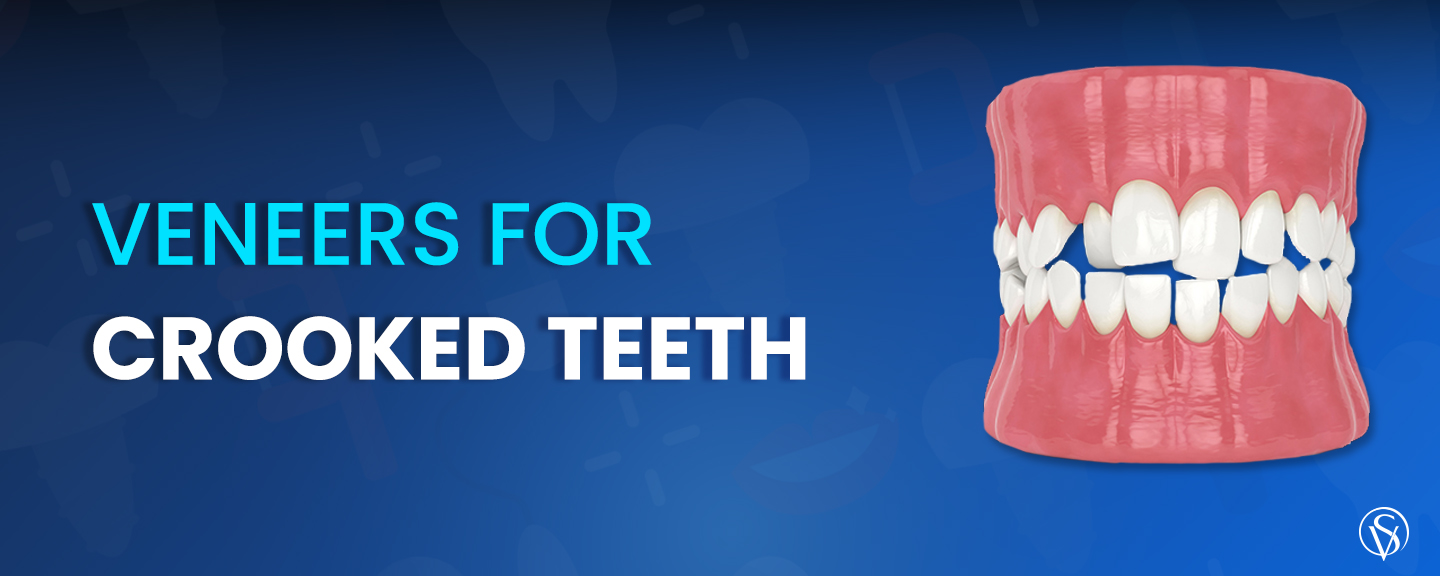
Veneers correct mild to moderate crooked teeth by reshaping the visible enamel surface rather than repositioning the roots. Thin porcelain or composite shells are bonded to the front of each tooth, producing the appearance of a straight, symmetrical smile within 5–10 days. The treatment is a cosmetic alignment solution, not an orthodontic one, and it suits patients whose misalignment is restricted to crowding, rotation, spacing, or edge irregularity rather than skeletal or bite issues. About 2.3 million patients worldwide receive porcelain veneers each year, and a growing share involves cosmetic correction of mildly misaligned teeth rather than discoloration alone. In Turkey, the per-tooth price ranges between €250 and €1,500 depending on material. Suitability is confirmed through clinical and radiographic examination, and in complex cases short-cycle aligner therapy precedes veneer placement rather than replacing it.
What Are Veneers for Crooked Teeth?
Veneers for crooked teeth are thin porcelain, lithium disilicate, or composite shells bonded to the front surface of the tooth to create the appearance of straight alignment. They mask rotation, overlap, gaps, and edge irregularity by reshaping the visible facial surface without moving the underlying root within the bone.
This treatment falls under cosmetic dentistry rather than orthodontics. The aim is visual harmony and proportional balance, not bite correction or jaw repositioning. Each shell is designed using Digital Smile Design (DSD) principles, which calculate tooth width, length, and incisal edge position relative to the lip line and facial midline before any enamel is touched.
Three veneer materials are used clinically for alignment correction. Composite veneers are layered directly chairside from resin and handle only minor angular adjustments. Feldspathic porcelain is a layered ceramic with high translucency suited to anterior cosmetic refinement. Lithium disilicate (E.max) is a pressed glass-ceramic with the highest fracture resistance among veneer materials, preferred for patients with mild functional load alongside cosmetic correction. Material choice is driven by case complexity, occlusal load, and the degree of visual rotation that needs masking.
How Is a Veneer Different from a Dental Crown for Crooked Teeth?
A veneer covers only the front surface of the tooth, requiring 0.3–0.7 mm of enamel reduction, while a crown encases the entire tooth and removes 1.5–2 mm of structure on all sides. Veneers preserve more natural tissue and apply when the underlying tooth is structurally intact. Crowns become necessary when the tooth has extensive decay, large fillings, or root canal treatment.
How Do Veneers Straighten Crooked Teeth Without Moving Them?
Veneers straighten crooked teeth visually by altering the angle, width, and edge position of each tooth’s facial surface, producing a uniform alignment line without changing root position in the bone. The dentist removes a thin layer of enamel from prominent areas, builds out recessed areas with veneer thickness, and uses uniform incisal edges to create a continuous smile line.
Four mechanical principles drive the correction:
- Surface reshaping: Selective enamel reduction of 0.3–0.7 mm is performed on protruding teeth so the bonded veneer sits flush with adjacent teeth.
- Angle masking: A rotated tooth is covered with a veneer whose facial contour is angled to align with neighbours, hiding rotation by up to 15–20°.
- Width balancing: A wider veneer compensates for spacing irregularities or closes a tooth gap of up to 2 mm without orthodontic movement.
- Incisal edge unification: The lower edges of the veneers are fabricated to a single horizontal plane, eliminating the visual stepping caused by uneven tooth heights.
The root remains in its original alveolar position throughout the procedure, the bite is unchanged, and only the visible front surface presented when the patient smiles is altered.
Who Is Suitable for Veneers on Crooked Teeth?
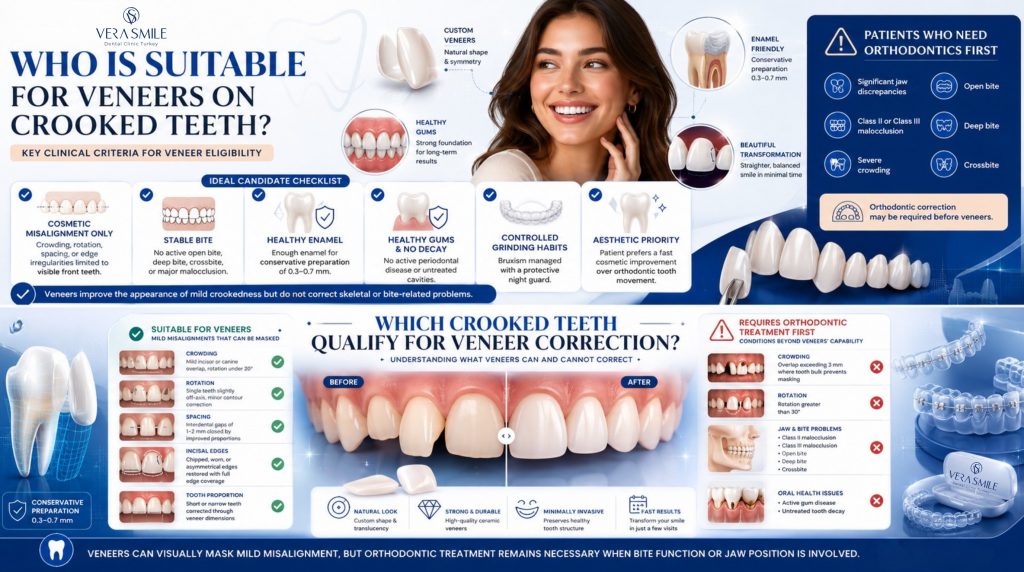
The ideal candidate for veneers on crooked teeth has cosmetic misalignment confined to the visible front teeth, a stable bite, and healthy enamel and gums. Veneers do not treat skeletal or bite-related crookedness, and suitability is confirmed during a clinical and radiographic examination. The criteria below define who qualifies.
- Cosmetic misalignment only: Crowding, rotation, spacing, or edge irregularity restricted to the front teeth, with no skeletal or jaw involvement.
- Stable bite: No active malocclusion, open bite, deep bite, or crossbite that would place abnormal load on the veneers.
- Healthy enamel: Sufficient enamel thickness to support 0.3–0.7 mm reduction without exposing dentine or weakening the tooth.
- Healthy gums and no active decay: No untreated periodontal disease or caries, both of which must be resolved before placement.
- Controlled grinding habits: Bruxism is managed with a night guard, since uncontrolled clenching shortens veneer lifespan and raises fracture risk.
- Aesthetic priority: The patient values a fast, visible cosmetic result over root-level repositioning of the teeth.
Patients who fall outside these criteria, particularly those with bite or jaw involvement, need orthodontic correction first, with veneers used afterward for aesthetic refinement.
Which Crooked Teeth Qualify for Veneer Correction?
Veneers suit misalignment confined to the visible front teeth where enamel masking can restore alignment without compromising structure. The table below sets out which conditions qualify and which require orthodontic correction first.
| Condition | Suitable for Veneers | Unsuitable for Veneers |
|---|---|---|
| Crowding | Mild incisor or canine overlap with rotation under 20° | Overlap exceeding 3 mm where tooth bulk prevents masking |
| Rotation | Single teeth slightly off-axis, restored by contour adjustment | Rotation beyond 30° from the natural axis |
| Spacing | Interdental gaps of 1–2 mm closed by widening veneer proportions | Not a limiting factor at this severity |
| Incisal edges | Worn, chipped, or asymmetrical edges restored with full edge coverage | Not a limiting factor at this severity |
| Tooth proportion | Short or narrow teeth corrected through veneer dimensions | Not a limiting factor at this severity |
| Jaw and bite | Not suitable for veneer correction alone | Class II/III malocclusion, open bite, deep bite, or crossbite require orthodontic or surgical correction first |
| Gum and decay status | Not suitable until resolved | Active periodontal disease or untreated caries disqualifies placement until treated |
In complex cases, orthodontic treatment precedes veneer placement rather than replacing it. Pre-alignment with clear aligners repositions the teeth first, after which veneers refine the final appearance.
Are Veneers Better Than Braces or Clear Aligners for Crooked Teeth?
In some cases, yes. Veneers deliver faster cosmetic results, while braces and clear aligners produce structural correction by repositioning the teeth. The right choice depends on whether the goal is visible alignment within days or functional correction over months.
| Factor | Veneers | Dental Braces | Clear Aligners |
|---|---|---|---|
| Treatment goal | Cosmetic surface alignment | Structural and cosmetic | Structural and cosmetic |
| Treatment time | 5–10 days | 12–24 months | 6–18 months |
| Tooth movement | None | Yes | Yes |
| Enamel alteration | 0.3–0.7 mm reduction | None | None |
| Bite correction | None | Yes | Mild to moderate |
| Reversibility | Permanent (enamel removed) | Reversible after retention | Reversible after retention |
| Visibility in treatment | None (immediate finish) | Visible brackets and wires | Near-invisible aligners |
| Cost in Turkey (upper arch) | €4,000 – €15,000 | €1,200 – €3,500 | €2,500 – €5,500 |
| Maintenance | 10–15 year replacement | Retainer after removal | Retainer after removal |
Veneers are the right choice when cosmetic appearance is the priority, the underlying bite is stable, and the patient prefers a single short treatment block. When crowding, bite imbalance, or jaw alignment requires structural correction, dental braces or clear aligners reposition the teeth and veneers refine the aesthetics afterward.
Can Veneers Replace Orthodontic Treatment?
No, veneers do not replace orthodontic treatment when the misalignment involves bite, jaw, or root position. Orthodontics moves teeth through bone, while veneers cover them. In hybrid cases, short-cycle aligner therapy followed by veneers gives the structural benefit of orthodontics with the aesthetic refinement of veneers in a combined timeline of 6–9 months.
What Are the Benefits of Veneers for Crooked Teeth?
Veneers deliver controlled, predictable cosmetic correction with a final result the patient previews before any irreversible treatment begins. The benefits extend beyond alignment to colour, surface texture, and proportion.
- Immediate visual result: A straight, symmetrical smile is delivered within 5–10 days, against 6–24 months for orthodontic options.
- Custom design per tooth: Each veneer is fabricated using DSD planning, with width, length, and incisal edge calculated against facial proportions.
- Simultaneous colour correction: The shade of every veneer is selected during planning, removing the need for separate whitening on the corrected teeth.
- High stain resistance: Lithium disilicate and feldspathic porcelain resist coffee, tea, red wine, and tobacco staining far better than natural enamel.
- Single short treatment window: Two visits over 5–10 days replace years of orthodontic adjustment, fitting the schedule of international patients.
- Edge and shape refinement: Chipped, worn, or short teeth are restored to ideal proportion within the same treatment.
Together these benefits make veneers the fastest route to a balanced smile when the misalignment is cosmetic and the underlying bite is stable.
Do Veneers Look Natural on Crooked Teeth?
Yes, veneers look natural when the design respects light reflection, surface texture, and proportional relationships. Lithium disilicate veneers replicate the translucency of natural enamel, and layered feldspathic porcelain reproduces internal colour gradients. The natural appearance depends more on the technician’s craftsmanship than the material specification, which is why laboratory selection is a decisive variable.
What Are the Risks and Limitations of Veneers on Crooked Teeth?
Veneers involve permanent enamel removal and do not address the underlying functional cause of crookedness. The clinical limitations are predictable and documented, and understanding them is part of informed consent.
- Irreversible enamel reduction: Between 0.3 and 0.7 mm of enamel is removed per tooth, committing it to veneer protection for life.
- Post-preparation sensitivity: Temporary thermal sensitivity for 1–3 weeks after preparation is common and resolves once the final veneers are bonded.
- No bite correction: Functional misalignment, bruxism, and TMJ issues remain untreated and shorten veneer lifespan when ignored.
- Replacement cycle: Porcelain veneers last 10–15 years on average, while composite veneers last 5–7 years before replacement.
- Fracture risk under abnormal load: Bruxism, hard biting habits, and uncorrected deep bite increase the risk of chipping or debonding.
- Margin staining: Composite veneers stain at the bonding margin over time, while porcelain margins remain colour-stable.
These limitations are manageable when case selection is correct, the bite is stable, and the patient maintains the agreed replacement and review schedule.
Do Veneers Damage the Natural Tooth?
Veneers require controlled enamel reduction, which is irreversible but clinically safe when performed within the recommended depth. The remaining tooth structure stays vital and protected by the bonded veneer. Damage occurs only when preparation exceeds the depth needed for the chosen material or when the tooth had pre-existing structural compromise that should have indicated a crown rather than a veneer.
How Much Do Veneers for Crooked Teeth Cost in Turkey?
Veneers for crooked teeth in Turkey cost between €250 and €1,500 per tooth depending on material, laboratory tier, and case complexity. A full upper-arch correction of 8–10 veneers ranges from €2,000 to €15,000, with most aesthetic cases falling between €4,000 and €9,000.
| Veneer Type | Price per Tooth | Full Smile (8) | Full Smile (16–20) | Included |
|---|---|---|---|---|
| Composite veneer | €250 – €400 | €2,000 – €3,200 | €4,000 – €8,000 | Direct chairside layering |
| Feldspathic porcelain | €400 – €700 | €3,200 – €5,600 | €6,400 – €14,000 | Lab-layered ceramic |
| Lithium disilicate (E.max) | €450 – €900 | €3,600 – €7,200 | €7,200 – €18,000 | Pressed ceramic, premium aesthetics |
| Zirconia veneer | €500 – €1,000 | €4,000 – €8,000 | €8,000 – €20,000 | High-strength substructure |
| Lumineers / no-prep | €500 – €1,500 | €4,000 – €12,000 | €8,000 – €30,000 | Minimal enamel preparation |
For comparison, equivalent porcelain veneers cost £700–£1,500 per tooth in the United Kingdom and $1,000–$2,500 per tooth in the United States. The lower veneer cost in Turkey reflects lower laboratory and operational costs in Istanbul, not reduced clinical standards, with internationally accredited clinics using the same DSD software, ceramic systems, and bonding protocols as their UK and US counterparts.
What Is the Veneer Procedure for Crooked Teeth in Turkey?
The veneer procedure for crooked teeth in Turkey is delivered across two clinical visits over 5–10 days, structured around digital planning, minimal enamel preparation, and laboratory-fabricated final bonding. The compressed timeline is built specifically for international patients arriving on a single trip.
Day 1, consultation and digital planning: Clinical examination, intraoral scanning, panoramic radiograph, and photographic records are completed, and a Digital Smile Design simulation shows the final result before any preparation begins.
Day 1 to 2, tooth preparation and impression: 0.3–0.7 mm of enamel is removed from each involved tooth, an intraoral scan or silicone impression is sent to the in-house laboratory, and temporary veneers protect the prepared teeth.
Days 2 to 6, laboratory fabrication: Each veneer is pressed, layered, characterised, and glazed under microscope-assisted control, with quality verified against the DSD blueprint.
Days 6 to 10, trial fit and final bonding: The veneers are tried in with water for fit and colour, then etched, primed, and bonded with light-cured resin cement, with occlusal adjustments completed in the same visit.
Day 10, post-treatment review: A final review confirms occlusion, gingival response, and shade, and written aftercare instructions in English are issued before remote follow-ups at 1 week and 1 month.
International patients flying into Istanbul finish the entire process within a single 7–10 day trip, with hotel accommodation and clinic transfers coordinated by the medical travel team.
How Long Do Veneers Last on Crooked Teeth?
Porcelain and lithium disilicate veneers last 10–15 years on average, while composite veneers last 5–7 years before replacement. Lifespan is determined by material, occlusal load, oral hygiene, and clinical follow-up.
- Material grade: Lithium disilicate and feldspathic porcelain outlast composite by a factor of two to three.
- Bite force and grinding: Bruxism shortens veneer lifespan to 5–8 years unless a night guard is worn.
- Oral hygiene: Brushing twice daily with a non-abrasive paste and daily interdental cleaning preserves margin integrity.
- Six-month dental review: Professional polishing and margin checks identify early debonding before fracture occurs.
- Diet: Hard foods such as ice, hard nuts, and bone increase the risk of edge chipping in any ceramic restoration.
Veneers placed on previously crooked teeth carry the same lifespan as veneers placed on aligned teeth, provided the bite is stable. An uneven bite concentrates occlusal pressure on specific veneers and reduces their working life, which is why bite stability is assessed before treatment.
Are Veneers a Permanent Solution for Crooked Teeth?
Veneers are a long-term cosmetic solution but not a permanent structural correction. The bonded ceramic lasts 10–15 years before replacement, and the underlying tooth position remains exactly as it was before treatment.
The implication is twofold. First, the patient commits to a lifelong cycle of veneer replacement once enamel has been reduced, since the tooth no longer reverts to its uncovered state. Second, the underlying crookedness remains in the bone, meaning any future orthodontic decision involves repositioning teeth that already carry bonded restorations, a more complex undertaking than orthodontic treatment on natural teeth. For patients seeking definitive structural correction, orthodontic treatment delivers permanence while veneers deliver speed and aesthetics with periodic renewal.
Should I Choose Composite Bonding or Veneers for Crooked Teeth?
Choose composite bonding for very mild crookedness on a budget and porcelain veneers for moderate cases where aesthetics and longevity matter most. Composite bonding is reversible, requires no enamel reduction, and costs less per tooth, but lasts only 4–7 years and stains at the margin. Porcelain veneers carry higher upfront cost and irreversible preparation but deliver superior aesthetics, stain resistance, and a 10–15 year lifespan.
Why Do International Patients Choose Vera Smile for Veneers on Crooked Teeth?
Vera Smile delivers cosmetic veneer procedures under a Digital Smile Design protocol with in-house ceramic laboratory production, by clinicians whose training and material protocols align with European and US cosmetic dentistry standards. On-site DSD planning, an in-house master ceramist, and a dedicated international patient coordinator remove the lag between scan, design, fabrication, and bonding, so a full smile makeover is completed in 5–10 days rather than the 3–4 weeks common in markets without integrated laboratory capacity.
Hotel accommodation, VIP transfers, and remote follow-up at 1 week and 1 month are coordinated as part of the package at this dental clinic in Turkey, with a written English aftercare protocol issued before the patient flies home. For those weighing the full cost against UK or US pricing, the dental tourism in Turkey pathway combines a 50–70% cost reduction with clinical standards consistent with international cosmetic dentistry guidelines.
FAQ
Can veneers fix crooked teeth without braces?
Yes, veneers fix mild to moderate crooked teeth without braces by reshaping the visible surface of each tooth. They suit crowding, rotation, and spacing within the front teeth, but cannot correct bite or jaw misalignment, which still requires orthodontic treatment.
How many veneers do I need to fix crooked teeth?
Most patients need 8 to 10 veneers to correct crooked teeth across the visible upper arch from canine to canine. The exact number depends on which teeth show when smiling and how many are misaligned, confirmed during the Digital Smile Design assessment.
Is it painful to get veneers on crooked teeth?
No, veneer placement is not painful, as enamel preparation is performed under local anaesthetic. Mild thermal sensitivity for 1–3 weeks after preparation is common and resolves once the final veneers are bonded.
Can you eat normally with veneers on crooked teeth?
Yes, you can eat normally with veneers, though hard foods such as ice, nuts, and bone should be avoided to prevent edge chipping. For the first 24 hours after bonding, soft foods are recommended while the resin cement reaches full strength.
Do veneers on crooked teeth show a dark line at the gum?
No, modern porcelain and lithium disilicate veneers do not show a dark gum line, because they contain no metal substructure. A visible dark margin is associated with older metal-based crowns, not with all-ceramic veneers placed at the correct gingival level.
Can veneers be removed from crooked teeth later?
No, veneers cannot be reversed once placed, because enamel is permanently reduced during preparation. A veneer can be replaced with a new one at the end of its lifespan, but the tooth requires veneer coverage for life and cannot return to its uncovered state.