
Some pain after a dental crown is normal for the first 1–2 weeks. Mild sensitivity to cold and light biting discomfort are expected while the tooth and surrounding tissue settle after preparation and cementation. Pain that throbs, stays constant, worsens, or lasts beyond 2 weeks is not normal and needs a dental assessment.
The most common fixable cause is a crown sitting fractionally too high on the bite, which a dentist corrects in under 10 minutes with no anaesthesia. Beyond a high bite, crown pain can come from pulp inflammation (pulpitis), a cracked tooth, an infection or abscess, an irritated gum margin, a loosening crown, or referred sinus pressure.
The pain that wakes you at night or comes with facial swelling is the kind to act on the same day. Pain that returns months after a pain-free period is a new problem, not lingering post-procedure sensitivity.
Is It Normal to Have Pain After a Dental Crown?
Yes. Pain after a dental crown is normal for the first 1–2 weeks. Crown placement involves several steps that each create temporary inflammation: tooth preparation (drilling), impression-taking, temporary crown placement, and final cementation. Each step triggers a mild inflammatory response in the pulp (the nerve tissue inside the tooth) and the periodontal ligament (the tissue that cushions the tooth in its socket).
This inflammation is not a damage. It is the tooth responding to procedure-related stress. For most patients it shows up as sensitivity to cold, mild aching after eating, and slight tenderness when biting. It peaks in the first 72 hours and settles within 2 weeks.
A tooth is more likely to be sensitive after crowning if the decay removed was deep (closer to the pulp), the tooth had symptoms before treatment, or the preparation required significant reduction of tooth structure. A tooth that had a large filling replaced by a crown reacts more than a structurally intact tooth receiving its first crown.
ℹ️ KEY POINT
Mild pain and sensitivity after a dental crown is normal for up to 2 weeks. It comes from inflammation in the pulp and periodontal ligament after tooth preparation and cementation. Sensitivity to cold and mild biting discomfort are expected. Throbbing, constant, or worsening pain beyond 2 weeks is not normal.
How Long Does Pain Last After a Dental Crown?
Normal post-crown sensitivity settles within 1–2 weeks for most patients. The exact timeline depends on the cause:
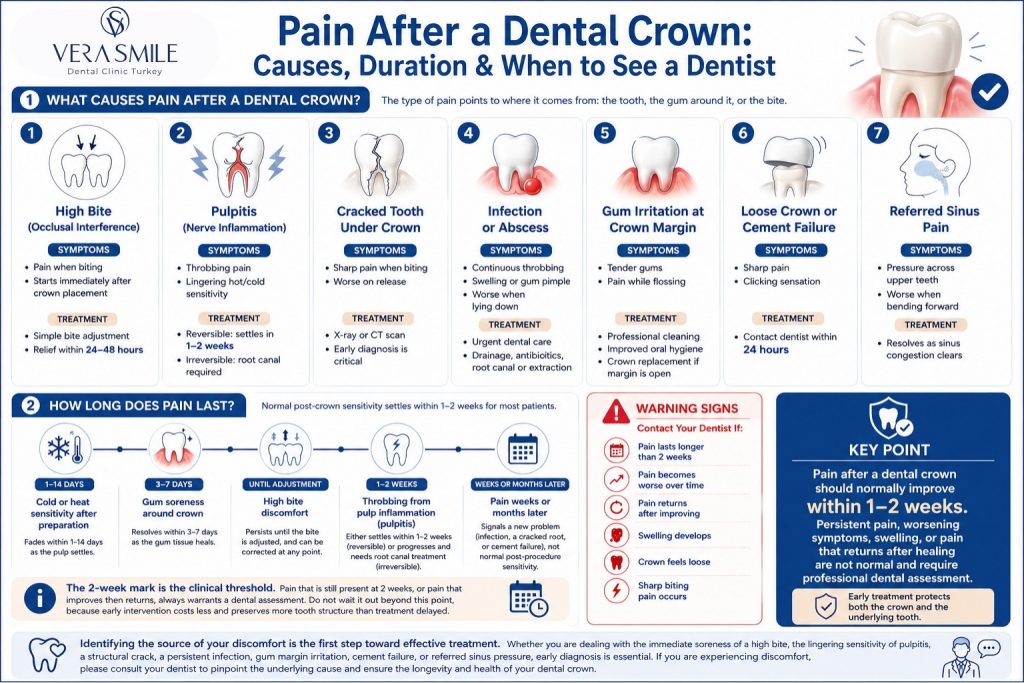
- Cold or heat sensitivity from preparation: Fades within 1–14 days as the pulp settles.
- Soreness of the gum around the crown: Resolves within 3–7 days as the gum tissue heals.
- Biting discomfort from a high bite: Persists until the bite is adjusted, and can be corrected at any point.
- Throbbing from pulp inflammation (pulpitis): Either settles within 1–2 weeks (reversible) or progresses and needs root canal treatment (irreversible).
- Pain weeks or months later: Signals a new problem (infection, a cracked root, or cement failure), not normal post-procedure sensitivity.
The 2-week mark is the clinical threshold. Pain that is still present at 2 weeks, or pain that improves then returns, always warrants a dental assessment. Do not wait it out beyond this point, because early intervention costs less and preserves more tooth structure than treatment delayed.
ℹ️ KEY POINT
Pain after a dental crown should resolve within 1–2 weeks for normal post-procedure sensitivity. Biting discomfort from a high bite persists until the dentist adjusts it. Pain that remains at 2 weeks, worsens over time, or returns after resolving is not normal and requires a dental assessment.
What Causes Pain After a Dental Crown?
Pain after a dental crown has seven common causes, and the type of pain points to which one. The key question is where the pain comes from: the tooth itself, the gum around it, or the bite. These are:
- High bite (occlusal interference): Biting soreness that starts the day the crown is placed, from a crown sitting fractionally too high. Fixed in minutes with a bite adjustment and no anaesthesia, with pain resolving within 24–48 hours.
- Pulpitis (nerve inflammation): Throbbing or lingering temperature sensitivity from an irritated pulp after preparation. Reversible pulpitis settles in 1–2 weeks, while irreversible pulpitis (spontaneous night pain, 30+ second heat sensitivity) needs root canal treatment.
- Cracked tooth under the crown: Sharp, brief pain on biting in a specific direction, worse on release. It needs an X-ray and often a CT scan to assess depth, and early diagnosis determines whether the tooth is saved.
- Infection or abscess: Continuous throbbing that worsens when lying down, with possible gum swelling, a pimple-like bump (sinus tract), or facial swelling. It requires urgent drainage, antibiotics, and root canal or extraction.
- Gum irritation at the crown margin: Localised dull gum ache or tenderness on flossing, from a rough or open margin trapping plaque. Managed with scaling and hygiene, though a persistently open margin needs crown replacement.
- Cement failure or a loose crown: Sharp pain and sometimes a clicking sensation as the crown moves on biting. This is a dental urgency; contact your dentist within 24 hours and avoid pharmacy adhesives beyond a day or two.
- Referred sinus pain: Dull pressure across several upper teeth during a cold or sinus infection, worse when bending forward, because upper molars sit close to the maxillary sinus. It resolves when the congestion clears and needs no dental treatment.
Identifying the source of your discomfort is the first step toward effective treatment. Whether you are dealing with the immediate soreness of a high bite, the lingering sensitivity of pulpitis, a structural crack, a persistent infection, gum margin irritation, cement failure, or referred sinus pressure, early diagnosis is essential. While some causes like a high bite require simple, non-invasive adjustments, others like abscesses or cracks demand more involved clinical intervention. Regardless of the symptom, persistent pain is a signal from your body that should not be ignored. If you are experiencing discomfort, please consult your dentist to pinpoint the underlying cause and ensure the longevity and health of your dental crown.
Why Does My Crown Hurt When I Bite Down?
Pain when biting down usually stems from a high bite or a cracked tooth. A high bite creates a dull, aching discomfort that feels worse during the first bites of a meal and improves as your jaw warms up. This pain typically starts within hours of treatment because local anesthesia often prevents you from feeling the bite accurately before you leave the dental chair. If you cannot bite comfortably two days after receiving a crown, contact your dentist for a quick, anesthetic-free adjustment. Leaving it uncorrected only inflames the periodontal ligament and delays your recovery.
In contrast, a cracked tooth causes sharp, brief, and localized pain, which often occurs specifically when you release biting pressure. This requires a professional evaluation using an X-ray or CT scan to determine the depth of the fracture. While a crown can stabilize many cracks, a fracture extending below the gumline results in a much more guarded prognosis for the tooth.
Why Is My Tooth Sensitive After a Crown?
Sensitivity after a crown, especially to cold, is the most common post-crown symptom and the one that settles most reliably on its own. Preparation exposes dentinal tubules at the crown margin and removes insulating tooth structure, so until the margin seals and the pulp adjusts, cold liquids and air trigger a brief sharp sensation.
This sensitivity is different from pain. It lasts 1–3 seconds then fades completely, does not happen spontaneously, and improves steadily over days.
To ease it at home, use a potassium nitrate sensitivity toothpaste twice daily, applied directly to the area with a finger and left for two minutes before rinsing, and avoid very cold food and drinks for the first week. Avoid whitening toothpastes, which contain abrasive particles that can worsen sensitivity at the margin.
Sensitivity that worsens rather than improves, or that starts to occur with heat, needs assessment. Lingering heat sensitivity is a red flag for irreversible pulpitis.
What Is Nerve Pain After a Crown?
Nerve pain after a crown originates in the dental pulp and ranges from mild irritation to severe, irreversible inflammation. Reversible pulpitis presents as a cold-triggered sensitivity that lasts less than 5 seconds and fades completely without spontaneous pain, settling on its own within two weeks. In contrast, irreversible pulpitis manifests as spontaneous throbbing, intense heat sensitivity lasting longer than 30 seconds, and nocturnal pain that necessitates root canal treatment. If the condition progresses to pulp necrosis, the initial throbbing may subside, but this indicates pulp death rather than recovery, often leading to a root-tip infection that makes the tooth tender to the touch and potentially causes visible swelling.
When Is Nerve Pain After a Crown Serious?
Nerve pain is serious once it becomes spontaneous or wakes you at night, because that signals the pulp can no longer recover. Night pain when lying down, unprovoked by hot or cold, is the most reliable sign of irreversible pulpitis. When the pulp cannot recover, root canal treatment removes the inflamed tissue, cleans the canals, and seals the tooth, and a well-fitting existing crown can often stay in place. The procedure itself is no more uncomfortable than having a filling placed. What causes the discomfort is the delay in seeking treatment, not the treatment.
When Should You Call Your Dentist About Crown Pain?
Call your dentist if crown pain is spontaneous, throbs, wakes you at night, lasts beyond 2 weeks, comes with swelling, or if the crown feels loose or has fallen off. Facial swelling, fever, or trouble swallowing needs same-day emergency care, not a routine appointment.
🚨 EMERGENCY
Facial swelling alongside crown pain can indicate a spreading dental abscess. This is a medical emergency. If your face is visibly swollen, your breathing or swallowing is affected, or you have a fever above 38°C / 100.4°F, attend an emergency department immediately.
How Urgent Are Different Crown Pain Symptoms?
Crown pain symptoms fall on a spectrum from normal to emergency. The table below matches each symptom to its urgency and the action to take.
| Symptom | Urgency | Action |
|---|---|---|
| Mild cold sensitivity that fades in seconds | Normal (up to 2 weeks) | No action needed |
| Biting discomfort, crown feels high | Common, fixable | Call dentist within 1 week |
| Lingering ache after cold or heat (30+ seconds) | Possible pulpitis | Call dentist within 2–3 days |
| Throbbing, constant, unprovoked pain | Likely needs root canal | Call dentist same day |
| Swelling of gum or face near the crown | Possible abscess | Same day / emergency |
| Crown fell off, tooth is sensitive | Urgent | Same day |
When a symptom sits in more than one row, act on the more urgent one.
Why Does My Crown Still Hurt Months Later?
Crown pain that begins weeks or months after placement, following a pain-free period, is not leftover post-procedure sensitivity. It is a new problem, and it belongs in a different category from the sensitivity of the first two weeks.
- Secondary decay under the crown margin: Bacteria enter a failing margin and decay the tooth beneath. Pain is mild and intermittent at first, then escalates as the decay nears the pulp.
- A developing abscess: A tooth with a pulp that was compromised before crowning can undergo slow necrosis over months, with pain appearing once the infection grows large enough to press on the root.
- A propagating crack: A crack that was stable at crowning can spread under normal biting forces until it reaches a painful depth.
- Cement washout: Old cement dissolves over time, opening a micro-gap at the margin that lets bacteria in and produces fresh sensitivity.
Caught early, secondary decay can sometimes be treated and the crown recemented. Left alone, it often ends in crown replacement and root canal treatment or extraction.
⚠️ WARNING
Crown pain that develops months after a pain-free period is not normal post-operative sensitivity. The common causes are secondary decay under the margin, a developing abscess, a propagating crack, or cement failure. This needs a dental assessment within one week, not home monitoring.
Can Pain After a Crown Mean It Needs to Be Replaced?
Yes, sometimes pain means the crown needs replacing, but not always. Crown replacement is necessary in specific situations: when an ill-fitting margin causes secondary decay, requiring the tooth to be cleaned and restored; when a fracture or chip breaks the seal or ruins the appearance; when a root canal is needed due to irreversible pulpitis or an abscess; or in rare cases of a persistently high bite that cannot be adjusted. However, replacement is never decided on pain alone, as a clinical exam and X-ray must first determine the underlying cause; what feels like a failing crown is often a fixable bite issue corrected in just 10 minutes rather than a new crown, though where a remake is unavoidable, modern options for dental crowns in Turkey include same-day CAD/CAM crowns that eliminate the wait for an external laboratory.
How Do You Relieve Pain After a Crown at Home?
You relieve mild crown pain at home with anti-inflammatory painkillers, sensitivity toothpaste, temperature care, and chewing on the opposite side. Home management suits mild post-crown sensitivity and mild biting discomfort in the first 1–2 weeks. It does not replace a dental assessment when warning signs are present.
- Ibuprofen (400–600 mg every 6–8 hours with food): Reduces both pain and inflammation, and works better than paracetamol for dental pain because it targets the inflammatory component; not suitable with kidney disease, active peptic ulcer, or blood thinners.
- Paracetamol (500–1000 mg every 4–6 hours, max 4 g/day): Suitable when ibuprofen is not, and can be alternated with ibuprofen for a stronger combined effect.
- Potassium nitrate sensitivity toothpaste: Applied directly to the area, eases temperature sensitivity within 2–4 days of consistent use.
- Avoiding temperature extremes: Skipping very cold or very hot food and drink for the first week removes the trigger for sharp sensitivity.
- Chewing on the opposite side: Lowers the mechanical load on the crowned tooth while the periodontal ligament settles.
- Clove oil (eugenol): A mild topical anaesthetic for gum soreness, applied with a cotton swab to the gum around the crown, not to exposed tooth structure.
If you grind your teeth at night, nocturnal grinding pressure makes crown pain significantly worse. A custom night guard worn nightly cuts the mechanical load on a new crown and speeds recovery. For anyone with bruxism, this is the single most effective step to protect the crown and reduce post-placement discomfort.
Why Choose Vera Smile for Dental Crowns in Turkey?
At Vera Smile, the most common cause of crown pain, a high bite, is prevented at placement through a full occlusal check in centric occlusion, lateral excursion, and protrusive movement, with articulating-paper marks verified under 5x magnification to ensure any uneven contact is adjusted on the spot. This clinical rigor ensures patients leave with a perfectly balanced bite, supported by a practice that holds certification from Turkey’s Ministry of Health, AACD membership, and the International Design Award for excellence in cosmetic dentistry; every consultation includes a comprehensive clinical assessment with written findings for both existing crown pain and planned treatment.
The second most common cause, a poorly fitting margin, is controlled through an in-house CAD/CAM laboratory. Every crown is scanned, milled, and checked on-site, with no third-party lab turnaround to introduce fit variability, so a margin that needs refinement is corrected the same day rather than over a two-week wait.
For patients with bruxism, a major risk factor for post-crown pain and crown failure, Vera Smile includes occlusal assessment in every consultation and provides a custom night guard as part of dental crown treatment plan.
FAQ
Crown preparation rarely causes permanent nerve damage. Teeth with deep decay or large fillings close to the pulp can develop irreversible pulpitis after crowning, where the pulp inflames and then dies. This needs root canal treatment, not neurological management.
Yes. A crown covers the outer tooth surface but does not block infection entering through the root canal system or a failed margin. Crowned teeth can develop abscesses, especially if the pulp was compromised before crowning or the margin fails over time and lets bacteria in.
Yes. Night-time grinding (bruxism) loads a new crown far beyond normal chewing and can cause or prolong pain. A custom night guard worn nightly reduces the load and protects the crown while the tooth settles.
Only if you have facial swelling, a fever, or trouble breathing or swallowing, which point to a spreading infection. Routine crown pain, sensitivity, or a high bite is handled by your dentist, not an emergency department.