
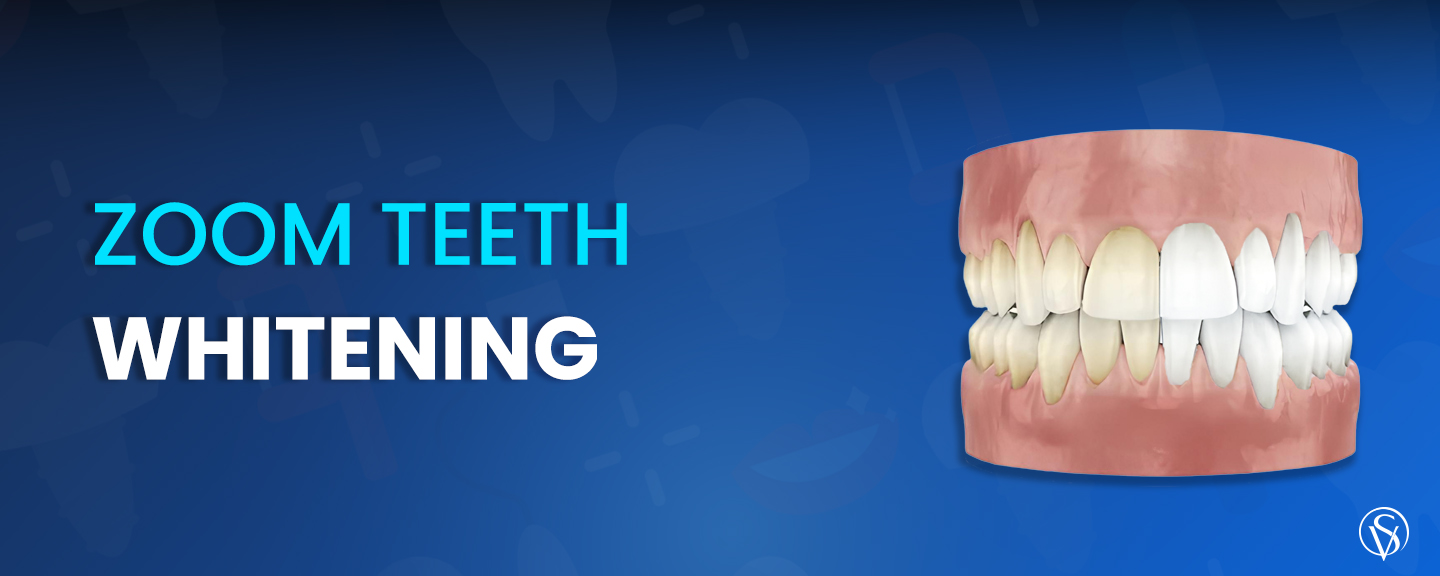
Zoom teeth whitening uses 25% hydrogen peroxide gel activated by an LED lamp to whiten teeth 6–8 shades in a single 45-minute session. Results last 12–24 months and cost $300–$1,500 in the US, £350–£700 in the UK, and €200–€400 in Turkey, where lower clinic overhead drives the price difference.
The LED lamp accelerates the oxidation reaction that breaks down stain molecules inside the enamel, which is photoactivated chemistry rather than a laser. Zoom removes extrinsic and some intrinsic staining but cannot whiten crowns, veneers, or tetracycline discoloration. Temporary sensitivity affects about 38% of patients during treatment and resolves within 48–72 hours, with no permanent enamel damage when a licensed dentist follows the correct protocol. The first 48 hours after treatment matter most for avoiding restaining, and annual touch-ups extend results. Zoom remains the fastest single-session option for patients with healthy enamel who want significant whitening quickly.
What Is Zoom Teeth Whitening?
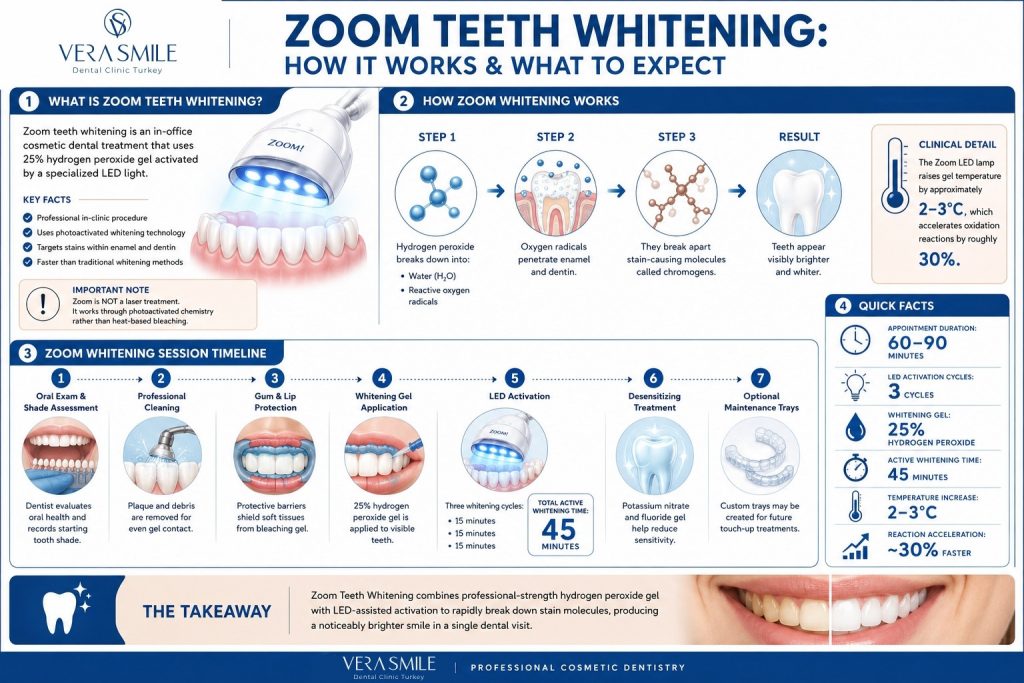
Zoom teeth whitening is an in-office cosmetic dental procedure in which a dental professional applies 25% hydrogen peroxide gel to the teeth and activates it with a specialized LED lamp. The combination of gel and light accelerates the breakdown of stain molecules inside the enamel and dentin.
Zoom teeth whitening is not a laser and does not bleach using heat in the traditional sense. It uses photoactivated chemistry, in which light accelerates a chemical reaction already happening in the gel.
How Does Zoom Teeth Whitening Work?
Zoom teeth whitening works by breaking hydrogen peroxide down into water and reactive oxygen radicals that oxidize the stain molecules inside the enamel and dentin. These radicals penetrate the tooth and break apart the long-chain organic molecules called chromogens that cause discoloration. When chromogen chains break apart, the tooth appears lighter.
The Zoom LED lamp raises the surface temperature of the gel by 2–3°C, which accelerates the oxidation reaction by roughly 30%. The dentist applies the gel in three rounds of 15 minutes each (45 minutes total), with fresh gel applied between rounds.
What Happens Step by Step During a Zoom Whitening Session?
The complete Zoom whitening appointment, including preparation, gum protection, and post-treatment care, typically takes 60 to 90 minutes from arrival to departure. The active whitening procedure follows a highly standardized clinical sequence:
- Oral Exam and Shade Assessment: The dentist evaluates your teeth and records the starting color using a standard Vita shade guide.
- Professional Cleaning: Any surface plaque or debris is removed to ensure the whitening gel makes direct and even contact with the enamel.
- Gum and Lip Protection: Specialized retractors and a protective barrier gel are applied to shield your gums, lips, and soft tissues from the strong bleaching agent.
- Gel Application: A clinical-grade 25% hydrogen peroxide whitening gel is carefully applied to all visible teeth.
- LED Activation: The Zoom LED lamp is positioned to activate the gel. The standard protocol includes three 15-minute light cycles, with the old gel removed and fresh gel applied between each cycle.
- Desensitizing and Fluoride Application: Once the whitening is complete, a post-treatment gel (typically containing potassium nitrate and fluoride) is applied to seal the dentinal tubules and minimize sensitivity.
- Maintenance Impressions (Optional but common): Impressions of your teeth may be taken to create custom trays for at-home touch-up treatments.
Note: While the results are visible immediately before you leave the clinic, the final shade will fully settle over the following 48 to 72 hours as your teeth naturally rehydrate.
What Is the 40-Minute Rule on Zoom Teeth Whitening?
The “40-minute rule” is a clinical guideline used by some dental professionals to cap the total active gel exposure at 40 minutes per session, rather than following the traditional 45-minute (three 15-minute cycles) protocol.
The rationale behind this is based on pharmacokinetics: approximately 75% to 80% of the total color change occurs within the first 30 minutes of gel contact. Beyond the 40-minute mark, any additional whitening achieved is marginal, while the risk of post-operative tooth sensitivity increases significantly.
To maximize patient comfort without sacrificing results, some clinicians modify the treatment into two 20-minute cycles. This approach is highly effective for achieving brilliant results, especially for patients with a known history of tooth sensitivity.
Does Zoom Teeth Whitening Really Work?
Yes. Zoom works on extrinsic staining (surface stains from food, drink, and tobacco) and some intrinsic staining (stains inside the enamel), but not on all discoloration.
Seven chairside whitening systems were evaluated head-to-head and Zoom WhiteSpeed produced the highest color change at the 1-week assessment point, with an average improvement of 6–8 shades on the Vita shade guide, according to a 2021 comparative study published in the Journal of Dentistry. A separate randomized clinical trial published in Operative Dentistry confirmed that LED-activated hydrogen peroxide systems achieve statistically significant whitening after a single in-office session in the majority of patients with extrinsic or mixed staining.
Zoom cannot whiten dental crowns, veneers, bonding, or composite fillings. It does not effectively treat tetracycline staining (blue-grey discoloration from antibiotic exposure during tooth development) or fluorosis (white patches or brown marks from excess fluoride during enamel formation).
How Much Does Zoom Teeth Whitening Cost?
Zoom whitening costs $300–$1,500 per session in the United States, £350–£700 in the UK, CAD $400–$900 in Canada, AUD $500–$1,200 in Australia, and €200–€400 in Turkey. Dental insurance does not cover it anywhere.
| Country / Region | Zoom Whitening Per Session Cost |
|---|---|
| United States | $300 – $1,500 |
| United Kingdom | £350 – £700 |
| Canada | CAD $400 – $900 |
| Australia | AUD $500 – $1,200 |
| Turkey | €200 – €400 |
The wide range in the US and UK reflects geographic location, clinic prestige, and whether take-home maintenance trays are included. In contrast, the average teeth whitening Turkey cost is lower because clinic overhead is reduced, not because the system or clinical standards differ.
Is Zoom Better Than Laser Teeth Whitening?
Zoom and laser whitening achieve comparable whitening results, but Zoom (LED) causes less sensitivity, which makes it the preferred choice for most patients. Zoom uses an LED lamp (cool light), while laser whitening uses a diode laser that generates more heat. The table below compares the two on the factors that affect the patient experience.
| Aspect | Zoom (LED) | Laser |
|---|---|---|
| Energy source | LED lamp (cool light) | Diode laser (more heat) |
| Whitening efficacy at 2 weeks | No significant difference | No significant difference |
| Sensitivity incidence | 38% of patients | 52% of patients |
| Best suited to | Tooth whitening for most patients | Cases where laser is already in use |
A 2020 systematic review in Lasers in Medical Science found no significant difference in whitening efficacy between LED-activated systems and traditional laser dentistry procedures at 2 weeks post-treatment; the difference was in side effects. In practice, most modern dental clinics have moved toward LED systems like Zoom because they achieve the same results with less patient discomfort.
How Many Years Does Zoom Whitening Last?
Zoom whitening results last 12–24 months for most patients. Heavy consumers of coffee, tea, red wine, and tobacco see results fade toward the 12-month end. Non-smokers who limit staining foods and use whitening toothpaste 2–3 times per week stay bright for 18–24 months.
One factor rarely mentioned is that immediately after treatment, teeth are temporarily dehydrated, which makes them look 1–2 shades whiter than the actual permanent result. Over 48–72 hours, teeth rehydrate and the shade settles. Some patients interpret this reversal as whitening wearing off, but the permanent whitening from the oxidation reaction remains. The dehydration effect is cosmetic, not chemical.
Touch-up sessions of 15–30 minutes, at a fraction of the original cost, can extend results significantly when scheduled annually.
How Often Can I Repeat Zoom Whitening?
Most dentists recommend waiting 6–12 months between full in-office Zoom sessions. Repeating too frequently does not produce proportionally better results and increases cumulative sensitivity risk. Short 15–30 minute touch-up sessions, using lower-concentration take-home gel or a single in-office application, are preferred for maintenance between full treatments.
Does Zoom Teeth Whitening Hurt?
No. Zoom whitening does not hurt in the conventional sense, but sensitivity during and after the procedure is common and sometimes intense.
Sensitivity occurs because hydrogen peroxide temporarily opens dentinal tubules, the microscopic channels in the dentin that lead to the nerve. When these tubules are open and exposed to temperature changes or airflow, the nerve fires. Patients describe brief electric-like shocks called “zingers,” lasting 1–2 seconds each.
Clinical data shows that about 38% of patients experience sensitivity during Zoom whitening, and 67% experience some sensitivity in the 24–48 hours afterward. This resolves without treatment in 48–72 hours.
What Are the Risk Factors that Make Zoom Whitening More Painful?
Five factors raise the risk of stronger discomfort during or after treatment: thin enamel, pre-existing sensitivity, gum recession, cracked teeth, and dehydration. Each one lets peroxide reach the nerve more easily.
- Thin or eroded enamel: Less enamel means peroxide reaches the dentin faster.
- Pre-existing dental sensitivity: Teeth that are already sensitive react more strongly.
- Recent gum recession: Exposed root surfaces lack protective enamel.
- Cracked or chipped teeth: Gel enters through the crack and reaches the nerve directly.
- Dehydration on the day of treatment: A dehydrated mouth intensifies the sensitivity response.
Disclosing these factors at consultation lets the dentist adjust the protocol in advance.
How Can You Reduce Sensitivity After Zoom Whitening?
While post-treatment sensitivity is a common side effect of Zoom Whitening, it is a temporary phase that can be easily managed. By taking the right precautions before, during, and after your appointment, you can significantly reduce discomfort and protect your teeth.
Here is how you can manage and minimize sensitivity throughout the process:
- Using sensitive toothpaste: Brush daily with a potassium nitrate toothpaste (such as Sensodyne) for two weeks leading up to your appointment to build up a protective barrier.
- Applying clinical desensitizing gels: Ensure your dentist applies a protective desensitizing gel before starting the procedure and a fluoride gel immediately afterward to seal the dentinal tubules.
- Avoiding extremely hot or cold food and drinks: Stay away from temperature extremes for at least 48 hours after treatment while the active sensitivity window is open.
- Rinsing with lukewarm saltwater: Use a mild saltwater mouthwash made with lukewarm water to soothe your gums and teeth without triggering temperature shock.
- Taking over-the-counter pain relief: Use ibuprofen if needed during the first 48 hours to safely manage any minor aches or temporary “zings.”
Following these proactive steps at each stage of your treatment ensures a much smoother recovery, allowing you to enjoy your bright new smile without the discomfort.
Why Are My Teeth Still Yellow After Zoom Whitening?
If teeth are still noticeably yellow after a Zoom session, one of four things is happening. Identifying which applies determines the right next step.
- Intrinsic staining Zoom cannot reach: Tetracycline taken during enamel formation (ages 0–8) causes grey-brown internal discoloration that hydrogen peroxide cannot penetrate, and the clinical solution is dental veneers or composite bonding rather than whitening.
- Post-treatment dehydration reversal: Teeth look brightest in the first 48 hours due to dehydration, then darken slightly as the tooth rehydrates, which is normal physiology rather than treatment failure.
- Staining foods consumed too soon: During the 48-hour window enamel is at its most porous, so coffee, tea, curry, or red wine penetrate faster than at any other time.
- Restorations on front teeth: Crowns, veneers, porcelain inlays, and composite fillings do not respond to hydrogen peroxide, so whitening natural teeth creates a visible mismatch with restorations placed at a darker shade.
Matching the cause to the right response, whether a wait, a touch-up, or a restorative option, prevents repeated whitening that will not solve the problem.
Who Should Not Get Zoom Whitening?
Zoom whitening is not suitable for children under 16, pregnant or breastfeeding patients, people with untreated decay or gum disease, severe pre-existing sensitivity, grey-blue tetracycline staining, or multiple front-tooth restorations. A clinical consultation confirms suitability before treatment.
- Children under 16: Enamel is still developing and more permeable.
- Pregnant or breastfeeding patients: Safety data is absent, not because harm is proven.
- Untreated cavities, exposed roots, or active gum disease: Peroxide on a cavity or inflamed tissue causes pain and can worsen the condition.
- Severe pre-existing tooth sensitivity: The discomfort would be disproportionate to the benefit.
- Grey-blue tetracycline staining: Results will be minimal to none.
- Multiple front-tooth restorations: Crowns, veneers, and large composites will not whiten.
Patients with mild to moderate enamel erosion can sometimes still receive Zoom whitening, but the treating dentist must assess erosion severity first and may recommend a teeth scaling and remineralization protocol beforehand.
What Not to Do After Zoom Whitening
The first 48 hours after Zoom whitening are the most critical, because the enamel surface is temporarily more porous and more vulnerable to restaining.
- Colorful foods and beverages: coffee, tea, red wine, dark sodas, dark beer, tomato-based sauces, curry, soy sauce, balsamic vinegar, and dark fruits (blueberries, blackberries, cherries, and pomegranate).
- Smoking: tobacco and cigarettes (nicotine stains travel deep when the enamel is open).
- Dark or brightly colored mouthwash: any dental rinses with artificial dyes that can easily stain the porous enamel.
- Brightly-colored candy or energy drinks: sports drinks and sweets containing heavy artificial colorants.
- Extremely hot or cold foods and drinks: temperature-sensitive items to avoid while the post-whitening sensitivity window is active.
- Acidic foods: citrus fruits and vinegar-heavy dressings, which can temporarily soften the vulnerable enamel.
A simple clinical rule used by dental teams across Turkey and Europe: if it stains a white shirt, it will stain your teeth in the first 48 hours.
Why Do Dentists Sometimes Not Recommend Teeth Whitening?
Dentists advise against whitening when it would be ineffective or unsafe for a specific patient, not because they oppose the procedure. The judgement is based on the patient’s stain type, restorations, and oral health.
- Intrinsic staining that does not respond: For tetracycline-stained teeth, whitening produces minimal change and creates unrealistic expectations, so the dentist is protecting the patient from an ineffective treatment.
- Multiple front-tooth restorations: Crowns, veneers, and large composite fillings do not whiten, so whitening natural teeth around them creates a visible mismatch that often requires the restorations to be replaced.
- Active decay or gum disease: Hydrogen peroxide applied to an open cavity or inflamed gum tissue causes significant pain and can worsen the underlying condition, so these must be treated first.
- Severe pre-existing sensitivity: For patients where whitening-induced sensitivity would be disproportionate, alternatives such as composite bonding or dental veneers provide cosmetic improvement without bleaching.
- Dehydration effect and unrealistic outcomes: A responsible dentist explains that some of the apparent whitening in the first 48 hours is dehydration rather than permanent bleaching, because managing expectations is part of informed consent.
Ultimately, when a dentist advises against teeth whitening, it is never to deny you a brighter smile. Instead, it is meant to protect your oral health and save you from mismatched or disappointing results. If traditional bleaching isn’t the right fit for your current dental profile, it simply opens the door to safer, more predictable cosmetic alternatives like composite bonding or dental veneers, ensuring you get the radiant outcome you actually want.
Will My Teeth Turn Yellow Again After Whitening?
Yes, whitening fades over time, and this is not a design flaw. The whitening effect from Zoom works by oxidizing chromogen molecules inside the enamel. Those chromogens are removed during treatment, not permanently sealed out. Daily exposure to coffee, tea, and staining foods re-introduces new chromogens through the same enamel channels over months and years.
How to Slow the Restaining Process After Teeth Whitening
A few habits slow the restaining process and extend the time between full sessions. Each one limits how much pigment reaches the enamel.
- Use a straw: Drink coffee and tea through a straw to reduce direct enamel contact.
- Rinse with water: Rinse immediately after consuming dark drinks.
- Whitening toothpaste: Use it 2–3 times per week to remove surface chromogens.
- Annual cleaning: Schedule professional teeth cleaning to remove buildup before it deepens.
- Touch-up sessions: Annual or biannual 30-minute touch-ups reset results at low cost.
For patients seeking longer-lasting color that resists restaining, dental veneers or a full Hollywood Smile makeover provide a more durable result, because porcelain is far less porous than natural enamel and highly resistant to chromogen penetration.,
Why Is Zoom No Longer as Popular as It Used to Be?
Zoom whitening hit its peak cultural visibility in the mid-2000s, partly due to television programs like Extreme Makeover, and since then its market position has shifted rather than collapsed. Four factors explain the change.
- At-home technology improved: Professional-grade take-home trays using 10–22% carbamide peroxide now produce results close to in-office systems over 2–4 weeks, so patients without a time constraint find the lower-cost route more attractive.
- Alternative in-office systems gained ground: KöR Whitening became the preferred option for deep tetracycline staining that Zoom cannot treat, and Opalescence Boost offers 40% hydrogen peroxide without light activation for clinics that prefer a simpler setup.
- The sensitivity reputation spread: Social media amplified patient accounts of intense post-treatment sensitivity, which deterred some patients toward gentler, slower protocols.
- OTC strips narrowed the gap: Products like Crest Whitestrips Professional Effects using 10% hydrogen peroxide deliver noticeable results for mild surface staining, reducing the perceived value gap for uncomplicated cases.
Zoom’s current role is the fastest and most reliable single-session whitening option for healthy teeth. It has not become obsolete; it has found its specific patient profile, namely someone who needs significant results fast, has healthy enamel, and has limited sensitivity.
Frequently Asked Questions
The Zoom 14% take-home gel is carbamide peroxide at 14% concentration, worn for the duration your dentist prescribes for your tray. In the mouth it breaks down to roughly 5% hydrogen peroxide, which is lower than in-office levels but suitable for maintenance.
No. Professionally supervised hydrogen peroxide whitening at standard concentrations does not cause permanent enamel demineralization when performed by a licensed dental professional following the correct protocol. Enamel damage is associated with misuse, such as leaving gel on far longer than directed or using very high concentration formulas without professional oversight.
Yes, but your restorations will not whiten, because hydrogen peroxide only affects natural tooth structure. If your veneers or crowns were placed when your teeth were a darker shade, whitening your natural teeth will create a visible color mismatch.
No, wait at least 30 minutes before brushing, because the enamel surface is temporarily softened and more vulnerable to abrasion. When you brush, use a soft-bristle toothbrush and a sensitive-formula toothpaste, and avoid whitening toothpastes with abrasive particles for the first 48 hours.
No. Zoom whitening is not performed on patients with fixed metal or ceramic braces, because the brackets and wires block the gel from reaching the full tooth surface and produce uneven whitening. The areas under the brackets remain unstained while exposed areas lighten, creating a patchy appearance when braces are removed. Whitening is scheduled either before brace placement or after debonding, once the teeth have stabilized.
It can be applied to a single tooth, but results are unpredictable in isolation, because Zoom whitens the entire arch during treatment. A single grey or dark tooth is often discolored due to internal causes such as trauma, a dead nerve, or past root canal treatment, which hydrogen peroxide cannot reach effectively. For a single discolored tooth, the more reliable solutions are internal bleaching (the walking bleach technique), a veneer, or a crown, depending on the underlying cause.
Several traditional South Asian dental hygiene practices have documented scientific support. Neem twigs (datun) contain nimbin and nimbidin, compounds confirmed antibacterial against Streptococcus mutans in the Journal of Ethnopharmacology (2004). Oil pulling with coconut oil reduced plaque index by 68.9% in a 30-day clinical trial in the Journal of Traditional and Complementary Medicine (2015). Diet patterns lower in coffee and higher in water-dense foods slow chromogen accumulation.