
Veneers require daily maintenance, but the routine is simple: brush twice a day with a non-abrasive fluoride toothpaste, floss along the gumline, avoid biting hard objects, and keep six-month dental visits. Done consistently, porcelain veneers commonly last 10 to 15 years or longer, while composite veneers last around 5 to 8 years. The factors that decide which end of that range you reach are brushing technique, diet, and whether you grind your teeth. This guide explains how to clean veneers without damaging the bond, which foods and drinks to limit, how porcelain and composite care differs, what to do about a chipped veneer, and how grinding shortens veneer life. It also covers how often to see a dentist and what a clinic checks at each visit. The aim is practical: protect the bond, protect the margins, and the veneers outlast the expectations that came with them.
Do Veneers Require Maintenance?
Yes, veneers require maintenance, though it rarely goes beyond brushing, flossing, and routine dental visits. The difference with veneers is that product choice and technique matter more than they do for natural teeth. Porcelain is stain-resistant, but the resin cement bonding it to the tooth is porous, and composite resin is more porous still, so both can discolour at the margins if plaque is allowed to build up. Neither surface is self-cleaning, and neither protects the tooth underneath from decay. The same daily habits that keep natural teeth healthy are what protect dental veneers over the long term.
How Do You Clean Veneers Properly?
Cleaning veneers correctly is the single most important daily habit for keeping them intact. The method matters because the wrong toothpaste or brush can scratch the glaze or weaken the bond over time.
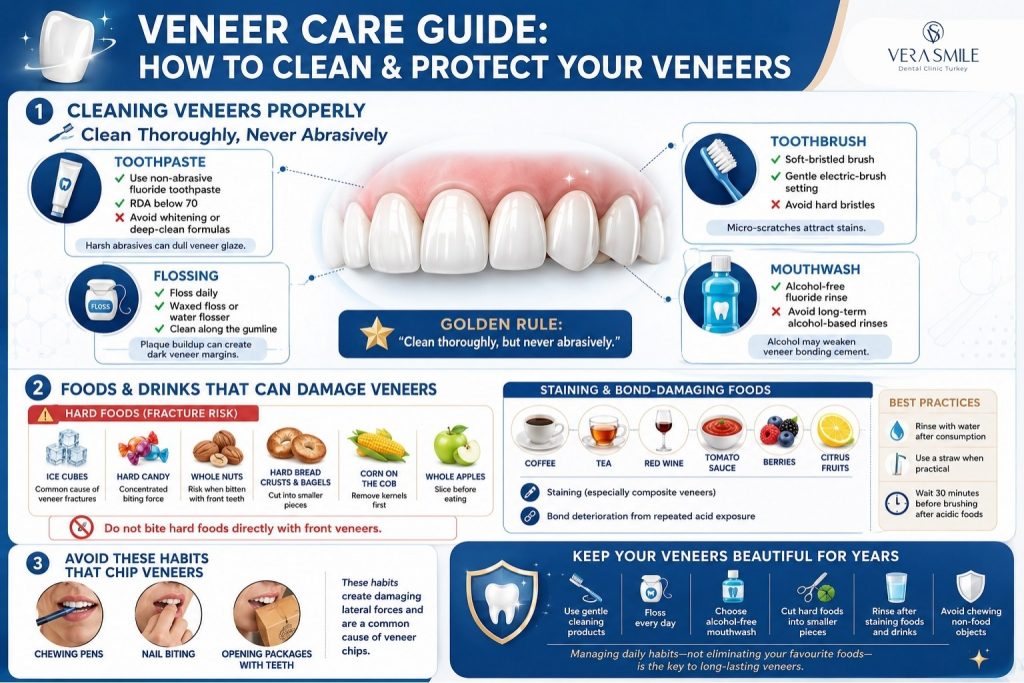
- Toothpaste: Use a non-abrasive fluoride toothpaste with a Relative Dentin Abrasivity (RDA) value below 70, and avoid whitening or deep-clean pastes, whose abrasive particles dull the veneer surface.
- Toothbrush: Use a soft-bristled manual brush or an electric brush on its gentle setting, since hard bristles create micro-scratches in porcelain glaze that trap staining agents.
- Flossing: Floss daily with waxed floss or a water flosser, working along the gumline where marginal plaque causes the dark lines some veneer patients develop.
- Mouthwash: Choose an alcohol-free fluoride mouthwash, because chronic use of alcohol-based rinses can soften the resin cement that holds the veneer to the tooth.
The principle behind all four is the same: clean thoroughly, but never abrasively.
What Foods and Drinks Damage Veneers?
Two kinds of food damage veneers: hard items that can fracture them, and acidic or pigmented items that stain composite and degrade the cement bond. You do not need to eliminate these foods, only manage how you eat them.
- Ice and hard candy: Biting ice is one of the most common causes of veneer fracture, and hard sweets apply the same concentrated force.
- Nuts and hard crusts: Bread crusts, bagels, and whole nuts should not be bitten directly with front veneers; break or cut them first.
- Corn and apples: Cut these off the cob or into pieces rather than biting in with the upper front teeth that carry most of the load.
- Coffee, tea, and red wine: These stain composite veneers progressively, so rinse with water afterward and drink through a straw where practical.
- Tomato sauces and berries: Their high pigment content discolours composite over time, especially without rinsing.
- Citrus and other acids: Repeated acid exposure weakens the cement bond, so avoid brushing for 30 minutes after acidic food while the surface is softened.
- Non-food habits: Chewing pens, biting nails, or opening packaging with the teeth puts lateral force on veneers and is a frequent cause of chips.
Managing these foods, rather than avoiding them entirely, is enough to protect the bond for years.
Do Veneers Stain?
Porcelain veneers do not stain on the surface, because the glazed ceramic is non-porous and resists pigment. They can still appear to yellow in two ways: the resin cement at the margins can darken with age, or the natural teeth beside and behind them can yellow and create a colour mismatch. Composite veneers behave differently. Their resin matrix is porous and absorbs pigment from coffee, tea, and tobacco, so they discolour gradually and need more frequent polishing. Whitening toothpaste and bleaching gel change neither material; if surrounding natural teeth have darkened, a dentist can whiten those teeth to restore the match rather than the veneers themselves. Surface stability is part of why many patients choose porcelain veneers for long-term colour consistency.
Do Porcelain and Composite Veneers Need Different Care?
Yes, porcelain and composite veneers need different care, mainly in polishing frequency and protection from impact. The table below summarises how the routine differs between the two materials.
| Aspect | Porcelain Veneers | Composite Veneers |
| Professional polishing | Standard six-month polish | More frequent polishing, as the resin surface dulls faster |
| Main vulnerability | Brittle under sharp impact; a hard lateral force can fracture it | Softer; chips more easily but is often repairable chairside |
| Repairability | Larger fractures need a full replacement | Small chips repaired with matching resin in one visit |
| Staining | Surface resists staining; margins may darken | Absorbs pigment over time |
| Daily routine | Non-abrasive brushing, alcohol-free rinse | Same, with extra attention to staining foods |
Both materials share the same core rules: avoid abrasives, limit chronic alcohol-based rinses, and keep regular dental visits.
Is Teeth Grinding Dangerous for Veneers?
Teeth grinding is the single most preventable cause of veneer failure. Around 8 to 10 percent of adults grind their teeth during sleep, and many are unaware of it. The forces produced during night grinding are far higher than normal chewing, and under that repeated pressure a veneer fracture becomes a question of when rather than if. The fix is straightforward: a custom-fitted hard acrylic nightguard made from dental impressions, which absorbs grinding forces and protects the veneers. The boil-and-bite versions sold over the counter offer far less protection. At Vera Smile, bruxism screening is part of every veneer consultation, and patients who grind are fitted with a nightguard as a standard step in treatment rather than an optional add-on. Because a replacement veneer costs many times more than a guard, a well-fitted mouth guard for grinding teeth is the most cost-effective protection a veneer patient can have.
Can a Chipped or Cracked Veneer Be Repaired?
Whether a chipped or cracked veneer can be repaired depends on the material and the size of the damage.
- Composite veneers: Most small chips are repaired chairside with matching resin in a single short appointment, though older veneers may show a slight tonal difference at the repair.
- Porcelain veneers: Micro-chips at the edge can sometimes be smoothed and polished, but larger fractures that expose the cement or tooth need a full replacement, because porcelain does not bond reliably to itself.
- Common causes: Most chips come from biting hard objects, trauma, or an uneven bite that overloads one veneer; a well-placed veneer in a balanced bite should not chip during normal eating.
- When to act: If a veneer feels loose or the gumline becomes sensitive, see a dentist within 48 hours, since a debonded veneer left in place lets bacteria reach the tooth.
The same matching-resin technique that repairs composite chips is the basis of composite bonding.
How Long Do Veneers Last With Proper Care?
With proper care, porcelain veneers commonly last 10 to 15 years or longer, and composite veneers last around 5 to 8 years. Maintenance is what moves a veneer toward the upper end of that range. The largest reducers of veneer life are untreated grinding and poor daily hygiene, both of which shorten lifespan substantially; diet plays a secondary role, mainly through staining of composite. At the ten-year mark, a well-maintained porcelain veneer shows little cosmetic change, with the main long-term issues being slight darkening at the cement margin and gum recession that can expose the veneer edge. Gum recession is the most underappreciated long-term risk, and it comes from aggressive brushing or gum disease rather than the veneer itself. When replacement is eventually needed, it is faster and less invasive than the first placement, and planning ahead for the dental veneers cost makes the timing easier to manage.
How Often Should You See a Dentist With Veneers?
You should see a dentist every six months, the same interval recommended for natural teeth. The visit serves two purposes: routine hygiene, and a veneer-specific check of the margins, bite, and any signs of grinding. At each visit the dentist looks for marginal integrity, colour stability, occlusion, gum health, and grinding signs.
Composite veneer patients should ask specifically for a non-abrasive polishing paste at each visit.
Why Choose Vera Smile for Veneers?
Maintenance at Vera Smile begins before the veneers are placed. Every case starts with a full occlusal analysis so biting forces are spread evenly across the teeth, and patients who grind are fitted with a custom nightguard as a standard part of treatment. Vera Smile uses lithium disilicate (e.max) as its primary veneer material for its combination of strength and natural translucency, and every margin is checked under magnification before bonding. Consultations include a written maintenance plan tailored to each patient’s diet, lifestyle, and grinding status, so the care routine is specific rather than generic. Patients comparing options abroad can review the clinic’s full approach to veneers in Turkey before deciding.
Frequently Asked Questions
Keep the veneer in a clean container and contact your dentist promptly; do not try to re-cement it yourself. If the tooth is sensitive, avoid very hot or cold food until you are seen. An undamaged veneer can often be re-bonded.
Yes. Veneers do not protect the tooth from decay, and plaque at the margin can cause a cavity at the veneer edge, which is why flossing the gumline daily matters.
Warning signs include sensitivity at the gumline, a visible gap at the margin, a colour change at the edge, the veneer feeling loose, or pain on biting. Any of these warrants a prompt appointment.
Not necessarily. Whitening does not change veneer colour, so surrounding teeth and veneers can fall out of match; for this reason a dentist often plans whitening before veneer placement to set the target shade.
Yes. A water flosser is gentle on veneer margins and useful for patients with several veneers or crowns, as long as it is directed along the gumline rather than aimed straight at the margin on a high setting.