
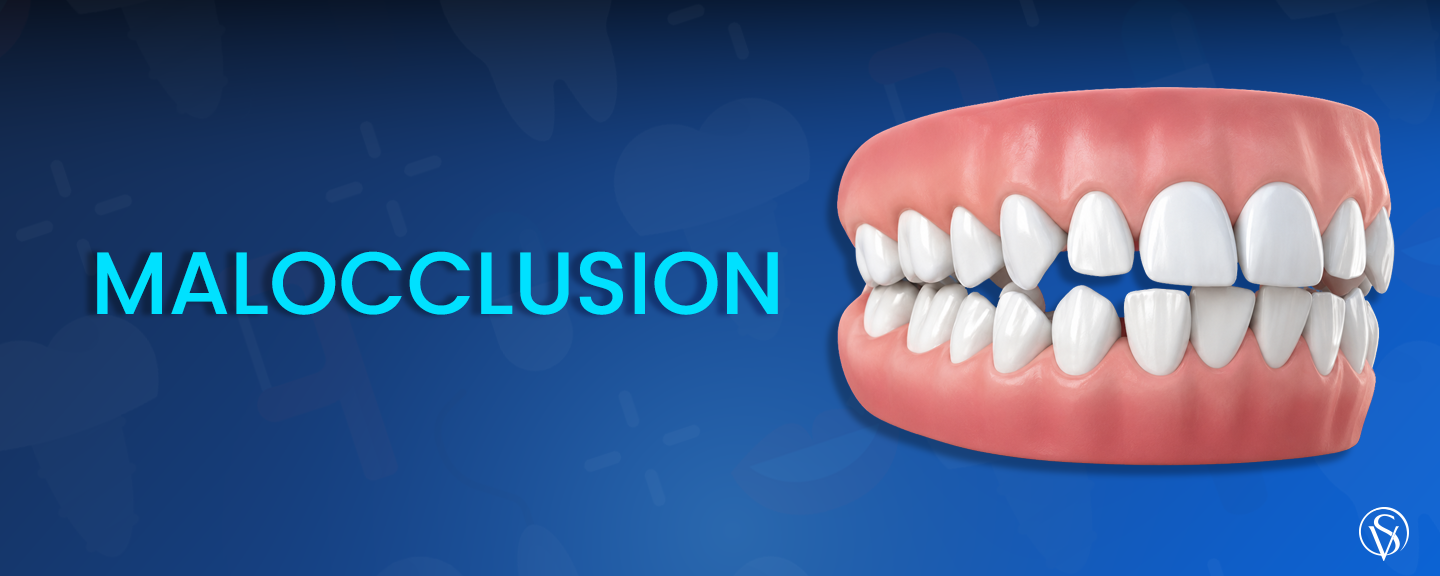
Malocclusion is the misalignment of the teeth or jaws that stops the upper and lower teeth from meeting correctly when the mouth closes. It is one of the most common dental conditions, and orthodontists group it into Angle Class I, Class II, and Class III according to how the back teeth bite together. The most recognised forms are overbite, underbite, crossbite, open bite, and crowding. Its causes are partly hereditary and partly linked to childhood habits such as thumb-sucking and mouth breathing.
Left untreated, malocclusion can raise the risk of tooth decay, gum inflammation, uneven tooth wear, and jaw-joint strain. Appliances treat mild through complex dental cases, while orthognathic surgery is reserved for significant skeletal discrepancy, and correction is possible at any age. In Turkey, orthodontic treatment costs a fraction of UK and US prices, which is a large part of why patients treat it here.
Key Points
- Malocclusion is a misaligned bite in which the upper and lower teeth do not meet correctly, not only crooked front teeth.
- It is grouped into Angle Class I (about 74.7%), Class II (about 19.6%), and Class III (about 5.9%), with common forms being overbite, underbite, crossbite, and open bite.
- The causes are partly hereditary and partly habit-related, including thumb-sucking, tongue thrusting, and mouth breathing in childhood.
- Left untreated, malocclusion raises the risk of tooth decay, gum disease, uneven tooth wear, and jaw-joint strain.
- It is correctable at any age with dental braces, clear aligners, or orthognathic surgery for severe skeletal cases.
What Is Malocclusion?
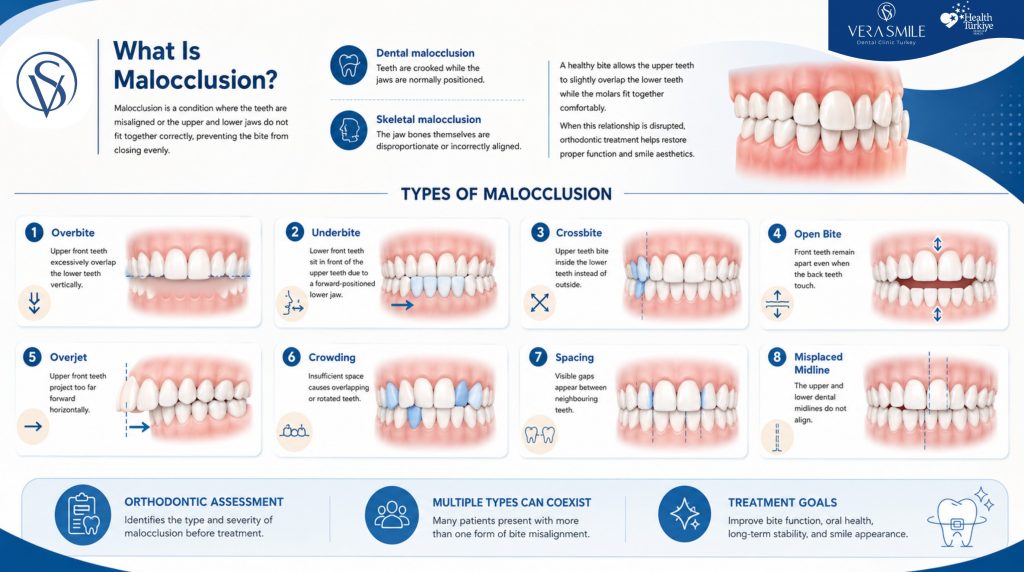
Malocclusion is a dental condition in which the teeth are poorly positioned or the upper and lower jaws do not align, so the bite fails to close evenly. The word comes from the Latin for a bad (mal) closure (occlusion). It can be dental, where the teeth are crooked but the jaws are sound, or skeletal, where the jaw bones themselves are out of proportion.
Normal occlusion means the upper teeth sit slightly over the lower teeth and the molar cusps fit into their opposing grooves. When this relationship is disturbed, the result is malocclusion. Correcting these bite problems is the focus of orthodontics, the dental specialty that repositions teeth and jaws to restore function and appearance. Worldwide, deviations from an ideal bite are common rather than exceptional (Alhammadi et al., 2018).
What Are the Types of Malocclusion?
Malocclusion is divided into several distinct forms based on how the teeth and bite deviate from normal. Each form describes a specific direction of misalignment, and one patient can present with more than one at the same time. Recognising the type matters because it guides which treatment will work. These are the recognised forms seen in orthodontic practice.
- Overbite: The upper front teeth overlap the lower front teeth vertically by more than the normal 2 to 4 mm, sometimes covering them almost completely in a deep bite.
- Underbite: The lower front teeth sit ahead of the upper front teeth, giving the lower jaw a protruded appearance.
- Crossbite: One or more upper teeth bite inside the lower teeth, at the front or the sides, instead of outside them.
- Open Bite: The upper and lower front teeth do not touch when the back teeth are closed, leaving a visible gap.
- Overjet: The upper front teeth project forward horizontally over the lower teeth, often described as protruding teeth.
- Crowding: There is not enough space in the jaw for all the teeth, so they overlap, twist, or push out of line.
- Spacing: Gaps appear between the teeth, arising from small teeth, missing teeth, or an oversized jaw.
- Misplaced Midline: The centre line of the upper front teeth does not match the centre line of the lower front teeth.
These forms are not mutually exclusive, and mild versions are widespread across the general population. Deep overbite affects around 22% and posterior crossbite around 9% of people, while open bite is less common at close to 5% (Alhammadi et al., 2018). The type and severity together decide whether treatment is cosmetic, functional, or both. An orthodontic assessment confirms which forms are present before any plan is made.
What Are the Three Classes of Malocclusion?
Orthodontists classify malocclusion into three classes using Angle’s classification, the system introduced by Edward Angle in 1899 and still in use today (Angle, 1899). The classes describe the relationship between the first upper and lower molars when the jaws close. This shorthand tells the clinician how the bite is structured at the back of the mouth. The three classes are defined as:
- Class I: The molar relationship is normal but individual teeth are crowded, spaced, rotated, or out of line. It is the most common class, accounting for about 74.7% of malocclusions in permanent teeth (Alhammadi et al., 2018).
- Class II: The lower molar sits further back than normal, so the upper teeth and jaw are positioned forward, producing an overbite or overjet. It represents close to 19.6% of cases (Alhammadi et al., 2018).
- Class III: The lower molar sits further forward than normal, pushing the lower jaw ahead and creating an underbite. It is the least common class at roughly 5.9% (Alhammadi et al., 2018).
The class sets the strategic direction of treatment, while the specific bite problems fill in the detail. Class I cases are often corrected with braces or aligners alone. Class II and Class III cases with a strong skeletal component may need growth appliances in children or jaw surgery in adults. Establishing the class early prevents an under-planned treatment.
What Causes Malocclusion?
Malocclusion develops from a combination of inherited jaw structure and environmental influences acting on the growing mouth. A single cause is rarely responsible on its own, as genetics set the framework while habits shape the outcome. Some causes are present from birth, and others build up through childhood behaviour. The main contributing factors are described here.
- Heredity: A mismatch between inherited tooth size and jaw size, passed down through families, is the leading structural cause of crowding and skeletal discrepancy.
- Thumb-Sucking and Pacifier Use: Sucking habits that continue past the age of 3 to 4 years push the front teeth forward and can create an open bite or overjet.
- Tongue Thrusting: Repeatedly pressing the tongue against the front teeth during swallowing or speech gradually moves them out of position.
- Mouth Breathing: Long-term breathing through the mouth, often from enlarged adenoids or allergies, alters tongue posture and can narrow the upper jaw.
- Early or Late Loss of Baby Teeth: Losing primary teeth too soon lets neighbouring teeth drift into the gap, leaving too little room for the permanent teeth.
- Jaw Injury or Trauma: A fracture or displacement of the jaw can leave the teeth meeting unevenly after healing.
- Poorly Fitted Dental Work: Ill-shaped fillings, crowns, or bridges can disturb an otherwise even bite over time.
Because several of these factors operate during childhood, early monitoring gives the best chance to intervene. Habit-driven causes can sometimes be reduced before the permanent teeth settle, while inherited skeletal patterns need active treatment. The mix of causes also explains why malocclusion varies so widely between individuals. A clinical history helps identify which factors are at work in a given case.
Is Malocclusion Hereditary?
Yes. Malocclusion has a strong hereditary component, particularly the skeletal forms where jaw size and shape are inherited much like height or facial features. Traits such as a small lower jaw, a protruding upper jaw, or a tooth-to-jaw size mismatch commonly run in families. Environmental habits then modify how severely those inherited traits show up. This is why two children in the same family can inherit a similar tendency yet end up with different degrees of misalignment.
What Are the Symptoms of Malocclusion?
The signs of malocclusion range from obvious cosmetic misalignment to subtle functional problems that patients may not connect to their bite. Mild cases can be symptom-free and are noticed only at a dental check. More pronounced cases interfere with everyday functions such as eating and speaking. The common symptoms are described here.
- Difficulty Chewing or Biting: Food feels hard to break down because the teeth do not meet evenly across the arch.
- Speech Changes: Certain sounds, especially s and th, become harder to pronounce when the front teeth are misaligned or fail to touch.
- Mouth Breathing: A habit of breathing through the mouth rather than the nose often accompanies certain bite patterns.
- Frequent Cheek or Tongue Biting: Misaligned teeth catch the soft tissue during chewing, causing repeated accidental bites.
- Jaw Discomfort: Aching or fatigue in the jaw muscles can follow from a bite that forces the muscles to compensate.
- Visible Misalignment: Crooked, crowded, protruding, or gapped teeth are the most immediate outward sign.
Any one of these signs on its own does not confirm malocclusion, but a cluster of them warrants a professional assessment. Symptoms tend to become more noticeable as a child grows or as an adult ages and the teeth shift. Tracking when the signs appear helps the orthodontist judge severity. A short clinical examination can usually tell whether the bite is the underlying cause.
Tips for Patients: You can do a rough self-check at home. Bite gently together in front of a mirror and look at whether the upper front teeth cover about a third of the lower teeth, whether the midlines line up, and whether any teeth sit inside or outside the opposing row. Note any clicking, discomfort, or difficulty when biting. Bring these observations to your consultation, as they give the orthodontist a useful starting point.
What Problems Can Untreated Malocclusion Cause?
Untreated malocclusion is not only a cosmetic matter, because a misaligned bite changes how force is distributed across the teeth and jaw. Over years, that altered load and the difficulty of cleaning crooked teeth can produce measurable harm. The risks grow with the severity of the misalignment and the length of time it is left. The main complications are set out here.
- Tooth Decay and Gum Disease: Crowded and overlapping teeth trap plaque in places a brush cannot reach, raising the risk of cavities and gum inflammation (Szyszka-Sommerfeld et al., 2026).
- Abnormal Tooth Wear: Teeth that strike each other unevenly wear down faster, flattening or chipping the biting surfaces.
- Temporomandibular Joint Strain: A bite that forces the jaw muscles and joint to compensate is associated with a higher rate of pain-related jaw-joint disorders (Szyszka-Sommerfeld et al., 2025).
- Chewing and Digestion Difficulty: Food that is not chewed thoroughly places more demand on the rest of the digestive process.
- Speech Difficulty: Persistent misalignment of the front teeth can keep certain sounds unclear into adulthood.
- Reduced Self-Confidence: A visibly irregular smile can affect social confidence and willingness to smile.
These complications are cumulative, so the case for treatment strengthens the longer malocclusion is left in place. The gum and joint risks in particular are supported by clinical research, although the evidence points to association rather than proving direct cause (Szyszka-Sommerfeld et al., 2026). Correcting the bite removes the mechanical driver behind most of these problems. An assessment can weigh the specific risks for an individual bite.
Warning: Seek a prompt dental assessment if you notice your bite changing suddenly, if your jaw locks or clicks with pain, or if chewing becomes painful. These can point to a temporomandibular joint problem that needs attention alongside the malocclusion, and delaying care can make both harder to treat.
How Is Malocclusion Diagnosed?
Malocclusion is diagnosed through a clinical examination supported by imaging and digital records of the bite. The orthodontist assesses how the teeth meet, measures the degree of deviation, and identifies the underlying class. The aim is to separate dental misalignment from skeletal discrepancy, because the two are treated differently. The standard diagnostic steps are:
- Clinical Bite Examination: The orthodontist inspects how the upper and lower teeth meet, checking overbite, overjet, crossbite, and midline alignment.
- Dental X-rays: Panoramic and periapical radiographs show the position of tooth roots, unerupted teeth, and the supporting bone.
- Cephalometric Analysis: A side-profile X-ray with standardised measurements reveals the relationship between the jaws and the skull base, confirming skeletal cases.
- Digital 3D Scan: An intraoral scanner captures a precise model of the teeth for planning and for tracking movement during treatment.
- Photographic Records: Standardised facial and intraoral photographs document the starting point and support treatment planning.
Together these records build a complete picture of the bite in three dimensions. The findings determine the class, the severity, and whether the problem is dental, skeletal, or a combination. Only then is a treatment option selected and a timeline estimated. Accurate diagnosis at this stage prevents wasted treatment time later.
Clinic Note: At Vera Smile, the first orthodontic assessment combines a clinical bite examination with a digital intraoral scan and the radiographs needed for the individual case. The scan lets patients see their own bite on screen and understand the plan before committing. International patients can send existing X-rays and photographs in advance for a preliminary review, which reduces the number of visits to Istanbul.
Does Malocclusion Always Need Treatment?
No. Not every malocclusion requires treatment, and very mild misalignment with no functional or hygiene problem can be monitored rather than corrected. Treatment becomes advisable when the bite interferes with chewing or speech, when crowding makes teeth hard to clean, when uneven wear is developing, or when the appearance concerns the patient. The decision balances the measurable health risk against the effort and cost of correction. For children, timing also matters, because some problems are easier to guide while the jaw is still growing.
Severity, not the mere presence of a deviation, is what drives the recommendation. A borderline case may be reviewed over time rather than treated straight away. This is a clinical judgement made after a full assessment.
Clinic Note: Vera Smile treats malocclusion when there is a functional reason, a hygiene or wear risk, or a clear aesthetic concern raised by the patient, and monitors very mild cases rather than over-treating them. Where a bite problem is skeletal and severe, the clinic refers for a combined orthodontic and surgical assessment rather than attempting to disguise it with teeth alone.
How Is Malocclusion Treated?
Malocclusion is treated by gradually moving the teeth, guiding jaw growth, or repositioning the jaws so the bite closes evenly. The right method depends on the class, the severity, and the patient’s age. Appliances handle mild through complex dental cases, while significant skeletal discrepancy needs surgery. The main treatment options are described here.
- Dental Braces: Fixed brackets and wires apply steady pressure to move teeth into alignment, suitable for mild through complex cases.
- Clear Aligners: Removable transparent trays correct mild to moderate misalignment discreetly, provided they are worn 20 to 22 hours a day.
- Palatal Expanders: A device that widens a narrow upper jaw in children, creating space and correcting crossbites before the jaw fuses.
- Retainers: Appliances worn after active treatment to hold the teeth in their new position and prevent relapse.
- Tooth Extraction: Removing one or more teeth to relieve severe crowding when the jaw cannot accommodate all the teeth.
- Orthognathic Surgery: Surgical repositioning of the upper jaw, lower jaw, or both, reserved for severe skeletal cases that appliances cannot correct.
In practice these methods are often combined, for example braces followed by a retainer, or pre-surgical orthodontics before jaw surgery. The class and severity established at diagnosis point to the most predictable option. Age is the other major factor, since growing children have treatment routes that are closed to adults. A tailored plan sequences the appropriate steps.
How Do Braces and Clear Aligners Correct Malocclusion?
Braces and aligners correct malocclusion by applying controlled, continuous force that remodels the bone around each tooth, allowing the tooth to move and settle in a new position. Fixed dental braces use brackets bonded to each tooth and an archwire the orthodontist adjusts, giving precise control over difficult movements and complex bites. Removable clear aligners use a sequence of custom trays, each shifting the teeth a fraction of a millimetre, and suit mild to moderate cases where appearance during treatment matters. Braces work around the clock because they are fixed, while aligners depend on the patient wearing them for the recommended hours. The choice between them is guided by the complexity of the case and the patient’s lifestyle.
When Is Jaw Surgery Needed for Malocclusion?
Jaw surgery is needed when malocclusion is skeletal and severe enough that moving the teeth alone cannot produce a stable, functional bite. This applies mainly to pronounced Class III underbites, severe Class II overbites, and marked facial asymmetry, where the jaw bones themselves are out of proportion. The procedure, called orthognathic surgery, repositions the upper jaw, the lower jaw, or both, and is planned together with a period of orthodontic treatment before and after the operation. In growing children, some skeletal problems can be guided with growth appliances, which is why early assessment matters. For an adult with a fixed skeletal discrepancy, surgery combined with orthodontics is the definitive route.
Which Treatment Suits Each Type of Malocclusion?
Matching the treatment to the type and severity of malocclusion is what makes a plan predictable. The table gives a general guide to the first-line option and the usual duration for each situation. Durations are clinical averages and depend heavily on case complexity and, for aligners, on wear discipline. The individual plan is always confirmed after assessment.
| Malocclusion Type / Severity | First-Line Treatment | Usual Duration |
|---|---|---|
| Mild crowding or spacing (Class I) | Clear aligners or braces | 6 to 12 months |
| Moderate crowding or bite issues | Braces, or aligners in suitable cases | 12 to 24 months |
| Overbite or overjet (Class II, dental) | Braces, sometimes with elastics | 18 to 24 months |
| Underbite (Class III, dental) | Braces | 18 to 30 months |
| Crossbite with narrow upper jaw (child) | Palatal expander, then braces | 12 to 24 months |
| Severe skeletal Class II or III | Orthognathic surgery with braces | 18 to 36 months total |
The pattern is consistent, in that milder dental cases favour aligners and shorter timelines, while skeletal cases need fixed appliances or surgery and longer plans. These figures are averages drawn from routine orthodontic practice rather than guarantees. A digital scan and X-rays sharpen the estimate for a specific bite. The final duration is confirmed once the appliance and plan are chosen.
How Much Does Malocclusion Treatment Cost?
The cost of correcting malocclusion depends on the treatment type, the complexity of the case, and the length of the plan rather than on the diagnosis itself. Turkey prices orthodontic treatment well below the United Kingdom and the United States, which is the main reason patients travel here for care. The table compares the same treatments across the three countries in euros, using rounded 2026 private-market ranges and approximate exchange rates. Exact figures are set after an assessment.
| Treatment | Turkey | United Kingdom | United States |
| Metal braces | €900 to €1,800 | €2,100 to €5,850 | €2,750 to €6,450 |
| Ceramic or sapphire braces | €2,000 to €2,300 | €2,900 to €7,000 | €3,700 to €7,800 |
| Lingual braces | €2,750 to €4,600 | €4,700 to €11,700 | €7,400 to €12,000 |
| Clear aligners | €1,650 to €4,600 | €1,750 to €6,400 | €2,750 to €7,350 |
| Orthognathic (jaw) surgery | €7,400 to €14,700 | €14,000 to €23,400 | €23,000 to €46,000 |
Across every treatment, Turkey sits well below UK and US pricing, with the widest gap on lingual braces and jaw surgery. The figures are rounded market estimates and shift with the appliance brand, the clinician’s experience, the number of visits, and the currency exchange rate. Fixed braces need in-person adjustments every few weeks, so clear aligners often suit international patients who cannot travel to Istanbul repeatedly, and Vera Smile manages check-ins remotely and provides follow-up after patients return home. A personalised quote follows the initial consultation.
FAQ
No. Crooked teeth are one visible form of malocclusion, but malocclusion is the wider term that also covers bite problems such as overbite, underbite, crossbite, and open bite, including cases where the teeth look straight but the jaws do not meet correctly. A person can have a skeletal malocclusion with reasonably aligned teeth. This is why an orthodontic assessment looks at the whole bite, not only the front teeth.
Partly. Inherited skeletal malocclusion cannot be prevented, but the habit-related forms often can be reduced. Discouraging thumb-sucking and prolonged pacifier use after the age of 3 to 4 years, treating mouth breathing, and keeping regular dental checks in childhood all lower the risk of an acquired bite problem. Early orthodontic monitoring catches developing issues while they are simpler to guide.
Yes. Adults can have malocclusion corrected at any age, because teeth respond to orthodontic force throughout life. Treatment in adults can take longer than in children because the bone is denser and the jaws are no longer growing, and severe skeletal cases may need surgery rather than appliances alone. Braces and clear aligners are both widely used for adult correction.
Yes, in some cases. A misaligned bite can overload the jaw muscles and the temporomandibular joint, and this strain is associated with headaches and facial pain in affected patients (Szyszka-Sommerfeld et al., 2025). Not everyone with malocclusion develops headaches, and other causes should be ruled out. Where the bite is the driver, correcting it can relieve the associated muscle strain.
Yes, it can. Misalignment of the front teeth, an open bite, or a large overjet can make certain sounds, especially s, z, and th, harder to form clearly. The effect is most noticeable in open bite and severe cases. Correcting the bite often improves clarity, and speech therapy can help alongside orthodontic treatment where needed.
Yes. Untreated malocclusion can progress, as teeth continue to drift, crowding increases, and uneven wear or gum problems develop with age. Late loss of teeth and shifting of the remaining teeth can also deepen an existing bite problem. This tendency to worsen is one reason clinicians advise assessing a noticeable malocclusion rather than leaving it indefinitely.
Alhammadi, M. S., Halboub, E., Fayed, M. S., Labib, A., & El-Saaidi, C. (2018). Global distribution of malocclusion traits: A systematic review. Dental Press Journal of Orthodontics, 23(6), 40.e1–40.e10.
Angle, E. H. (1899). Classification of malocclusion. Dental Cosmos, 41(3), 248–264.
Szyszka-Sommerfeld, L., Sycińska-Dziarnowska, M., Gerreth, K., Spagnuolo, G., Woźniak, K., & Czajka-Jakubowska, A. (2025). The impact of malocclusion on the prevalence of pain-related temporomandibular disorders in children and adolescents: A systematic review. Frontiers in Neurology, 16, 1550110.
Szyszka-Sommerfeld, L., Machoy-Rakoczy, M., Belova, A., Lipski, M., Schuster, L., Dammaschke, T., Budzyńska, A., Świtała, J., Warcholak-Grzeszewska, A., Woźniak, K., Armogida, N. G., Spagnuolo, G., Stratul, S.-I., & Boariu, M. (2026). The relationship between malocclusion and periodontal health in children and adolescents: A systematic review and meta-analysis. Journal of Clinical Medicine, 15(3), 1155.