
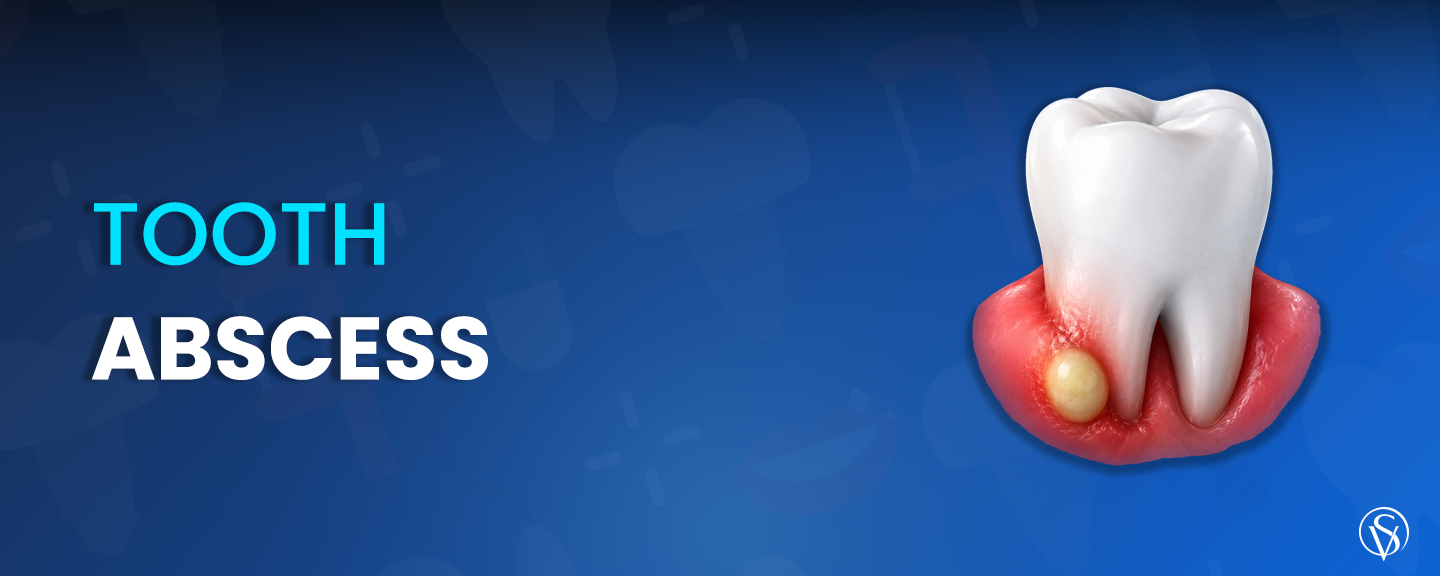
A tooth abscess is a pocket of pus that forms when a bacterial infection reaches the soft tissue inside a tooth or the gum around it. It develops most often from untreated tooth decay that breaks through the enamel and infects the inner pulp, though advanced gum disease, a cracked tooth, or failed dental work can trigger one as well. The infection builds pressure at the root or in the gum and produces throbbing pain, swelling, and often a fever. A tooth abscess does not clear up on its own, and pain easing is not a sign that the infection has gone.
Because the infection can travel from the tooth into the jaw, sinus, neck, or bloodstream, a tooth abscess is treated as a dental emergency rather than something to wait out. Treatment removes the source of infection through drainage, root canal treatment, or tooth extraction, and antibiotics are used only as support when the infection has started to spread (Cope et al., 2024). In Turkey, this care is available at accredited clinics for a fraction of UK and US prices, which is why many international patients choose to treat an abscess here rather than at home.
Key Points
- A tooth abscess is a pocket of pus caused by a bacterial infection at the root of a tooth or in the surrounding gum.
- The most common cause is untreated tooth decay that reaches the inner pulp, followed by gum disease, cracked teeth, and failed dental work.
- The main warning signs are severe throbbing pain, facial or gum swelling, fever, and a bad taste from draining pus.
- A tooth abscess does not heal on its own, and pain stopping often means the nerve has died while the infection keeps spreading.
- Treatment ranges from incision and drainage to root canal treatment or tooth extraction, with antibiotics as support only.
- Left untreated, the infection can reach the jaw, sinus, or bloodstream and become life-threatening, so prompt care matters.
What Is a Tooth Abscess?
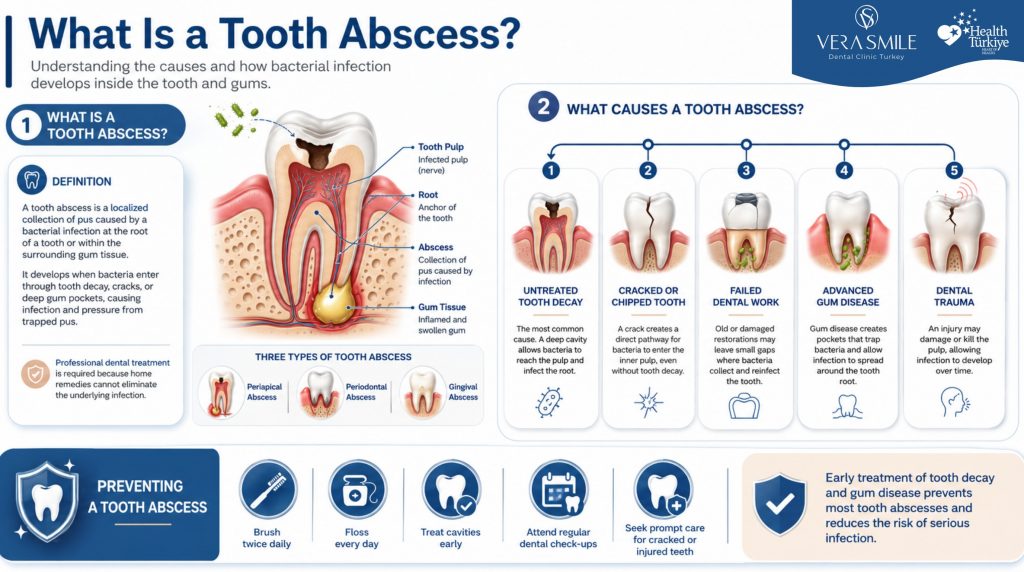
A tooth abscess is a localised collection of pus caused by a bacterial infection at the root of a tooth or in the surrounding gum tissue. It forms when bacteria enter through a cavity, a crack, or a deep gum pocket, and the body walls off the infection so that pus becomes trapped under pressure. The three recognised forms are periapical, periodontal, and gingival, and they are named by where the infection begins.
Draining and treating this kind of infection is routine work in general dentistry, and a dentist can confirm the diagnosis with a short examination and an X-ray. An abscess is a structural infection rather than passing irritation, so it will not settle without treatment that removes the source. Home care can ease the pain for a time, but it cannot clear the bacteria that keep the abscess alive.
What Are the Types of Tooth Abscess?
A tooth abscess is grouped into three main forms according to where the infection starts and which tissue it affects. Knowing the type matters because it guides the treatment the dentist chooses. All three produce pus and pain, yet each begins in a different place. These are the three recognised types of tooth abscess.
- Periapical abscess: This forms at the tip of the tooth root when bacteria reach the inner pulp through a deep cavity or crack, and it is the most common type.
- Periodontal abscess: This develops in the gum and bone beside the tooth, generally from advanced gum disease that traps bacteria in a deep pocket.
- Gingival abscess: This stays in the surface gum tissue only, often after a foreign object such as a popcorn hull lodges under the gum, and it does not involve the tooth or bone.
The type determines both the treatment and how quickly the tooth can be saved. A periapical abscess is managed inside the tooth, a periodontal abscess through the gum pocket, and a gingival abscess by cleaning the surface tissue. A dentist confirms the type with an examination and an X-ray before starting treatment. Getting the type right is what makes the treatment work the first time.
What Is the Difference Between a Periapical and a Periodontal Abscess?
A periapical abscess starts inside the tooth, while a periodontal abscess starts in the gum and bone that support it. This difference decides whether the tooth needs treatment through the root or through the gum pocket. The two can feel similar to the patient, so the dentist relies on an examination and an X-ray to tell them apart. The table compares the two side by side.
| Aspect | Periapical Abscess | Periodontal Abscess |
|---|---|---|
| Where it starts | Tip of the tooth root | Gum pocket beside the tooth |
| Main cause | Untreated decay reaching the pulp | Advanced gum disease |
| Usual treatment | Root canal or extraction | Deep gum cleaning or drainage |
Both types are painful and both need prompt treatment, so the difference lies in method rather than urgency. A periapical abscess is reached through the tooth, while a periodontal abscess is reached through the gum. Identifying the right one avoids repeated treatment and gives the tooth the best chance of survival. This is why the diagnosis always comes before any drainage or root canal work.
What Causes a Tooth Abscess?
A tooth abscess begins when bacteria get past the protective layers of a tooth or gum and reach living tissue. Anything that opens a route for bacteria can start one, which is why decay, injury, and gum disease are the usual triggers. Poor oral hygiene raises the risk across all of them. These are the most common causes of a tooth abscess.
- Untreated tooth decay: This is the most common cause, as a cavity left to grow eventually reaches the pulp and lets bacteria infect the root.
- Cracked or chipped tooth: This opens a direct path to the inner pulp, so a fracture from injury or heavy biting can lead to infection even without decay.
- Failed or deep dental work: This can leave gaps under a filling or crown where bacteria collect and reinfect the tooth.
- Advanced gum disease: This pulls the gum away from the tooth to form deep pockets that trap bacteria, and treating those pockets is the work of periodontics.
- Dental trauma: This can kill the pulp over time after a knock or fall, and the dead tissue then becomes a site for infection.
Most abscesses trace back to bacteria reaching the pulp or a deep gum pocket, so treating decay and gum disease early prevents the majority of cases. The cause also shapes the treatment, since a decayed tooth and an infected gum pocket are managed in different ways. Identifying the trigger helps the dentist stop the same problem from returning. In many patients more than one cause is at work at the same time.
What Are the Symptoms of a Tooth Abscess?
The symptoms of a tooth abscess come from the pressure of trapped pus and the body’s response to infection. They range from a nagging ache to obvious swelling and fever as the abscess grows. Recognising them early is what allows treatment before the infection spreads. These are the typical warning signs of a tooth abscess.
- Throbbing pain: This is the classic sign, a constant ache at the tooth that can spread to the jaw, ear, or neck and worsen when lying down.
- Facial or gum swelling: This appears as the pus builds, sometimes with a visible lump on the gum or puffiness in the cheek.
- Fever and feeling unwell: These signal that the body is fighting the infection and that it may be spreading.
- Sensitivity to hot and cold: This often comes early, with sharp pain on eating or drinking that lingers after the trigger is gone.
- Bad taste and pus discharge: These happen if the abscess drains, releasing a salty, foul-tasting fluid and easing the pressure for a while.
- Swollen lymph nodes: These become tender under the jaw or in the neck as the immune system responds.
Any single one of these signs is reason enough to see a dentist, and several together point clearly to an abscess. The symptoms tend to build over days as the pressure of trapped pus increases. Catching them early gives the best chance of saving the tooth. Waiting for them to pass on their own only allows the infection to spread further.
Warning: Go to an emergency room if swelling spreads across your face or neck, if you have a high fever, or if you have trouble breathing or swallowing. These signs mean the infection may be spreading into deeper tissue and needs urgent medical care.
Can You Have a Tooth Abscess Without Pain?
Yes. A tooth abscess can be present without any pain. When the infected pulp dies, the nerve stops sending signals, so the ache fades even though the bacteria keep spreading. A painless abscess can also drain through a small channel in the gum called a sinus tract, which relieves pressure while the infection continues underneath. The absence of pain is not a sign of healing, so any lump, discharge, or swelling still needs a dental check.
Is a Tooth Abscess a Dental Emergency?
Yes. A tooth abscess is a dental emergency because the infection can spread from the tooth into the jaw, the sinus, the neck, and in rare cases the bloodstream. The longer it is left, the harder it becomes to treat and the greater the risk to overall health. Prompt drainage and removal of the source stop the infection before it reaches deeper tissue.
Warning: An untreated tooth infection can become life-threatening within days if it reaches the bloodstream or the airway. Anyone with a weakened immune system, diabetes, facial swelling, or difficulty breathing should seek same-day care.
What Complications Can an Untreated Tooth Abscess Cause?
An untreated tooth abscess can spread well beyond the tooth and cause serious infections in the surrounding bone, tissue, and further afield. These complications are uncommon with prompt care but rise sharply the longer treatment is delayed. Each one shows why an abscess should never be ignored. These are the main complications of an untreated tooth abscess.
- Osteomyelitis: This is an infection of the jawbone around the tooth that can develop when an abscess is left to spread.
- Cellulitis: This is a spreading infection of the soft tissue in the face and neck that causes rapid, diffuse swelling.
- Maxillary sinusitis: This can occur when an upper tooth abscess opens a route into the sinus above it.
- Ludwig’s angina: This is a serious infection of the floor of the mouth that can block the airway and needs emergency treatment.
- Sepsis: This is a life-threatening reaction that happens if the infection enters the bloodstream.
Every one of these complications is avoidable with prompt treatment of the original abscess. They become more likely the longer the infection is left, and some can develop within days in a vulnerable patient. The purpose of urgent care is to remove the source before the infection can reach any of these sites. This is the core reason a tooth abscess is never something to wait out.
When Should You See a Dentist for a Tooth Abscess?
A tooth abscess always needs professional care, and in most cases that means a dentist who can drain the abscess and treat the tooth. The right time to book is as soon as the first symptoms appear, not once the pain becomes severe. Early treatment is simpler, keeps more of the tooth, and lowers the risk of spread. These signs mean a dentist should be seen without delay.
- Persistent throbbing pain that does not settle with over-the-counter painkillers.
- A gum lump, pimple, or discharge near a painful tooth.
- Swelling around a tooth or in the cheek that stays in one place.
- Pain when biting or a tooth that feels loose, which points to infection at the root.
The sooner the abscess is seen, the more straightforward the treatment tends to be. If the swelling starts to spread, a fever develops, or breathing or swallowing becomes difficult, the situation has become a medical emergency that needs a hospital rather than a dental clinic. When in doubt, it is safer to be assessed than to wait at home. Acting quickly on these signs is what prevents a serious complication.
How Is a Tooth Abscess Diagnosed?
A dentist diagnoses a tooth abscess through an examination combined with imaging that shows the infection at the root or in the gum. The visit confirms which tooth is involved, how far the infection has spread, and whether the tooth can be saved. The checks take only a few minutes and cause little discomfort. Several of them are used together to reach the diagnosis.
- Clinical examination and tapping: The dentist taps the tooth and checks for tenderness, swelling, and a gum lump.
- Dental X-ray: This shows the abscess as a dark area at the root tip and reveals bone loss around it.
- CBCT scan: This 3D scan is used for complex cases where a standard X-ray is not enough.
- Pulp vitality test: This checks whether the nerve inside the tooth is still alive.
Used together, these checks confirm the abscess and show how far it has spread. The X-ray is central because it reveals bone loss that an examination alone would miss. The findings then decide whether the tooth can be saved or needs removal. A clear diagnosis is what makes the treatment predictable and quick.
How Is a Tooth Abscess Treated?
A tooth abscess is treated by draining the pus and removing the source of the infection, either with root canal treatment to save the tooth or with tooth extraction when the tooth cannot be saved. Draining the abscess alone does not cure it, because the infection returns unless the tooth itself is treated (Tampi et al., 2019). Antibiotics support treatment when the infection is spreading, yet they never replace it (Cope et al., 2024). The right option depends on how badly the tooth is damaged and whether enough healthy structure remains. These are the main treatments for a tooth abscess.
- Incision and drainage: The dentist makes a small opening to release the pus, which relieves pressure and pain straight away.
- Root canal treatment: This removes the infected pulp and seals the tooth so it can be kept, in a procedure known as root canal.
- Tooth extraction: When the tooth cannot be saved, the safest option is tooth extraction, and the gap can be restored afterwards.
- Antibiotics as support: These are added only when the infection has spread beyond the tooth, with signs such as fever or facial swelling (Cope et al., 2024).
The aim in every case is to clear the infection and, where possible, keep the natural tooth. Whether the tooth is saved or removed depends on how much healthy structure is left once the infection is cleared. Draining the abscess brings fast relief, but the tooth still has to be treated to stop the infection returning. A dentist explains which option fits the tooth before any treatment begins.
Clinic Note: At Vera Smile, treatment starts by controlling the source of the infection through drainage or root canal treatment, and antibiotics are reserved for cases with spreading or systemic signs. This follows current clinical guidance and helps limit unnecessary antibiotic use (Cope et al., 2024).
Can a Tooth Abscess Go Away on Its Own?
No. A tooth abscess does not go away on its own and cannot be fixed with home remedies. The pain may ease if the abscess bursts or the nerve dies, but the bacteria stay active and keep spreading. Without treatment that removes the source, the infection returns and worsens over time.
Warning: Waiting for a tooth abscess to clear by itself allows the infection to reach the jaw and beyond. Book dental care even if the pain has stopped.
Do You Need Antibiotics for a Tooth Abscess?
Antibiotics alone do not cure a tooth abscess, because the medicine cannot reach the dead tissue at the source of the infection (Cope et al., 2024). They are prescribed as support when the infection is spreading, when there is fever or facial swelling, or for patients with weakened immunity. The tooth itself still has to be treated by drainage, root canal, or extraction. Current guidance recommends against routine antibiotics for a localised abscess that can be drained (Tampi et al., 2019).
How to Relieve Tooth Abscess Pain Before Treatment
Home measures can ease the pain of a tooth abscess for a short time while you wait to see a dentist, but they do not treat the infection. Use them only as a bridge to professional care. Each of the steps that follows is safe to try at home. Together they make the wait for treatment more bearable.
- Rinse with warm salt water several times a day to reduce bacteria and soothe the gum.
- Take an over-the-counter painkiller such as ibuprofen, following the dose on the packet.
- Apply a cold compress to the outside of the cheek for fifteen minutes to bring down swelling.
- Keep the head raised when resting to reduce throbbing at night.
- Avoid very hot, cold, or sugary food and drink that can sharpen the pain.
Many people search for how to get rid of tooth abscess at home, but no home remedy can clear the infection at its source. These measures ease the pain and reduce swelling for a short time, and nothing more. They are a bridge to treatment, not a substitute for it. The abscess still needs a dentist to drain it and treat the tooth.
Tips for Patients: Home care controls symptoms, not the infection. If the pain returns once a painkiller wears off, or if swelling appears, treat that as a signal to see a dentist without delay.
How Much Does Tooth Abscess Treatment Cost in Turkey?
The cost of treating a tooth abscess depends on the tooth involved and whether it is saved or removed, and prices differ sharply between countries. Turkey is a leading destination for this care because accredited clinics charge far less than private clinics in the UK and the United States. The saving is large enough that many patients travel specifically to have the work done. The table compares approximate 2026 prices for the main treatments.
| Treatment | Turkey | UK (private) | USA |
|---|---|---|---|
| Root canal treatment | €150 – €400 | €410 – €1,640 | €615 – €1,750 |
| Root canal and crown | €300 – €1,000 | €760 – €2,810 | €1,315 – €3,500 |
| Tooth extraction | €70 – €100 | €110 – €760 | €130 – €440 |
The gap comes from lower clinic and laboratory costs in Turkey rather than any difference in materials, since Turkish clinics use the same brands as their European counterparts. For an international patient the saving stays large even after flights and a short stay are counted. The final figure depends on the tooth and the treatment it needs. An itemised quote from the clinic turns these ranges into an exact price.
Clinic Note: Vera Smile provides a written, itemised quote after an examination and X-ray, so the price covers the exact treatment the tooth needs rather than a fixed package.
How Can You Prevent a Tooth Abscess?
Preventing a tooth abscess comes down to stopping the decay and gum disease that let bacteria reach the inner tooth. Consistent home care and regular dental visits catch problems while they are still small. None of these steps is difficult, and together they remove most of the risk. These habits lower the chance of a tooth abscess.
- Brush twice a day with fluoride toothpaste to remove the plaque that causes decay.
- Floss once a day to clean between teeth where a brush cannot reach.
- Cut down on sugary food and drink, which feed the bacteria that erode enamel.
- See a dentist twice a year for a checkup and a professional clean, where hardened plaque is removed by teeth scaling and polishing.
- Treat cavities and cracked teeth early, before bacteria reach the pulp.
Together these habits remove most of the risk of a tooth abscess long before one can form. The single most valuable step is the regular checkup, because it catches decay while it is still painless and easy to treat. Daily brushing, flossing, and fluoride handle the rest by keeping bacteria in check. Prevention costs far less than treatment, in both discomfort and money.
Tips for Patients: Book a dental checkup even when nothing hurts. Early decay is painless, and catching it at that stage is what prevents an abscess from ever forming.
What Happens After Tooth Abscess Treatment?
Recovery after tooth abscess treatment is smooth in most cases once the source of infection has been removed and home care is followed. The gum settles, the swelling goes down, and any drainage stops within a few days. A little tenderness around the treated tooth is normal at first. These measures protect the area and support recovery after treatment.
- Take any prescribed medication exactly as directed, and finish the full course of antibiotics if one was given.
- Eat soft food and chew on the opposite side for the first few days.
- Keep the area clean with gentle brushing and warm salt water rinses.
- Attend the follow-up appointment so the dentist can confirm the infection has cleared.
- Watch for returning pain, swelling, or fever, and report them straight away.
A tooth saved by a root canal is usually capped to protect it, and dental crowns give it the strength to handle normal biting for years. Following the aftercare steps closely is what keeps the infection from returning. Most people are back to normal eating within about a week. A short follow-up visit confirms that the tooth has fully settled.
Tips for Patients: The treated tooth can feel tender for a few days, which is normal. Persistent or worsening pain after a week is not, and it means the tooth needs to be checked again.
How Long Does It Take to Recover From a Tooth Abscess?
Most people feel relief within one to two days once the abscess is drained and the source is treated. Soft tissue swelling settles over three to five days, while the bone around the tooth heals more slowly across several weeks. Recovery takes longer when the infection had spread, when a tooth is extracted, or when the patient has a condition such as diabetes that slows healing. A follow-up visit confirms that the infection has fully resolved.
FAQ
Yes, in rare cases. A tooth abscess can become life-threatening if the infection spreads to the airway, the bloodstream, or the brain and is left untreated. This outcome is uncommon and almost always follows weeks or months of ignored symptoms. Prompt dental care removes the risk.
A tooth abscess should never be left untreated, as there is no safe waiting period. Some abscesses cause severe symptoms within days, while others smoulder quietly for months before flaring up. Because the infection only spreads with time, the safe course is to seek care as soon as symptoms appear.
Yes. A periapical abscess shows on a dental X-ray as a dark area at the tip of the tooth root where the bone has been destroyed. Very early or purely soft-tissue abscesses may not appear clearly, so the dentist combines the X-ray with an examination. A CBCT scan is used when a standard image is not enough.
Flying with an untreated tooth abscess is not advised, because changes in cabin pressure can increase pain and the infection may worsen far from dental care. Anyone with facial swelling or fever should be treated before travelling. If treatment is not possible first, a dentist should assess the tooth and may prescribe medication for the journey.
Yes. A tooth abscess often produces a foul smell and a bad taste when pus drains into the mouth. The odour comes from the bacteria inside the infection. It is a common sign that an abscess is present and draining.
Yes. A tooth abscess can return if the source of infection is not fully removed or if new decay develops. After a root canal, a small share of teeth become reinfected and need retreatment or removal. Once a tooth is extracted it cannot abscess again, but the gap it leaves may need restoration with dental implants to protect the bite and surrounding bone.
Cope, A. L., Francis, N., Wood, F., & Chestnutt, I. G. (2024). Systemic antibiotics for symptomatic apical periodontitis and acute apical abscess in adults. Cochrane Database of Systematic Reviews, 2024(5), CD010136.
Tampi, M. P., Pilcher, L., Urquhart, O., Pahlke, S. C., O’Brien, K. K., & Carrasco-Labra, A. (2019). Antibiotics for the urgent management of symptomatic irreversible pulpitis, symptomatic apical periodontitis, and localized acute apical abscess. Journal of the American Dental Association, 150(12), 1048-1050.