
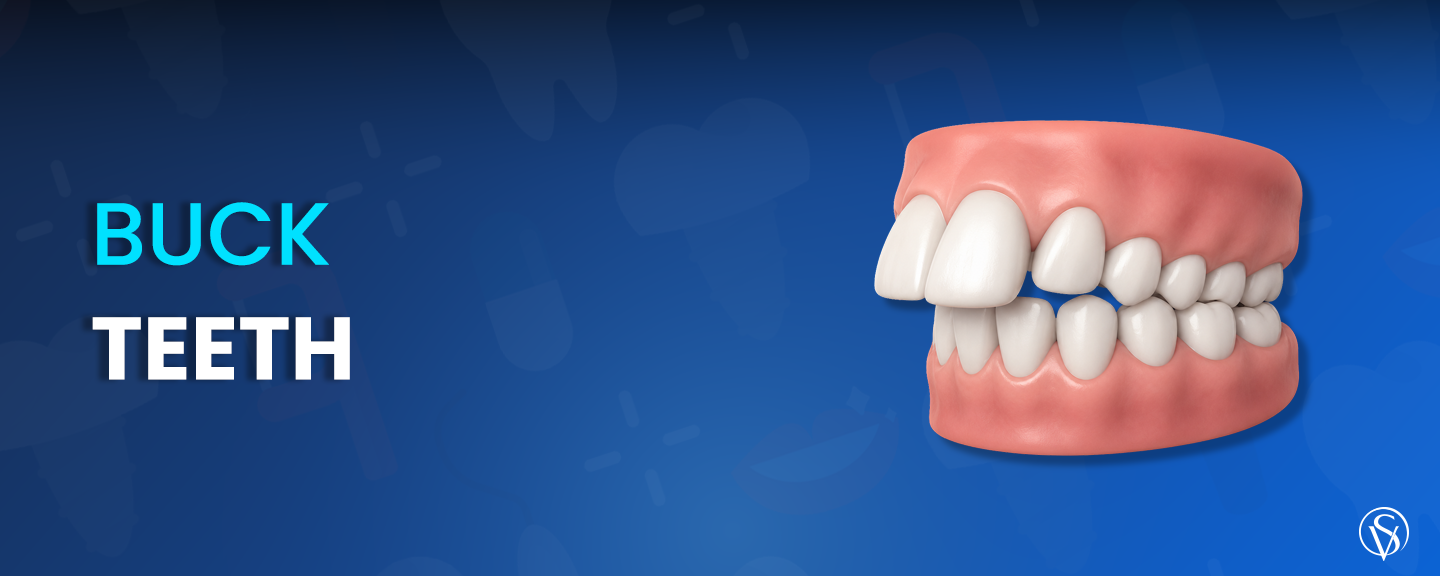
Buck teeth are upper front teeth that tilt or protrude forward beyond the lower teeth, a position measured clinically as an increased overjet. The trait is one of the most recognised features of Angle Class II Division 1 malocclusion, and it ranges from a mild cosmetic tilt to a pronounced protrusion that changes the bite. Some cases are inherited through jaw shape, while others develop from childhood habits such as prolonged thumb sucking. Because buck teeth sit at the meeting point of appearance, function, and dental health, correction is handled within orthodontics rather than treated as a purely cosmetic concern.
Buck teeth respond well to treatment at almost any age. Braces and clear aligners correct the majority of cases by moving the teeth into a healthier position, while veneers can camouflage very mild protrusion without moving anything. Pronounced protrusion driven by jaw position may need surgical correction alongside orthodontics. The right route depends on how severe the protrusion is and whether the cause is dental or skeletal, which a clinical assessment confirms before treatment begins.
Key Points
- Buck teeth are upper front teeth that protrude horizontally, a position measured clinically as an increased overjet.
- They develop either from an inherited jaw structure or from childhood habits such as thumb sucking and tongue thrusting.
- Clinically they are the defining feature of Angle Class II Division 1 malocclusion, which affects close to 1 in 5 people worldwide.
- A large overjet is more than a cosmetic issue, since it raises the risk of injury to the front teeth and can affect biting and speech.
- Most cases are corrected with braces or clear aligners, while veneers only camouflage very mild protrusion and severe skeletal cases may need jaw surgery.
- Buck teeth can be treated at any age, though an early evaluation in childhood opens the widest range of options.
What Causes Buck Teeth?
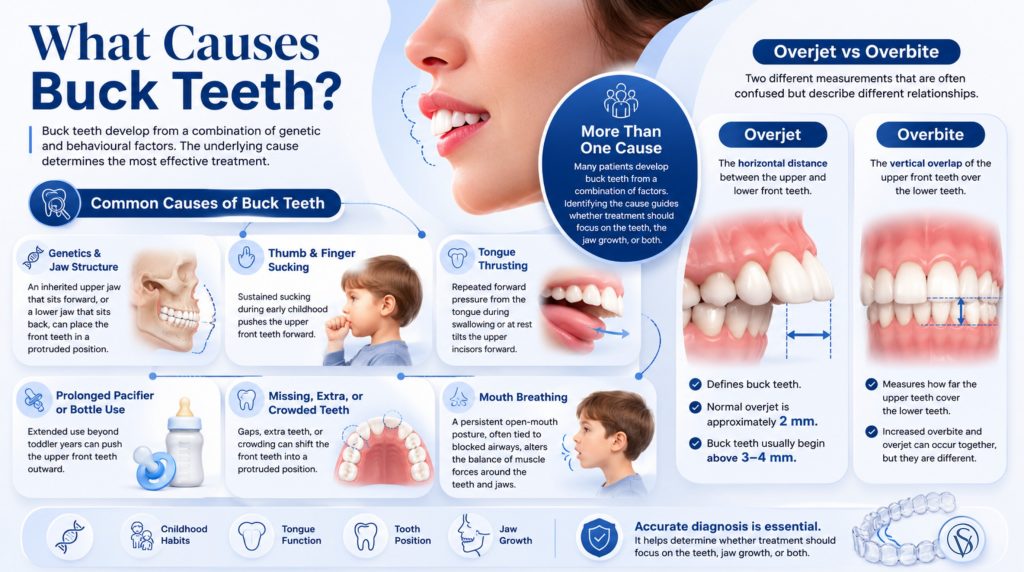
Buck teeth develop from a mix of genetic and behavioural factors, and often more than one factor is involved. The forward tilt of the upper teeth can come from the shape of the jaws a person inherits, from habits that push the teeth outward during childhood, or from problems with the number and spacing of teeth. Understanding the cause matters because it decides which treatment will work. The most common causes fall into a few clear groups.
- Genetics and jaw structure: An inherited upper jaw that sits forward, or a lower jaw that sits back, positions the front teeth in a protruded relationship from birth.
- Thumb and finger sucking: Sustained daily sucking during early childhood pushes the upper front teeth forward and is linked to increased overjet and a Class II relationship (Ling et al., 2018).
- Tongue thrusting: Repeated forward pressure from the tongue during swallowing or at rest proclines the upper incisors over time.
- Prolonged pacifier or bottle use: Extended use beyond the toddler years applies the same outward force as digit sucking on the developing dental arch.
- Missing, extra, or crowded teeth: Gaps, supernumerary teeth, or crowding can shift the front teeth into a protruded position.
- Mouth breathing: A persistent open-mouth posture, often tied to blocked airways, alters the balance of muscle forces around the teeth.
These causes explain why buck teeth appear in some children with no family history and in others despite no habits at all. A single strong habit can create protrusion in a child with otherwise normal jaws, while an inherited skeletal pattern can produce buck teeth on its own. Identifying which is at work guides whether treatment focuses on the teeth, the jaw growth, or both.
Clinic Note: At Vera Smile, buck teeth are assessed by separating dental causes from skeletal ones using a clinical examination and records before any treatment route is chosen, because the two respond to very different approaches.
Are Buck Teeth Genetic or Caused by Habits?
Buck teeth can come from both, and the two often overlap. A skeletal pattern, meaning the size or position of the jaws, is largely inherited and sets the underlying relationship between the upper and lower teeth. Habit-driven protrusion, by contrast, develops when forces such as thumb sucking or tongue thrusting tip the upper front teeth outward during the years the teeth and bone are still forming. Many patients show a combination, where a mild inherited tendency is made more pronounced by a childhood habit. This distinction shapes treatment, since habit-related cases caught early can sometimes be intercepted, while skeletal cases need tooth movement or, in severe forms, jaw correction.
What Is the Difference Between Overjet and Overbite?
Overjet and overbite describe two different measurements that are frequently confused. Overjet is the horizontal gap between the upper and lower front teeth, and it is the measurement that defines buck teeth. Overbite is the vertical overlap, meaning how far the upper teeth cover the lower teeth from top to bottom. A healthy overjet sits at roughly 2 mm, and buck teeth generally begin once the overjet passes 3 to 4 mm. When the upper front teeth also tip forward as part of a Class II bite, the pattern is classed as Angle Class II Division 1, a malocclusion that affects close to 1 in 5 people worldwide (Alhammadi et al., 2018). A person can have an increased overjet, an increased overbite, or both at once, which is why an accurate measurement at consultation matters more than the everyday label of buck teeth.
What Problems Can Buck Teeth Cause?
Buck teeth can create functional, physical, and emotional problems, and the risk grows as the overjet increases. Mild protrusion may cause nothing more than a cosmetic concern, while a large overjet carries measurable health consequences. The clinical significance rises with the size of the gap and with how much the lips can cover the front teeth. The main problems group as follows.
- Injury risk: A large overjet can double or even triple the chance of trauma to the upper front teeth, and this trait is linked to hundreds of millions of dental injuries worldwide (Petti, 2015). The risk climbs sharply once an overjet reaches 5 mm or more (Arraj et al., 2019).
- Difficulty biting and chewing: Protruding front teeth may not meet the lower teeth correctly, which reduces biting efficiency.
- Speech effects: A pronounced overjet can interfere with certain sounds and contribute to a lisp.
- Lip strain and mouth breathing: When the lips cannot close comfortably over the front teeth, the result is lip strain and a tendency toward mouth breathing.
- Enamel and gum wear: An uneven bite concentrates force on specific teeth, accelerating enamel wear and gum irritation.
- Emotional and social impact: Visible protrusion can affect confidence and willingness to smile, particularly in children and teenagers.
The takeaway is that buck teeth are not only an appearance issue once the overjet becomes significant. The injury risk in particular gives a clear medical reason to correct a large overjet, especially in active children whose front teeth are exposed. A consultation can measure the overjet precisely and weigh the functional risk against the cosmetic concern.
Warning: An untreated large overjet combined with poor lip coverage significantly raises the risk of fracturing the front teeth during a fall or sports impact. A custom mouthguard is strongly advised for children with protruding front teeth who play contact sports, until the overjet is corrected.
How Are Buck Teeth Corrected?
Buck teeth are corrected by moving the teeth into a healthier position, and in severe cases by adjusting the jaw relationship as well. The treatment is matched to the severity of the protrusion and to whether the cause is dental or skeletal. Mild cases have the widest choice of options, while pronounced skeletal cases need more involved treatment. The main routes are set out here.
- Braces: The most reliable option for moderate to severe dental protrusion, using brackets, wires, and often elastics to retract the front teeth.
- Clear aligners: A discreet option for mild to moderate protrusion, using removable trays to shift the teeth.
- Veneers: A cosmetic camouflage for very mild protrusion, changing the appearance without moving the teeth.
- Tooth extraction: Sometimes combined with braces when crowding leaves no room to retract the front teeth.
- Jaw surgery: Reserved for severe skeletal protrusion where the jaw position itself must be corrected.
Choosing between these depends on measurements taken at consultation and on the patient’s goals. The following sections answer the questions patients ask most about each option.
Can Braces Fix Buck Teeth?
Yes. Dental braces are the most dependable treatment for buck teeth and can correct even severe protrusion. Braces apply steady, controlled force through brackets and wires, and elastics are often added to draw the upper teeth back and close the overjet. They handle the widest range of cases, from a moderate tilt to a pronounced Class II bite, and give the orthodontist precise control over each tooth. For skeletal cases in growing children, braces are sometimes combined with growth-guiding appliances to influence jaw development before the bones mature.
Can Buck Teeth Be Fixed Without Braces?
Yes, in several situations. Mild to moderate protrusion can be corrected with clear aligners instead of fixed braces, and a very slight cosmetic tilt can be masked with veneers. Severe skeletal cases are corrected through jaw surgery paired with orthodontics rather than dental braces alone. What no approach avoids is the need for professional tooth movement or surgery when the overjet is significant, because the position of the teeth or jaw has to physically change for the correction to hold.
Can Clear Aligners Fix Buck Teeth?
Yes, for mild to moderate cases. Clear aligners use a series of removable transparent trays to move the teeth gradually and can close a small to medium overjet. They appeal to adults and older teenagers who want a discreet, removable option. Their main limitation is compliance, since the trays must be worn 20 to 22 hours a day to work, and very complex or heavily skeletal protrusion is better handled with braces. A consultation confirms whether a specific overjet falls within the range clear aligners can treat predictably.
Can Veneers Fix Buck Teeth?
No, not in the true sense, and only for very mild cases. Veneers are thin shells bonded to the front of the teeth, so they change how buck teeth look without moving them or correcting the bite. They can mask a slight cosmetic tilt in a person whose bite is otherwise healthy, but they do not reduce the overjet or address the functional and injury risks of a large protrusion. Using dental veneers on a significant overjet can require aggressive tooth reduction and leave the underlying bite problem untreated.
Clinic Note: Vera Smile recommends orthodontic correction rather than veneers whenever the overjet is functionally significant, and reserves cosmetic veneers for the narrow group of patients with a healthy bite and only a minor appearance concern.
When Is Jaw Surgery or Tooth Extraction Needed?
Jaw surgery is needed when the protrusion is skeletal and severe, meaning the jaw bones themselves are out of position rather than just the teeth. In these cases orthognathic surgery repositions the jaw and is planned together with braces to align the teeth before and after the operation. Tooth extraction, a less involved step, is used when crowding leaves no space to move the front teeth backward, so removing selected teeth creates the room needed to retract them. Both routes are decided after imaging and are limited to cases where tooth movement alone cannot achieve a stable result.
What Is the Best Age to Fix Buck Teeth?
The best age to begin depends on the cause, but early evaluation gives a child the most options. The American Association of Orthodontists recommends a first orthodontic check by age 7, when enough permanent teeth have erupted and the jaw is still growing (American Association of Orthodontists, n.d.). Buck teeth can be treated across three broad stages.
- Growing children (around 7 to 10): Early or interceptive treatment can guide jaw growth and reduce a large overjet while the bones are still forming.
- Teenagers: The years when most permanent teeth are present are a strong window for comprehensive braces or aligners.
- Adults: Correction remains fully possible at any age, since teeth can be moved throughout life, though adult treatment can take longer because the bone is denser and the jaws no longer grow.
Early evaluation does not always mean early treatment. For many children the orthodontist simply monitors development and begins active treatment later. The value of the age 7 check is catching a developing overjet before jaw growth is complete, when reducing the injury risk is simplest.
How Much Does It Cost to Fix Buck Teeth?
The cost of correcting buck teeth depends mainly on the treatment route and the severity of the protrusion. The figures below are broad international ranges for context, and the final quote is set at consultation once the overjet and case complexity are measured.
| Treatment | Estimated cost range | Best suited for |
|---|---|---|
| Metal braces | €2,600 to €6,200 | Moderate to severe protrusion |
| Ceramic braces | €3,500 to €7,500 | Patients wanting less visible braces |
| Clear aligners | €2,600 to €7,000 | Mild to moderate protrusion |
| Lingual braces | €7,000 to €11,500 | Adults wanting hidden appliances |
| Veneers (per tooth) | €800 to €2,200 | Very mild cosmetic cases only |
| Jaw surgery with orthodontics | €17,500 and above combined | Severe skeletal protrusion |
The cheapest option is not always the right one, because a treatment that does not match the severity of the overjet will not hold. A mild case may be corrected affordably with aligners, while a large skeletal overjet needs the greater investment of surgery and braces. A consultation matches the treatment to the case so the cost reflects what is clinically needed.
How Long Does It Take to Correct Buck Teeth?
Correcting buck teeth takes anywhere from a few weeks to several years, depending on the route and the severity. Cosmetic veneers on a very mild case can be completed in a few weeks, since no tooth movement is involved. Orthodontic correction takes longer because the teeth move gradually. Mild cases treated with braces or aligners often finish in 12 to 18 months, moderate cases in 18 to 24 months, and severe or skeletal cases in 24 to 36 months or more. Cases that combine jaw surgery with orthodontics run at the longer end, often 18 to 36 months in total. Compliance affects the timeline strongly, particularly with clear aligners and with elastics on braces, where inconsistent wear extends treatment.
How Do Children Develop Buck Teeth?
Children develop buck teeth when the upper front teeth are pushed or grow into a forward position while the jaw and teeth are still forming. In the early years the bone is soft and responsive, so repeated force from habits such as thumb sucking, tongue thrusting, or prolonged pacifier use can gradually tip the upper incisors outward and widen the overjet. Sustained daily digit sucking in particular is linked to an increased overjet and a Class II relationship in the primary teeth (Ling et al., 2018).
Growth and timing matter just as much as habits. Buck teeth can first show in the baby teeth and then carry through as the permanent front teeth erupt, most of which come in between ages 6 and 8. During this mixed dentition stage, an inherited jaw pattern, where the upper jaw sits forward or the lower jaw sits back, becomes visible as the adult incisors settle into place. This is why a child with no habit at all can still develop protruding front teeth, purely from the way the jaws grow.
Because the trait sets in while the jaw is still growing, childhood is the ideal time to catch it. The forces and growth patterns behind buck teeth act early, so identifying them during the primary or mixed dentition stage gives the widest choice of gentle, growth-guiding options later. A first assessment in pediatric dentistry can spot a developing overjet and set a monitoring plan long before permanent treatment is needed.
How to Prevent Buck Teeth in Children
Preventing buck teeth focuses on breaking the childhood habits that push the front teeth forward and on catching problems early. Not every case is preventable, since inherited jaw patterns cannot be avoided, but habit-related protrusion often can be reduced. Parents can take several practical steps during the early years.
- Limit thumb and finger sucking and help the child stop by around age 3 to 4, before the habit reshapes the developing bite.
- Wean the pacifier early rather than letting use continue into the preschool years.
- Encourage nasal breathing and address tongue thrust by seeking help for blocked airways or persistent open-mouth posture.
- Book an early evaluation in pediatric dentistry to catch a developing overjet while the jaw is still growing.
These steps work best when started early, because the forces that create buck teeth act while the bone and teeth are still forming. Once a habit is broken in a young child, a mild overjet can sometimes improve on its own as the bite settles. When it does not, early monitoring means treatment can begin at the ideal moment.
Tips for Patients: Replace a sucking habit with a positive alternative such as a comfort toy, praise progress rather than punishing lapses, and use gentle daytime reminders. A paediatric dentist can add a simple habit-breaking appliance if encouragement alone is not enough.
FAQ
Buck teeth can gradually worsen when the underlying cause is still active. An ongoing habit such as thumb sucking or tongue thrusting keeps pushing the teeth forward, and continued jaw growth in a child can increase a skeletal overjet. In adults with no active habit the protrusion is more stable, but existing bite wear and gum strain can still progress. A monitoring visit shows whether a specific case is stable or changing.
No. Buck teeth cannot be safely corrected at home. Moving teeth requires controlled, professionally planned force, and do-it-yourself methods or unsupervised mail-order aligners can cause root damage, gum recession, and new bite problems. Correction should always be planned and monitored by a qualified orthodontist who can measure the overjet and confirm the cause first.
Buck teeth can relapse after treatment when retainers are not worn as directed. Teeth have a natural tendency to drift back toward their original position, so a retainer is essential to hold the corrected result. With consistent retainer wear the correction is stable long term, which is why retention is treated as part of the treatment rather than an optional extra.
Coverage depends on the plan and on whether the treatment is judged medically necessary rather than purely cosmetic. Many plans include a separate lifetime orthodontic benefit, often in the region of $1,000 to $3,000, which applies to braces or aligners but rarely to cosmetic veneers. Checking the orthodontic benefit before starting treatment is the clearest way to know what is included.
Alhammadi, M. S., Halboub, E., Fayed, M. S., Labib, A., & El-Saaidi, C. (2018). Global distribution of malocclusion traits: A systematic review. Dental Press Journal of Orthodontics, 23(6), 40.e1–40.e10.
American Association of Orthodontists. (n.d.). The right time: When should your child see an orthodontist?
Arraj, G. P., Rossi-Fedele, G., & Doğramacı, E. J. (2019). The association of overjet size and traumatic dental injuries: A systematic review and meta-analysis. Dental Traumatology, 35(4–5), 217–232.
Ling, H. T. B., Sum, F. H. K. M. H., Zhang, L., Yeung, C. P. W., Li, K. Y., Wong, H. M., & Yang, Y. (2018). The association between nutritive, non-nutritive sucking habits and primary dental occlusion. BMC Oral Health, 18(1), 145.
Petti, S. (2015). Over two hundred million injuries to anterior teeth attributable to large overjet: A meta-analysis. Dental Traumatology, 31(1), 1–8.