
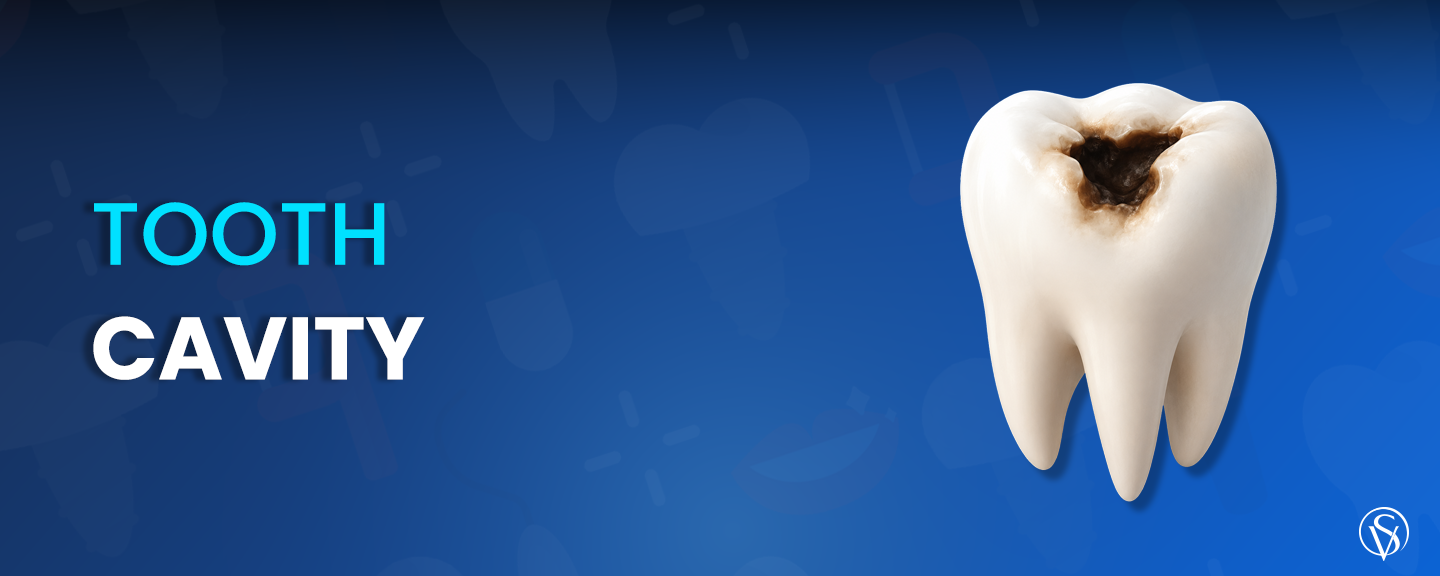
A tooth cavity is a permanently damaged area of a tooth that develops into a hole when acid-producing bacteria feed on sugars and dissolve the enamel. It starts as invisible mineral loss and moves through defined stages until it reaches the softer dentin and, if ignored, the nerve. Caries in permanent teeth is one of the most common health conditions worldwide, with an estimated 2.24 billion prevalent cases in 2021.
The encouraging part is that early decay can be reversed with fluoride before a hole forms; once the surface cavitates, professional treatment becomes necessary. What that treatment involves depends on how deep the decay has reached, ranging from a fluoride application or a filling to a root canal, or extraction as a last resort. Cost follows the same pattern, a cavity caught early is smaller, faster, and far cheaper to treat than one that reaches the pulp.
Key Points:
- A tooth cavity (dental caries) is a permanently damaged area of the tooth that develops into a hole, caused by acid-producing bacteria feeding on sugars.
- Caries in permanent teeth is one of the most common health conditions worldwide, with an estimated 2.24 billion prevalent cases in 2021.
- Decay progresses through defined stages: demineralization, enamel decay, dentin decay, and pulp involvement.
- Early-stage decay can be reversed with fluoride; once a hole forms, professional treatment is required.
- Treatment depends on severity: fluoride, fillings, inlays/onlays, crowns, root canal, and extraction as a last resort.
- In Turkey, a composite filling generally costs about €50–€130 per tooth, well below UK, German, and US private fees.
What Is a Tooth Cavity?
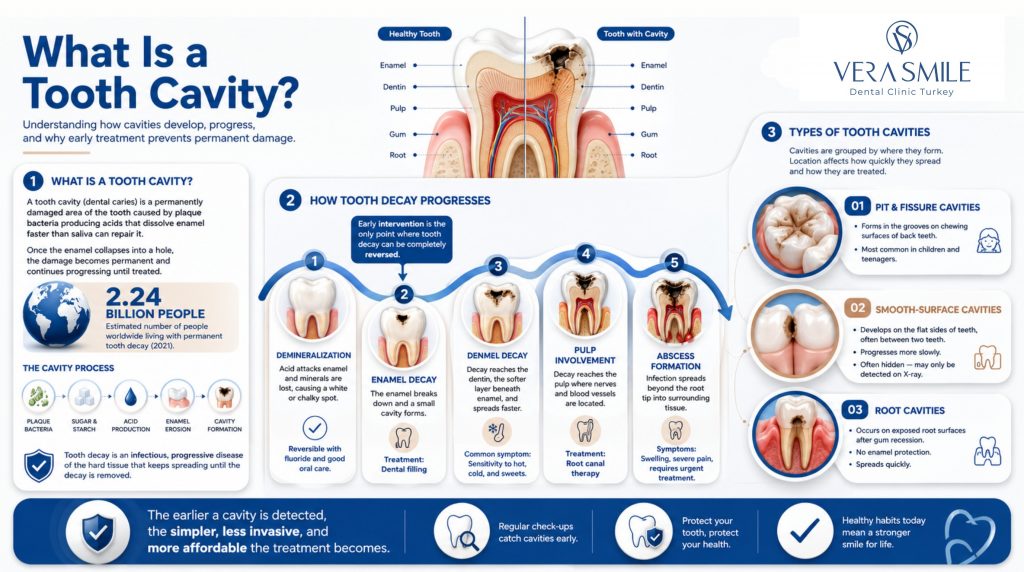
A tooth cavity, known clinically as dental caries, is a permanently damaged area of the tooth surface that has decayed into a hole. It forms through a repeating cycle, plaque bacteria feed on sugars and starches, release acid, and that acid strips minerals from the enamel faster than saliva can replace them. Over time the weakened surface collapses into a cavity. A tooth cavity is not a cosmetic flaw but an infectious, progressive disease of the hard tissue, which is why it keeps spreading until the decay is removed. Its scale is significant; an estimated 2.24 billion people had caries in permanent teeth in 2021, making it one of the most widespread health conditions on record (Li, Z., Yu, C., & Chen, H., et al. (2025). Global, regional, and national caries of permanent teeth incidence, prevalence, and disability-adjusted life years, 1990–2021: analysis for the Global Burden of Disease Study. BMC Oral Health, 25.).
What Are the Stages of Tooth Decay?
Tooth decay does not appear all at once; a tooth cavity develops through recognisable stages, each affecting a deeper layer of the tooth. Knowing the stage matters because the first is reversible while every stage after it is not. The stages are:
- Demineralization: The earliest stage, where acid removes minerals from the enamel and leaves a white or chalky spot that can still be repaired with fluoride.
- Enamel decay: The surface breaks down and a small hole forms in the enamel, at which point the damage becomes permanent and needs a filling.
- Dentin decay: Decay reaches the softer dentin beneath the enamel and spreads faster, often bringing sensitivity to hot, cold, and sweet foods.
- Pulp involvement: The decay reaches the pulp where the nerves and blood vessels sit, causing throbbing pain and requiring root canal treatment.
- Abscess formation: Bacteria infect the tissue around the root tip, producing a painful abscess and swelling that can spread if the tooth is left untreated.
The gap between the first and second stage is the most important moment in the life of a tooth cavity. Catching it during demineralization can reverse the damage entirely, while every stage after that adds tissue loss, cost, and complexity to the fix.
What Are the Types of Tooth Cavities?
Cavities are grouped by where they form on the tooth, and the location shapes how quickly a tooth cavity spreads and how it is treated. Three types account for the majority of cases. These are:
- Pit and fissure cavities: These form in the grooves on the chewing surfaces of back teeth and are the most common type in children and teenagers.
- Smooth-surface cavities: These develop on the flat sides of teeth, often between two teeth where floss does not reach, and progress more slowly.
- Root cavities: These appear on the exposed root surface when gums recede, and they spread quickly because root surfaces have no protective enamel.
Because each type sits in a different place, some are far easier to spot than others; root and between-teeth cavities are often found only on an X-ray. Matching the treatment to the type and location is what keeps a small tooth cavity from turning into a larger restoration.
What Causes Tooth Cavities?
A tooth cavity forms when acid from plaque bacteria repeatedly dissolves enamel until a hole develops. Frequent sugar and starch intake is the main driver, but low saliva flow, weak oral hygiene, and exposed roots all raise the risk of a tooth cavity. The main causes are:
- Plaque and bacteria: A sticky film of bacteria builds up on teeth and produces the acid that starts the decay process.
- Frequent sugar and acid intake: Every sugary or starchy snack feeds the bacteria and triggers a fresh acid attack, so frequency matters more than quantity.
- Poor oral hygiene: Skipped brushing and flossing let plaque sit long enough to demineralise the enamel.
- Dry mouth (low saliva): Saliva neutralises acid and repairs early damage, so reduced flow leaves teeth exposed.
- Fluoride deficiency: Without regular fluoride, enamel is weaker and less able to resist and repair acid attacks.
- Gum recession and exposed roots: Receded gums uncover soft root surfaces that decay faster than enamel-covered crowns.
- Deep tooth grooves: Narrow grooves on molars trap food and plaque that a toothbrush cannot reach.
Most of these causes are within a patient’s control, which is why daily habits matter more than genetics for the majority of people. Cutting sugar frequency and keeping plaque down removes the exact conditions a tooth cavity needs to develop, and that is where prevention begins.
What Are the Symptoms of a Tooth Cavity?
The symptoms of a tooth cavity depend on how far the decay has advanced, and the earliest cavities often produce no symptoms at all. As decay reaches the dentin and nerve, the warning signs become harder to ignore. The most common signs are:
- Sensitivity to hot and cold: A short, sharp reaction to temperature can signal that decay has thinned the enamel.
- Pain when eating sweets: Sugar reaching exposed dentin produces a distinctive ache.
- Visible holes or dark spots: A hole, pit, or dark patch on the tooth is a clear sign the decay has broken the surface.
- Discoloration: Brown, black, or white staining can mark the area where minerals have been lost.
- Toothache or lingering pain: Pain that lasts after eating, or wakes you at night, points to deeper decay near the nerve.
- Bad breath: Trapped decay and bacteria can produce a persistent bad taste or odour.
Because pain arrives late in the process, waiting for symptoms is a poor way to catch a tooth cavity. The absence of discomfort does not mean the tooth is healthy, which is the reason routine check-ups matter more than most people expect.
Clinical Note: Early cavities frequently cause no pain or visible change, so they are missed during self-checks at home. A dental examination with X-rays detects decay between teeth and under the enamel before it reaches the stage where a patient would feel it.
How Are Cavities Diagnosed?
A tooth cavity is diagnosed through a clinical examination combined with dental X-rays. The dentist inspects each tooth visually, checks suspect areas with a probe for softened enamel, and uses bitewing X-rays to find decay hidden between teeth or beneath existing fillings. X-rays are the deciding tool because they reveal decay before it is visible to the eye, which is how early and between-teeth cavities are caught. The diagnosis also establishes the stage of the cavity, and that stage determines whether the tooth needs fluoride, a filling, or something more involved.
What Happens if a Tooth Cavity Is Left Untreated?
Untreated, a tooth cavity does not stay the same; it keeps growing deeper and wider until it damages the nerve and the tissue around the root. The longer it is left, the more the complications compound. As the decay spreads, they build in stages. These are:
- Pulpitis and severe pain: Once decay reaches the pulp, the nerve becomes inflamed and produces sharp, throbbing pain.
- Dental abscess and infection: Bacteria reaching the root tip form a pocket of pus that can swell and spread to surrounding tissue.
- Tooth loss: When too much structure is destroyed, the tooth can no longer be saved and has to be extracted.
- Spread to neighbouring teeth: Decay and infection can move to adjacent teeth, turning one problem into several.
Each stage of neglect turns a smaller, cheaper procedure into a larger one: a filling becomes a root canal, and a root canal becomes an extraction and replacement. Treating a tooth cavity early is the difference between saving the tooth and losing it.
Clinical Note: Decay at the demineralization stage can be reversed with fluoride, but once the surface cavitates into a hole, the damage is permanent and cannot heal on its own. From that point the only question is how much of the tooth can be saved, which is why timing changes the outcome.
How Are Tooth Cavities Treated?
Treatment for a tooth cavity is chosen according to how deep the decay has reached, from a surface that can still be remineralised to a tooth that can no longer be saved. The options move in order of severity. These are:
- Fluoride treatment and remineralization: For a cavity still at the demineralization stage, professional fluoride can rebuild the enamel and reverse the damage without drilling.
- Dental fillings: Once a hole has formed, the decay is removed and the space is filled with composite or amalgam to restore the tooth.
- Inlays and onlays: For larger cavities that a standard filling cannot support, a custom ceramic inlay or onlay rebuilds the chewing surface.
- Dental crowns: When decay has weakened much of the tooth, a crown caps and protects what remains.
- Root canal treatment: If decay reaches the pulp, the infected nerve is removed, the canal is cleaned and sealed, and the tooth is crowned.
- Tooth extraction: When a tooth is beyond repair, removal is the last resort, followed by a replacement option to protect the bite.
The pattern across every option is the same; the earlier a tooth cavity is treated, the more of the natural tooth is preserved and the simpler the procedure. The right choice is made by the dentist after an examination and X-ray, not by the symptom alone. Professionally applied fluoride has been shown to remineralise early enamel caries, which is why the first option on this list is a real treatment and not only prevention (Gao, S. S., Zhao, I. S., Duangthip, D., Lo, E. C. M., & Chu, C. H. (2016). Caries remineralisation and arresting effect in children by professionally applied fluoride treatment: A systematic review. BMC Oral Health, 16, 12.).
Tips for the Patients: Before a filling, ask your dentist which material will be used (composite or ceramic) and how many surfaces are involved, since both affect the price and the lifespan. In Istanbul, a single-surface composite filling is generally completed in one 30 to 60 minute visit, so international patients rarely need a second trip for a straightforward cavity.
What Is the Use of Composite, Amalgam, and Ceramic Fillings?
Each filling material is suited to a different kind of tooth cavity, based on where the tooth sits, how much structure is lost, and how much biting force it takes. Composite is the default for visible teeth, amalgam is a durable low-cost option for back teeth, and ceramic handles larger restorations. Their main uses compare as follows:
| Aspect | Composite | Amalgam | Ceramic |
|---|---|---|---|
| Aesthetics | Tooth-coloured, blends in | Silver, clearly visible | Tooth-coloured, closest to natural |
| Typical use | Front and visible teeth, small to medium cavities | Back teeth, larger cavities where looks matter less | Large cavities, inlays and onlays, high-load molars |
| Durability | Around 7–10 years, median near 11 years | Longest-lasting, median over 16 years | High, comparable to or above composite for large restorations |
| Relative cost | Moderate | Lowest | Highest |
In posterior teeth where longevity is the priority, amalgam has historically outlasted composite: one long-term trial reported a seven-year survival of 94.4 percent for amalgam against 85.5 percent for composite, with a secondary-cares risk 3.5 times higher in composite restorations.
For most patients at Vera Smile the choice still favours tooth-coloured composite on visible teeth and ceramic inlays or onlays on large posterior cavities, matching the material to the specific tooth rather than applying a blanket rule (Bernardo, M., Luís, H., Martin, M. D., Leroux, B. G., Rue, T., Leitão, J., & DeRouen, T. A. (2007). Survival and reasons for failure of amalgam versus composite posterior restorations placed in a randomized clinical trial. Journal of the American Dental Association, 138(6), 775–783; Moraschini, V., Fai, C. K., Alto, R. M., & Dos Santos, G. O. (2015). Amalgam and resin composite longevity of posterior restorations: A systematic review and meta-analysis. Journal of Dentistry, 43(9), 1043–1050.).
Are Amalgam Fillings Safe?
Yes. Amalgam fillings are considered safe for most patients by major dental and health authorities, even though they contain mercury bound inside a stable metal alloy. Once the filling sets, the mercury is locked into the material, and amalgam carries a clinical safety record spanning roughly 150 years of use in back teeth. The move away from amalgam in many countries is driven mainly by aesthetics and environmental mercury regulation, not by proven harm to patients, and international agreements such as the Minamata Convention are phasing it down for ecological reasons. Patients who prefer a natural look or want to avoid metal can choose tooth-coloured composite or ceramic, the two most common modern tooth fillings.
What Is a Composite Filling?
A composite filling repairs a tooth cavity with a tooth-coloured resin that is bonded to the tooth and hardened with a curing light. It is placed in a single visit, shaped directly in the mouth, and colour-matched to the surrounding enamel, which makes it the default choice for front and visible teeth. Because composite bonds to tooth structure, it needs less drilling than metal fillings and preserves more of the natural tooth. The same resin material is also used cosmetically in composite bonding to reshape teeth or close gaps, though a filling treats decay while bonding is an aesthetic procedure. Its main limit is lifespan: composite lasts around 7 to 10 years and wears faster than amalgam on heavy-load back teeth.
What Is a Ceramic Filling?
A ceramic filling restores a larger tooth cavity with a custom porcelain inlay or onlay, made in a lab or milled chairside and then bonded into the prepared tooth. It suits cavities too large for a direct composite but not extensive enough to need a full crown, and it withstands the biting force on molars well. Ceramic is the closest match to natural enamel in colour and translucency, and it resists staining better than composite over time. The same porcelain used here is used in porcelain veneers, where thin ceramic shells cover the front of teeth for cosmetic reasons rather than to treat decay. Its trade-off is cost: ceramic is the most expensive of the three materials, but its durability on large restorations often justifies the difference.
How Much Does Tooth Cavity Treatment Cost in Turkey?
Treating a tooth cavity in Turkey costs far less than in the UK, Germany, or the US, mainly because lab and clinical overheads are lower rather than the materials being cheaper. A single-surface composite filling is the baseline, and the price rises with the number of surfaces treated and any added procedure. The average figures are:
| Treatment | Turkey | Germany | UK (private) | USA |
|---|---|---|---|---|
| Composite filling (1 surface) | €50–€130 | €100–€250 | €115–€290 | €140–€415 |
| Composite filling (multi-surface) | +20–40% per surface | €200–€400 | €235–€470 | €185–€550 |
| Root canal (molar) | ~€120 | €300–€800* | €350–€1,400 | €645–€1,380+ |
| Crown (porcelain/zirconia) | €170–€300 | €300–€900* | €470–€1,170+ | €920–€2,760 |
These figures reflect standard fees at a dental clinic in Turkey, where the examination, filling, and follow-up are generally handled in a single visit for international patients. The wider the gap between a filling and a crown, the more early treatment saves, a tooth cavity caught at the filling stage costs a fraction of the root canal and crown it turns into once the decay reaches the pulp. As a Turkey-specific reference point, the 2026 Turkish Dental Association tariff lists clinician fees of 3,068 ₺ (€ 56,90) for a single-surface composite, 3,850 ₺ (€ 71,40) for two surfaces, and 4,818 ₺ (€ 89,35) for three surfaces, before VAT.
Note on choosing a clinic: When comparing clinics for cavity treatment, check three things, that diagnosis is made with an examination and X-ray, that the filling material and brand are stated in writing, and that a follow-up policy is in place. Vera Smile carries out these steps within a single patient journey in Istanbul, planning diagnosis, filling, and review together.
How Can You Prevent Tooth Cavities?
Most cases of tooth cavity are preventable, and prevention comes down to controlling plaque and limiting how often teeth meet sugar. A consistent daily routine does more than any single product. The key steps are:
- Brush twice daily with fluoride toothpaste: Brushing morning and night removes plaque and delivers the fluoride that hardens enamel.
- Floss daily: Flossing clears plaque and food from between teeth where a brush cannot reach, the site of many hidden cavities.
- Cut back on sugary and starchy foods: Reducing how often you snack limits the acid attacks that drive decay.
- Get regular dental check-ups: Twice-yearly visits catch a tooth cavity while it is still small or reversible.
- Consider fluoride treatments or sealants: Professional fluoride and protective sealants add an extra barrier, especially on grooved molars.
- Manage dry mouth: Staying hydrated and treating low saliva flow restores the mouth’s natural defence against acid.
Prevention is not only easier than treatment, it is far cheaper; the cost of fluoride toothpaste and twice-yearly check-ups is a small fraction of a single filling, let alone a crown. Because professionally applied fluoride can remineralise early enamel damage, regular dental visits also catch a tooth cavity while it can still be reversed (Gao, S. S., Zhao, I. S., Duangthip, D., Lo, E. C. M., & Chu, C. H. (2016). Caries remineralisation and arresting effect in children by professionally applied fluoride treatment: A systematic review. BMC Oral Health, 16, 12.).
Tips for the Patients: Use a toothpaste with 1,450 ppm fluoride, and after brushing spit rather than rinse with water, so the fluoride stays on the teeth longer. If you snack on something sugary, have it with a meal instead of spreading sweets across the day, since it is the frequency of acid attacks, not the total amount, that drives a tooth cavity.
FAQ
No. A tooth cavity cannot heal once a hole has formed, because enamel and dentin do not regrow. Only the earliest stage, demineralization, can be reversed, and only with fluoride before the surface breaks. After that point the decay needs professional treatment to stop it spreading.
A tooth cavity generally takes months to a few years to progress from the first white spot to a hole, depending on diet, hygiene, and saliva flow. In high-sugar, low-fluoride conditions it can advance in a matter of months, while good habits can stall or reverse it at the early stage.
No. A filling is placed under local anaesthesia, so the procedure itself is not painful. Mild sensitivity for a day or two afterwards is normal and settles on its own.
Yes. A straightforward composite filling is completed in a single visit, generally within 30 to 60 minutes, so same-day treatment is standard for a simple tooth cavity. Several fillings can be placed in one appointment, which suits international patients on a short stay.
No. Cavities caught at the demineralization stage can be treated with fluoride instead of drilling. Once decay has broken through the enamel into a hole, the decayed tissue has to be removed and the tooth restored, which is where drilling and filling apply.
Yes. Decay can develop at the edge of an old filling where it meets the tooth, known as secondary or recurrent caries. This is a common reason fillings are replaced, and it is one of the things a dentist checks for on an X-ray at each visit.