
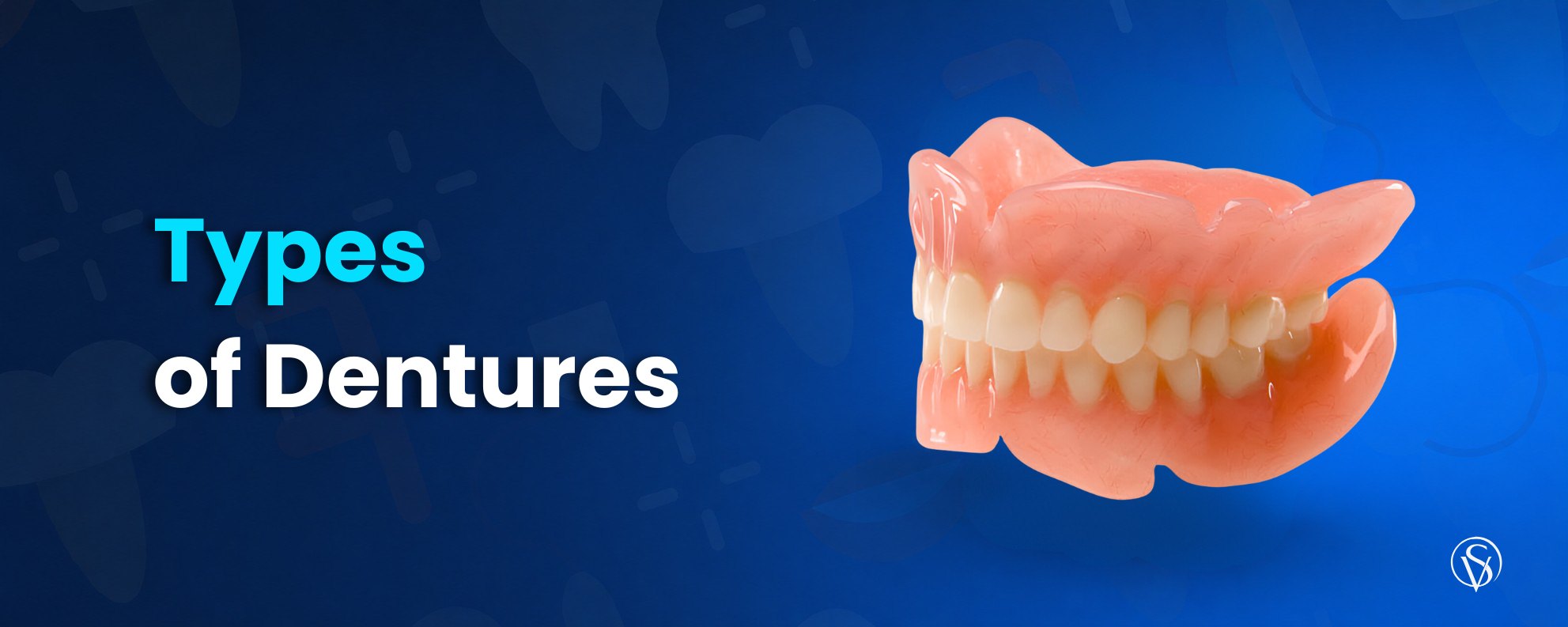
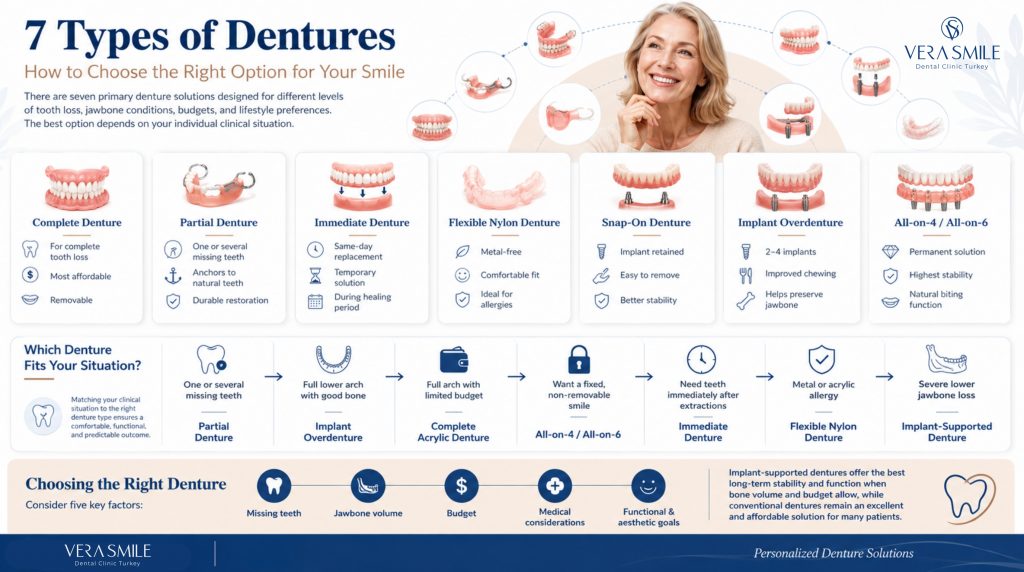
There are seven main types of dentures, covering every clinical situation from the loss of a single tooth to a completely edentulous jaw. This diverse line-up includes complete, partial, immediate, flexible nylon, snap-on, implant-supported overdentures, and fixed All-on-4 or All-on-6 systems, ensuring that every patient can find a tailored solution for smile restoration.
In terms of functionality, conventional complete and partial dentures simply rest on the gums or clip onto remaining teeth, while immediate dentures serve as a transitional option fitted the exact day your teeth are extracted. For those seeking maximum stability, implant-supported designs range from removable clip-on overdentures to permanent, screw-retained All-on-4 and All-on-6 prostheses that only a dentist can remove.
The table below summarises how the seven types differ in retention, lifespan, and best clinical use.
| Denture type | Retention | Lifespan | Best clinical use |
|---|---|---|---|
| Complete (full) dentures | Suction on gum and palate | 5 to 7 years | Edentulous arches, budget cases |
| Partial dentures (cast metal) | Clasps on natural teeth | 10+ years | Several missing teeth, strong remaining teeth |
| Partial dentures (acrylic) | Clasps on natural teeth | 5 to 7 years | Transitional or budget cases |
| Flexible (nylon) | Gum-colored clasps | 5 to 8 years | Cosmetic cases, metal allergy |
| Immediate dentures | Suction or clasps | 6 to 12 months (transitional) | Same-day replacement after extractions |
| Implant overdentures | Locator or bar on 2 to 4 implants | 10 to 15 years | Edentulous lower jaw, bone resorption |
| All-on-4 / All-on-6 | Screw-retained on 4 to 6 implants | 15 to 25 years | Fixed full-arch, high function |
Selecting the ideal design depends on variables like your jawbone quality, budget, and functional priorities. While traditional removable options offer lower upfront costs, modern implant-stabilized designs consistently provide superior long-term jawbone preservation and restore up to 95% of natural biting function.
- Complete (Full) Dentures
Complete dentures replace all of the teeth in one or both arches and rest directly on the gum and supporting bone. They are the most established and most affordable solution for fully edentulous patients.
Each complete denture is built from an acrylic resin base carrying acrylic or porcelain artificial teeth, with the tooth shape, shade, and gum colour customised to the patient. Retention comes from suction against the palate and ridge in the upper jaw and from gravity and muscle control in the lower jaw. Complete dentures restore 20 to 30% of natural biting force, so chewing efficiency is lower than with natural teeth. A complete denture lasts 5 to 7 years before it needs remaking, with relining at 2 to 5 years to compensate for bone resorption.
Complete dentures remain the entry-level option for full-arch tooth loss, but their stability on the lower jaw is limited, which is why implant retention is often added later.
Clinical Note: The lower complete denture is the most challenging conventional prosthesis to stabilize. Mandibular bone resorption begins immediately after extractions and gradually undermines retention. For this reason, the McGill Consensus Statement recommends a two-implant overdenture as the minimum standard of care for the edentulous lower jaw.
- Partial Dentures
Partial dentures replace several missing teeth in one arch while clipping onto the remaining natural teeth for retention. They are the standard treatment when some natural teeth still anchor the prosthesis.
Partial dentures are available in three common sub-types. Cast metal partial dentures utilize a cobalt-chromium framework for maximum strength and durability. All-acrylic partial dentures serve as cost-effective or transitional solutions using stainless steel clasps. Flexible nylon partial dentures employ a thermoplastic polyamide frame to provide a metal-free, cosmetic benefit with discreet gum-colored clasps.
Cast metal frameworks are the most durable partial option, acrylic versions suit transitional or budget cases, and flexible nylon frames are chosen mainly for their hidden clasps and metal-free composition.
- Immediate Dentures
Immediate dentures are prosthetic teeth fitted on the same day the natural teeth are extracted, so the patient is never without teeth. They serve as transitional dentures while the gum and bone heal.
The laboratory fabricates the denture in advance from pre-extraction impressions, so it can be placed the same day, immediately after the extractions and once bleeding is controlled. Healing then continues for 3 to 6 months beneath the denture as the bone remodels. The fit is corrected with a reline at 6 to 12 months, and the denture is replaced or converted to a definitive prosthesis at 12 to 18 months once the ridge has stabilised, either as a new conventional denture or an implant-supported option.
Because the ridge changes shape so much in the first year, immediate dentures are planned as a temporary stage rather than a final result.
Patient Tip: Immediate dentures are designed as transitional, not as long-term final prostheses. Patients who want a permanent solution should plan the eventual conversion to implant-supported dentures from the start.
- Implant-Supported Dentures (Overdentures)
Implant-supported dentures, also called overdentures, are removable dentures that clip onto two or more dental implants for stable retention and improved chewing function. They are the modern reference standard for the edentulous lower jaw.
The standard minimum is two implants in the lower jaw and four in the upper jaw, fitted with locator-style snap attachments, ball attachments, or bar-clip systems, and the patient removes the denture each day for cleaning. Because dental implants transmit chewing load into the jawbone, they slow or stop the bone resorption that undermines conventional dentures, and they restore roughly 60 to 80% of natural biting force, well above a conventional complete denture. The implants are designed to last 15 years or more, while the overlying acrylic prosthesis is relined or replaced every 5 to 10 years.
The McGill Consensus Statement and the British Society for the Study of Prosthetic Dentistry position the two-implant overdenture as the minimum standard of care for the edentulous mandible, rather than a luxury option.
- Snap-On Dentures
Snap-on dentures are a sub-category of implant-supported overdentures that use locator-style male and female attachments to clip the denture onto the implants. The patient can remove them for cleaning, while the clipped retention holds reliably during eating and speaking.
A nylon female component embedded inside the denture clips directly onto a metal male component on each implant. This design allows the dentist to easily adjust the overall retention force by swapping out the nylon inserts for stronger or weaker versions depending on the patient’s needs. Those inserts are replaced every 6 to 24 months depending on wear. Snap-on systems are most often used on two to four implants in the edentulous lower jaw.
Snap-on dentures and overdentures overlap heavily in terminology, and in clinical practice “snap-on” refers to a locator-attached overdenture.
- All-on-4 and All-on-6 Dentures
All-on-4 and All-on-6 are fixed full-arch implant prostheses that replace an entire arch of teeth on four or six dental implants. They are not removable by the patient and are screw-retained by the dentist.
All-on-4 uses four implants and All-on-6 uses six, with the posterior implants angled to make the most of the available bone. The prosthesis is made from acrylic on a titanium framework, composite on titanium, or monolithic zirconia. These designs restore 80 to 95% of natural biting force, the closest functional result to natural teeth, with a highly natural appearance that conceals the implant components. The implants are designed for 15 years or more, while the prosthesis is repaired or replaced every 10 to 15 years depending on material, and ongoing bone resorption is reduced far more than with any removable option.
Fixed full-arch implant bridges suit patients who want a permanent, non-removable result and have, or can build, enough bone to support the implants.
Key Fact: Zirconia-based All-on-4 and All-on-6 prostheses are the most durable full-arch option in modern prosthodontics, with multi-year clinical studies showing very low complication rates compared with acrylic-on-titanium hybrids.
- Flexible Dentures
Flexible dentures are removable partial or complete dentures made from polyamide nylon thermoplastic rather than rigid acrylic or metal. They use gum-coloured clasps and conform to the soft-tissue contours for a more discreet appearance.
The nylon material carries no visible metal clasps, so the gum-coloured framework blends with the soft tissue, and the denture is thinner and lighter than an acrylic one. It contains no methyl methacrylate monomer and no metal, which makes it suitable for patients with an allergy to either. Flexible dentures last 5 to 8 years. Their main limitation is that the material does not bond well to standard reline acrylics, so they are replaced rather than relined as the ridge changes.
Flexible dentures are most appropriate for selected cosmetic partial cases, not for full-arch or heavy-load cases.
Which Type of Denture Lasts the Longest?
Implant-supported solutions, specifically All-on-4 and All-on-6 zirconia dentures, last the longest. While the titanium implants themselves are designed to be a permanent foundation lasting 15 years or more, the high-quality zirconia prosthesis attached to them can comfortably last between 15 and 25 years before needing refurbishment or replacement.
| Denture type | Prosthesis lifespan | Implant lifespan |
|---|---|---|
| All-on-4 / All-on-6 (zirconia) | 15 to 25 years | 15+ years |
| Implant overdentures | 10 to 15 years | 15+ years |
| Cast metal partial dentures | 10+ years | Not applicable |
| Flexible partial dentures | 5 to 8 years | Not applicable |
| Complete acrylic dentures | 5 to 7 years | Not applicable |
| All-acrylic partial dentures | 5 to 7 years | Not applicable |
| Immediate dentures | 6 to 12 months (transitional) | Not applicable |
A denture’s lifespan directly tracks its level of implant support. The more a prosthesis relies on stable implants rather than shifting gums or vulnerable natural teeth, the longer it lasts before needing a complete remake. Conventional acrylic options must be replaced every 5 to 7 years due to wear and changes in your jawbone shape, while implant-anchored options preserve the bone and maintain their fit for decades.
How Do Denture Types Compare for Cost, Comfort, and Function?
The comparison table below brings the three core decision variables together. Costs reflect average ranges for international patients in Istanbul.
| Denture type | Comfort | Function (% natural bite) | Cost range per arch (Istanbul) | Bone preservation |
|---|---|---|---|---|
| Complete acrylic | Moderate, less stable on lower jaw | 20 to 30% | €400 to €800 | Poor; bone continues to resorb |
| Cast metal partial | Good | 40 to 60% | €500 to €900 | Adjacent teeth supported, ridge resorbs |
| Flexible partial | Good | 30 to 50% | €450 to €800 | Adjacent teeth supported, ridge resorbs |
| Implant overdenture (2 implants) | High | 60 to 80% | €1,800 to €3,500 | Good; ridge largely preserved |
| All-on-4 | Very high | 80 to 95% | €4,000 to €8,000 | Excellent; bone preserved long term |
| All-on-6 (zirconia) | Very high | 85 to 95% | €6,000 to €11,000 | Excellent; bone preserved long term |
The price difference between conventional and implant-supported solutions is significant, but lifetime cost can favour implant solutions because conventional dentures are remade every 5 to 7 years while implants last 15 years or more.
How Should Patients Choose Between Denture Types?
Choosing the right denture type depends on five key variables including how many teeth are missing, your jawbone volume, your budget, your medical status, and your personal functional or aesthetic priorities. Matching your specific clinical situation to the correct prosthetic design is the best way to ensure a comfortable, functional, and predictable outcome.
Here is how common clinical situations align with the most recommended denture options:
- One or several missing teeth generally benefit from a partial denture, utilizing cast metal for long-term durability or flexible nylon for enhanced aesthetics, provided your remaining natural teeth are strong enough to anchor the framework.
- A missing full lower arch with adequate bone makes an implant overdenture on two or four implants the ideal standard of care, as it provides stable retention and essential jawbone preservation.
- A missing full arch coupled with a limited budget is best addressed with a conventional complete acrylic denture, which offers the lowest upfront cost while keeping an upgrade path to implants open for the future.
- A missing full arch where a non-removable result is preferred requires an All-on-4 or All-on-6 system, depending on your bone density, to achieve the highest possible biting function with a permanent prosthesis.
- Same-day replacement directly after extractions utilizes an immediate denture as a transitional prosthesis, ensuring that you are never left without teeth during the multi-month healing phase.
- A severe metal or acrylic monomer allergy can be safely bypassed by choosing a flexible nylon denture, which completely eliminates the use of metal or methyl methacrylate monomer.
- A severely resorbed lower jaw necessitates implant-supported options because conventional lower dentures simply cannot achieve acceptable stability on a flattened bone ridge.
Ultimately, when your budget allows and your jawbone volume is adequate, implant-supported options provide the most reliable and functional long-term results. However, conventional dentures remain a highly valuable and valid starting point when upfront costs or medical restrictions rule out oral surgery for the time being.
Clinical Note: Bone resorption is the single most important variable in long-term denture outcomes. Patients who choose conventional dentures should understand that 25% of the jawbone height can be lost in the first year after extractions, after which the rate slows but continues. Implants stop this process at the implant sites.
How Do Digital Workflows Improve Denture Outcomes?
Digital workflows improve denture outcomes through 3D intraoral scanning, CAD/CAM design, digital try-in previews, and milled or printed fabrication. They deliver a more accurate fit, faster turnaround, and reproducible results when a denture needs relining or remaking.
A 3D intraoral scan captures the soft-tissue and bone contour with high accuracy, and CAD/CAM design lets the prosthesis be previewed and approved before it is milled or printed. Milled acrylic or zirconia is denser and more durable than poured acrylic, and the stored digital record allows an exact remake if the denture is lost or damaged. For international patients, the digital route also shortens turnaround so the prosthesis can be completed within a single trip.
Digital planning matters most for implant-supported and full-arch cases, where fit precision directly affects how the prosthesis loads the implants and how long it lasts.
Why Choose Vera Smile for Denture Treatment?
Vera Smile is an international dental clinic in Istanbul that offers every recognised denture type, from conventional acrylic to All-on-6 zirconia, within a digitally planned and coordinated workflow. Patients choose Vera Smile for denture treatment for several reasons.
- Regulatory oversight comes from Turkish Ministry of Health authorisation, which gives full clinical accountability.
- Slow Dentistry standards are met through membership of the Slow Dentistry Global Network, supporting careful planning, surgical timing, and isolation throughout implant and prosthesis steps.
- Digital dentistry uses 3D intraoral scanning and CAD/CAM design for accurate impressions, digital try-ins, and milled prostheses.
- In-house implantology is delivered by a surgical team experienced in single-tooth implants, overdentures, and All-on-4 and All-on-6 cases.
- Transparent planning provides written quotations, lifespan expectations, and replacement projections agreed in advance.
- International patient coordination covers VIP airport transfers, accommodation, and remote aftercare for follow-up scheduling.
- Tailored care for older adults combines conservative planning with consolidated visit scheduling.
Each denture case is delivered with a written maintenance plan that includes relining intervals, an attachment service schedule for overdentures, and a remote review schedule for international patients after they return home.
FAQ
No, not with removable dentures. Conventional dentures and overdentures should be taken out overnight, while fixed All-on-4 and All-on-6 prostheses stay in because they are screw-retained. Removing a denture overnight lets the gum tissue recover, reduces fungal colonisation, and slows ridge resorption.
Adaptation takes 2 to 6 weeks. The first 7 to 10 days cover adjustments for speech, chewing, and sore spots, and the following weeks are for fine-tuning. Patients who have worn dentures before adapt faster than first-time wearers.
Yes, for conventional dentures. Same-day delivery is possible for conventional acrylic dentures in clinics with an on-site laboratory, though the patient returns for adjustments. Implant-supported solutions follow a different protocol. All-on-4 can carry temporary fixed teeth on the day of implant surgery, with the permanent prosthesis fitted 3 to 6 months later.
No. The closest functional match to natural teeth is the fixed implant-supported full arch (All-on-4 or All-on-6 with zirconia). Conventional dentures restore 20 to 30% of biting force, overdentures restore 60 to 80%, and All-on-4 and All-on-6 restore 80 to 95%.
Yes. When teeth are missing due to trauma, congenital absence, or extensive disease, partial dentures and implant-supported options are both used in younger adults, and long-term plans favour implants because they preserve bone across the patient’s remaining life.
Coverage varies widely. Some national health systems (the UK NHS in defined categories, and Turkey for nationals in selected indications) cover basic conventional dentures. Private insurance partly covers conventional dentures but rarely covers implant-supported solutions, so international patients self-fund denture treatment in Turkey.