
While teeth whitening is an excellent way to brighten your smile, the temporary sensitivity it causes can catch you off guard. This happens when peroxide opens microscopic pathways in your teeth, causing minor fluid shifts that trigger sharp nerve shocks commonly called “zingers.”. This discomfort usually subsides within 24 to 72 hours for at-home kits, and up to two weeks for professional sessions, representing temporary dentin hypersensitivity rather than permanent enamel damage.
To fast-track your relief, you can easily combine targeted desensitizing treatments like potassium nitrate to seal these open pathways with ibuprofen to reduce internal inflammation. However, keeping your teeth whitening routine safe relies on listening to your body; you should always pause your treatment and consult a dentist if your pain becomes spontaneous, reacts to warm liquids, or lingers past two weeks.
What Is Teeth Sensitivity After Teeth Whitening?
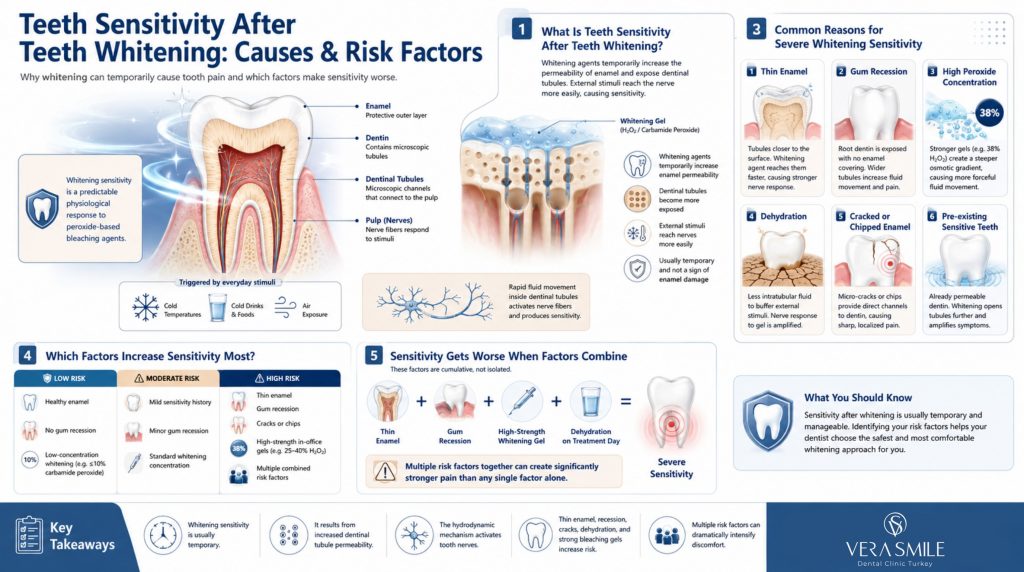
Teeth sensitivity after teeth whitening is dentin hypersensitivity triggered by whitening agents temporarily increasing the permeability of the enamel and exposing dentinal tubules. It is not a sign of enamel damage in most cases. It is a predictable physiological response to peroxide-based bleaching agents.
Dentinal tubules are microscopic channels inside the dentin layer that connect the tooth surface to the pulp, where nerve fibers are located. When hydrogen peroxide or carbamide peroxide opens these channels, external stimuli (temperature, air, pressure) cause rapid fluid movement inside the tubules. That fluid movement activates nerve fibers. (“Hydrodynamic Mechanism of Dentin Sensitivity”, Journal of Clinical Dentistry, 2015.)
This process is called the hydrodynamic mechanism. It is the same mechanism responsible for all dentin hypersensitivity, not just whitening-related sensitivity. The difference is that bleaching agents deliberately increase tubule permeability to achieve whitening, making the hydrodynamic response more pronounced than in everyday dentin sensitivity.
What Does Teeth Whitening Sensitivity Feel Like?
Teeth whitening sensitivity feels like a sudden, sharp electric shock or a persistent, dull throbbing that occurs when bleaching gels temporarily open microscopic pores in your enamel. The most immediate sensation, occurring during or right after treatment, is commonly known as a zinger, which feels like a sudden electric jolt, a shooting star, or a tiny ice pick striking a specific tooth. These sharp, localized shocks last for just one to two seconds, arriving entirely without warning as temperature changes and airflow hit the exposed, sensitive inner layers of your teeth before disappearing just as quickly.
Within 12 to 48 hours after the procedure, this flash pain shifts into a deeper, heavy background ache that radiates through multiple teeth simultaneously, mimicking the dull sensation of a bruised tooth that gradually peaks and fades as the pores naturally reseal. Distinguishing between these two feelings helps you manage your treatment safely, because while quick flashes triggered by cold air or cold drinks are a completely normal part of the recovery process, a relentless background ache or any sharp pain triggered by hot liquids is a clear warning sign to pause your whitening sessions and consult your dentist.
What Are Zingers After Teeth Whitening?
Zingers are the sharp, spontaneous shooting pains that occur during or in the hours after whitening. They are the clinical result of A-delta nerve fiber activation inside the dental pulp.
The mechanism is that hydrogen peroxide molecules are small enough to diffuse through enamel and dentin. They enter the dentinal tubules, create osmotic pressure changes, and cause rapid inward fluid movement toward the pulp. This fluid pulse activates A-delta fibers, which fire in a burst (producing the characteristic 1–2 second electric shock) then reset. The zinger stops as quickly as it starts because A-delta fibers fatigue rapidly after activation. (“A-delta nerve fiber activation during whitening”, Journal of Endodontics, 2014.)
Zingers occur in approximately 38% of patients during in-office whitening sessions and are more common with higher-concentration hydrogen peroxide (25–38%) than with carbamide peroxide home kits. Carbamide peroxide releases hydrogen peroxide more slowly as it breaks down, producing a lower peak concentration at any given moment, which is why most patients find home trays less immediately painful than a professional session. (“Zinger Incidence during In-Office Whitening”, Operative Dentistry, 2021.)
How Long Do Whitening Zingers Last?
Each individual zinger lasts 1–2 seconds. The period during which zingers occur (the active sensitivity window) ends within 24 hours for home whitening and within 48 hours for professional whitening in patients without pre-existing sensitivity.
How Long Does Teeth Sensitivity Last After Whitening?
Teeth sensitivity after whitening lasts 24–72 hours for most people and up to two weeks after professional in-office treatment. Duration depends on the whitening method used, the peroxide concentration, individual enamel thickness, and whether pre-existing dentin hypersensitivity was present before treatment.
| Whitening method | Peroxide concentration | Typical sensitivity duration |
|---|---|---|
| Whitening strips | 6–10% H₂O₂ | 24–48 hours |
| At-home trays (OTC) | 10–16% carbamide peroxide | 24–72 hours |
| Dentist take-home trays | 10–22% carbamide peroxide | Up to 5 days |
| Professional in-office | 25–38% H₂O₂ | 72 hours to 2 weeks |
| Pre-existing sensitivity + in-office | 25–38% H₂O₂ | Up to 2–3 weeks |
The peak sensitivity window is the first 24 hours. Dentinal tubules begin resealing through two natural processes: salivary remineralization, where calcium and phosphate from saliva deposit back into the tubule surface, and tubule sclerosis, where mineral deposits gradually narrow the tubule diameter over time, reducing fluid conductance. (“Tubule Sclerosis and Sensitivity Recovery Timeline”, Journal of Dentistry, 2018.)
The dehydration paradox: Teeth look their brightest immediately after whitening because they are temporarily dehydrated. Dehydrated teeth also have more open dentinal tubules; the absence of intratubular fluid removes the buffering layer that normally dampens nerve signals. Sensitivity peaks at exactly the same moment as whitening appears most dramatic. As teeth rehydrate over 48–72 hours, the apparent shade settles slightly and sensitivity decreases simultaneously.
Why Do My Teeth Hurt So Bad After Bleaching?
Severe pain after bleaching is almost always due to one or more pre-existing vulnerabilities that the bleaching agent exploits.
- Thin enamel: When the enamel layer is thin, dentinal tubules sit closer to the surface, so the bleaching agent reaches them faster, causes more fluid movement, and triggers a stronger nerve response. (“Thin Enamel and Whitening Sensitivity”, European Journal of Oral Sciences, 2019.)
- Gum recession: Recession exposes the root surface, which has no enamel covering at all, so root dentin is directly exposed to the gel; its wider tubules allow faster, more forceful fluid movement and more nerve activation.
- Higher peroxide concentration: A 38% hydrogen peroxide in-office gel creates a steeper osmotic gradient than a 10% carbamide peroxide home kit, so fluid movement inside the tubules is more forceful and the A-delta response is stronger.
- Dehydration on treatment day: Dehydrated teeth have less intratubular fluid to buffer external stimuli, so the nerve response to gel application is amplified.
- Cracked or chipped enamel: Micro-cracks and chips provide direct channels for the bleaching agent to bypass the enamel and reach dentin immediately, producing disproportionate sensitivity in specific teeth.
- Pre-existing dentin hypersensitivity: Patients who already feel cold air or cold water on their teeth before treatment have structurally more permeable dentin, and whitening reliably opens tubules that were already more open than average.
These factors are cumulative. A patient with thin enamel and mild gum recession who whitens with a high-concentration in-office gel on a dehydrated treatment day will feel far more pain than any single factor predicts.
How Do You Fix Sensitive Teeth After Whitening?
Four clinically proven interventions reduce sensitivity after whitening: potassium nitrate, fluoride, nano-hydroxyapatite, and ibuprofen. They work through different mechanisms and can be combined for faster relief.
Potassium Nitrate
This ingredient reduces sensitivity by raising the potassium ion concentration around your nerve fibers. This blocks depolarization, safely preventing the nerves from reaching the electrical threshold required to send pain signals.
To use it correctly, rub the toothpaste directly onto your sensitive teeth, leave it for three to five minutes, and spit without rinsing. Rinsing with water dilutes the active ions before they can properly penetrate your tooth pathways.
Fluoride
Fluoride reacts with the natural calcium in your teeth to form protective crystals that physically shield the open pathways. This process narrows the pore openings until internal fluid can no longer move fast enough to trigger your nerves.
While nerve-calming ingredients target the pain signal itself, fluoride reinforces the physical structure of the tooth surface. Applying a fluoride gel immediately after bleaching significantly cuts down on discomfort within the first 24 hours.
Nano-Hydroxyapatite
These synthetic mineral particles replicate natural enamel to mechanically bond with your teeth and seal exposed pathways. It acts much faster than fluoride because it coats the surface instantly without needing a chemical reaction to take place.
This biomimetic layer provides measurable relief within just one or two applications. It stands as a highly effective, fast-acting alternative to traditional desensitizing options for managing post-bleaching irritation.
Ibuprofen
Ibuprofen targets the internal inflammation that topical gels cannot reach by reducing prostaglandin synthesis. This medication directly tackles the deep pulp swelling that occurs when whitening gel diffuses into the inner tooth chamber.
Taking a 400 milligram dose one hour before your appointment and continuing every six hours for the first day lowers pain levels. This pre-treatment protocol is incredibly beneficial for anyone with a known history of tooth sensitivity.
Experiencing tooth sensitivity after whitening can be incredibly frustrating, but you do not have to just suffer through the discomfort. Because these four interventions tackle the problem from different angles, you can easily calm irritated nerves, seal exposed tooth pores, and knock out internal inflammation. Choosing the right approach, or combining a few of them, ensures you can enjoy your bright new smile without the unwanted ache.
Can I Use Potassium Nitrate Toothpaste After Whitening?
Yes. Potassium nitrate toothpaste directly addresses the nerve mechanism behind whitening sensitivity, which is why it is the standard at-home desensitizer.
Apply potassium nitrate toothpaste to the teeth with a finger after whitening, leave it in contact for 3-5 minutes, then spit without rinsing. Rinsing immediately afterward removes the potassium ions before they can penetrate the dentinal tubules, and direct contact without dilution maximizes ion delivery to the nerve. This is the same approach used with professional desensitizing gels applied at the dental chair.
Strontium acetate and sodium fluoride formulations work through a different mechanism: strontium acetate physically blocks the dentinal tubule openings rather than depolarizing the nerve. This produces faster onset relief than a standard potassium nitrate formula, making it more suitable for acute post-whitening sensitivity.
Important⚠️: Do not use abrasive whitening toothpaste immediately after whitening. The enamel surface is temporarily more porous during the 24–48 hour post-whitening window, and abrasive formulas can increase surface wear during this period. A non-abrasive sensitivity formula is the correct choice.
What Calms Down Sensitive Teeth After Whitening?
To quickly calm sensitive teeth after whitening, you need to block nerve signals, seal open tooth pores, and make a few temporary lifestyle adjustments.
Here are the most effective ways to get fast relief:
- Potassium Nitrate Toothpaste: Rub a desensitizing toothpaste directly onto sensitive areas, leave it for three to five minutes, and spit without rinsing so the minerals can calm the nerves.
- Fluoride or Nano-Hydroxyapatite Gels: Apply these treatments, ideally using custom trays for 20 minutes, to physically shield and plug the open microscopic pores in your teeth.
- Ibuprofen (400 mg): Take this anti-inflammatory to target the internal pulp inflammation caused by the bleaching gel, which topical treatments cannot reach.
- Dietary Restrictions: Avoid hot, iced, carbonated, or highly acidic items for 48 hours, sticking strictly to room-temperature water.
- Gentle Brushing: Switch to a soft-bristle manual toothbrush and skip electric brushing or abrasive whitening toothpastes for at least two days.
- Air and Sleep Adjustments: Breathe through your nose outdoors to avoid cold air shocks, and sleep on your side to reduce internal fluid pressure changes in your teeth.
Matching the intervention to the timeframe matters because the tubules are most open in the first 24 hours, so occluding and desensitizing agents have the largest effect when applied early.
For patients where sensitivity or restoration mismatch makes whitening impractical, alternatives such as composite bonding or dental veneers provide a stable cosmetic result without peroxide exposure.
Clove oil (eugenol): A traditional remedy with a documented mechanism. Eugenol is a natural COX-inhibitor and acts directly on pulpal nerve endings as a topical analgesic; a small amount applied to the sensitive tooth with a cotton swab provides short-term relief and is used clinically as a temporary sedative dressing material. (International Endodontic Journal, 2012.)
Should I Stop Whitening My Teeth If It Hurts?
The answer depends on the kind of pain present and how long it lasts. You can pause and continue whitening later if the pain is limited to zingers occurring during or within 24 hours of treatment, if sensitivity resolves fully within 72 hours, if pain is triggered only by cold rather than warmth, or if this is your first or second whitening experience and the sensitivity is new. You should stop and see a dentist if sensitivity persists beyond two weeks without improvement, if pain occurs spontaneously with no temperature, air, or contact trigger, if warm or hot liquids cause pain, if sensitivity increases between sessions instead of decreasing, or if pain lingers more than 30 seconds after a temperature stimulus is removed.
The last four symptoms are red flags for reversible pulpitis, an inflammation of the pulp caused by hydrogen peroxide diffusing into the pulp chamber.Reversible pulpitis resolves when the irritant is removed. Irreversible pulpitis, which can develop from repeated over-whitening, does not resolve without clinical intervention and requires root canal treatment. The distinction depends on symptom pattern, not severity, and continuing to whiten through escalating pain is the primary cause of whitening-related pulp complications.
Does Whitening Damage Tooth Enamel?
No. At standard clinical protocols, professional whitening does not cause permanent enamel damage. It does cause temporary, surface-level demineralization: a measurable but reversible reduction in enamel mineral content. Saliva remineralizes the enamel surface within 24–48 hours after whitening through natural calcium and phosphate re-deposition, fluoride accelerates this process significantly, and surface microhardness returns to baseline within 1–2 weeks. (“Surface Microhardness Recovery after Whitening”, Dental Materials, 2020.)
When Does Teeth Whitening Cause Permanent Enamel Damage?
Permanent enamel damage occurs when teeth are exposed to whitening agents so aggressively that the body’s natural remineralization process is completely overwhelmed. While standard, dentist-approved protocols are entirely safe, structural harm happens under specific conditions of severe misuse.
This irreversible damage triggers in two distinct scenarios, most commonly through the incorrect use of over-the-counter products. Leaving high-concentration bleaching gels on the teeth significantly longer than directed, or repeating applications more frequently than recommended, depletes enamel mineral content faster than saliva can restore it. This repeated misuse over several weeks produces measurable enamel loss that cannot fully recover. A similar destruction happens when undergoing multiple professional in-office sessions less than two weeks apart, which causes an accumulation of surface demineralization that your natural saliva simply cannot keep pace with.
To avoid this permanent mineral loss, you should always follow standard clinical guidelines. Sticking to professional in-office treatments no more than once every six to twelve months and using home trays exactly as directed ensures a brighter smile with absolutely no clinically significant enamel damage. (“Reversible vs. Irreversible Pulpitis from Whitening”, Journal of the American Dental Association, 2018.)
Does Enamel Grow Back After Whitening?
No. Enamel cannot regenerate. Enamel is produced by ameloblasts; specialized cells active only during tooth development before the tooth erupts into the mouth. Once the tooth erupts, ameloblasts die and are never replaced. No other cell in the body can produce enamel, so lost enamel is permanently lost.
However, remineralization is not the same as regeneration. Demineralized enamel (enamel that has lost calcium and phosphate ions but whose protein matrix is still structurally intact) can be remineralized.
What Are the Three Agents Used to Rebuild Softened Enamel?
Three specific agents supply the essential minerals needed to repair and rebuild the crystal lattice of softened enamel:
- Fluoride: Reacts with calcium to form fluorapatite, a more acid-resistant mineral than natural hydroxyapatite, and is well established as the primary post-whitening recovery mechanism. (“Enamel Remineralization mechanisms”, Caries Research, 2020.)
- CPP-ACP (casein phosphopeptide-amorphous calcium phosphate): Provides bioavailable calcium and phosphate directly to the enamel surface, promoting remineralization independent of fluoride, which makes it useful for patients who cannot use fluoride.
- Nano-hydroxyapatite (n-HAp): A synthetic mineral identical in crystal structure to natural enamel that deposits directly onto demineralized surfaces and into surface pores, rebuilding the mineral layer from the outside in, and is the fastest-acting of the three approaches.
Your enamel operates on a strict “no returns” policy, meaning you cannot grow a brand-new layer once it is gone. Fortunately, you can still fortify the structural shield you already have. By actively using remineralizing agents like fluoride, CPP-ACP, or nano-hydroxyapatite after a whitening treatment, you can protect your teeth from damage and ensure your smile stays both bright and resilient.
Can You Over-Whiten Your Teeth?
Yes. Over-whitening is a real clinical condition with specific symptoms and specific consequences.
It occurs when whitening sessions are repeated too frequently: multiple professional sessions within days of each other, or home whitening used continuously for weeks without a recovery break. The cumulative hydrogen peroxide exposure pushes mineral loss faster than saliva can restore it, and the pulp becomes progressively inflamed from peroxide diffusion.
The safe clinical maximum is two full in-office sessions per year with at least six months between them. Short touch-up sessions of 15–20 minutes can be done quarterly without accumulating significant mineral loss. (British Dental Journal, 2020.)
What Are the Signs of Over-Whitening?
The signs of over-whitening are heat sensitivity, spontaneous pain, pain that lingers after a stimulus is removed, translucency at the biting edges, and chalky white spots on the enamel.
- Heat sensitivity: Sensitivity to warm or hot liquids, not just cold, which is the key clinical differentiator between normal whitening sensitivity and pulp inflammation.
- Spontaneous pain: Pain that starts with no external trigger, without touching or eating anything.
- Lingering pain: Pain that persists beyond 30 seconds after a stimulus is removed.
- Edge translucency: Visible translucency at the biting edges of the front teeth, where thinning enamel lets the grey-blue underlying dentin show through.
- Chalky white spots: Blotchy white patches on the enamel surface that signal focal hypomineralization.
- The blue-grey paradox: When enamel becomes severely thinned from over-whitening, the underlying dentin (which is naturally grey-yellow) becomes visible through the remaining translucent enamel. The tooth then appears grey or blue-grey at the edges, the direct opposite of the white result the patient was seeking.
When it comes to teeth whitening, more is definitely not always better. Crossing the line into over-whitening literally reverses your hard work, leaving you with translucent, painful teeth instead of a bright smile. If your morning coffee is suddenly agonizing or your teeth are starting to take on a blue-grey tint, it is time to put down the bleaching gel and let your enamel recover. A healthy, strong smile will always look better than an overprocessed one.
FAQ
Yes, in most cases. Carbamide peroxide breaks down slowly in the mouth, releasing hydrogen peroxide gradually, about 50% in the first 2 hours and the remainder over 4–6 hours. This lower peak concentration produces a milder hydrodynamic response in the dentinal tubules than direct hydrogen peroxide at equivalent label strengths. Patients with known sensitivity tolerate carbamide peroxide home kits better than in-office hydrogen peroxide sessions. (American Journal of Dentistry, 2017.)
Yes, but preparation matters. Using a potassium nitrate or n-HAp toothpaste for 2 weeks before whitening significantly reduces sensitivity during treatment by pre-treating the dentinal tubules. Choose a lower-concentration protocol (home trays rather than in-office) and inform your dentist of your sensitivity history so they can apply desensitizing agents before starting. Do not begin whitening during a period of active sensitivity flare-up. (Dental Research Journal, 2018.)
Wait at least 48 hours for hot coffee specifically, not only for staining reasons but for sensitivity reasons. Hot temperatures during the post-whitening sensitivity window can trigger severe zinger responses in sensitized tubules. If waiting 48 hours is not possible, let the coffee cool to room temperature before drinking.
No, in most cases. Sensitivity and enamel damage are not the same thing. Sensitivity is a nerve response; enamel damage is mineral loss. You can have high sensitivity with no enamel damage (thin but healthy enamel) and enamel damage without immediate sensitivity (slow erosion). Post-whitening sensitivity that resolves within 72 hours indicates a temporary tubule response, not structural enamel damage.
No. Benzocaine provides topical numbness at the gum surface but does not reach the dentinal tubules or pulp where whitening sensitivity originates. It is a surface anesthetic with no mechanism to address the nerve activation inside the dentin. Potassium nitrate, n-HAp, or fluoride gel are clinically appropriate; benzocaine is not the right tool for this specific type of pain.