
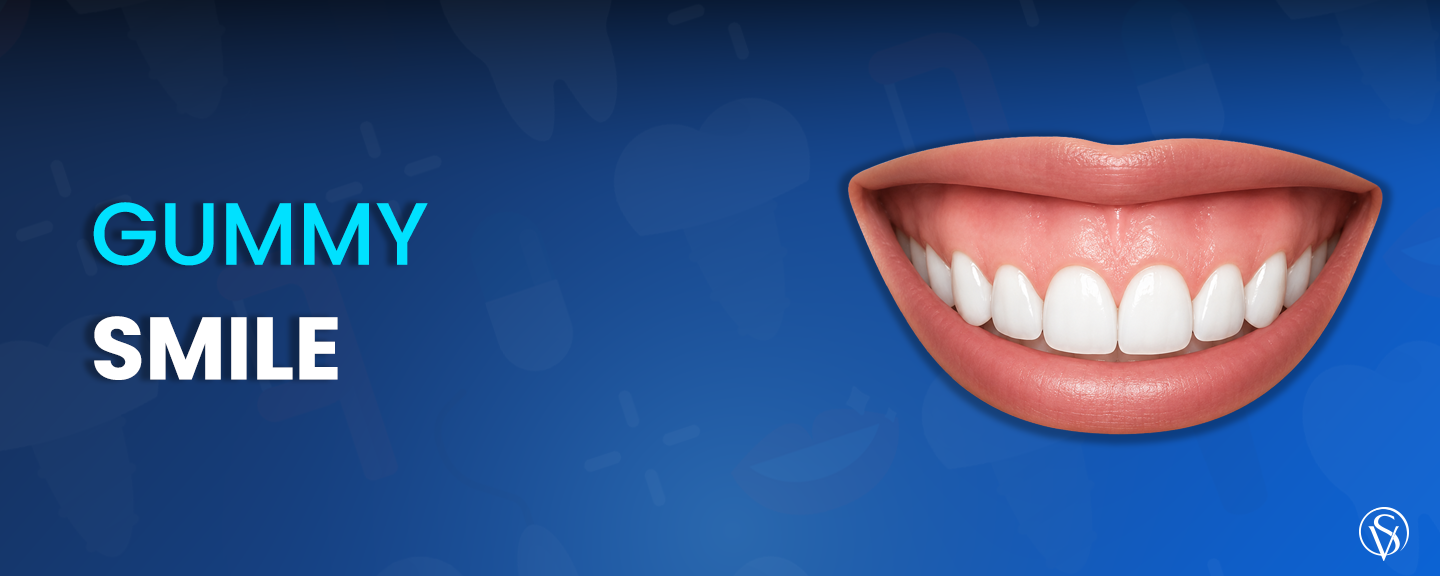
A gummy smile, known clinically as excessive gingival display, is the visibility of more than 2 to 3 mm of gum tissue above the upper teeth during a full smile, while a balanced smile shows only 1 to 2 mm (Peck & Peck, 1995; Inchingolo et al., 2024). It is a cosmetic condition rather than a disease, and it affects an estimated 10 to 30 percent of people (Inchingolo et al., 2024). The cause is multifactorial and can be gingival, dental, muscular, or skeletal, which is why the correct treatment depends on identifying the exact cause before any procedure.
Treatment ranges from minimally invasive options such as gum contouring and Botox to lip repositioning surgery, orthodontics, and jaw surgery for skeletal cases. Botox results are temporary, while surgical and laser corrections last far longer. Turkey has become a common destination for this treatment because costs are considerably lower than in the UK or the USA, with the same procedures available in a short visit. Patients who need combined gum and tooth correction are planned as part of broader gingival aesthetics.
Key Points
- A gummy smile (excessive gingival display) shows more than 2 to 3 mm of gum above the upper teeth on a full smile, while an ideal smile shows 1 to 2 mm (Peck & Peck, 1995; Maleki et al., 2024).
- It is a cosmetic condition, not a disease, and affects an estimated 10 to 30 percent of people, more often women (Inchingolo et al., 2024; Tjan et al., 1984).
- The cause is multifactorial and falls into four groups, which are gingival, dental, muscular (lip), and skeletal (jaw).
- The right treatment depends on the cause, so accurate diagnosis comes before any procedure.
- Options run from gum contouring and Botox to lip repositioning, orthodontics, and jaw surgery for skeletal cases.
- Botox is temporary and lasts about 4 to 6 months, while surgical and laser corrections are long-lasting (Fatani, 2023; Maleki et al., 2024).
What Is a Gummy Smile?
A gummy smile is a smile that exposes an excessive band of gum tissue above the upper front teeth, medically termed excessive gingival display. The condition reflects a disharmony between the teeth, gums, lips, and upper jaw rather than any dental disease. It is judged on how much gum shows during a full, natural smile, not on the gums at rest.
How Much Gum Display Counts as a Gummy Smile?
A smile is generally considered gummy when more than 3 mm of gum shows above the upper teeth during a full smile. An ideal smile exposes only 1 to 2 mm of gum, and the accepted upper limit sits at around 3 mm (Inchingolo et al., 2024). The clinical definition ranges from more than 2 mm (Peck & Peck, 1995) to more than 3 mm (Maleki et al., 2024), so the number is a guide rather than a fixed cutoff.
What Causes a Gummy Smile?
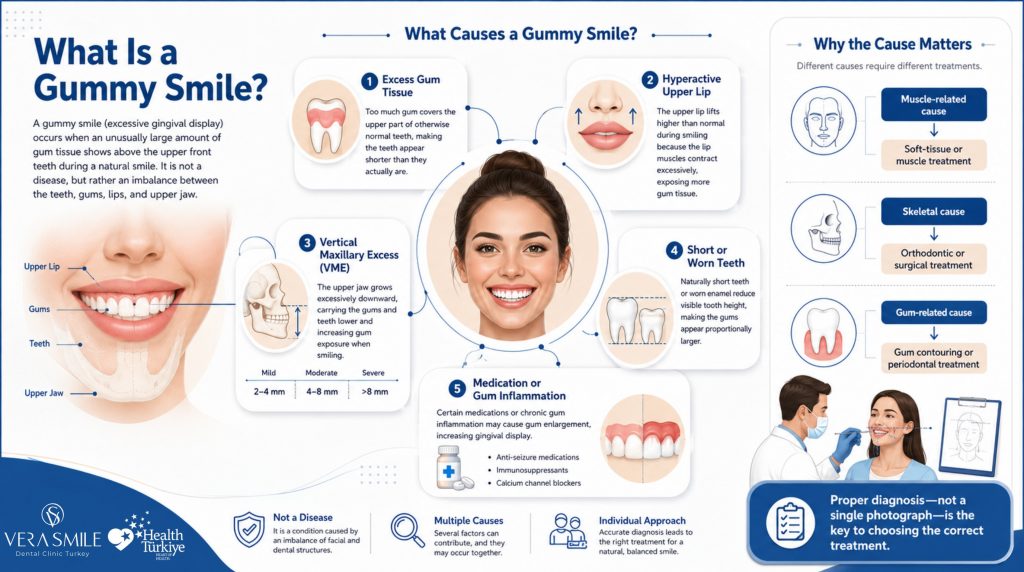
A gummy smile develops from four broad groups of causes, and each group points to a different treatment. The condition is multifactorial, meaning more than one cause can be present in the same patient (Inchingolo et al., 2024). Understanding which cause applies is the single most important step, because a procedure aimed at the wrong cause will not correct the smile. The main causes are set out here as distinct clinical groups.
- Excess or Overgrown Gum Tissue: Too much gum, often from altered passive eruption, covers the upper part of the teeth and makes them look short even when the teeth are a normal size.
- Hyperactive Upper Lip: The muscles that raise the upper lip contract too strongly, so the lip rises higher than the usual 6 to 8 mm and exposes extra gum (Inchingolo et al., 2024).
- Vertical Maxillary Excess (VME): The upper jaw grows too far in the vertical direction, pushing the teeth and gums downward, and this skeletal cause is graded as mild at 2 to 4 mm, moderate at 4 to 8 mm, and severe above 8 mm (Inchingolo et al., 2024).
- Short or Worn Teeth: Wear or a short clinical crown reduces the visible tooth height, so the gum-to-tooth ratio looks unbalanced even with a normal gum line.
- Medication or Inflammation: Anti-seizure drugs, immunosuppressants, and calcium channel blockers, along with gum inflammation, can trigger gum overgrowth known as gingival enlargement.
These groups explain why two people with an identical amount of gum display can need completely different treatments. A muscular cause calls for a soft-tissue or muscle solution, while a skeletal cause may need surgery. This is also why a proper examination, rather than a single photograph, sits at the centre of planning. The next section explains how much of this is inherited.
⚠️ Warning: Gum enlargement that appears alongside bleeding, swelling, or rapid change may signal medication side effects or active gum disease. This should be assessed and treated before any cosmetic gum procedure is planned.
Is a Gummy Smile Genetic or Caused by Habits?
Yes. A gummy smile is often genetic, because both the vertical growth of the upper jaw and the way the upper lip is built are largely inherited traits. Vertical maxillary excess and a naturally short or hyperactive upper lip run in families and are present from a young age. Acquired forms exist too, mainly the gum overgrowth linked to certain medications or to long-standing gum inflammation, and these are the forms most influenced by oral hygiene and general health.
Is a Gummy Smile a Health Problem or Only Cosmetic?
No. In most cases a gummy smile is a cosmetic concern rather than a health problem, and it does not damage the teeth or gums on its own. Its main impact is on confidence and social comfort, and research has linked excessive gingival display to reduced self-esteem in affected patients (Inchingolo et al., 2024). The exception is when the extra gum comes from inflammation or medication-related overgrowth, since that points to an underlying issue that needs attention.
Clinic Note: When bleeding gums, swelling, or fast gum growth accompany a gummy smile, a periodontal check comes first. Cosmetic planning follows only after any active gum condition has been treated.
How Is the Cause of a Gummy Smile Diagnosed?
The cause of a gummy smile is diagnosed through a clinical examination that measures the teeth, watches the lip in motion, and checks the jaw. A single measurement of gum display is not enough, because the same 4 mm of visible gum can come from a short crown, a high-moving lip, or an overgrown jaw. A structured, step-by-step diagnostic scheme is used to separate these causes (El-Bokle & Ghany, 2022). The examination focuses on a small number of concrete checks.
- Crown height measurement: The visible height of the upper central incisors is measured against the normal 10 to 12 mm, since a short crown suggests excess gum or wear.
- Lip movement assessment: The upper lip is watched during a full smile, because movement beyond about 10 mm points to a hyperactive lip muscle (Inchingolo et al., 2024).
- Smile line evaluation: The relationship between the lip, gum line, and teeth is recorded at rest and during smiling.
- Skeletal check: An X-ray or cephalometric analysis is used when a jaw cause such as vertical maxillary excess is suspected.
Together these checks show which single cause dominates, or which combination is present, and that finding drives the whole treatment plan. Many patients turn out to have more than one contributing factor. Naming the cause precisely is what separates a lasting correction from a disappointing one.
Clinic Note: The right treatment depends on the right diagnosis. A gum trimming performed on a gummy smile that is actually caused by a hyperactive lip will not fix the problem, which is why the cause is confirmed before any procedure is booked.
How Is a Gummy Smile Treated?
A gummy smile is treated by matching the procedure to the diagnosed cause, and several distinct options exist. Minimally invasive methods handle gum and muscle causes, while surgery is reserved for skeletal cases (Inchingolo et al., 2024). The aim is to restore a balanced gum-to-tooth ratio using the least invasive option that will hold. The main treatments are:
- Gum Contouring (Gingivectomy or Gingivoplasty): Excess gum is reshaped with a laser or a fine surgical instrument to expose more of the tooth, and this is the first choice when the cause is excess gum tissue. This procedure is covered in detail on the gum contouring page.
- Crown Lengthening: The gum, and sometimes a small amount of bone, is lowered to increase the visible tooth height in cases of short clinical crowns.
- Lip Repositioning Surgery: The upper lip is repositioned to limit how high it can rise, giving a permanent result for a hyperactive lip, and the surgical approach is explained on the gum reduction surgery page.
- Botulinum Toxin (Botox): The lip-elevator muscles are relaxed to lower the lip line, a fast and minimally invasive option for mild muscular cases.
- Orthodontics: Braces or aligners with small anchorage devices reposition the teeth and gum line, and treatment runs about 12 to 24 months (Inchingolo et al., 2024).
- Orthognathic (Jaw) Surgery: The upper jaw is repositioned in cases of significant vertical maxillary excess, offering a stable correction for severe skeletal cases.
The best option is rarely a matter of preference and almost always a matter of cause. A patient with an overgrown gum line and a patient with a high-moving lip may both want a quick fix, yet they need entirely different procedures. The table that follows maps each cause to its recommended treatment.
Tips for Patients: Two gummy smiles that look identical can need different procedures. Before agreeing to any treatment, ask the clinic to confirm the specific cause of your case and how the proposed procedure addresses it.
Which Treatment Is Best for Each Cause of Gummy Smile?
The recommended treatment follows directly from the diagnosed cause.
| Cause | Recommended Treatment | Invasiveness | Permanence |
|---|---|---|---|
| Excess or overgrown gum tissue | Gum contouring (gingivectomy) | Low | Long-lasting |
| Short or worn teeth | Crown lengthening | Low to moderate | Long-lasting |
| Hyperactive upper lip | Botox (short term) or lip repositioning (permanent) | Low to moderate | Botox 4 to 6 months, surgery long-lasting |
| Vertical maxillary excess | Orthodontics, or orthognathic surgery in severe cases | Moderate to high | Long-lasting |
Stability differs sharply between these paths. At six months, surgical corrections retained an average reduction of 2.86 mm in gum display, while non-surgical methods such as Botox retained only 0.51 mm (Maleki et al., 2024). This gap is the main reason surgical and laser options are preferred when a permanent result is the goal.
Can a Gummy Smile Be Fixed Without Surgery?
Yes. Some gummy smiles can be corrected without surgery, mainly those caused by a hyperactive lip or by tooth position. Botox relaxes the lip muscles and reduces gum display within 1 to 2 weeks, though the effect fades after about 4 to 6 months and needs repeating (Fatani, 2023). Orthodontics can reposition teeth over 12 to 24 months for mild dental and skeletal cases. Cases driven by significant vertical maxillary excess, however, still need a surgical approach for a lasting result.
How Much Does Gummy Smile Treatment Cost in Turkey Compared to the UK and USA?
Gummy smile treatment in Turkey costs considerably less than the same procedures in the UK or the USA, with savings of roughly 50 to 75 percent. The final price depends on the cause and the method, since a single Botox session and a jaw operation sit at opposite ends of the scale.
| Treatment | Turkey (€) | UK (€) | USA (€) |
|---|---|---|---|
| Botox (per session) | 100 to 200 | 120 to 470 | 370 to 650 |
| Gum contouring (front smile zone) | 200 to 500 | 1,750 to 3,500 | 1,850 to 4,600 |
| Crown lengthening (smile zone) | 300 to 700 | 900 to 1,800 | 1,800 to 3,700 |
| Lip repositioning surgery | 800 to 1,500 | 1,200 to 2,300 | 1,800 to 4,600 |
| Orthodontics | 1,000 to 2,500 | 2,500 to 5,000 | 3,700 to 7,400 |
| Orthognathic (jaw) surgery | 4,000 to 6,000 | 12,000 to 28,000 | 18,400 to 46,000 |
The pattern holds across every procedure, with Turkey offering the lowest price for both minor and major treatments. The saving is largest for surgical cases, where the gap between Turkey and the USA runs into tens of thousands of euros. Travel and accommodation are separate costs to weigh against these figures.
Tips for Patients: When comparing prices, ask whether a quote is per tooth or for the whole smile zone. A low per-tooth figure can add up to more than a single all-zone price once every tooth is counted.
What Is Recovery Like After Gummy Smile Treatment?
Recovery after gummy smile treatment depends on the procedure, and it ranges from no downtime to several months. Minimally invasive options let most patients return to normal life the same day, while surgical and orthodontic routes take longer. Knowing what to expect helps patients plan the timing of their treatment. The recovery profile of each option is described as:
- Botox: There is no downtime, and the muscle-relaxing effect becomes visible within 1 to 2 weeks.
- Gum Contouring (Laser): Mild tenderness lasts a few days, and most patients heal within about 1 week on a soft diet.
- Lip Repositioning: Swelling and tightness last a few days, with dissolving stitches and a short adjustment period.
- Orthodontics and Jaw Surgery: These follow much longer timelines measured in months, with orthodontic treatment running 12 to 24 months (Inchingolo et al., 2024).
Across all of these, following the aftercare instructions closely has a direct effect on the result. Gum procedures in particular respond well to gentle care in the first week. The longevity of each result is covered next.
Tips for Patients: For the first few days after a gum procedure, stick to soft foods such as yoghurt, mashed potato, and eggs, and avoid disturbing the treated area so the gum can settle cleanly.
How Long Do Gummy Smile Results Last?
The longevity of a gummy smile correction depends on the method used. Botox is temporary and lasts about 4 to 6 months, so it needs repeating to hold the result (Fatani, 2023). Laser gum contouring and surgical corrections are long-lasting, with only occasional minor gum regrowth, and jaw surgery gives a permanent change to the skeletal cause. The stability data reflect this, with surgery retaining far more of its correction at six months than non-surgical methods (Maleki et al., 2024).
Clinic Note: For patients who want a lasting result, a hyperactive lip is best managed with lip repositioning and an overgrown gum line with laser contouring. Botox is offered as a trial or a short-term option rather than a permanent solution.
FAQ
No. A gummy smile does not resolve on its own when the cause is skeletal, dental, or muscular, since these are structural traits that stay stable through adulthood. The only exception is gum swelling from temporary inflammation, which can reduce once the inflammation is treated.
Yes. Braces or clear aligners can improve a gummy smile when the cause is tooth position or a mild skeletal issue, by intruding and repositioning the upper teeth over 12 to 24 months (Inchingolo et al., 2024). They do not correct a gummy smile caused by a hyperactive lip or by excess gum tissue alone.
Most gummy smile procedures cause little pain, as they are performed under local anaesthesia. Laser gum contouring and Botox involve minimal discomfort, while lip repositioning and jaw surgery bring some swelling and tenderness that is managed with standard pain relief.
A gummy smile is usually treated in adulthood, once facial growth is complete, which is around age 18 for most people. Treating a skeletal cause before growth finishes risks an unstable result, so clinicians wait until the jaw has stopped changing.
No. A correctly planned treatment reduces the gum display without altering the character of your smile, because the goal is a balanced gum-to-tooth ratio rather than a different expression. Overtreatment is the main risk to a natural look, which is why conservative dosing and measured gum removal are used.
Yes, in some cases. A gummy smile returns after Botox because the effect is temporary and fades after about 4 to 6 months (Fatani, 2023). Surgical and laser corrections are far more stable, though minor gum regrowth can occur if oral hygiene is poor, and skeletal correction through jaw surgery is permanent.
Accordion Andijani, R. I., & Tatakis, D. N. (2019). Hypermobile upper lip is highly prevalent among patients seeking treatment for gummy smile. Journal of Periodontology, 90(3), 256-262.
El-Bokle, D., & Ghany, A. H. A. (2022). A systematic diagnostic scheme for excessive gingival display “gummy smile”. AJO-DO Clinical Companion, 2(4), 335-343.
Fatani, B. (2023). An approach for gummy smile treatment using botulinum toxin A: A narrative review of the literature. Cureus, 15(1), e34032.
Inchingolo, A. D., Inchingolo, A. M., Viapiano, F., Netti, A., Ciocia, A. M., Ferrara, I., Mancini, A., Palermo, A., Inchingolo, F., & Dipalma, G. (2024). Effectiveness and personalized approaches in the correction of gummy smile: A systematic review of orthodontic and surgical treatments. Journal of Clinical Medicine, 13(22), 6843.
Maleki, M., Huang, B., Mendes, V. C., Caminiti, M. F., & Finer, Y. (2024). A systematic review and meta-analysis comparing surgical and nonsurgical treatments for excessive gingival display. Dentistry Journal, 12(6), 154.
Peck, S., & Peck, L. (1995). Selected aspects of the art and science of facial esthetics. Seminars in Orthodontics, 1(2), 105-126.
Tjan, A. H. L., Miller, G. D., & The, J. G. P. (1984). Some esthetic factors in a smile. The Journal of Prosthetic Dentistry, 51(1), 24-28.content.