

Tartar, also called tooth stone or dental calculus, is a hardened dental plaque that has absorbed calcium and phosphate from saliva and bonded firmly to the tooth surface and along the gumline (White, 1997). It begins as a soft, sticky film that mineralizes within days, turning into a rough deposit that brushing and flossing can no longer remove. Once tartar forms, only professional scaling by a dentist or hygienist can take it off. Left in place, it fuels gingivitis and periodontitis, the main drivers of adult tooth loss, and contributes to bad breath, gum recession, and surface staining.
Tartar sits above the gumline as yellow or tan buildup and below the gumline as a darker, more damaging deposit. It is also preventable, since consistent daily cleaning combined with a professional cleaning every six months stops mineralization before it starts. Because the rough surface of existing tartar attracts still more plaque, early removal matters, as the longer it stays the harder it becomes to clean.
Key Points
- Tartar (dental calculus) is a hardened dental plaque that has mineralized with calcium and phosphate from saliva and bonded firmly to the tooth surface and gumline (White, 1997).
- Also called tooth stone, tartar starts forming when plaque is left in place, with mineralization beginning within 24 to 72 hours and hardening over roughly 10 to 14 days.
- Once formed, tartar cannot be brushed or flossed away and requires professional scaling by a dentist or hygienist (Jepsen et al., 2011).
- Tartar above the gumline (supragingival) is usually yellow or tan, while tartar below the gumline (subgingival) is darker and more closely tied to gum disease.
- Dental calculus affects the majority of adults worldwide and is a recognized secondary factor in gingivitis and periodontitis, the leading causes of adult tooth loss (White, 1997).
- The most effective control is daily plaque removal plus professional cleaning every six months, because preventing mineralization is far easier than removing a hardened deposit.
What Is Tartar (Tooth Stone)?
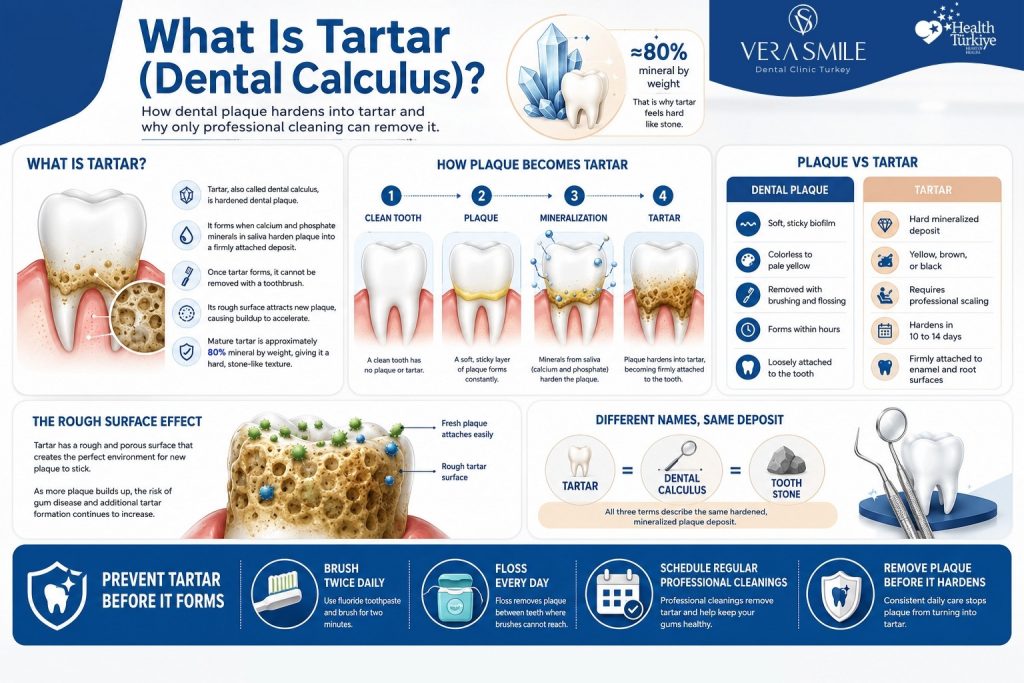
Tartar, or dental calculus, is dental plaque that has hardened into a mineralized deposit firmly attached to the teeth. It forms when the calcium and phosphate salts in saliva precipitate into the bacterial film on the tooth, cementing it in place and killing most of the bacteria trapped inside (White, 1997). The result is a rough, porous crust that a toothbrush cannot dislodge. That rough surface is the real problem, because it gives fresh plaque an ideal foothold, so once tartar appears the buildup tends to accelerate. Mature deposits are roughly 80% mineral by weight, which is why they feel stony and bond so strongly to enamel and root surfaces.
What Is the Difference Between Plaque and Tartar?
Plaque and tartar are two stages of the same process, where plaque is the soft, living film and tartar is the hardened version it becomes when left in place. Plaque forms continuously and can be removed at home with routine brushing and flossing. Tartar is what remains when that plaque is not cleared before saliva minerals harden it. The distinction matters because it determines who can remove the deposit and how.
| Feature | Dental Plaque | Tartar (Calculus) |
|---|---|---|
| Texture | Soft, sticky film | Hard, calcified crust |
| Color | Colorless to pale yellow | Yellow, brown, or black |
| Removal | Brushing and flossing | Professional scaling only |
| Timeframe | Forms within hours | Hardens in about 10 to 14 days |
| Bond to tooth | Loosely attached | Firmly cemented to enamel and roots |
The practical takeaway is that daily home care is aimed at plaque, not tartar. If plaque is disrupted before it mineralizes, tartar never gets the chance to form. Once the deposit has calcified, home tools stop working and the problem moves into the dentist’s hands. This is why the timing of cleaning matters as much as the technique.
Is Tartar the Same as Dental Calculus?
Yes. Tartar, dental calculus, and tooth stone are three names for the same hardened deposit. Calculus is the clinical term used by dentists, tartar is the everyday word, and tooth stone is a common translation of the same idea, describing how stony the buildup feels. All three refer to mineralized plaque, so they can be treated as interchangeable in practice.
How Does Tartar Form on Teeth?
Tartar forms when dental plaque is left undisturbed long enough for minerals in saliva to crystallize inside it. The process runs in a predictable sequence. First, a thin protein layer called the pellicle coats the clean tooth within minutes. Bacteria colonize that layer and build a sticky biofilm, which is plaque. If the plaque is not removed, calcium and phosphate ions from saliva begin depositing into it, forming calcium phosphate crystals that grow and merge into a rigid mass (White, 1997). This mineralization kills most of the bacteria within the deposit, but the hardened surface that remains is rougher than enamel, so it collects new plaque faster than a clean tooth would. That feedback loop is why untreated tartar keeps growing.
How Long Does It Take for Plaque to Turn Into Tartar?
Plaque begins hardening into tartar within a matter of days, not weeks. Soft plaque starts forming on a clean tooth within hours, and mineralization can begin as early as 24 to 72 hours afterward. Most deposits reach the bulk of their final hardness within about 10 to 14 days (Jepsen et al., 2011). The exact speed varies from person to person and is shaped by saliva composition, diet, age, and genetics, which is why some people build visible tartar in days while others take longer. Because the window before mineralization is so short, daily consistency protects the teeth more than occasional thorough cleaning.
Where Does Tartar Build Up the Most?
Tartar concentrates where saliva reaches the teeth most directly and where cleaning is hardest. In people who brush regularly, supragingival tartar tends to gather on the tongue-facing surfaces of the lower front teeth and the cheek-facing surfaces of the upper back teeth, both of which sit next to salivary gland openings (White, 1997). It also collects along the gumline and between crowded teeth. Below the gumline, subgingival tartar forms inside periodontal pockets, where it is invisible to the patient and more strongly linked to gum disease. The difference in location matters, because subgingival deposits are darker, harder to reach, and more damaging than the visible buildup above the gum.
What Causes Tartar to Build Up Quickly?
Some people accumulate tartar far faster than others, and the reasons come down to a mix of habits, biology, and diet. Understanding the drivers helps explain why two people with similar routines can have very different amounts of buildup. The factors that speed up tartar formation are:
- Inconsistent brushing and flossing: Skipping cleaning or missing surfaces leaves plaque in place long enough to mineralize.
- Saliva composition: People whose saliva carries more calcium and phosphate mineralize plaque faster and are known as heavy calculus formers (White, 1997).
- Sugary and starchy diet: Frequent sugar and starch feed the bacteria that build plaque, giving tartar more raw material.
- Smoking and tobacco use: Tobacco both accelerates buildup and stains the deposits a darker color.
- Crowded or crooked teeth: Overlapping surfaces are difficult to clean thoroughly, so plaque lingers and hardens.
- Dry mouth and certain medications: Reduced saliva flow disrupts the natural clearing of bacteria and food debris.
- Age and time since the last cleaning: Buildup compounds over months, so longer gaps between professional cleanings mean more accumulated tartar.
These factors rarely act alone, and most rapid buildup reflects several of them together. The encouraging part is that most are modifiable, from tightening a home routine to quitting tobacco. Where crowding or dry mouth is the driver, a dentist can tailor a cleaning schedule to keep pace with the faster formation. Identifying the main cause is the first step toward slowing the cycle.
What Are the Signs and Symptoms of Tartar?
Tartar is often visible and felt directly, unlike the invisible plaque that precedes it. Recognizing it early allows for removal before it damages the gums. Because supragingival tartar can be seen and subgingival tartar usually cannot, some signs point to buildup hidden below the gumline. The common signs to watch for are:
- Visible hard buildup: Yellow, tan, brown, or black deposits appear along the gumline and between the teeth.
- A rough feeling: The tongue detects a gritty or crusty texture on the teeth that brushing does not smooth away.
- Persistent bad breath: Bacteria within and around the deposit produce a lingering odor that mouthwash only masks.
- Bleeding or swollen gums: Gums that bleed easily during brushing signal the early irritation tartar causes.
- A receding gumline: Gums that pull back and expose more of the tooth can indicate deposits below the gum.
Visible deposits confirm tartar, while gum bleeding and bad breath often point to buildup that a mirror cannot show. None of these signs resolve on their own, because the deposit is fixed to the tooth. If any of them are present, a professional cleaning is the reliable next step. The sooner the tartar is removed, the less chance it has to inflame the gums.
What Problems Can Tartar Cause?
Tartar is more than a cosmetic concern, because its rough, bacteria-friendly surface drives several oral health problems. The deposit keeps live plaque pressed against the gums and teeth, which sets off a chain of consequences if it is not removed. Dental calculus is recognized as a secondary factor in periodontal disease and a prominent plaque-retentive surface, which is why the dental team removes it routinely (Jepsen et al., 2011). The main problems tartar contributes to are:
- Gingivitis: Constant plaque against the gum line causes early inflammation, redness, and bleeding, the reversible stage known as gingivitis.
- Periodontitis: Untreated inflammation can progress to advanced gum disease, with loss of the bone and tissue that hold teeth in place.
- Gum recession: Buildup and inflammation can push the gums back, a process described under gum recession.
- Tooth decay risk: The porous surface traps acids and bacteria against enamel, raising the chance of cavities.
- Bad breath: The bacteria harbored by tartar generate ongoing halitosis that home care struggles to control.
- Staining and discoloration: Deposits absorb pigment from coffee, tea, and tobacco, darkening the visible teeth.
Most of these problems stem from the same root cause, which is plaque held in place by a surface that cannot be cleaned at home. Caught early, the damage is usually reversible, while advanced cases can end in tooth loss. This is why professional removal is treated as prevention rather than repair. Addressing tartar promptly protects both the teeth and the gums that support them.
Can Tartar Lead to Gum Disease?
Yes. Tartar is one of the main contributors to gum disease. Its rough surface holds live bacteria against the gumline, triggering the inflammation that begins as gingivitis. If the deposit stays, that early, reversible inflammation can advance to periodontitis, where the supporting bone and attachment break down and teeth can loosen or be lost (White, 1997). Removing the tartar breaks this chain, which is why regular cleaning is central to preventing gum disease rather than only treating it.
Can You Remove Tartar at Home?
No. Tartar cannot be removed at home once it has hardened. It is a calcified deposit cemented to the enamel and root surfaces, so brushing, flossing, mouthwash, baking soda, and oil pulling cannot lift it (White, 1997). What home care can do is prevent new tartar by clearing plaque before it mineralizes, which is where daily brushing and flossing earn their value. Existing tartar, especially anything below the gumline, needs professional instruments to break and remove it safely.
⚠️ Warning: Do not use metal picks, DIY scrapers, or online tartar-removal tools at home. They can scratch the enamel, cut or infect the gums, and cannot reach deposits below the gumline. Removal is a job for a trained dentist or hygienist.
Do Tartar-Control Toothpastes Actually Work?
Yes, but tartar-control toothpastes reduce new buildup, do not remove tartar that has already formed. Most contain pyrophosphate compounds, often around 3.4%, which interrupt the conversion of soft calcium phosphate into the hard crystals that make up calculus (White, 1997). By slowing that mineral hardening, they limit how much fresh supragingival tartar develops between cleanings. They have no effect on existing deposits, though, and none on tartar below the gumline. They are best understood as a preventive layer that supports brushing and flossing, not a substitute for professional removal.
Is It Safe to Scrape Tartar Off Yourself?
No. Scraping tartar off yourself is not safe. Consumer scalers and sharp tools are difficult to control, and in untrained hands they can gouge the enamel, damage the gums, and drive bacteria into the tissue, raising the risk of infection. They also cannot see or reach subgingival deposits, so the harmful tartar inside gum pockets stays behind. A dentist uses calibrated instruments under direct vision to remove the deposit without injuring the surrounding tissue.
⚠️ Warning: Attempting to scrape below the gumline is especially risky, because that is where the most damaging tartar sits and where the tissue is most easily injured. Persistent or heavy buildup should be assessed in the clinic.
How Is Tartar Removed by a Dentist?
Tartar is removed through professional scaling, a routine dental procedure that breaks the deposit off the tooth and smooths the surface. The visible buildup above the gumline is usually cleared in a single session, and the process follows a set order. The steps a dentist or hygienist works through are:
- Assessment: The dentist examines the teeth and gums, and where gum disease is suspected, measures pocket depths and may take an X-ray to find hidden deposits.
- Ultrasonic scaling: A vibrating tip loosens and breaks up hardened tartar while a water spray flushes it away.
- Hand scaling: Fine hand instruments remove any remaining deposits from tight or delicate areas with precision.
- Polishing: A prophylaxis paste smooths the tooth surface, removing residual stain and making it harder for new plaque to cling.
- Fluoride application: A fluoride varnish may be applied afterward to strengthen enamel and ease any short-term sensitivity.
Together these steps restore a clean, smooth surface that resists fresh buildup. Mild sensitivity for a day or two afterward is common, particularly to cold. Routine tartar above the gumline is typically handled in a single teeth scaling and polishing appointment. Deposits reaching below the gum call for a deeper approach.
When Is Deep Cleaning (Scaling and Root Planing) Needed?
Deep cleaning is needed when tartar has formed below the gumline or gum disease is already present. In these cases a standard cleaning is not enough, because the deposit sits inside periodontal pockets against the root. The dentist performs scaling and root planing, cleaning beneath the gum and smoothing the root surfaces so bacteria cannot easily reattach, usually under local anesthesia. Some tenderness and cold sensitivity for a few days afterward is expected. Where pockets are deep, treatment may be staged across quadrants or supported with additional therapy.
How Can You Prevent Tartar From Coming Back?
Preventing tartar comes down to removing plaque consistently and keeping regular professional cleanings, because tartar cannot form if plaque is cleared before it hardens. A steady home routine controls most buildup, and scheduled cleanings catch what home care misses. The habits that keep tartar from returning are:
- Brush twice a day: Use a fluoride toothpaste and a soft or electric brush, covering the gumline and inner surfaces where plaque hides.
- Clean between the teeth daily: Floss or interdental brushes reach the contact points a toothbrush cannot.
- Use a tartar-control toothpaste: Pyrophosphate formulas slow the hardening of new plaque between visits (White, 1997).
- Limit sugar and starch: Reducing how often you eat them starves the bacteria that build plaque.
- Avoid tobacco: Quitting smoking slows buildup and reduces staining of any deposits that do form.
- Book a professional cleaning every six months: Regular visits remove buildup before it can inflame the gums.
No single habit prevents tartar on its own, and the combination is what keeps it under control. People who form tartar quickly may benefit from cleanings more often than every six months. Because prevention is far easier than removing a hardened deposit, the daily routine is where the real work happens.
Tips for Patients: An electric toothbrush and daily interdental cleaning make the biggest difference for people prone to fast buildup. If you notice tartar returning quickly between visits, ask your dentist whether a shorter cleaning interval suits your needs.
FAQ
Yes. Black or dark brown tartar usually indicates subgingival deposits below the gumline, which are more closely linked to gum disease than the yellow or tan buildup seen above the gum. Dark tartar often means the deposit has been present longer and may involve the gums, so it warrants a prompt professional assessment.
No. Tartar is cemented to the tooth and does not fall off by itself. A fragment may occasionally break loose, but the deposit as a whole stays firmly attached until it is professionally scaled away. Waiting for it to clear on its own only gives it more time to affect the gums.
Routine scaling of tartar above the gumline is generally painless, though some people feel mild sensitivity during and after the appointment. Deep cleaning below the gumline is performed under local anesthesia, so the procedure itself is comfortable, with tenderness and cold sensitivity for a few days afterward.
No. Professional scaling does not damage healthy enamel or loosen stable teeth. If teeth feel slightly loose or gaps seem larger after a deep cleaning, that reflects the removal of heavy buildup and the settling of previously inflamed gums, not harm from the procedure. The teeth are more stable once the tartar and inflammation are gone.
Removing tartar and polishing the teeth can make them look brighter by lifting surface stains and buildup, but this is not the same as whitening. Scaling restores the natural shade of the tooth rather than lightening it beyond that. Deeper discoloration within the tooth needs a separate whitening treatment.
Yes. Children and teenagers can develop tartar, though it is generally less common than in adults. Buildup tends to increase with inconsistent brushing, orthodontic appliances that trap plaque, and diets high in sugar. Regular brushing, flossing, and dental cleanings prevent it at any age.