
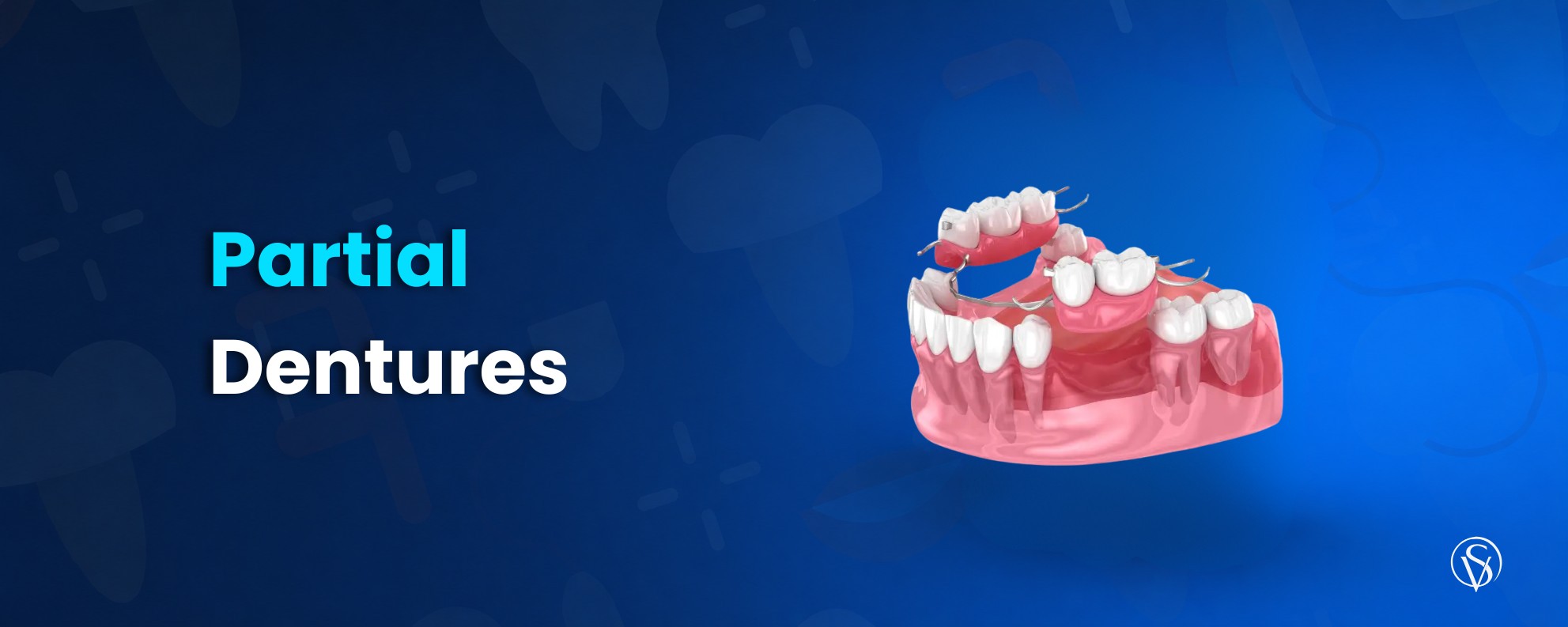
A partial denture is a removable dental prosthesis that replaces one or several missing teeth in an arch while the remaining natural teeth stay in place and provide retention. The prosthesis rests on the gum, grips the natural teeth through metal clasps, gum-coloured clasps, or precision attachments, and is taken out by the patient each day for cleaning.
Four designs cover almost every case, cast cobalt-chromium frameworks for durable long-term support, all-acrylic dentures as transitional or budget options, flexible nylon dentures for better aesthetics in selected cases, and implant-retained partials for weak remaining dentition. Lifespan runs from 5 to 8 years for acrylic and flexible designs to 10 or more years for cast metal.
Against fixed dental bridges and surgical dental implants, dentures and also partial types of it remain the most accessible tooth-replacement option.
At a Glance: A partial denture replaces several missing teeth using clasps that grip the remaining natural teeth, and it is removed daily for cleaning. It is indicated when healthy abutment teeth and adequate ridge support remain and the patient prefers or needs a non-surgical option. The selection rule is simple, cast cobalt-chromium for long-term durability, flexible nylon for visible front-tooth cases, and all-acrylic for transitional or budget situations.
What Are Partial Dentures?
Partial dentures are removable dental prostheses that replace one or several missing teeth in an arch while using the remaining natural teeth for retention and support. The patient takes the prosthesis in and out for cleaning each day.
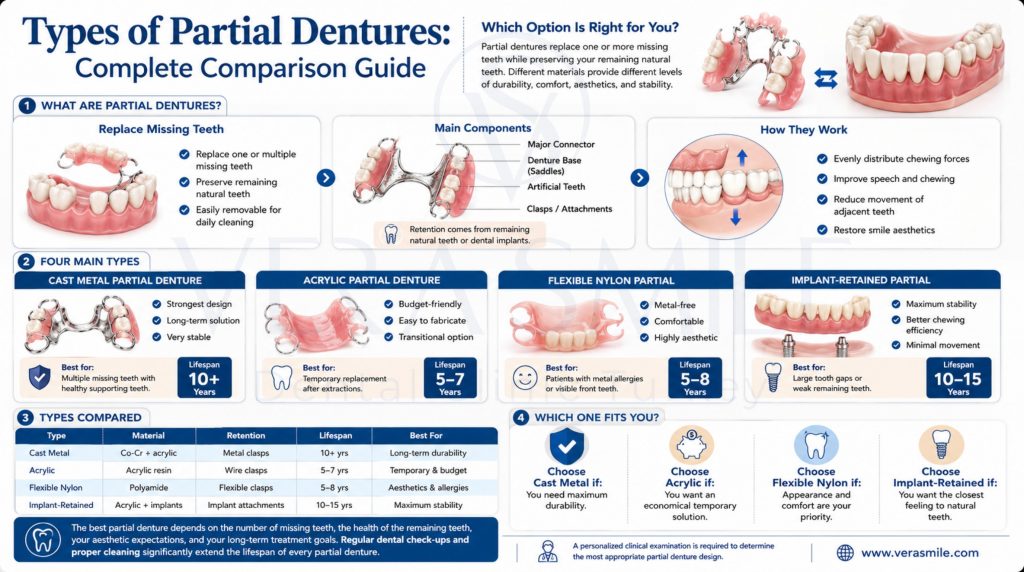
Every partial denture is built from three working parts as the major connector, the saddles (denture base), and the retention elements. The major connector is the rigid metal or acrylic bar that joins the two sides of the prosthesis and resists displacement during chewing. The saddles are the gum-coloured acrylic or nylon sections that carry the artificial teeth and rest on the edentulous (toothless) ridge. The retention elements are the clasps, precision attachments, or flexible clasps that grip the remaining natural teeth and hold the denture steady.
In clinical literature, a partial denture is also called an RPD (removable partial denture). Because the design distributes biting force across both the soft tissue and the natural teeth, the condition of those supporting teeth largely determines how well the prosthesis performs over time.
Partial Denture: A removable prosthesis that replaces missing teeth using a major connector, gum-coloured saddles, and clasps that grip the remaining natural teeth, removed daily for cleaning.
How Are Partial Dentures Made?
The partial denture procedure runs through seven core clinical stages including impressions, framework design and casting, framework try-in (for cast metal designs), bite registration, tooth try-in, final fitting, and review visits if needed. The full process usually takes 2 to 4 weeks across two to four appointments. The stages are:
- Impressions or 3D Scanning: Intraoral scanning or impressions capture the existing teeth, gum contours, and edentulous areas with high accuracy.
- Framework Design And Casting: For cast metal partials, the cobalt-chromium framework is digitally designed or waxed up and cast in the lab.
- Framework Try-In: The metal framework is tested in the mouth for fit, retention, and clasp position before the teeth and saddles are added.
- Bite Registration: The patient’s bite is recorded so the artificial teeth meet the opposing arch correctly.
- Tooth Try-In (Wax Stage): The denture is presented in wax so the patient can preview aesthetics, lip support, and tooth position.
- Final Fitting: The finished denture is inserted, the bite is checked, and adjustments are made for comfort.
- Review Visits: One or two follow-ups in the first month refine clasp tension and address sore spots.
The cast metal pathway adds the framework try-in stage, which is why metal designs take slightly longer than acrylic ones but fit more precisely.
Clinical Note: Sore spots in the first week are common and are not a failure of the denture. They are pressure points that the dentist refines at the first follow-up visit. Patients who push through pain without seeking adjustment risk ulceration and prolonged tissue damage.
How Do Digital Workflows Improve Partial Denture Outcomes?
Digital workflows improve partial denture outcomes through 3D intraoral scanning, digital framework design, and CAD/CAM milling or 3D printing, which together deliver a more accurate fit, faster turnaround, and reproducible records. The main gains are:
- 3D Intraoral Scanning: Replaces putty impressions and captures fine undercuts and rest seats with greater detail.
- CAD Framework Design: Lets the lab place clasps and rests precisely before the framework is fabricated.
- Milled Or Printed Try-Ins: Improve the accuracy of the framework try-in stage.
- Reproducible Digital Records: Allow an exact remake if the denture is lost or damaged.
- Faster Turnaround: Often complete the prosthesis within a single 7 to 10 day visit, which suits international patients.
For patients travelling to Turkey, the digital route compresses the timeline and creates a permanent record that makes future relines and remakes straightforward.
How Do Partial Dentures Work?
Partial dentures work by combining tissue support from the gum ridge with tooth-borne support from the remaining natural teeth, so biting force is shared rather than carried by one structure alone. Retention comes mainly from clasps that engage undercuts on the natural teeth, while the saddle that contacts the gum adds secondary stability.
In function, the acrylic or nylon saddle spreads chewing load across the soft tissue and the bone beneath it, and rest seats placed on the natural teeth transfer part of that load directly onto the teeth. This shared loading reduces pressure on the gum and slows bone change under the saddle. The major connector holds the two halves of the prosthesis together and resists movement during chewing, and the patient removes the denture each night so the soft tissues can recover.
Because load is split between teeth and tissue, a design that channels more force through the natural teeth, such as a cast metal framework with defined rest seats, behaves more predictably than one that relies mostly on the gum.
Clinical Note: Cast metal partial dentures (cobalt-chromium framework) are more biomechanically sound than all-acrylic versions because they transfer load through rest seats onto the teeth rather than relying mostly on tissue support. This is why cast metal is the preferred long-term option in most clinical guidelines.
What Are the Different Types of Partial Dentures?
The four recognised partial denture designs are cast metal (cobalt-chromium), all-acrylic, flexible nylon thermoplastic, and implant-retained partial dentures. Each has a distinct material, retention method, and best-use case, such as:
- Cast Metal Partial Dentures: A cobalt-chromium framework with acrylic gum-coloured saddles and acrylic or porcelain teeth, retained by metal clasps on the natural teeth, and the strongest, most durable option.
- All-Acrylic Partial Dentures: Acrylic resin throughout with stainless steel wire clasps, used as a transitional or low-cost solution and during the healing phase after extractions.
- Flexible (Nylon Thermoplastic) Partial Dentures: A metal-free polyamide nylon framework with gum-coloured flexible clasps, with brand examples including Valplast, TCS Unbreakable, and Sunflex.
- Implant-Retained Partial Dentures: A removable partial that snaps onto one or more strategically placed dental implants instead of clasping natural teeth, combining removability with implant-grade stability.
The right design depends on how many teeth are missing, the strength of the remaining teeth, and whether aesthetics or budget drives the decision for the proper type of dentures .
How Do Partial Denture Types Compare?
Evaluating different removable dental prostheses requires balancing mechanical durability against aesthetic integration and tissue support. Modern clinical protocols utilize distinct material combinations to achieve stable retention while distributing masticatory forces across the remaining natural teeth and edentulous ridges. Analyzing these designs based on their base compounds, attachment mechanisms, and structural longevity helps identify the most effective solution for varying levels of tooth loss.
| Partial Denture Type | Material | Retention | Lifespan | Best Use |
|---|---|---|---|---|
| Cast metal (Co-Cr) | Cobalt-chromium framework, acrylic teeth | Metal clasps on natural teeth | 10+ years | Long-term, multiple missing teeth, strong remaining teeth |
| All-acrylic | Acrylic resin, stainless steel clasps | Wire clasps and tissue contact | 5-7 years | Transitional or budget cases |
| Flexible nylon | Polyamide thermoplastic | Gum-coloured flexible clasps | 5-8 years | Cosmetic priority, metal allergy, smaller saddles |
| Implant-retained partial | Acrylic/metal frame on locator attachments | 1 or more implants | 10-15 years | Long edentulous spans, weak remaining teeth |
Selecting the correct configuration depends on the alignment of the remaining dentition and specific patient preferences. While cast metal frameworks offer the highest structural stability for extensive tooth loss, flexible polyamide alternatives provide an excellent metal-free option for highly visible zones. Regardless of the chosen material, meticulous oral hygiene and periodic clinical relining remain the critical factors that determine if a prosthesis reaches its maximum expected lifespan.
Who Is a Candidate for a Partial Denture?
Candidates for partial dentures are patients missing one or more teeth who still have healthy remaining teeth to act as retention abutments, adequate bone and gum support, and a preference for or need of a non-surgical option. Periodontal stability in the remaining teeth is essential. Suitable cases include:
- Stable Remaining Dentition: Patients missing several teeth in one or both arches whose remaining teeth are firm and healthy.
- Patients Declining Surgery: Those who refuse implant surgery for medical, financial, or personal reasons.
- Insufficient Bone Without Grafting: Patients who lack the bone volume for implants and decline bone grafting.
- Healthy Periodontium: Patients with controlled periodontal health in the supporting teeth.
- Cost-Sensitive Older Adults: Adults seeking a non-surgical replacement at a manageable cost.
- Transitional Cases: Patients in the phase after extractions, before a final implant-based plan.
- Anatomical Limitations: Patients with severely resorbed ridges where a conventional fixed bridge is not feasible.
Not every missing-tooth case is suitable. Active periodontal disease, mobile remaining teeth, unmanaged bruxism, or an inability to maintain dental hygiene reduce the chance of partial denture success.
What Are the Benefits of Partial Dentures?
The main benefits of partial dentures are non-surgical placement, lower cost than implants or bridges, the ability to replace several missing teeth in one prosthesis, and adjustability as the dentition changes. They are the most accessible tooth-replacement option. Key advantages include:
- No Surgery Required: No incisions, sutures, or implant healing period.
- Lower Cost: A clear price advantage over implants and bridges for budget-sensitive cases.
- Multi-Tooth Replacement: Several teeth across non-adjacent positions can be replaced in a single prosthesis.
- Adjustable Over Time: Additional teeth can sometimes be added to the same denture when other teeth are lost.
- Faster Timeline: Most partial dentures are completed in 2 to 4 weeks.
- Removable For Cleaning: Easier daily hygiene around the remaining natural teeth.
- Suitable For Medically Complex Patients: Patients on anticoagulants or with diabetes or osteoporosis can usually still receive a partial denture.
For many patients these benefits make the partial denture the practical first choice, particularly when surgery is unwanted or bone volume is limited.
What Are the Disadvantages of Partial Dentures?
The disadvantages of partial dentures include lower chewing efficiency than implants or bridges, daily removal for cleaning, added stress on the supporting natural teeth, a speech adjustment period, and ongoing bone resorption under the saddle. The main drawbacks are:
- Lower Chewing Efficiency: Partial dentures restore 40 to 60% of natural biting force, against 80 to 95% for implants.
- Daily Removal: The prosthesis must be taken out and cleaned every night.
- Clasp Visibility: Metal clasps on cast metal designs can show when smiling, particularly on premolars.
- Stress On Abutment Teeth: Clasps and rests load the supporting teeth, which can accelerate wear, mobility, or decay if hygiene is poor.
- Bone Resorption: The bone beneath the saddle continues to resorb over the years.
- Speech Adjustment: Most patients adapt within 1 to 2 weeks, though some report lasting speech changes.
- Relining Or Remaking: Needed at 2 to 5 year intervals as the bone changes.
- Increased Plaque Trapping: Plaque collects around clasp areas, raising decay and gum disease risk if hygiene declines.
Most of these drawbacks are manageable with good design and consistent hygiene, but they explain why fixed options outperform partials on long-term function.
Tip for the patients: The supporting natural teeth (abutments) are the long-term key to partial denture success. Twice-daily hygiene around the clasp areas and six-month professional cleanings preserve those teeth, which preserves the prosthesis.
How Should Patients Care for Partial Dentures?
Partial dentures need daily mechanical cleaning, careful handling, nightly removal, and regular professional review, with particular attention to the natural teeth because clasp areas trap plaque. A reliable routine includes:
- Brush Twice Daily: Clean the denture with a denture brush and a non-abrasive cleaner, not standard toothpaste, which is too abrasive for acrylic.
- Soak Overnight: Keep the denture in a denture-cleaning solution to control biofilm and prevent fungal growth.
- Rinse After Meals: Remove food debris from the denture after eating.
- Remove For Sleep: Take the denture out at night so the gum tissue can recover.
- Protect The Natural Teeth: Brush and floss the remaining teeth thoroughly, especially the surfaces that meet clasps and rest seats.
- Use The Right Tools: Apply a soft-bristled brush and, in higher-risk patients, a high-fluoride toothpaste on the natural teeth.
- Attend Six-Month Reviews: Professional cleanings remove plaque around clasps and monitor periodontal health.
- Reline On Schedule: Have the saddle relined every 2 to 5 years as the underlying bone changes.
- Avoid Hot Water: Hot water can warp the acrylic, so clean with cool or lukewarm water.
Consistent dental hygiene around the clasps is what keeps both the denture and the abutment teeth healthy through the full lifespan.
How Do Partial Dentures Compare to Bridges and Implants?
Partial dentures, dental bridges, and dental implants solve the same problem, missing teeth, but they differ sharply in cost, chewing function, lifespan, and their effect on the jawbone and neighbouring teeth. A partial denture is removable and non-surgical, a bridge is fixed and relies on the adjacent teeth, and an implant is surgically placed and stands alone. The table sets the three side by side on the variables that decide most treatment plans.
| Variable | Partial Denture | Dental Bridge | Dental Implant |
|---|---|---|---|
| Removability | Removable | Fixed | Fixed |
| Surgery required | None | None | Yes |
| Function (% natural bite) | 40-60% | 70-80% | 90-100% |
| Adjacent teeth preserved | Mostly yes; clasps engage them | Reduced for abutment crowns | Yes, no involvement |
| Bone preservation | No, ridge resorbs | No, ridge resorbs | Yes, load preserves bone |
| Lifespan | 5-15 years | 10-15 years | 15+ years for the implant |
| Cost per missing tooth (Turkey) | €350-€600 | €300 – €1,500 | €700 – €2,500 |
| Aesthetic outcome | Good with proper design | Very good | Excellent |
| Daily care | Remove and clean separately | Floss under the bridge | Brush and floss as normal |
Implants are the long-term reference standard for tooth replacement, and dental bridges sit between dental implants and partials on cost and function. Partial dentures remain the most accessible non-surgical solution and are often the right answer for patients who decline implants, lack bone, or need a transitional prosthesis.
Why Choose Vera Smile for Partial Denture Treatment?
Vera Smile is an international dental clinic that delivers partial dentures across every recognised material and design within a single digital workflow, including cast metal, flexible nylon, all-acrylic, and implant-retained partials.
Patients choose Vera Smile for partial denture treatment because the clinic combines:
- Regulatory Oversight: Turkish Ministry of Health authorisation governing every stage of treatment.
- Slow Dentistry Standards: Membership of the Slow Dentistry Global Network, supporting careful framework planning, isolation, and disinfection during prosthetic work.
- Digital Dentistry: 3D intraoral scanning and CAD/CAM fabrication for precise cast metal frameworks and digital try-ins.
- In-House Implantology: An implant team for implant-retained partial denture options where indicated.
- Transparent Planning: Written quotations, material disclosures, and projected relining and replacement timelines.
- International Coordination: VIP airport transfers, accommodation, and remote aftercare for relining schedules.
- Abutment-First Assessment: Periodontal evaluation of the remaining natural teeth before design, since abutment health is the most important variable in long-term success.
For every partial denture case, patients are provided with a written care plan upon leaving the dental clinic in Turkey, designed to ensure they receive the best possible care; this plan includes a schedule for relining, checks on the tension of the retainer, and remote follow-up appointments for patients living abroad.
FAQ
In most cases, no. Removing the denture at night lets the gum tissue recover, reduces fungal growth under the saddle, and lowers decay risk on the supporting teeth. Daily removal is the standard recommendation for both metal and acrylic designs.
Most patients adapt within 2 to 4 weeks. Speech, chewing, and saliva flow normalise as the muscles learn the new contours. Discomfort that lasts beyond the first month warrants a clinical review for clasp adjustment or saddle reshaping.
It can, if hygiene is inadequate. Clasps trap plaque against the supporting teeth, which raises decay and gum disease risk. With twice-daily hygiene around the clasp areas and six-month professional cleanings, the supporting teeth usually stay stable for the lifespan of the prosthesis.
In many cases, yes. Acrylic partials can have a tooth added at the lab. Cast metal partials are harder to modify because the framework is rigid, so small additions are possible while larger changes usually mean a remake. Implant-retained partials follow a separate protocol.
Yes, and flexible partials are often preferred for front-tooth cases because the gum-coloured clasps show no metal. The clinical situation must suit the material, with short edentulous spans, adequate ridge support, and a stable bite.