
Teeth whitening strips are thin flexible polyethylene films coated with a hydrogen peroxide or carbamide peroxide gel that bleaches surface and subsurface tooth stains. Over-the-counter strips contain 6 to 14% hydrogen peroxide (or 14 to 26% carbamide peroxide), while in-office professional teeth whitening uses 25 to 40% hydrogen peroxide. Most users see a two to four shade improvement after a full 14 to 28 day treatment course. Tooth sensitivity and gum irritation are the most common side effects, reported in up to 50% of users. Whitening strips do not change the colour of veneers, crowns, or composite bondings, only natural enamel. Results last 6 to 12 months without touch-ups. For deeper, faster, and more controlled whitening, in-office treatment under dental supervision is the comparative reference standard.
Teeth whitening strips are over-the-counter cosmetic products that release a low concentration of hydrogen peroxide or carbamide peroxide against the tooth surface for 20 to 30 minutes per day across a 14 to 28 day course. They lighten the natural enamel and dentine but do not whiten existing restorations such as veneers, crowns, or composite fillings. Most users record a two to four shade change. Sensitivity is the most common side effect. Strips are convenient and affordable, but the concentration is lower and the contact area is less controlled than in professional in-office whitening, which uses 25 to 40% hydrogen peroxide under isolation. Patients with existing restorations, severe stains, or sensitivity history may benefit more from in-office or custom-tray whitening.
What Are Teeth Whitening Strips?
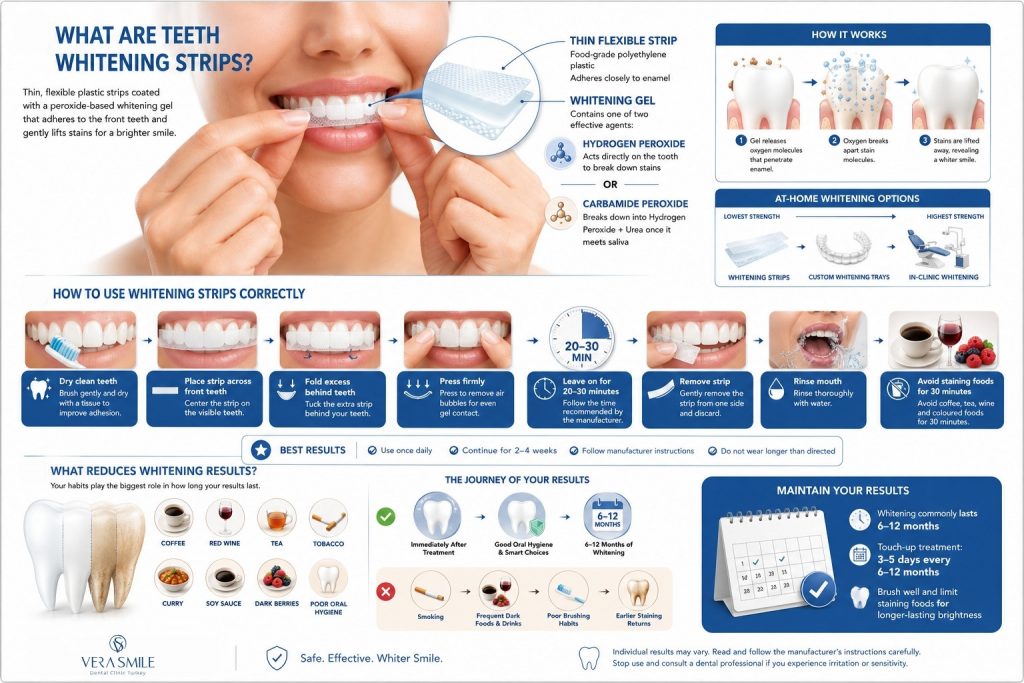
Teeth whitening strips are thin, flexible plastic strips coated with a peroxide-based bleaching gel that sticks to the front teeth for a set time each day. The strip is made of polyethylene, a food-grade plastic, and the gel carries one of two active agents. Hydrogen peroxide acts directly on the tooth, while carbamide peroxide breaks down into hydrogen peroxide and urea once it meets saliva.
A user presses the strip onto the upper and lower front teeth, leaves it for 20 to 30 minutes, then removes it, repeating the routine daily for two to four weeks. Brands differ in peroxide concentration, strip thickness, contact time, and total treatment days, but the mechanism stays the same across the category. Whitening strips sit at the at-home, lower-strength end of teeth whitening, alongside custom trays and in-clinic treatment.
What Active Ingredients Do Whitening Strips Contain?
Most over-the-counter whitening strips contain 6 to 14% hydrogen peroxide, or 14 to 26% carbamide peroxide, which is roughly equal to 5 to 9% hydrogen peroxide once activated. Concentration is the main difference between consumer and professional products.
- Standard strength: 6 to 10% hydrogen peroxide covers most consumer strips and balances results against sensitivity.
- Higher-strength variants: 12 to 14% hydrogen peroxide acts faster but raises the risk of sensitivity.
- Carbamide peroxide formulations: 14 to 26% carbamide is used in some strip and tray combination products and works more slowly.
- Professional in-office whitening: 25 to 40% hydrogen peroxide is used only under dental supervision.
Regulation varies by country. In the EU, retail products are capped at 0.1% hydrogen peroxide unless a dentist supplies them, where the limit rises to 6%, so the 6 to 14% figures above describe markets such as the US. Always read the label and check local limits.
How Do Whitening Strips Work?
Whitening strips work by releasing hydrogen peroxide through the enamel surface into the underlying dentine, where it breaks down chromogenic (stain-causing) molecules through an oxidation reaction. The result is a lighter tooth shade, not a coating or paint over the natural surface.
The mechanism operates in three sequential steps. First, during peroxide diffusion, the peroxide penetrates the enamel surface and reaches the underlying dentine. Next, the oxidation of chromogens occurs as stain molecules in the dentine are broken down by free radicals released from peroxide breakdown. Finally, a visible shade change is achieved as light reflects more uniformly through the lightened dentine, producing a brighter clinical appearance.
The reaction affects only natural tooth structure. Existing porcelain, zirconia, composite, or any restorative material remains unchanged.
Clinical Note: Whitening removes pigments inside the tooth and does not remove plaque, tartar, or surface roughness. A professional cleaning before any whitening course improves the result because the gel reaches the enamel more evenly.
How Effective Are Teeth Whitening Strips?
Whitening strips produce a measurable two to four shade improvement on the VITA shade guide in most users after a 14 to 28 day course, similar to a single in-office session. The final result depends on starting shade, stain type, and how consistently the strips are used.
- Average shade improvement: Two to four shades on the VITA scale across a full course.
- Best response: Yellow staining from food, drink, and ageing lightens most reliably.
- Limited response: Grey staining from tetracycline, fluorosis, or developmental causes responds poorly.
- No response: Veneers, crowns, composite fillings, and other restorations do not change shade.
- User compliance: Effectiveness drops sharply with inconsistent use or shorter contact times than instructed.
The clearest results appear on natural teeth with surface and age-related staining, while mixed or restored smiles need a different plan.
Key Fact: Whitening strips lighten enamel and dentine only. Patients with a mix of natural and restored teeth often see an uneven smile after whitening because restorations stay at their original shade.
How Long Do Whitening Strips Take to Show Results?
Most users notice a visible shade change within 3 to 5 days of starting a course, with the full result reached after the complete 14 to 28 day cycle. Speed depends on starting shade and peroxide concentration.
- Day 3 to 5: First visible brightness change, often subtle.
- Day 7 to 10: A clear two to three shade shift in most users.
- Day 14 to 21: Most users reach their maximum result with standard 14% formulations.
- Day 28: End of treatment for slower or sensitive-tooth formulations.
Using strips beyond the recommended course adds little extra brightness and raises the risk of sensitivity and gum irritation.
What Factors Reduce the Effectiveness of Teeth Whitening Strips?
Whitening strip results last 6 to 12 months on average, and how long they hold depends on diet, oral and dental hygiene, and tobacco use. The factors below shorten that window the most.
- Coffee, tea, and red wine: Add new staining molecules to the enamel every day.
- Tobacco: Reverses the result within weeks in heavy smokers.
- Curry, soy sauce, and dark berries: Stain readily within the first 48 hours after finishing.
- Inadequate brushing: Lets surface stains build back up.
- Acidic diet: Softens the enamel surface and speeds stain pickup.
A short touch-up course of 3 to 5 days every 6 to 12 months is the standard way to hold the result.
How Do You Use Teeth Whitening Strips Correctly?
Users apply whitening strips to dry, clean teeth, press them firmly for the stated contact time, and then remove and rinse them away once a day for the full course. Correct technique improves both adhesion and the evenness of the result.
- Brush gently before application to clear surface debris, but avoid hard brushing right before the strip.
- Dry the teeth with a tissue to improve adhesion.
- Apply the strip to the visible front teeth and fold the excess behind them.
- Press firmly to push out air bubbles so the gel meets the enamel evenly.
- Leave the strip in place for the stated time, around 20 to 30 minutes.
- Remove the strip and rinse with water, then avoid coloured food and drink for 30 minutes.
- Repeat once a day for the full treatment course.
- Remove the strip if it slips, and avoid swallowing the gel.
- Stop and seek advice if pain, blistering, or severe sensitivity appears.
Following the manufacturer schedule rather than extending it gives the best balance of brightness and comfort.
Tips for the Patients: Avoid coffee, red wine, tea, berries, and tobacco for at least 30 minutes after each session. Enamel is slightly more porous straight after whitening, which raises stain pickup during that window.
What Are the Side Effects of Whitening Strips?
The two most common side effects of whitening strips are tooth sensitivity, reported by up to 50% of users, and short-lived gum irritation where the strip touches soft tissue. Most effects clear within days of finishing the course.
- Cold and air sensitivity: Sharp, brief pain on cold drinks or cold air that settles within one to two weeks.
- Gum irritation: Mild redness, soreness, or tingling at the gum line from peroxide contact.
- Sore throat: From a swallowed gel or a slipped strip, and it settles on its own within a day or two.
- White spots on the gum: Temporary tissue blanching that resolves within hours.
- Uneven whitening: Patchy colour where the strip misses part of the tooth, especially around fillings.
- Short-term porosity: Enamel stays more open to staining for 24 to 48 hours after each session.
- No effect on restorations: Veneers, crowns, and bonding stay their original shade, which can create a mismatch.
- Rebound effect: A mild shade rebound in the first two weeks as the enamel rehydrates.
A break between courses, a desensitising toothpaste with potassium nitrate or stannous fluoride, and correct contact time all reduce these effects.
Who Should Avoid Whitening Strips?
Whitening strips should be avoided by people under 16, pregnant or breastfeeding women, and anyone with active decay, untreated gum disease, severe sensitivity, exposed roots, or extensive front-tooth restorations. A dental review before whitening is the standard recommendation.
- Under-16s: Enamel is not fully matured, so peroxide can cause sensitivity and pulp irritation.
- Pregnant or breastfeeding women: Regulators advise avoiding peroxide whitening while safety data stays limited.
- Active cavities or gum disease: Peroxide can reach the pulp through compromised enamel and cause acute pain.
- Exposed roots: Root dentine cannot be whitened and reacts with sharp sensitivity.
- Severe existing sensitivity: Whitening can worsen sensitivity in the first two weeks and may not be tolerated.
- Extensive front-tooth restorations: Veneers, crowns, and bonding will not whiten, leaving a colour mismatch.
- Tetracycline staining: Strips do little for intrinsic grey staining, where in-office treatment or veneers fit better.
- Peroxide or polyethylene glycol allergy: Rare, but reported.
A short dental check before starting confirms which of these apply and prevents most avoidable problems.
Clinical Note: A dental review before whitening finds hidden cavities, gum recession, and restorations that could spoil the result or cause harm. This single step prevents most adverse outcomes.
Are Whitening Strips Safe for Veneers, Crowns, and Bonding?
Whitening strips are safe to use over veneers, crowns, and composite bonding in that they do not damage the restoration, but they do not change its colour either, which often disappoints users with a mix of natural and restored teeth. Porcelain veneers, lithium disilicate (E.max), and zirconia crowns keep the shade set at fabrication and do not respond to peroxide. Composite bonding and composite veneers also stay the same and can show discoloration along the line where the strip meets the bonding edge. Older amalgam and metal restorations are unaffected.
Only the natural enamel between restorations lightens, and that is exactly what widens any mismatch between natural teeth and existing dental work. For anyone with front-tooth restorations who wants an even smile, the colour difference after whitening is the main point to plan around.
Tips for the Patients: If the goal is a uniform smile and front-tooth restorations are already in place, professional in-office whitening followed by restoration replacement or veneer placement is the predictable plan. Whitening strips alone do not suit patients with extensive front-tooth restorations.
How Do Whitening Strips Compare to Professional Teeth Whitening?
Whitening strips use a lower peroxide concentration than professional in-office whitening, take longer to reach the same shade, and give less control over the outcome.
| Whitening method | Active ingredient | Time to full result | Average shade change | Cost range | Supervision |
|---|---|---|---|---|---|
| OTC whitening strips | 6 to 14% hydrogen peroxide | 14 to 28 days | 2 to 4 shades | €30 to €80 | None |
| Custom take-home trays | 10 to 16% carbamide peroxide | 7 to 21 days | 4 to 7 shades | €200 to €500 | Dentist |
| In-office (Zoom, Philips, BTL) | 25 to 40% hydrogen peroxide | 1 to 2 sessions of 60 to 90 minutes | 4 to 8 shades | €300 to €700 | Dentist |
| Combined in-office and take-home | 25 to 40% in clinic, 10 to 16% at home | 1 to 2 weeks | 6 to 10 shades | €400 to €800 | Dentist |
In-office whitening is faster, deeper, and supervised, which lowers the risk of sensitivity and gum irritation, while custom take-home trays sit between strips and in-office treatment on both speed and cost. Strips remain the most affordable route and suit mild, even staining on fully natural teeth, but they reward strict daily compliance and give weaker results than any dentist-supervised option. For patients who want a predictable shade, a faster timeline, or treatment planned around existing restorations, supervised whitening is the stronger choice.
FAQ
Daily use within the manufacturer’s recommended cycle is considered safe for most adults, but the same strips used continuously beyond the recommended course increase sensitivity and gum irritation without adding proportional benefit. A break of several months between full courses is the standard approach.
Whitening strips at retail concentrations do not cause clinically significant enamel damage when used as directed. Studies show transient roughness and porosity that recovers within 24 to 48 hours. Overuse, longer contact times than recommended, or use with damaged enamel can produce more lasting effects.
Patients with mild sensitivity can sometimes use strips with a dedicated sensitivity formulation that contains potassium nitrate. Patients with severe or persistent sensitivity should avoid strips and consider supervised whitening, which allows desensitiser application and shorter, controlled exposures.
Yes, yellow staining from food, drink, and aging responds best to peroxide-based whitening, including strips. Grey or brown intrinsic staining from tetracycline antibiotics, developmental enamel defects, or trauma responds less reliably and may require alternatives such as veneers.
Wait at least 30 minutes after removing the strip. The enamel is more permeable to staining in the first 24 to 48 hours, so reducing coffee, tea, and red wine during the active whitening course produces the best final shade.
Yes, and many patients do. Pre-veneer whitening lightens the surrounding natural teeth so the veneer shade can be planned to match a brighter base. The whitening course should finish at least one to two weeks before veneer fabrication so the final enamel shade is stable when the lab matches the ceramic.