
Bruxism is the involuntary grinding, gnashing, or clenching of teeth that happens outside normal chewing or speaking. It shows up in two forms, sleep bruxism at night and awake bruxism during the day, and its combined global prevalence is about 22%. Stress, sleep problems, some medications, and habits like heavy caffeine or alcohol use are the common triggers.
Most people notice it through a sore jaw, morning headaches, or a partner mentioning grinding sounds at night. Left alone, it slowly wears down enamel, cracks teeth, and strains the jaw joint. The reassuring part is that it is manageable, a custom night guard protects the teeth, treating the underlying cause reduces the grinding, and worn teeth can be rebuilt when needed. The right plan depends on whether you grind in your sleep or while you are awake.
What Are the Types of Bruxism?
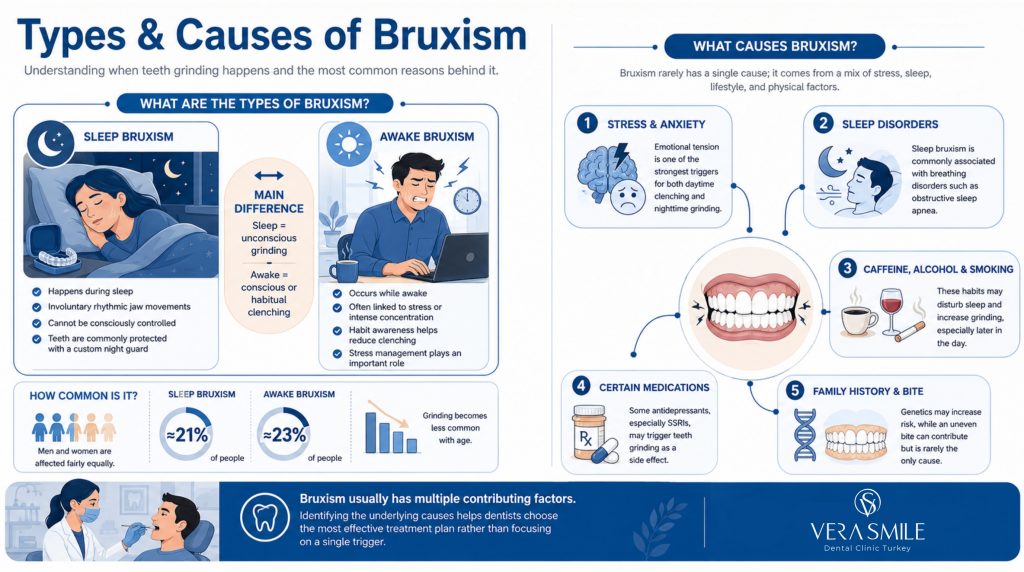
There are two types of bruxism, and the difference comes down to when the grinding happens. Knowing which one you have shaped the treatment, since one is unconscious and the other is a daytime habit.
- Sleep Bruxism: This happens during sleep as rhythmic jaw movements you cannot control, which is why it is treated mainly by protecting the teeth with a night guard.
- Awake Bruxism: This is clenching or bracing the teeth while you are awake, often tied to stress or deep concentration, and it responds best to habit-awareness and stress management.
Both are common, sleep bruxism affects about 21% of people and awake bruxism about 23%, with men and women affected fairly equally and grinding becoming less common with age (Zieliński et al., 2024).
What Causes Bruxism?
Bruxism rarely has a single cause; it comes from a mix of stress, sleep, lifestyle, and physical factors. Because these overlap, a dentist looks at the whole picture rather than blaming one thing.
- Stress and Anxiety: Emotional tension is one of the strongest triggers and drives both daytime clenching and night-time grinding.
- Sleep Disorders: Sleep bruxism often goes hand in hand with breathing problems during sleep, such as obstructive sleep apnea.
- Caffeine, Alcohol, and Smoking: These stimulants disturb sleep and increase grinding, especially when used later in the day.
- Certain Medications: Some antidepressants, particularly SSRIs, can trigger grinding as a side effect.
- Family History and Bite: Grinding can run in families, and an uneven bite may add to the problem, though it is rarely the main cause on its own.
Many people have more than one of these at play at the same time, which is why finding the real trigger matters before choosing a treatment.
Clinic Note: In our consultations, stress-related grinding is by far the most common pattern we see. Before recommending a guard, we always ask about caffeine, sleep quality, and recent stress, because fixing the trigger is what keeps the guard from becoming a lifelong crutch.
What Are the Symptoms of Bruxism?
The most common signs of bruxism are a sore jaw, morning headaches, and grinding noises a partner hears at night. These usually appear before any visible damage to the teeth.
- Grinding Sounds at Night: A partner often hears grinding or squeaking while you sleep, which is one of the clearest signs.
- A Sore or Tired Jaw in the Morning: The jaw feels tight, achy, or worn out when you wake up.
- Morning Headaches: A dull headache around the temples on waking comes from overworked jaw muscles.
- Face or Ear Aches: Pain can spread across the face, cheeks, or ears even though it starts in the jaw.
- Marks on the Tongue or Cheeks: Ridges along the tongue or a white line inside the cheek point to heavy clenching.
- Broken Sleep: Grinding can disturb sleep for both you and your partner.
If several of these show up together, it is worth having your teeth and jaw checked before any lasting wear sets in.
Tips for the Patient: Ask whoever shares your room whether they hear grinding at night, and take a quick phone photo of your front teeth every few months. Comparing the photos makes it much easier to spot flattening or small chips early.
How Does Bruxism Affect Your Teeth and Jaw?
Over time, grinding presses on the teeth with far more force than normal chewing, which wears them down, cracks them, and strains the jaw joint. This damage builds up slowly and cannot be undone once it happens.
- Worn and Flattened Teeth: Constant grinding wears away enamel and flattens the biting edges, making the teeth look shorter.
- Cracks and Chips: The heavy pressure can crack or chip teeth, sometimes deep enough to need a crown or root canal treatment.
- Sensitive Teeth: As enamel thins and the softer layer underneath is exposed, teeth react more to hot, cold, and sweet.
- Loose Teeth and Receding Gums: Strong sideways forces can loosen teeth and pull the gums back around them.
- Jaw Joint Problems (TMJ): Ongoing strain on the joint can cause pain, clicking, and limited movement.
- Damage to Dental Work: Grinding can chip or loosen existing fillings, veneers, and crowns, shortening how long they last.
Because this damage builds quietly and is permanent, protecting the teeth early is far cheaper and easier than repairing them later. Evidence from a systematic review and meta-analysis also indicates that bruxism is associated with an increased likelihood of temporomandibular joint disorders (Mortazavi et al., 2023).
How Is Bruxism Diagnosed?
A dentist diagnoses bruxism mainly by examining your teeth and jaw and asking about your symptoms and sleep, since there is no single test for it. The diagnosis combines what the dentist sees in your mouth with what you and your partner notice.
- Wear Patterns: Flat, polished spots on the teeth are a clear sign of grinding.
- Jaw Muscle Check: Tender or enlarged jaw muscles point to regular clenching.
- Your History: Morning headaches, jaw soreness, and a partner’s report of grinding help confirm it.
- Sleep Study (When Needed): If sleep apnea is suspected, a sleep study may be arranged to look at what happens overnight.
Together these show the dentist how severe the grinding is and what treatment will help.
Clinic Note: During an exam we run a finger along the biting edges and feel the cheek muscles while you clench. Flattened canine tips and a firm, bulky jaw muscle often tell us grinding has been going on for a while, even before the patient has noticed anything.
How Is Bruxism Treated?
Treatment aims to protect the teeth and calm the jaw muscles rather than force the habit to stop, because grinding often comes from causes you cannot simply switch off. The right mix depends on whether you grind in your sleep or while awake and on what is driving it.
- Custom Night Guard: A mouth guard for grinding teeth worn at night shields the teeth from wear and quietens the grinding, though its effect on the muscle activity itself is temporary (Guaita & Högl, 2016).
- Managing Stress and Sleep: Better sleep habits plus muscle-relaxation exercises meaningfully reduced grinding and stress over six months in a randomized trial (Tandon et al., 2025).
- Botox: A small injection into the jaw muscle relaxes it and eases grinding pain for about three to six months (Fernández-Núñez et al., 2019).
- Treating Sleep Apnea: When grinding comes alongside sleep apnea, treating the breathing problem often reduces the grinding too.
- Bite or Alignment Correction: If an uneven bite plays a part, adjusting the bite or straightening the teeth with orthodontics can help, though the bite is rarely the whole story.
There is not enough evidence to call a night guard a cure on its own, so it works best as protection alongside treatment that tackles the cause (Macedo et al., 2007).
A Question We Often Hear: “I wear a night guard but still wake up with a sore jaw, why?” A guard protects the teeth, but it does not stop the muscles from working, so we usually pair it with jaw-relaxation and stress steps to ease the soreness itself.
How Are Teeth Damaged by Bruxism Restored?
Teeth worn or cracked by years of grinding can be rebuilt, and the choice depends on how many healthy teeth are left. The aim is to bring back both the look and the strength of the tooth while protecting what is underneath.
- Composite Bonding: Rebuilds small chips and worn edges by adding tooth-coloured material directly to the tooth.
- Dental Veneers: Restore worn or shortened front teeth with thin shells bonded to the surface.
- Dental Crowns: Cap badly worn or cracked teeth to bring back their strength and shape.
After any restorative treatment, protecting the new restorations is just as important as rebuilding the damaged teeth. Patients who continue to grind their teeth are typically advised to wear a custom night guard, which helps distribute biting forces and reduces the risk of fractures, chipping, or premature wear of composite bonding, veneers, and crowns.
How to Reduce Teeth Grinding
You can ease teeth grinding at home by cutting its triggers and helping the jaw relax, and this works best alongside your dentist’s treatment rather than in place of it.
- Cut back on caffeine and alcohol in the evening, since both make night-time grinding worse.
- Keep a steady sleep routine with a calm wind-down and less screen time before bed.
- Catch yourself clenching during the day and rest the jaw with your lips together and teeth apart.
- Warm and relax the jaw with a warm compress and gentle stretching before sleep.
- Lower your stress with exercise, breathing, or relaxation exercises you can keep up.
These are more than general advice: relaxation and better sleep habits measurably cut grinding, especially when paired with a night guard (Tandon et al., 2025).
How Much Does Bruxism Treatment Cost?
What you pay depends on the type of guard and whether any worn teeth need rebuilding. A basic guard is inexpensive, while a custom guard and any repairs cost more but last longer and prevent bigger bills later.
| Treatment | What is included | Price range |
| Over-the-counter / boil-and-bite guard | Generic or self-moulded stock guard, no professional fitting | $15 to $50 |
| Custom night guard (online dental lab) | At-home impression kit, lab-made guard, no in-office fitting | $100 to $200 |
| Custom night guard / occlusal splint (dentist) | Consultation, scan or impression, made-to-fit guard, fitting | $300 to $800 |
| TMJ stabilisation splint | Stronger guard for jaw-joint symptoms | $500 to $1,500 |
| Rebuilding worn teeth (per tooth) | Crowns or veneers for teeth damaged by grinding | Priced per tooth by damage |
A custom guard costs more than a shop-bought one, but it fits properly, lasts longer, and helps you avoid the much larger cost of crowns or veneers down the line. In Turkey, custom splints generally run about £100 to £300, against roughly $400 to $1,500 in the UK, US, and Europe.
When Should You See a Dentist About Teeth Grinding?
See a dentist if you have ongoing jaw pain, teeth that look worn or chipped, regular morning headaches, or a partner who says you grind at night. Enamel and cracks cannot heal on their own, so catching it early saves your teeth and often your money too. A quick check lets the dentist confirm what is happening, see how far it has gone, and fit a guard before more damage is done.
⚠ Why Not to Wait: Worn enamel and cracks are permanent once they happen, and heavy night-time grinding can be a sign of an untreated sleep or airway problem. Putting off a check risks bigger repairs like crowns or root canals later, and can leave a sleep issue unaddressed.
FAQ
Sometimes, yes, especially when it is tied to a short-term trigger like a stressful period or a new medication. But many cases stick around and slowly damage the teeth, so a night guard is worth it if the grinding keeps up.
Mostly stress and sleep, though an uneven bite can add to it for some people. Since the causes overlap, treatment focuses on whatever is driving it most.
Yes, it is common in children, mostly during sleep, and it often settles on its own as they grow and their adult teeth come in. Treatment is only needed if it is wearing the teeth, causing pain, or disturbing sleep.
No, not completely. Botox relaxes the jaw muscle to ease the force and the pain for about three to six months, but it is used as part of a wider plan, not as a standalone fix.
Not an emergency, but over time it wears down enamel, cracks teeth, and strains the jaw joint. A night guard protects your teeth while the underlying cause is dealt with.