

A chipped dental crown is a fracture in the ceramic or porcelain surface of a crown already cemented onto a tooth, not damage to the natural tooth underneath. Small surface chips are smoothed by chairside polishing or rebuilt with bonded composite in a single visit, while chips that reach the margin, expose the metal substructure, change the bite, or recur after repair call for a full crown replacement.
A chipped crown is rarely a dental emergency; same-day care is needed only with severe pain, an exposed nerve, soft-tissue laceration, or a crown about to detach, and most cases are assessed within one to two weeks.
Crowns chip because of grinding, biting hard objects, material fatigue, occlusal interference, or trauma, and monolithic zirconia and lithium disilicate (E.max) resist chipping best. Replacement cost in Istanbul varies by material, and a custom night guard is the single most effective way to prevent a recurrence.
What Is a Chipped Dental Crown?
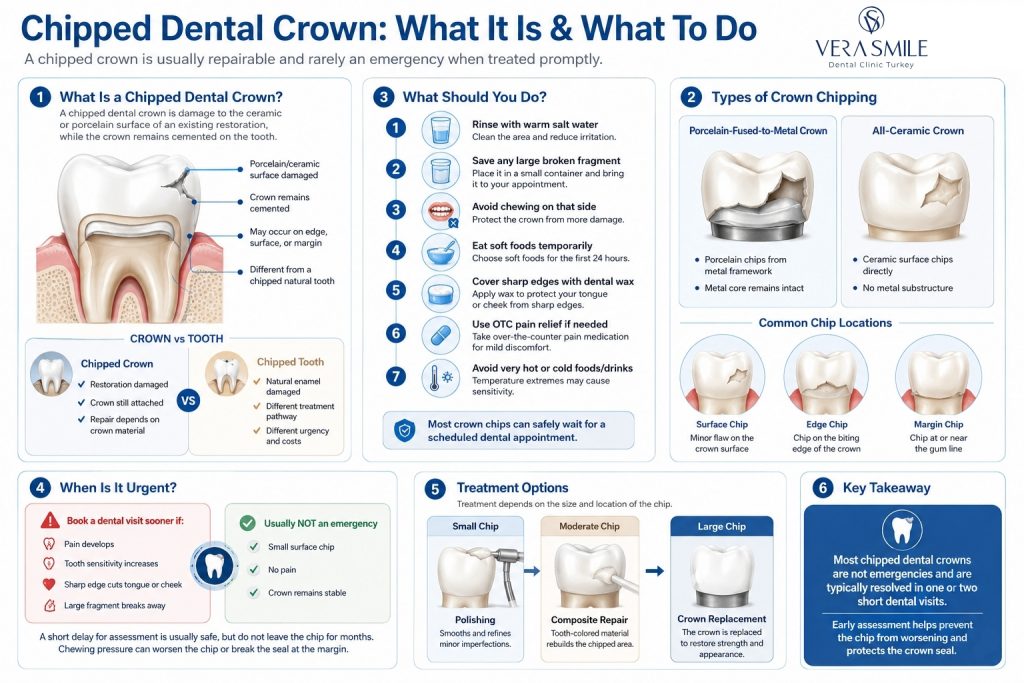
A chipped dental crown is damage to the ceramic or porcelain of an existing restoration, where a piece of the crown surface has broken away while the crown stays cemented on the tooth. This is different from a chipped natural tooth, where enamel or dentine breaks off, and the repair path, urgency, and cost all depend on which one applies. A chip can be a shallow surface flaw, a larger fragment loss that reaches the biting edge, or a break at the gum-line margin.
Porcelain-fused-to-metal crowns chip at the porcelain layer covering the metal core, while all-ceramic crowns chip at the surface. The size and location of the chip decide whether the crown is polished, rebuilt with composite, or replaced. Chipping is one of the more common surface problems seen across the full range of dental crowns, and most chips are resolved in one or two short visits.
What Should You Do If Your Dental Crown Chips?
If a dental crown chips, check the size and location of the chip, keep the area clean, manage any sharp edge, and book a dental appointment within one to two weeks unless there is pain or soft-tissue irritation.
- Rinse the area: Use warm salt water to clean the site and calm any irritation.
- Save a large fragment: Keep any sizable broken piece in a small container and bring it to the appointment.
- Protect the affected side: Avoid chewing on the chipped crown until it is assessed.
- Switch to soft foods: Move to a soft diet for the first 24 hours if the chip has left a sharp edge.
- Cover a sharp edge: Apply dental wax over an edge that is cutting the tongue or cheek as a short-term measure.
- Manage mild pain: Take an over-the-counter painkiller for mild discomfort.
- Avoid temperature extremes: Skip very hot or very cold food and drink if the underlying tooth feels sensitive.
Most crown chips are not emergencies, and a short wait for a scheduled visit is safe. A short delay for assessment is safe, but the chip should not be left for months, because chewing load can widen it or break the seal at the margin.
Is a Chipped Crown a Dental Emergency?
A chipped crown is generally not considered a dental emergency unless it is accompanied by severe pain, exposed nerve tissue, a soft-tissue laceration from a sharp edge, or a loose restoration at risk of being swallowed or inhaled. In the vast majority of cases, a chip is a minor structural or cosmetic issue that can be handled through a regularly scheduled appointment rather than urgent care. The true level of urgency depends entirely on your specific symptoms and whether the underlying tooth or surrounding oral tissues are compromised.
If you experience unmanageable pain, bleeding, or a completely loose restoration, you should seek same-day dental care. Moderate discomfort, sharp cold sensitivity, or a rough edge irritating your tongue can typically wait 24 to 48 hours, while a purely cosmetic chip with no pain can safely be evaluated within one to two weeks. However, even if the chip causes no immediate discomfort, it still requires a routine dental assessment eventually because a fractured surface can deepen over time, alter your bite, or break the protective marginal seal that shields the underlying tooth from decay.
Can a Chipped Dental Crown Be Repaired?
Yes, a chipped dental crown can often be repaired, but the feasibility of the fix depends entirely on the size, location, and material of the damage. Small surface chips that do not affect your bite or appearance can simply be smoothed and polished during a single, quick visit. For larger but safely contained chips, a dentist can rebuild the missing section right in the chair using tooth-colored composite resin, applying specialized priming agents such as hydrofluoric acid and silane for porcelain, or zirconia-specific primers for zirconia crowns. While this bonded repair is much faster and more cost-effective than a full replacement, it is inherently less durable than the original ceramic and will wear or stain faster over time.
Ultimately, if the fracture compromises the crown’s marginal seal, exposes an underlying metal substructure, or sits directly in a high-pressure chewing zone, a simple repair will not hold and a complete crown replacement is required.
When Does a Chipped Dental Crown Need to Be Replaced?
A chipped dental crown needs to be replaced when the chip compromises the bite, the fit, the marginal seal, or the appearance, when the metal substructure is exposed, or when a previous composite repair has failed. Replacement is the standard outcome for moderate to large chips.
- Margin involvement: The chip reaches the crown edge at the gum line and breaks the seal that keeps bacteria out.
- Exposed metal core: A porcelain-fused-to-metal crown shows a dark line or a rough metal edge.
- Altered bite: The chip changes how the upper and lower teeth meet.
- Repeated chipping: Several chips on the same crown point to material fatigue through the bulk of the ceramic.
- Failed repair: A chip returns in the same spot after a previous composite repair.
- Smile-zone defect: A visible flaw sits on a front crown.
- Loose crown: The crown moves when it is checked.
Replacement means removing the chipped crown, checking and preparing the tooth underneath, taking a fresh digital scan or impression, and fitting a new crown through the same workflow used for the original.
How Much Does It Cost to Replace a Chipped Crown in Turkey?
Replacing a chipped crown in Istanbul is priced per crown by material, with porcelain-fused-to-metal at the lower end and monolithic zirconia and feldspathic ceramics at the higher end. The indicative Istanbul-market ranges below are placeholders; Vera Smile current-quarter figures must replace them before publication.
| Crown material | Price per crown (Istanbul) | Notes |
| Porcelain-fused-to-metal (PFM) | €180 to €280 | Metal core, lowest cost |
| Lithium disilicate (E.max) | €280 to €450 | Strong and aesthetic |
| Monolithic zirconia | €300 to €500 | Strongest, suits back teeth and grinders |
| All-ceramic feldspathic | €350 to €600 | High-aesthetic front cases |
| Gold alloy (high-noble) | €450 to €700 | Specialist, non-cosmetic cases |
These figures sit inside the wider range of dental crowns cost in Turkey and shift with case complexity, the number of crowns replaced, and whether the tooth underneath needs treatment first.
Why Do Dental Crowns Chip?
Dental crowns chip mainly because of grinding, biting hard objects, material fatigue, occlusal interference, and trauma. Each cause has its own pattern and its own prevention measure.
- Grinding (bruxism): Repeated clenching loads the ceramic past its flexural strength and produces fatigue cracks at the biting edge.
- Biting hard objects: Ice, hard candy, pens, and nails create point loads that exceed the local strength of the crown.
- Material fatigue: All ceramics build microcracks over years, and porcelain-fused-to-metal crowns lose porcelain from the metal core.
- Occlusal interference: A high or premature contact concentrates force on one point and speeds up chipping.
- Trauma: A fall, a sports impact, or an accident can fracture even a well-made crown.
- Weak cementation: A poorly bonded crown flexes under load and develops micromotion cracks.
- Over-thinned ceramic: A crown reduced too far in the lab is structurally weak where it is thinnest.
Identifying the cause is what stops a replacement crown from chipping the same way, which is why the prevention steps target each mechanism directly.
Which Crown Material Resists Chipping the Most?
Monolithic zirconia resists chipping the most among materials in routine use, followed by lithium disilicate (E.max) and gold alloy, while feldspathic ceramic and porcelain-fused-to-metal chip more readily. Higher flexural strength tracks with better chip resistance, as the comparison below shows.
| Material | Flexural strength | Chip resistance | Best use |
| Monolithic zirconia | Above 900 MPa | Highest | Back teeth, grinders |
| Lithium disilicate (E.max) | 360 to 400 MPa | High | Posterior and front crowns |
| Gold alloy | Metal, not ceramic | Does not chip | High-load, non-cosmetic cases |
| Feldspathic ceramic | 60 to 110 MPa | Low | High-aesthetic front, light bite |
| Porcelain-fused-to-metal | Strong core, weak surface porcelain | Low at surface | Budget cases |
Because material choice changes how likely a future chip is, a recurrent chip is often the trigger to replace a weaker ceramic with monolithic zirconia or lithium disilicate.
How Can You Prevent a Chipped Crown From Chipping Again?
The most effective ways to prevent a crown from chipping again are wearing a night guard if you grind, avoiding hard and non-food items, correcting any bite interference, keeping six-month reviews, and choosing the strongest material the case allows.
- Wear a custom night guard: For anyone who grinds, a fitted night guard is the single highest-impact step, and a clinic-made mouth guard for grinding teeth protects the crown surface from overnight clenching forces.
- Avoid hard objects: Do not bite ice, hard candy, pens, or fingernails.
- Do not use teeth as tools: Avoid opening packaging or tags with your teeth.
- Correct bite interference: Have an uneven or high contact adjusted promptly at a review.
- Choose stronger materials: Select monolithic zirconia or lithium disilicate over feldspathic porcelain in heavy-load cases.
- Keep six-month reviews: Routine checks catch small cracks and fatigue before they become a replacement case.
- Brush gently: A soft-bristled brush and a low-abrasive paste preserve the surface glaze.
Most chips found at a routine review are very small, and a small chip caught early can be polished in one visit, while the same chip left for a year can become a full replacement.
FAQ
No. A chipped fragment cannot be glued back, because it is too small to reposition and bonding to old cement is not predictable. If a whole crown has come off intact and the tooth underneath is healthy, it can sometimes be re-cemented, but that is a different situation. Composite repair is the chairside fix for a chip.
It depends on where the chip sits. A chip on the outer porcelain does not reach the tooth. A chip that extends to the gum-line margin can break the seal and let bacteria reach the tooth, which can cause decay or infection underneath. Margin-involving chips warrant prompt assessment.
No. A chipped front tooth can often be restored with composite bonding for small chips, or with a porcelain or composite veneer for medium chips with intact tooth structure. A crown is reserved for cases with major structural loss or after root canal treatment.
It depends on your insurer. Many dental plans cover part of a crown replacement when there is structural failure, but not when the original crown has not yet reached its expected service life. Cosmetic repair is rarely covered. Confirming directly with the insurer is the only reliable answer.