
Receding gums occur when the gum margin moves away from the tooth, exposing the root surface and, in advanced cases, the bone beneath. Gum tissue that has already receded cannot grow back on its own, because the gum does not regenerate the way skin does. The earliest signs are tooth sensitivity, teeth that look longer, and a visible root at the gumline. The main causes are periodontal disease, aggressive brushing, thin inherited gum tissue, teeth grinding, and smoking, which often act together.
A 2025 systematic review and meta-analysis found recession affects an estimated 81% of adults at 1 mm or more, rising sharply with age (Marschner et al., 2025). Treatment ranges from professional cleaning and habit changes to connective tissue and free gingival grafts, chosen by severity and cause. In Turkey, costs run well below UK and US prices, from about €50 for a deep clean to €400 to €800 per tooth for a graft. Early diagnosis matters, because shallow and deep defects are treated very differently.
What Is Gum Recession?
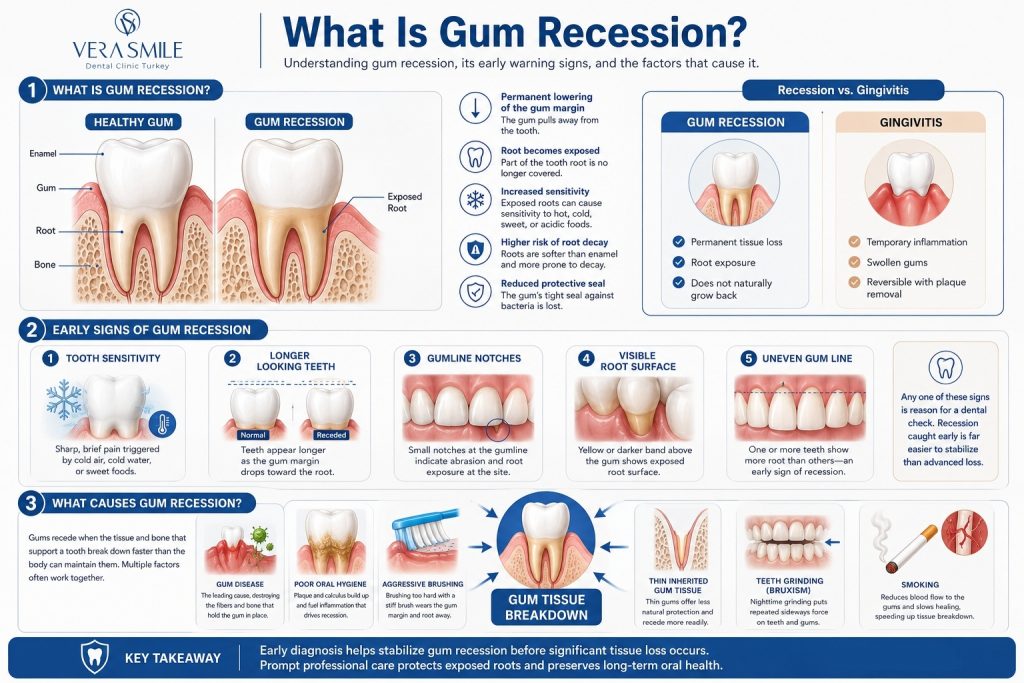
Gum recession is the permanent downward movement of the gum margin, which exposes part of the tooth root. It is a structural change in where the gum sits. The exposed root behaves differently from the enamel-covered crown in two ways that matter. The root surface is softer than enamel, so it is more sensitive to temperature and more prone to decay. It also loses the tight seal that healthy gum provides against bacteria, which is why untreated recession tends to accelerate rather than settle. Recession can affect a single tooth or spread across a whole arch, and the pattern often points straight to the cause.
Gum recession is frequently confused with gingivitis, but the two are different. Recession is a permanent loss of gum position, while gingivitis is temporary inflammation and swelling that firms up again once plaque is removed. This distinction shapes treatment, because recession involves lost protective tissue that does not return to its original height without help, whereas gingivitis reverses with cleaning.
What Are the Early Signs of Gum Recession?
The first sign most people notice is tooth sensitivity to cold, sweet, or acidic things, caused by the newly exposed root. Recession develops slowly, so the physical changes are often visible before any discomfort appears. The signs below, from most to least commonly reported, help catch it early.
- Increased tooth sensitivity often appears first, with sharp, brief pain triggered by cold air, cold water, or sweet foods.
- Teeth that look longer than before reflect a gum margin that has dropped toward the root.
- Small notches at the gumline point to abrasion and root exposure at the recession site.
- A visible root surface, seen as a yellow or darker band above the gum, is an exposed root that contrasts with the whiter crown.
- An uneven gum line, where one or a few teeth show more root than the rest, is a reliable early marker of localized recession.
Any one of these is reason for a dental check, since recession caught early is far easier to stabilize than advanced loss.
What Is the Cause of Gum Recession?
Gums recede when the tissue and bone that support a tooth break down faster than the body can maintain them, and more than one cause is often at work at once. Someone with thin inherited gum tissue who also brushes hard and grinds at night is placing three separate loads on the same tissue. The main causes are:
- Gum disease is the leading cause, destroying the fibers and bone that hold the gum in place.
- Poor oral hygiene lets plaque and hardened calculus build up, feeding the inflammation that drives recession.
- Aggressive brushing with a stiff brush physically wears the thin gum margin and root away.
- Thin inherited gum tissue offers less natural protection and recedes more readily.
- Nighttime grinding sends repeated sideways force into specific teeth and drives recession at the gumline.
- Smoking reduces blood flow to the gums and slows healing, speeding up tissue breakdown.
These causes rarely act alone, so the sections below look at how the main ones work.
Yes. Periodontitis is the leading cause of widespread gum recession, because it destroys the fibers and bone that hold the gum in place. Bacterial plaque left along the gumline triggers chronic inflammation, which breaks the attachment between gum and tooth and dissolves the bone underneath. As that support disappears, the gum margin follows the shrinking bone downward. This is why recession from periodontitis is progressive and often affects several teeth, and why controlling the infection has to come before any coverage procedure.
Yes, both do, but in opposite ways. Scrubbing hard with a stiff brush physically wears the thin gum margin and the root beneath it away, producing the wedge-shaped notches of mechanical recession. Too little cleaning lets plaque and hardened calculus build up, feeding the inflammation that drives periodontal recession. Consistent, gentle dental hygiene removes plaque without eroding the gum margin, which is why technique matters as much as frequency, a point reinforced by a 2025 narrative review on toothbrushing and gum health (Kumar et al., 2025).
Yes. Thin inherited gum tissue and abnormal bite forces are major contributors, and they often explain recession in people with excellent oral hygiene. A thin gum type, meaning naturally delicate tissue with little bone behind it, offers less protection and recedes more readily. Nighttime bruxism sends repeated sideways force into specific teeth, flexing them and driving recession at the gumline. Crowded or protruding teeth concentrate force on individual spots, which is why recession from bite problems tends to cluster on a few teeth rather than spread evenly.
Smoking and oral piercings both speed up recession by combining constant irritation with slower healing. Tobacco reduces blood flow to the gums and weakens the immune response, so smokers break down faster and heal more slowly after any treatment. Lip and tongue piercings rub against the gum with every movement, wearing the tissue down where they touch and often causing recession on the lower front teeth. Both factors are modifiable, and removing them improves the outcome of any later gum treatment.
Can Receding Gums Grow Back Naturally?
No. Receding gums cannot grow back naturally, because gum tissue does not regrow to cover a root once it has been lost. This is the single most important fact for patients to understand, and it is often misrepresented online. What can change is the direction of travel. Active recession can be halted, and the tissue that remains can be protected, but height already lost returns only through a surgical graft.
Why Can’t Gum Tissue Regenerate on Its Own?
Gum tissue cannot regrow over a bare root because it lacks the blood supply and the anchoring surface it would need to migrate back down and reattach. Skin heals by growing across a wound that still has a blood supply underneath, but an exposed root is a dry, hard surface that offers new gum cells nothing to hold onto. Without that underlying blood supply and a stable surface, the body cannot rebuild the lost margin, which is why root coverage means transplanting tissue that brings its own blood supply.
Can Early Gum Recession Be Stopped Before It Gets Worse?
Yes. Early gum recession can almost always be stopped, even though it cannot be reversed without surgery. Stopping progression and reversing loss are two different goals. Progression is controlled by removing the cause, which means correcting brushing technique, treating any gum infection, managing grinding with a night guard, and quitting smoking. Once the cause is gone, a shallow recession can stay stable for years without ever needing a graft. Reversing the lost height is a separate decision, made only when sensitivity, decay risk, or appearance justifies surgery.
What Happens If Receding Gums Are Left Untreated?
Untreated receding gums progress toward root decay, bone loss, and eventually tooth loss, because the exposed root and the shrinking support around it break down together. The consequences are structural rather than cosmetic, and they build on each other over time. They generally appear in this order.
- Root surface decay sets in first, because the softer exposed root develops cavities faster than enamel and reaches the nerve sooner.
- Progressive attachment loss follows, as each round of inflammation strips more of the fibers connecting gum to tooth and deepens the pockets.
- Alveolar bone loss is the next stage, and continued attachment loss produces bone loss in teeth that is irreversible once the supporting bone dissolves.
- Tooth mobility appears as bone support drops, and the tooth begins to loosen and shift under normal chewing.
- Tooth loss is the end stage, where support is lost past the point of stability and the tooth falls out or must be removed.
Because these stages build on one another, stepping in at the sensitivity or notching stage prevents the far costlier problems that follow.
Can Receding Gums Affect Only One Tooth?
Yes. Receding gums often affect a single tooth, and a single-tooth pattern most often points to a mechanical or anatomical cause rather than gum disease. Localized recession on one tooth is commonly linked to a tooth sitting outside the bony arch, thin gum over that spot, a strong lip or cheek pull, or repeated trauma from a hard toothbrush in one place. Recession across many teeth, by contrast, more often reflects periodontal disease, long-term plaque, or a habit such as smoking. Knowing whether recession is localized or widespread is a useful shortcut, because it narrows the cause before probing even begins.
How Do Dentists Diagnose and Measure Gum Recession?
Dentists diagnose gum recession through a clinical exam and precise measurements, not by appearance alone. The dentist first inspects the gum line for exposed roots and notches, then runs a thin probe around each tooth to record pocket depths and measure how far the gum has dropped. Combining pocket depth with the exposed-root height gives the total attachment loss, which is the most accurate measure of lost support. X-rays are added when bone loss is suspected, because the bone level cannot be seen with a probe alone. Together these steps decide how serious the case is and which treatment will work.
How Are Pocket Depths and Recession Severity Measured?
Recession is measured with a thin periodontal probe that records several values around each tooth, which together show how much support has been lost. The measurements below make up a standard assessment.
- Pocket depth is recorded in millimeters around each tooth, mapping where the gum has pulled away from the surface.
- Recession height is measured directly, as the distance from the neck of the tooth down to the current gum margin.
- Attachment loss combines pocket depth and recession height into the single most accurate measure of total support lost.
- X-rays are taken when bone loss is suspected, because they show the bone level around the tooth that a probe cannot reach.
After measuring, the dentist grades how serious the recession is, mainly by how deep it is and whether the gum between the teeth is still healthy. This grading matters because it predicts how much of the root can be covered again. When the gum between the teeth is intact, a graft can often cover the exposed root fully, and when that in-between gum is already gone, only partial coverage is realistic.
What Are Surgical and Non-Surgical Treatments for Receding Gums?
Treatment ranges from non-surgical cleaning and habit changes to gum grafting, and the right choice depends on how severe the recession is and what caused it. Mild recession from brushing or plaque often needs no surgery, while deeper defects or those from gum disease need a graft to restore coverage.
Treatment depends on the severity and cause of the recession. Non-surgical care is usually the first step to stop further gum loss and manage symptoms, while surgical procedures are recommended when root exposure causes sensitivity, increases the risk of decay, or creates aesthetic concerns by restoring gum coverage over the exposed root.
Non-Surgical Treatments:
- Professional cleaning removes plaque and calculus above and below the gumline, clearing the bacterial load that drives inflammatory recession.
- Scaling and root planing, often described as deep cleaning teeth, cleans bacterial deposits from the root below the gumline and smooths it so the gum can reattach.
- Plaque control at home with gentle technique halts the mechanical and bacterial damage that started the recession.
- Bite adjustment reshapes a high contact point to relieve the concentrated force that drives recession on individual teeth.
- Night guards, such as a custom mouth guard for grinding teeth, redistribute bite force and protect at-risk gum margins overnight.
- Desensitizing agents like fluoride varnish or bonding seal the exposed root to control the sensitivity it causes.
When these steps stabilize a shallow recession, no further treatment may be needed, and the tooth can stay healthy for years under regular checks.
Surgical Options:
- Connective tissue grafts are the reference standard, taking tissue from beneath the palate and placing it under the gum, and they deliver the highest and most predictable root coverage of all the techniques.
- Free gingival grafts take a surface layer from the palate to thicken thin gum, which suits patients who need sturdier tissue, though the color match is less refined.
- Pedicle grafts rotate gum from next to the recession over the exposed root while keeping its own blood supply, which works well for an isolated defect with thick neighboring tissue.
- The tunnel technique threads the graft through a small tunnel under the gum without vertical cuts, which protects the blood supply, treats several teeth at once, and improves healing and appearance.
Full coverage is realistic when the gum between the teeth is still healthy, while deeper cases with in-between gum already lost achieve partial coverage. The American Academy of Periodontology’s 2015 root-coverage review by Chambrone and Tatakis found connective tissue grafts give the highest and most predictable coverage of the available techniques, which is why they remain the first choice for most cases (Chambrone & Tatakis, 2015).
What Is the Most Modern Treatment for Gum Recession?
The most modern treatments for gum recession are graft substitutes and minimally invasive techniques that avoid taking tissue from the palate. Collagen matrices, which are graft substitutes made from animal collagen, can produce recession reduction approaching that of connective tissue grafts in deeper defects, with shorter surgery and less discomfort because no palate donor site is needed. Tunnel and pinhole-style approaches place tissue through tiny openings without vertical cuts, which speeds healing and improves appearance.
Biologic agents are sometimes added to grafts to support healing, although the evidence does not show a consistent improvement in final coverage. These options widen the choice for patients who want to avoid a second surgical site, but the connective tissue graft still holds up as the benchmark for durable coverage in the Chambrone and Tatakis review (Chambrone & Tatakis, 2015).
How Much Do Gum Recession Treatments Cost?
The cost of treating gum recession in Turkey runs from around €50 for a deep clean to €400 to €800 per tooth for a connective tissue graft, well below UK and US prices. The final figure depends on the technique, the number of teeth treated, and the clinic and surgeon. The table below shows typical Turkey ranges by treatment.
| Treatment | What it covers | Approximate cost in Turkey |
| Scaling and root planing (deep clean) | Non-surgical cleaning below the gumline for early recession | €50 to €150 per session |
| Free gingival graft | Thickening thin gum with tissue from the palate | €300 to €600 per tooth |
| Connective tissue graft | Root coverage using tissue from beneath the palate | €400 to €800 per tooth |
| Pedicle graft | Covering an exposed root with gum from next to the tooth | €350 to €700 per tooth |
Patients travelling from the UK or US commonly save between 60% and 75% on gum grafting compared with private fees at home, and many Turkish clinics quote all-inclusive prices that fold in imaging, anesthesia, and follow-up visits.
How to Prevent Further Gum Recession at Home
Preventing further gum recession at home comes down to four daily habits, brushing gently with a soft brush, cleaning between the teeth, quitting smoking, and protecting the teeth from grinding, all backed by regular dental visits. Daily technique protects the gum far more than any product does, and steady home care keeps a stabilized recession from advancing. Getting the brushing right matters most, since pressure and stiff bristles cause more recession than missed cleanings do. The two areas below break down exactly how.
What Are the Best Brushing Techniques and Tools?
The best approach is a soft-bristled brush used with light pressure and a gentle angled motion, because pressure and stiff bristles cause more recession than infrequent brushing does. Hard bristles and a hard back-and-forth scrub are the most common mechanical cause of gumline wear. The habits below protect the margin.
- Light pressure, no firmer than needed to bend the bristles slightly, prevents mechanical wear of the gum.
- A soft or extra-soft brush, manual or electric with a pressure sensor, cleans well without abrading the tissue.
- An angled technique, holding the bristles at 45 degrees to the gumline with small circular strokes, cleans the margin without dragging tissue down.
- A low-abrasion toothpaste protects the exposed root, since gritty whitening pastes speed up wear on the softer root surface.
For more effective protection, learning how to brush teeth with light pressure and a soft brush is the single most effective home step for anyone with early recession.
Can Flossing, Water Flossers, and Lifestyle Changes Prevent Gum Recession?
Yes. Cleaning between the teeth and adjusting a few daily habits both prevent recession, because together they control the plaque and the wider factors that drive it. The three areas below work alongside gentle brushing.
- Flossing matters daily, and gentle dental flossing removes plaque from between the teeth as long as it is guided along the tooth rather than snapped into the gum.
- Water flossers offer a softer option, since a water flosser clears plaque between the teeth and along the gumline without the abrasion of forceful string flossing, which suits sensitive or already-receded areas.
- Lifestyle changes carry the most weight, because quitting smoking restores gum blood flow and healing, managing nighttime grinding removes repeated force on the teeth, and regular teeth scaling and polishing clears the hardened calculus that brushing cannot reach.
Together these habits keep a stabilized recession from advancing and cut the chance of new defects forming elsewhere.
Can You Get Dental Implants If You Have Receding Gums?
Yes. Receding gums do not rule out dental implants, because implant success depends mainly on the bone underneath, not the gum line itself. What matters is whether enough healthy bone remains and whether any active gum infection has been controlled first. Recession from advanced gum disease is the bigger concern, since the same disease that pulled the gum down has often thinned the bone as well, which can mean extra steps before a dental implant. Many patients specifically ask if you can have dental implants with receding gums, and the answer turns on bone volume, active infection, and gum stability rather than the recession alone. For patients treated in Turkey, clinics such as Vera Smile run this full assessment, from 3D imaging to gum stabilization, before planning any implant.
When Should You See a Dentist for Receding Gums?
See a dentist as soon as you notice sensitivity, a visible root, or any bleeding, because early recession is far easier to stabilize than advanced loss. Recession is silent in its early stages, so waiting for pain often means waiting until support is already gone. Book a check if any of the following apply.
- Persistent bleeding during brushing or flossing points to active inflammation that can drive recession.
- A visible root, seen as a yellowish surface or a tooth that suddenly looks longer, means the gum margin has already dropped.
- Worsening sensitivity to cold or sweet suggests a growing area of exposed root.
- A loose tooth signals bone and attachment loss that needs urgent evaluation.
- Fast-changing gums that visibly shift over weeks or a few months need prompt assessment.
- Signs of infection, such as lingering bad breath, gum swelling, or pus around a tooth, should be treated before recession advances.
Acting on even one warning sign protects far more tissue than waiting for several to appear together.
FAQ
No. Salt water rinses and oil pulling cannot reverse receding gums, because neither can regrow lost tissue over an exposed root. A warm salt water rinse can soothe inflamed gums and lower bacteria for a short time, and it is a reasonable supportive step after treatment. Oil pulling has no reliable evidence for reversing recession or replacing brushing. Both are, at best, minor add-ons to plaque control, and leaning on them instead of professional care lets recession advance unchecked.
No. Receding gums are not an inevitable part of aging, even though they become more common with age. The link between age and recession reflects decades of accumulated plaque, brushing wear, and untreated gum disease, not aging itself. A review in the Journal of the American Dental Association reported that around 88% of people over 65 show at least one site of recession, driven by lifetime exposure to preventable causes (Kassab & Cohen, 2003). Older adults who control plaque, brush gently, and treat gum disease can keep their gum margins stable, which shows recession is preventable rather than a fixed part of getting older.
Gum health improves a lot after quitting smoking, though quitting restores healing capacity rather than regrowing lost tissue. Within weeks of stopping, blood flow to the gums increases and the immune response recovers, which slows breakdown and reduces bleeding. This better environment makes any gum treatment more likely to succeed, since former smokers heal better after grafting than current smokers. The recession that already happened does not reverse on its own, but quitting is one of the most effective steps for stopping it from getting worse.
Vitamin C and vitamin D are the nutrients most clearly linked to gum health, because both support the tissue and the immune response that keep gums attached. Vitamin C is needed to build the collagen that forms gum tissue, and a real deficiency weakens the gums and worsens bleeding. Vitamin D, alongside calcium, supports the bone that anchors the teeth. For most people a balanced diet supplies enough of these nutrients, and supplements help only where a genuine deficiency exists. Vitamins support healthy gums but do not treat established recession, which still needs professional care.
Not during the procedure. Gum graft surgery is done under local anesthesia, so the surgery itself is not painful, and discomfort afterward is generally mild and manageable. The main soreness comes from the palate donor site when a free gingival or connective tissue graft is used, and it settles within one to two weeks. Techniques that avoid a palate donor site, such as the tunnel technique with a collagen matrix, tend to cause less discomfort. Most patients control any soreness with standard pain relief and return to normal routines within a few days.