
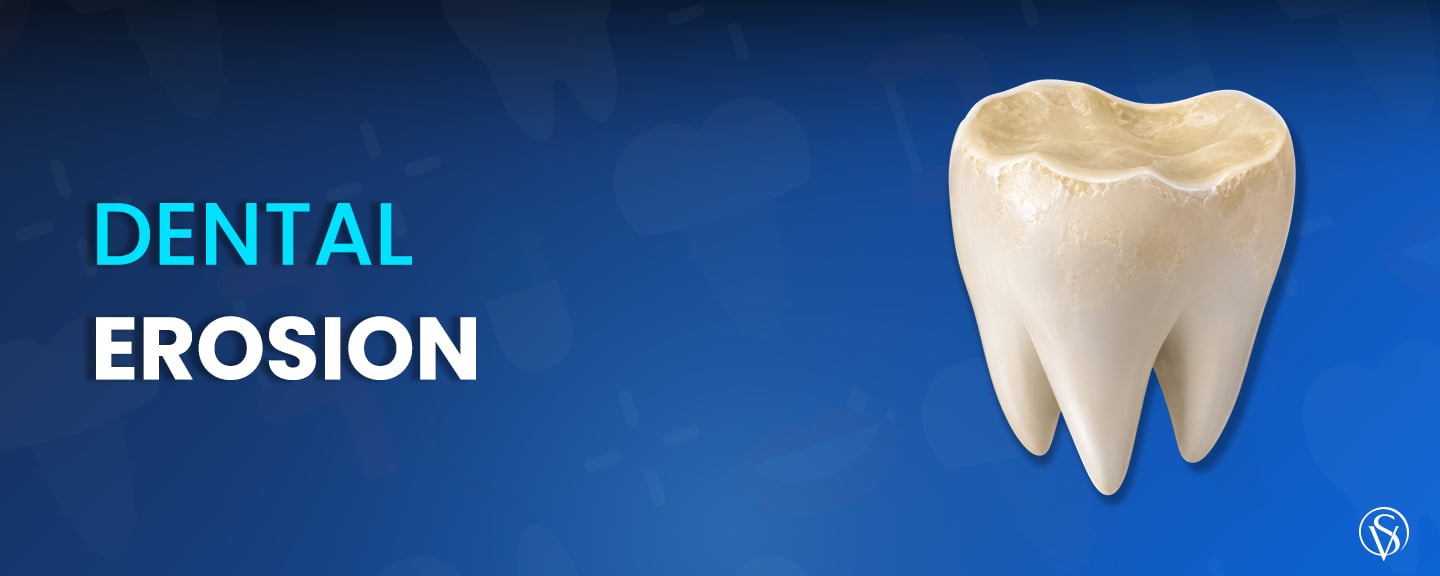
Dental erosion is the irreversible loss of tooth enamel caused by acid dissolving the tooth surface, and it differs from tooth decay because it involves no bacteria. The acid comes from the diet, such as citrus, soft drinks, and wine, or from inside the body, such as acid reflux and repeated vomiting, and a dry mouth speeds the damage. Early erosion shows up as tooth sensitivity, yellowing as the darker dentin becomes visible, and rounded, translucent, or shiny surfaces. Because enamel is not living tissue, it cannot grow back once it is lost, although early mineral loss can be halted and remineralized with fluoride.
Treatment depends on how far the wear has reached, moving from fluoride and remineralization in early cases to composite bonding for moderate wear and veneers or crowns for advanced loss. Removing the acid source early is the single most effective step, and it keeps treatment smaller, faster, and less expensive.
Key Points
- Dental erosion is the irreversible loss of tooth enamel caused by acid, and it differs from tooth decay, which is driven by bacteria.
- Acid sources are dietary, such as citrus, soft drinks, and wine, or internal, such as acid reflux and frequent vomiting, and low saliva makes damage worse.
- Early signs include tooth sensitivity, yellowing as the dentin shows through, and rounded, translucent, or shiny tooth surfaces.
- Enamel does not regenerate, so once it is eroded it cannot grow back, although early mineral loss can be halted with fluoride.
- Treatment depends on severity, moving from fluoride and remineralization to composite bonding, and then to veneers or crowns for advanced loss.
- Dental erosion affects an estimated 20% to 45% of permanent teeth in adults, and it is best managed by removing the acid source early.
What Is Dental Erosion?
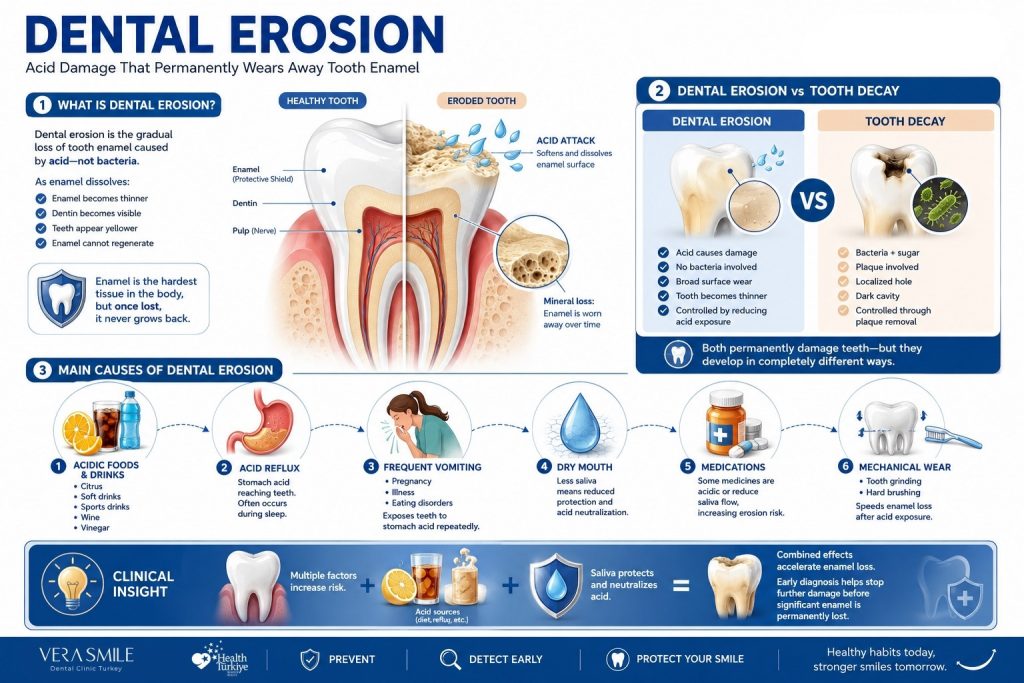
Dental erosion is the gradual, acid-driven loss of the hard outer layer of the tooth, called enamel. Acids soften the mineral surface, and over time that softened layer wears away, exposing the yellower dentin underneath. Enamel is the hardest tissue in the human body, yet it is not living tissue, so it does not repair or regrow itself once it is gone.
Erosion belongs to a wider family of tooth wear that also includes mechanical damage, but its defining cause is chemical, meaning acid rather than bacteria or force. This chemical origin is what separates it from a cavity and shapes how it is prevented and treated. Erosion is common in adults and the rate has been rising, with an estimated 20% to 45% of permanent teeth affected (Salas, M. M. S., Nascimento, G. G., Huysmans, M. C., & Demarco, F. F. (2015). Estimated prevalence of erosive tooth wear in permanent teeth of children and adolescents: An epidemiological systematic review and meta-regression analysis. Journal of Dentistry, 43(1), 42–50.).
What Is the Difference Between Dental Erosion and Tooth Decay?
The main difference is the cause, because dental erosion comes from acid alone while tooth decay comes from bacteria feeding on sugar. Erosion softens and wears the whole surface in a broad pattern, so the tooth looks thinner, smoother, and more see-through. Decay is localized, drilling a defined hole through the enamel into the dentin at a single point. Both damage the tooth permanently, but they call for different prevention, since erosion is managed by controlling acid and decay by controlling plaque and sugar.
| Aspect | Dental Erosion | Tooth Decay |
|---|---|---|
| Main cause | Acid from diet or stomach | Bacteria feeding on sugar |
| Bacteria involved | No | Yes |
| Damage pattern | Broad surface wear | Localized hole |
| Early stage reversible | Yes, at mineral-loss stage | Yes, at mineral-loss stage |
Recognizing which process is at work lets the dentist target the real cause instead of only repairing the visible damage.
What Causes Dental Erosion?
Dental erosion is caused by repeated contact between the teeth and acid, whether that acid comes from food and drink or from the stomach. The more often the enamel meets acid, and the less saliva there is to neutralize it, the faster the surface breaks down. Some causes are easy to spot, such as a daily habit of sipping soft drinks, while others stay hidden, such as silent night-time reflux. The most common contributing factors are:
- Dietary acids: Frequent citrus, soft drinks, sports drinks, wine, and vinegar keep the enamel bathed in acid and are the leading everyday cause.
- Acid reflux: Stomach acid that rises into the mouth, often silently during sleep, wears the inner and biting surfaces of the teeth.
- Frequent vomiting: Repeated exposure to stomach acid from illness, pregnancy, or an eating disorder strips enamel quickly.
- Dry mouth: Low saliva flow removes the natural buffer that neutralizes acid and washes it away, so damage accelerates.
- Medications: Some drugs are acidic themselves or reduce saliva, and both effects raise erosion risk.
- Mechanical wear: Grinding and hard brushing do not cause erosion on their own, but they speed the loss of enamel that acid has already softened.
These causes often overlap, so a person with a high-acid diet and mild reflux faces more wear than either factor would produce alone. Reflux is easy to underestimate because it can happen without heartburn, yet in patients with gastro-oesophageal reflux disease the reported median prevalence of erosion sits near 24% (Pace, F., Pallotta, S., Tonini, M., Vakil, N., & Bianchi Porro, G. (2008). Systematic review: Gastro-oesophageal reflux disease and dental lesions. Alimentary Pharmacology & Therapeutics, 27(12), 1179–1186.). Identifying which acid source is dominant is the first practical step in stopping the damage. That is why the dental exam looks at diet and medical history as closely as it looks at the teeth.
Clinic Note: Restoring an eroded tooth before the acid source is under control leads to repeat damage, so at Vera Smile the underlying cause, whether dietary or reflux-related, is identified before any bonding, veneer, or crown is placed.
What Is the Difference Between Erosion, Abrasion, and Attrition?
These three terms describe different ways teeth lose structure, and they often appear together, which is why they are easy to confuse. Erosion is chemical, while abrasion and attrition are mechanical. Telling them apart matters because each has a different trigger and a different fix. The distinction guides both prevention and the choice of treatment.
- Erosion: Acid dissolves the enamel surface across a broad area, leaving smooth, cupped, or shiny worn zones.
- Abrasion: An outside mechanical force, such as hard brushing or an abrasive toothpaste, wears grooves often near the gumline.
- Attrition: Tooth-to-tooth contact from grinding or clenching flattens the biting edges over time.
In real cases these processes reinforce one another, since acid-softened enamel is far easier for brushing or grinding to wear away. This is why controlling acid protects the teeth even when the main complaint looks mechanical. A careful exam separates the dominant process so the advice fits the real problem.
What Are the Symptoms and Stages of Dental Erosion?
The most common symptoms of dental erosion are tooth sensitivity, a yellowing colour change, and teeth that look rounded, thin, or see-through at the edges. These signs appear gradually and track the stage of the damage, so early erosion feels and looks different from advanced erosion. In the beginning the changes are easy to miss, which is why erosion is often found first by a dentist rather than the patient. The specific signs to watch for are:
- Sensitivity: Short, sharp twinges to hot, cold, sweet, or sour foods appear as thinning enamel exposes the dentin beneath.
- Discoloration: Teeth take on a yellow tone because the darker dentin shows through the thinning surface.
- Translucent edges: The biting edges of the front teeth look glassy or see-through as enamel is lost.
- Rounded, cupped surfaces: Smooth, sand-blasted dents form on the chewing surfaces where acid has pooled.
- Chipping and shiny spots: Fragile edges chip, and flat, glossy patches appear where the enamel has worn away.
Because these signs build up slowly, many people adjust to them without realizing the enamel is thinning. Sensitivity that keeps returning, or front teeth that look increasingly transparent, are reliable prompts to seek an assessment. Catching erosion at the tooth sensitivity stage gives the widest range of gentle treatment options. Waiting until the edge chip often means restorative work is already needed.
Warning: Pain when biting, visibly chipped edges, and see-through front teeth point to advanced erosion that has reached the dentin, and these signs should prompt a dental visit without delay to prevent further tooth loss.
What Are the Stages of Tooth Enamel Erosion?
Dental erosion moves through recognizable stages, from invisible mineral loss to deep structural damage. Each stage is more advanced than the one before and harder to reverse. Knowing the stage explains why the same condition is sometimes managed with a fluoride gel and other times with a crown. The typical progression has four stages.
- Demineralization: Acid strips minerals from the enamel surface without yet forming a visible defect, and this stage can still be reversed.
- Enamel loss: The softened surface wears down, the tooth looks thinner and glossier, and sensitivity often begins.
- Dentin exposure: Once the enamel is breached the softer dentin is uncovered, which speeds wear and increases sensitivity and yellowing.
- Structural or pulp involvement: Deep loss reaches close to the nerve, causing pain, chips, and cracks, and restorative treatment becomes necessary.
The dividing line that matters most is between demineralization and enamel loss, because only the first stage can be rebuilt naturally. After that point the tooth can be protected and restored but not regrown. This is the reason dentists stress early detection so strongly.
Can Enamel Grow Back After Dental Erosion?
No. Tooth enamel cannot grow back once it has eroded, because it is not living tissue and contains no cells that can regenerate it. What can be recovered is the early, invisible mineral loss, since fluoride and minerals in saliva can reharden softened enamel before a physical defect forms. Once the surface has actually worn away, the lost structure is gone for good and can only be replaced with a filling, bonding, veneer, or crown. This is why prevention and early action carry so much weight, as they work in the only window where the tooth can still repair itself. Erosion also tends to increase with age, which makes protecting the remaining enamel a long-term priority (Jaeggi, T., & Lussi, A. (2014). Prevalence, incidence and distribution of erosion. Monographs in Oral Science, 25, 55–73.).
Who Is at Risk of Dental Erosion?
Anyone whose teeth meet acid often is at risk of dental erosion, but certain habits and conditions raise the odds sharply. Risk depends less on age than on how frequently and how long the enamel is exposed to acid. The following profiles carry the highest risk:
- High-acid diets: People who consume citrus, soft drinks, sports drinks, or wine throughout the day give the enamel little time to recover.
- Reflux patients: Those with GERD or frequent heartburn expose their teeth to stomach acid, often overnight.
- Eating disorders: Repeated self-induced vomiting is one of the strongest risk factors for severe erosion.
- Athletes: Frequent sports and energy drinks combined with a dry mouth during exercise raise exposure.
- Frequent snackers and night sippers: Grazing and slow sipping keep the mouth acidic for long stretches.
- Bruxism sufferers: Grinding wears enamel that acid has already weakened.
- Dry-mouth patients: Reduced saliva from medication or illness removes the mouth’s natural acid buffer.
The overlap of several factors, such as reflux plus a dry mouth, is far more damaging than any single one. The link with eating disorders is especially strong, since a systematic review found tooth erosion in 54.4% of patients with bulimia nervosa and reported that they were more than ten times as likely to have erosion as healthy individuals (Nijakowski, K., Jankowski, J., Gruszczyński, D., & Surdacka, A. (2023). Eating disorders and dental erosion: A systematic review. Journal of Clinical Medicine, 12(19), 6161.). Recognizing a high-risk profile early allows preventive steps before visible damage appears. It also tells the dentist where to look during the exam.
Clinic Note: When erosion is driven by active reflux or an eating disorder, Vera Smile addresses the medical cause first and delays purely cosmetic restoration, because placing veneers or crowns over an uncontrolled acid problem risks early failure.
How Is Dental Erosion Treated?
Dental erosion is treated according to how much enamel has been lost, ranging from strengthening the surface to rebuilding the tooth. The first priority is always to stop the acid, because no restoration lasts if the cause continues. From there the options move from the least to the most invasive. The main treatments are grouped here.
- Acid control first: Diet changes and treatment of reflux come first, because no restoration lasts while acid keeps attacking the teeth.
- Fluoride and remineralization: In early cases, fluoride varnish and remineralizing products reharden softened enamel and ease sensitivity.
- Composite bonding for moderate wear: Worn edges and surfaces are rebuilt when a dentist applies composite bonding, a tooth-coloured resin placed in one visit with minimal enamel removal.
- Veneers for front-tooth wear: Visible wear on the front teeth is covered when dental veneers are bonded over the surface to restore shape, colour, and protection.
- Crowns for advanced loss: Severely worn or weakened teeth are rebuilt when dental crowns cap the whole tooth to restore strength and function.
The right choice depends on the amount of tissue lost, the teeth involved, and whether the acid source is under control. Early cases are often managed without any drilling, while advanced cases need full restorations. Matching the treatment to the stage avoids both under-treatment and unnecessary work.
When Do Eroded Teeth Need Veneers or Crowns?
Eroded teeth need veneers or crowns when the lost enamel is too extensive for bonding to rebuild reliably. Bonding handles minor to moderate wear well, but past a certain point a bonded repair chips or fails. The signs that point toward a veneer or crown are:
- Large surface loss:When much of the visible enamel is gone, a veneer covers more area than bonding can hold.
- Structural weakness: When erosion has thinned the tooth enough to threaten fracture, a crown restores full strength.
- Back-tooth function: When heavily loaded chewing teeth are worn, a crown withstands bite forces better than bonding.
- Aesthetic demand of front teeth: When the front teeth need a durable colour and shape change, veneers give a longer-lasting result.
The decision balances how much tooth remains against how much force it must handle. Front teeth with mainly cosmetic wear often suit veneers, while badly weakened or back teeth more often need crowns. A dentist confirms the choice after checking the bite and the amount of healthy teeth left.
How Can You Prevent Dental Erosion?
Dental erosion is largely preventable by reducing how often and how long the teeth meet acid. Because lost enamel never returns, prevention protects the tooth in the only stage where it can still be saved. Small daily changes make a measurable difference over time. The most effective steps are:
- Cut acidic intake: Limit citrus, soft drinks, sports drinks, and wine, and keep them to mealtimes rather than sipping through the day.
- Use a straw: Drinking acidic beverages through a straw keeps much of the acid away from the teeth.
- Wait to brush: After anything acidic, wait about 30 minutes before brushing so the softened enamel is not scrubbed away.
- Use a fluoride toothpaste: A stannous fluoride toothpaste strengthens enamel and reduces sensitivity.
- Treat reflux: Managing GERD with medical help removes a major hidden acid source.
- Stay hydrated: Water and sugar-free gum boost saliva, which neutralizes acid naturally.
- Wear a night guard: A night guard protects softened enamel in people who grind their teeth.
- Keep regular checkups: Routine dental visits catch erosion early, when it is still reversible.
No single step is enough on its own, so the strongest protection comes from combining diet control with good saliva flow and fluoride. Treating any reflux closes the hidden source that undoes the other efforts. Regular checkups tie it together by catching changes before they become permanent.
How Should You Brush After Eating Acidic Food?
You should wait about 30 minutes after eating or drinking anything acidic before you brush your teeth. Acid temporarily softens the enamel surface, and brushing straight away scrubs that softened layer off, which speeds erosion rather than preventing it. Rinsing with water or milk right after the acid helps neutralize it while you wait. Brushing later, once the enamel has rehardened, then cleans the teeth safely.
Tips for Patients: After an acidic drink or meal, rinse with plain water, wait about 30 minutes, and then brush with a soft toothbrush and a fluoride toothpaste, since this order cleans the teeth without wearing down softened enamel.
How Does the Cost of Dental Erosion Treatment Compare in Turkey, Germany, the UK, and the US?
Dental erosion treatment costs far less in Turkey than in Germany, the UK, or the US, while using the same materials and techniques. The price depends on the treatment the erosion actually needs, from composite bonding for moderate wear to veneers or crowns for advanced loss. The figures here are per-tooth ranges in euros for private treatment. They show why many patients travel to Turkey for restorative dental work.
| Treatment | Turkey | Germany | UK | USA |
|---|---|---|---|---|
| Composite bonding | €100–€200 | €250–€500 | €350–€600 | €350–€800 |
| Laminate / E-max veneer | €200–€350 | €600–€1,200 | €800–€1,400 | €900–€2,000 |
| Zirconia crown | €150–€250 | €450–€900 | €600–€1,200 | €700–€1,800 |
The gap widens with the size of the case, so a full-mouth restoration in Turkey can cost a fraction of the same plan elsewhere. Lower clinic overheads and in-house laboratories explain most of the difference, not a drop in quality. Fluoride and remineralization for early erosion are far cheaper everywhere and are part of a routine dental visit. A personal quote still depends on how many teeth are affected and which treatment each one needs.
Why Is Dental Erosion Treatment More Affordable in Turkey?
Dental erosion treatment is more affordable in Turkey mainly because clinic running costs are far lower than in Western Europe or the US. Rent, salaries, and laboratory fees in Istanbul are a fraction of those in London or New York, and many clinics run their own laboratories, which removes outside markups. A favourable exchange rate lowers the euro price further for international patients. The saving comes from these structural cost differences rather than from cheaper materials, since the same brands of composite, ceramic, and zirconia are used.
Why Choose Vera Smile for Dental Erosion Treatment?
Vera Smile treats dental erosion at its Istanbul clinic with a plan that starts by finding the cause, not just covering the damage. The team assesses diet, reflux, and grinding, then builds a step-by-step plan that runs from fluoride and remineralization through minimally invasive composite bonding to durable veneers or crowns when needed.
International patients benefit from transparent material choices, experienced cosmetic and restorative dentists, treatment completed in a single trip, and a clear post-treatment follow-up and aftercare plan for when they return home. With modern technology, internationally used materials, and clear pricing, Vera Smile offers a comfortable and cost-effective path to protecting and rebuilding eroded teeth.
FAQ
No. Teeth whitening does not fix eroded teeth and is often a poor choice for them, because whitening gel can worsen sensitivity on thinned enamel and cannot restore lost structure. Eroded teeth look yellow because the darker dentin shows through, not because of surface stains, so bonding or veneers address the colour far more effectively. A dentist should assess the enamel before any whitening is considered.
Tooth enamel erodes slowly in most people, over years rather than weeks, and the speed depends on how often the teeth meet acid. Heavy daily acid exposure, frequent vomiting, or a very dry mouth can accelerate the process noticeably. Because it is gradual, erosion is often advanced before it is noticed.
Yes. Dental erosion can lead to tooth loss if it is left untreated, because continued acid wear can reach the nerve and weaken the tooth until it fractures or needs removal. This outcome is uncommon and takes years of unmanaged erosion to reach. Early treatment almost always prevents it.
Yes, if the acid is coming from inside the body, such as from reflux or frequent vomiting. A dentist can restore the teeth, but only a doctor can treat the underlying reflux disease or eating disorder that keeps producing the acid. Addressing both together gives the most durable result.
Yes. Drinking or rinsing with water after acidic food helps protect enamel by diluting the acid and speeding its clearance from the mouth. It also supports saliva in returning the mouth to a neutral state. Water is a simple, effective habit, though it does not replace reducing acid intake overall.
Yes. Children can get dental erosion on baby teeth, and the softer enamel of primary teeth can wear even faster than adult enamel. Frequent fruit juices, soft drinks, and reflux are common causes in children. Early dental visits help catch and slow the damage.