
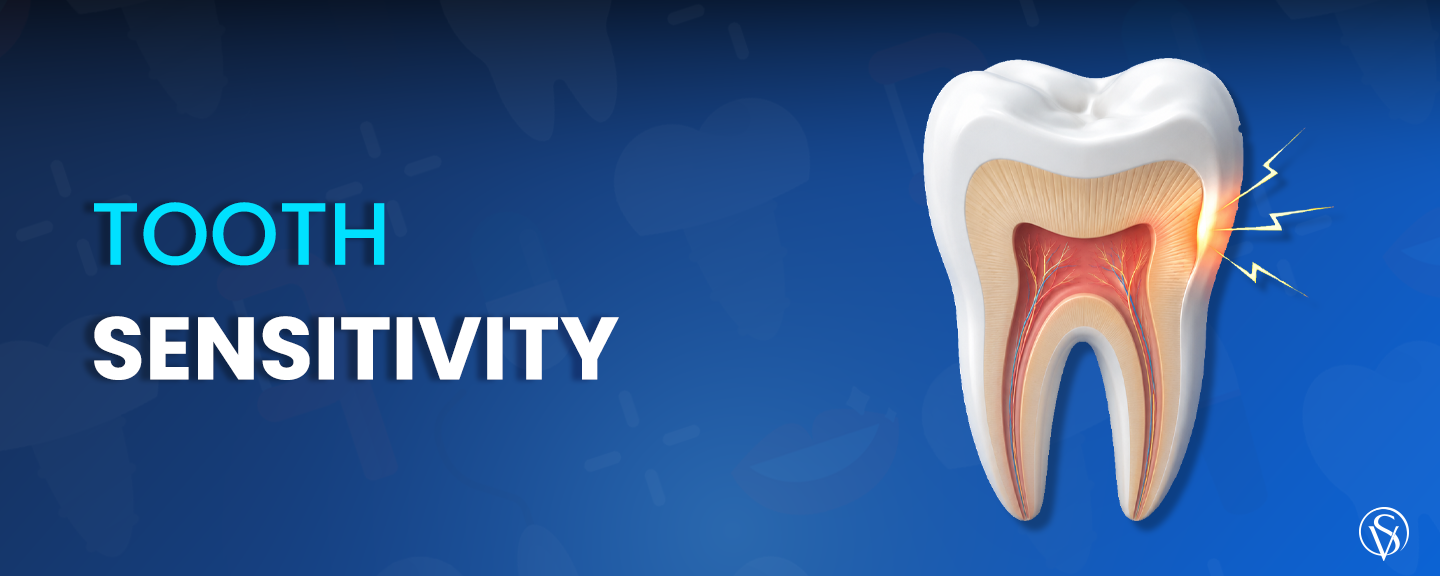
Tooth sensitivity is a short, sharp pain that strikes when a tooth meets something hot, cold, sweet, sour, or even cold air, and it happens when the protective enamel wears thin or the gums pull back and expose the softer dentin underneath. That dentin is threaded with microscopic tubules leading straight to the nerve, so any stimulus travels quickly and triggers the familiar wince. The problem is widespread, with an average reported prevalence of about 33.5% across studies, though estimates vary considerably (Zeola, L. F., Soares, P. V., & Cunha-Cruz, J. (2019). Prevalence of dentin hypersensitivity: Systematic review and meta-analysis. Journal of Dentistry, 81, 1–6.).
Sensitivity is a symptom rather than a disease in itself, and its causes range from enamel erosion and gum recession to decay, a cracked tooth, teeth grinding, and recent dental work. Mild cases often ease with a desensitizing toothpaste and fluoride, while pain that lingers or wakes you points to a deeper problem. Knowing the difference between harmless, temporary sensitivity and the kind that signals decay, a crack, or nerve involvement decides whether home care is enough or a dentist needs to step in.
Key Points
- Tooth sensitivity is a short, sharp pain triggered by hot, cold, sweet, sour, or cold-air stimuli when the dentin beneath the enamel becomes exposed.
- It develops when enamel wears down or gums recede, opening the dentin tubules that carry stimuli to the tooth’s nerve (Orchardson & Gillam, 2006).
- Dentin hypersensitivity is common, with an average reported prevalence of about 33.5% across studies, though estimates range widely (Zeola et al., 2019).
- The most frequent causes are enamel erosion, gum recession, tooth decay, cracked teeth, teeth grinding, and recent dental procedures.
- Mild cases often respond to desensitizing toothpaste and fluoride, while persistent pain needs professional diagnosis.
- Sensitivity lasting more than a few weeks, or sharp lingering pain, can signal decay, a cracked tooth, or nerve involvement and should be examined by a dentist.
What Is Tooth Sensitivity?
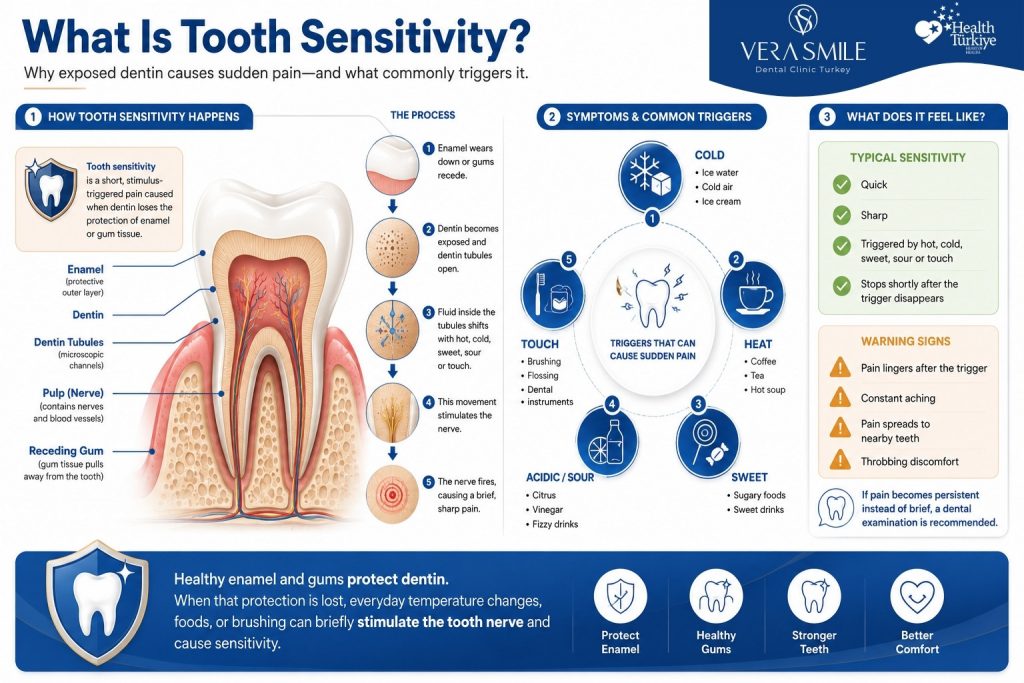
Tooth sensitivity is a temporary, stimulus-triggered pain that occurs when the inner layer of the tooth, the dentin, loses the protection of enamel above it or gum tissue around the root. Enamel is the hard outer shell, and dentin sits directly beneath it, packed with thousands of tiny channels called dentin tubules that connect to the pulp where the nerve lives. When enamel thins or the gumline recedes, these tubules open to the mouth. Fluid inside the tubules then shifts with heat, cold, or pressure, and that movement stimulates the nerve to fire, which is why the pain is sudden and brief rather than constant (Orchardson, R., & Gillam, D. G. (2006). Managing dentin hypersensitivity. Journal of the American Dental Association, 137(7), 990–998.).
The way sensitivity feels depends on which layer is involved, and clinicians separate it into two broad forms. Recognising the type helps explain why one person’s discomfort disappears after a cold sip while another’s keeps aching. The distinction also guides how aggressively the problem needs to be treated.
What Are the Types of Tooth Sensitivity?
There are two main types of tooth sensitivity, and they differ in both their cause and how long the pain lasts. One comes from the surface of the tooth losing its protective cover, and the other comes from the nerve itself becoming inflamed. Telling them apart is the first step a dentist takes, because the treatment paths diverge sharply. The two forms are:
- Dentinal sensitivity: Pain caused by exposed dentin, which is short and sharp and stops almost as soon as the trigger is removed.
- Pulpal sensitivity: Pain caused by inflammation of the nerve inside the tooth, which lasts longer, can linger after the trigger is gone, and sometimes arrives on its own.
Dentinal sensitivity is by far the more common form and responds well to conservative care. Pulpal sensitivity is a warning that the nerve may be damaged by deep decay, a crack, or trauma, and it rarely settles without treatment. When pain lingers for more than a few seconds after the trigger is removed, the cause is more likely pulpal than dentinal.
What Are the Symptoms of Tooth Sensitivity?
The main symptom of tooth sensitivity is a quick, sharp pain in one or more teeth in response to a specific trigger, rather than a dull ache that is always present. Most people first notice it during everyday activities like drinking a cold glass of water or biting into ice cream. The pain is brief, but the triggers can be surprisingly varied. The most common ones are:
- Cold: Iced drinks, cold air, and refrigerated food are the classic triggers for exposed dentin.
- Heat: Hot coffee, tea, or soup can set off the same sharp response.
- Sweet: Sugary foods and drinks often provoke sensitivity even when temperature does not.
- Sour or acidic: Citrus fruit, vinegar, and fizzy drinks trigger pain and also wear enamel further.
- Touch: Brushing, flossing, or a dental instrument passing over the area can cause a sudden twinge.
For most people the discomfort is intermittent and easy to link to a particular food or drink. What matters is how the pain behaves once the trigger is gone, since a twinge that fades instantly is far less concerning than one that keeps throbbing. A change in pattern, such as pain that becomes constant or spreads, is a reason to have the tooth checked.
Warning: Pain that arrives on its own, lasts a long time, or wakes you at night can point to nerve involvement rather than simple surface sensitivity. This pattern should be assessed by a dentist promptly.
What Causes Tooth Sensitivity?
Tooth sensitivity is caused by anything that exposes dentin or inflames the nerve, and in practice several everyday factors are responsible for most cases. Dentin hypersensitivity is closely associated with dental caries, periodontal disease, tooth wear, and non-carious cervical lesions, all of which strip away the tooth’s outer protection (Zeola et al., 2019). Some causes are habits, some are conditions, and some follow routine dental care. The most frequent ones are grouped here.
- Enamel erosion: Acidic foods, drinks, and reflux gradually dissolve enamel, and dental erosion leaves the dentin closer to the surface.
- Gum recession: When gums pull away from the tooth the root has no enamel to shield it, and gum recession is one of the most common reasons adults become sensitive.
- Tooth decay: Decay breaks through enamel toward the dentin, so a tooth cavity often announces itself first as sensitivity to sweet or cold.
- Cracked or chipped tooth: A fracture opens a direct path to the dentin and nerve and can cause sharp pain on biting.
- Teeth grinding: Grinding and clenching wear enamel flat and can crack teeth, and bruxism is a frequent hidden cause because it happens during sleep.
- Recent dental procedures: Fillings, cleanings, and whitening can cause short-term sensitivity that settles within a few weeks.
- Teeth whitening: Peroxide can temporarily irritate the nerve, and teeth sensitivity after teeth whitening fades within a few days once treatment stops.
- Aggressive brushing: A hard brush and heavy pressure wear enamel and push gums back over time.
- Acidic diet: Frequent citrus, wine, and carbonated drinks keep the mouth acidic and thin the enamel.
Most of these causes overlap, which is why sensitivity can be difficult to pin to a single source without an exam. A cracked tooth, for example, may sit behind grinding, and gum recession may follow years of hard brushing. Identifying the true driver is what separates a lasting fix from temporary relief.
Clinic Note: At Vera Smile, an examination and dental X-ray are used to identify the specific cause before any treatment is chosen. Matching the treatment to the confirmed cause avoids treating the symptom while the real problem continues.
When Should You See a Dentist for Sensitive Teeth?
You should see a dentist when sensitivity lasts more than a few weeks, becomes severe, or is joined by other warning signs, because at that point it may reflect a problem that home care cannot fix. Occasional mild sensitivity to cold is common and often harmless, but certain patterns suggest decay, a crack, or nerve damage. Knowing which signs matter helps you act before a small issue becomes a painful one. The clearest warning signs are grouped here.
- Sensitivity that does not improve: Discomfort lasting more than two to three weeks despite using desensitizing toothpaste.
- Localized pain in one tooth: Sharp pain focused on a single tooth rather than spread across the mouth.
- Lingering or spontaneous pain: Pain that continues after the trigger is gone or starts without any trigger at all.
- Visible damage: A crack, chip, hole, or dark spot you can see or feel.
- Gum or facial swelling: Any swelling near the tooth, which can indicate infection.
- Pain that disturbs sleep: Discomfort strong enough to wake you or keep you awake.
Any of these signs is worth a professional assessment rather than another round of over-the-counter products. A dentist can confirm whether the cause is a simple exposed surface or something that needs restorative treatment. Catching the problem early means a smaller, simpler, and more comfortable fix.
Warning: Sharp pain when biting down combined with cold sensitivity is a classic sign of a cracked tooth. Delaying care can allow the crack to deepen until the tooth can no longer be saved.
How Is Tooth Sensitivity Treated?
Tooth sensitivity is treated first with conservative measures that block the pain signal and rebuild the tooth surface, and these work well for most dentinal cases. The goal at this stage is to close or shield the exposed tubules so stimuli no longer reach the nerve. A systematic review of desensitizing agents found that professional and at-home products can meaningfully reduce sensitivity, although results vary by product and by patient. The main first-line options are:
- Desensitizing toothpaste: Formulas with potassium nitrate or stannous fluoride calm the nerve response with daily use over several weeks.
- Fluoride application: In-office fluoride varnish strengthens enamel and helps seal the open tubules.
- In-office desensitizers: Resin or varnish barriers painted onto exposed areas give faster relief for stubborn spots.
- Trigger control: Cutting back on acidic foods and switching to gentle brushing stops further enamel loss while the surface recovers.
In the earliest stage, when enamel is only thinning rather than lost, remineralizing teeth with fluoride can rebuild the surface before any restoration is needed. Most people notice a clear improvement within a few weeks of consistent care. When these measures do not settle the pain, the underlying cause needs a definitive treatment.(Marto, C. M., Baptista Paula, A., Nunes, T., Pimenta, M., Abrantes, A. M., Pires, A. S., … Botelho, M. F. (2019). Evaluation of the efficacy of dentin hypersensitivity treatments: A systematic review and follow-up analysis. Journal of Oral Rehabilitation, 46(10), 952–990.)
How Can You Relieve Sensitive Teeth at Home?
You can relieve mild sensitivity at home by protecting the enamel you have and calming the nerve response, though home care manages the symptom rather than curing the cause. These steps are most useful for occasional sensitivity linked to diet or brushing habits. They also support any professional treatment your dentist provides. Follow the steps are:
- Switch to a soft-bristled toothbrush to stop further enamel and gum wear.
- Brush gently in small circles rather than scrubbing side to side.
- Use a desensitizing toothpaste every day and give it several weeks to work.
- Cut back on acidic foods and drinks such as citrus, wine, and soda.
- Wait about an hour after acidic food or drink before brushing.
- Rinse with a fluoride mouthwash to strengthen enamel.
- Wear a night guard if you grind or clench your teeth.
Tips for Patients: Leaving desensitizing toothpaste on the teeth without rinsing after brushing improves the effect. Relief becomes noticeable after two to four weeks of daily use, so consistency matters more than quantity.
Which Treatments Are Used for Sensitive Teeth?
When conservative care is not enough, the treatment that works is the one that fixes the underlying cause, so the right procedure depends on why the dentin or nerve is exposed. A dentist first confirms the source with an exam and X-ray, then selects the least invasive option that will hold. Each of the common causes has a matched restorative treatment. The main options are grouped here.
- Decay-related sensitivity: When decay is the source, tooth fillings seal the cavity and stop the stimulus from reaching the nerve.
- Exposed root or notch: For a worn groove at the gumline, composite bonding covers the bare dentin with a tooth-colored resin.
- Cracked or heavily worn tooth: A fractured or badly worn tooth may need full coverage, and dental crowns protect the remaining structure while sealing the sensitive surface.
- Irreversible nerve inflammation: When the nerve is permanently inflamed, root canal treatment removes the pulp and ends the pain.
- Plaque and gum-related: When buildup at the gumline drives the sensitivity, teeth scaling and polishing removes the tartar and lets the gums settle.
- Grinding-related: For grinders, a mouth guard for grinding teeth shields the enamel overnight while the habit is addressed.
These treatments range from a simple filling to full root canal therapy, and the choice reflects how deep the problem has reached. A dentist aims to preserve as much natural tooth as possible, so early treatment means a smaller procedure. The same exposed tooth left untreated often ends up needing the more involved option later.
How Can You Prevent Tooth Sensitivity?
You can prevent most tooth sensitivity by protecting enamel and gums from the wear that exposes dentin in the first place. Prevention is far easier than treatment, and small daily habits make the biggest difference over years. The aim is to keep enamel intact and gums where they belong. The most effective measures are grouped here.
- Use a soft-bristled brush: A soft brush cleans effectively without grinding away enamel.
- Brush with the correct technique: Gentle circular strokes protect the gumline from receding.
- Use fluoride toothpaste: Daily fluoride strengthens enamel and helps close early tubule openings.
- Limit acidic foods and drinks: Fewer acidic items mean less enamel loss over time.
- Wait before brushing after acids: Enamel is softer right after acid, so waiting prevents extra wear.
- Wear a night guard if you grind: A guard shields teeth from the pressure of clenching and grinding.
- Avoid overusing whitening products: Frequent whitening can irritate the nerve and thin enamel.
- Keep regular dental checkups: Routine visits catch erosion and recession before they cause pain.
Consistency with these habits keeps enamel strong and gums healthy, which is the foundation of pain-free teeth. Rinsing with water after acidic food or drink and delaying brushing supports stronger teeth and keeps enamel intact. A six-month checkup remains the simplest way to spot a problem while it is still painless to fix.
Tips for Patients: Rinsing with plain water after an acidic drink and holding off on brushing for an hour reduces enamel loss. Chewing sugar-free gum also helps by neutralising acid and keeping the mouth’s pH balanced.
FAQ
Sometimes, yes. Sensitivity that follows a cleaning, a new filling, or whitening often settles by itself within a few weeks as the tooth recovers. When the cause is ongoing, such as gum recession, decay, or grinding, the sensitivity will not resolve until that cause is treated.
Sudden cold sensitivity means the dentin has become exposed or the nerve has been irritated. Common reasons are a new area of gum recession, a small crack, early decay, or recent whitening. If it appears in one specific tooth and lingers, it is worth having that tooth examined.
Yes. Desensitizing toothpaste reduces sensitivity for most people by calming the nerve response and sealing exposed tubules. It works gradually rather than instantly, so relief builds over two to four weeks of daily use.
No. Many cases come from exposed roots, worn enamel, or grinding rather than decay. That said, a cavity is one of the possible causes, so persistent sensitivity in a single tooth should be checked to rule decay out.
No. Whitening-related sensitivity is almost always temporary and fades within a few days of stopping treatment. Using a lower peroxide concentration and a desensitizing gel reduces the effect for people prone to it.
Sugar draws fluid movement inside exposed dentin tubules, which stimulates the nerve and causes a sharp pain. This pattern often signals thinning enamel, an early cavity, or an exposed root. If sweet sensitivity keeps returning in the same spot, a dentist can find and treat the source.