
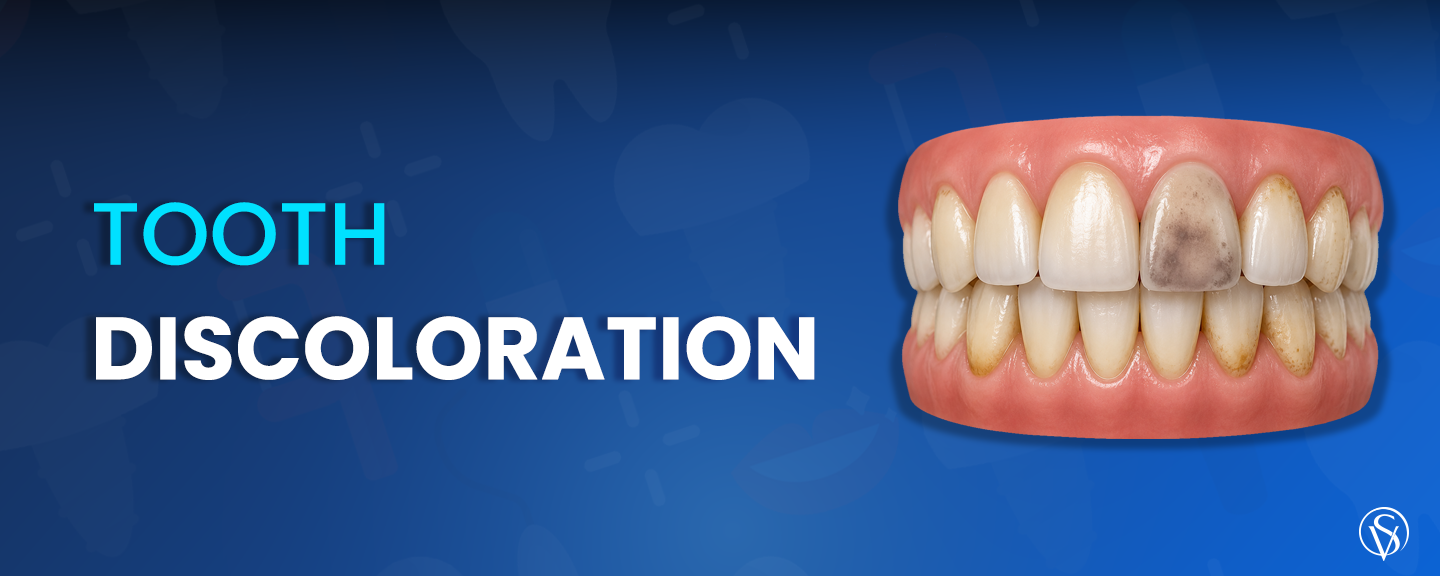
Tooth discoloration is any change in the natural colour of a tooth, from surface yellowing and brown staining to deeper grey or dark shades that come from inside the tooth. It falls into two broad groups. Extrinsic discoloration sits on the enamel surface and comes from food, drink, and tobacco, while intrinsic discoloration forms within the dentine and is far harder to remove.
The cause decides the fix, so a coffee stain and a trauma-darkened tooth are treated in completely different ways. Most surface staining responds to professional cleaning or whitening, while intrinsic shades often need bonding or veneers. Diet, smoking, ageing, certain medications, and dental fluorosis are the most common triggers, and a single tooth that darkens on its own can signal a dying nerve. Since discoloration is one of the most visible dental problems people notice first, knowing its type is what points you to the right treatment.
Key Factors:
- Tooth discoloration falls into two main types, with extrinsic staining sitting on the enamel surface and intrinsic discoloration forming inside the dentine.
- The cause guides the treatment, so surface stains respond to cleaning or whitening while intrinsic shades often need bonding, veneers, or internal bleaching.
- Most cases trace back to a familiar set of triggers, namely coffee, tea, red wine, tobacco, ageing, some medications, and dental fluorosis.
- A single tooth that darkens on its own is a different problem, since it points to a dead or dying nerve rather than surface staining.
- Intrinsic stains resist whitening, which is why dense tetracycline and fluorosis shades need restorative options instead of bleaching.
- Most everyday staining is preventable, and limiting staining drinks, stopping tobacco, and having regular cleanings keep colour changes to a minimum.
What Is Tooth Discoloration?
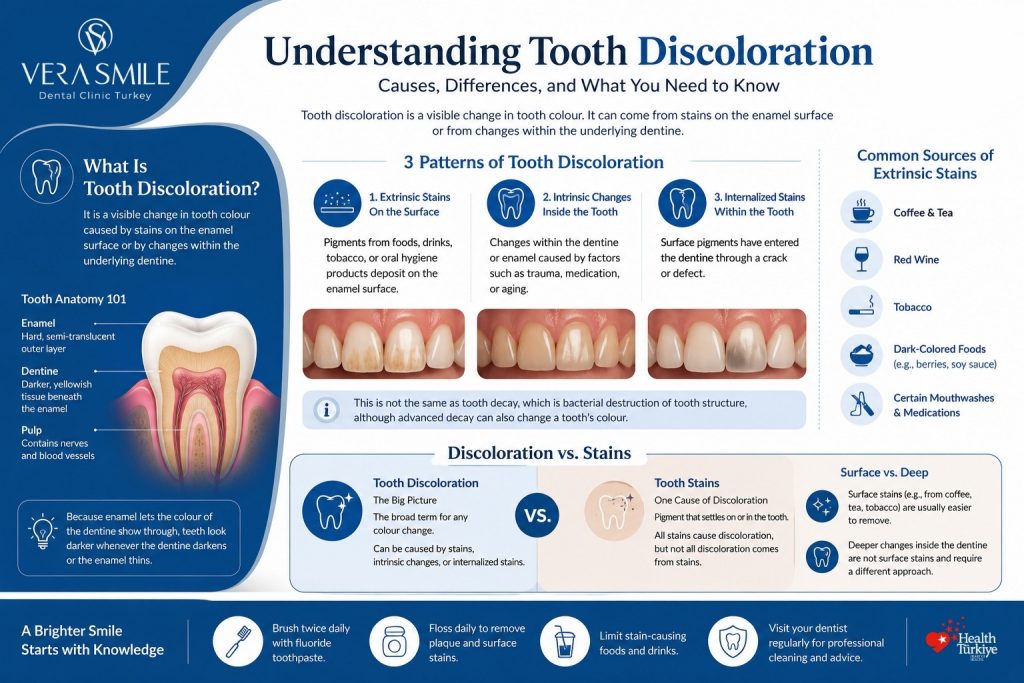
Tooth discoloration is a visible change in tooth colour caused by stains on the enamel surface or by changes within the underlying dentine. Enamel is the hard, semi-translucent outer layer, and dentine is the darker, yellowish tissue beneath it. Because enamel lets the colour of the dentine show through, teeth look darker whenever the dentine darkens or the enamel thins. Dentists group the causes into three patterns, extrinsic stains on the surface, intrinsic changes inside the tooth, and internalized stains where surface pigment has entered the dentine through a crack or defect (Watts & Addy, 2001; Sulieman, 2005). This is not the same as tooth decay, which is bacterial destruction of tooth structure, although advanced decay can also change a tooth’s colour.
What Is the Difference Between Tooth Discoloration and Tooth Stains?
Tooth discoloration is the broad term for any colour change, while a tooth stain is one cause of it, namely pigment that settles on or in the tooth. All stains cause discoloration, but not all discoloration comes from stains, since intrinsic causes such as trauma or medication change colour without any external pigment. Surface pigment from coffee, tea, and tobacco is the most familiar form of tooth stain, and it is also the easiest to lift. Deeper colour changes that sit inside the dentine are not stains in the surface sense, so they need a different approach.
What Are the Types of Tooth Discoloration?
Tooth discoloration is divided into three main types based on where the colour change sits, extrinsic, intrinsic, and age-related. This classification matters because it decides which treatment will work. A surface stain and a stain locked inside the dentine can look similar to the eye, yet they respond to completely different procedures. Knowing the type first is what separates an effective treatment plan from a wasted one (Watts & Addy, 2001).
- Extrinsic Discoloration: Surface staining on the enamel from coloured food, drink, tobacco, and coloured mouth rinses, which lifts with cleaning or whitening.
- Intrinsic Discoloration: Colour change inside the dentine from trauma, medication, fluorosis, or developmental defects, which resists surface treatment.
- Age-Related Discoloration: A combination effect where enamel thins, dentine yellows, and a lifetime of surface stains accumulate together.
In practice, most adult cases are a blend of surface staining and gradual intrinsic darkening. Extrinsic staining is the most common and the most treatable form, which is why professional cleaning and whitening resolve so many complaints. Intrinsic and age-related shades are the ones that push treatment toward bonding or veneers. Sorting a case into the right type is the first clinical decision before any colour change is treated.
What Are Internalized Tooth Stains?
Internalized stains are a distinct fourth pattern in which external pigment passes into the dentine through cracks, enamel defects, or exposed dentine, so the stain sits inside the tooth even though its source is external (Sulieman, 2005). This matters because the tooth then behaves like an intrinsic case even though the pigment started on the surface. Common routes include developmental enamel defects, wear, and cracks in older restorations. Because the pigment is now inside the tooth, cleaning the surface does not help, and treatment follows the intrinsic route.
What Causes Tooth Discoloration?
Tooth discoloration is caused by a mix of surface staining, changes inside the tooth, and developmental factors that shape how enamel and dentine form. Some causes are entirely within your control, such as diet and smoking, while others, such as fluorosis or a genetic enamel defect, are set during childhood. Identifying the specific cause is what tells a dentist whether the fix is a clean, a whitening course, or a restoration. The causes group into the following categories:
- Food and Drink: Coffee, tea, red wine, cola, and dark sauces contain chromogens and tannins that bind to the enamel pellicle and stain the surface (Watts & Addy, 2001).
- Tobacco: Nicotine and tar produce stubborn yellow-brown to black surface staining that builds up faster than dietary stains.
- Plaque and Tartar Buildup: Poor cleaning lets pigment-trapping plaque and hardened tartar accumulate, which darkens the tooth surface and the gumline.
- Dental Fluorosis: Too much fluoride while teeth are forming leaves white flecks to brown mottling, with prevalence rising from about 16.7% in low-fluoride areas to about 32.2% where water fluoride is higher (Khan, Moola, & Cleaton-Jones, 2005).
- Tooth Trauma: A knock can damage the pulp, and the breakdown products of blood inside the tooth turn it grey or brown over time.
- Genetic and Developmental Conditions: Amelogenesis imperfecta and dentinogenesis imperfecta produce abnormal enamel or dentine that is discoloured from the moment teeth erupt.
- Aging: Enamel thins and the body lays down darker secondary dentine over the years, so teeth gradually yellow with age.
These causes rarely act alone, and a single set of discoloured teeth often reflects diet, smoking history, and age at the same time. The important split is whether the cause is external, and therefore reachable by cleaning and whitening, or internal, and therefore needing a restorative fix. That distinction runs through every treatment decision that follows.
Clinic Note: At Vera Smile, the first step is not choosing a treatment but working out whether the discoloration is extrinsic or intrinsic, because the same shade can need a simple clean in one patient and a veneer in another.
Can Certain Medications Cause Tooth Discoloration?
Yes. Several medications discolour teeth, either during development or through direct surface contact (Tredwin, Scully, & Bagan-Sebastian, 2005). Tetracycline and doxycycline taken while teeth are forming bind into the dentine and leave grey, brown, or yellow bands that are intrinsic and permanent. Chlorhexidine mouthwash produces a reversible brown surface stain with prolonged use. Some antihistamines, antipsychotics, and iron supplements are also linked to staining. Because tetracycline staining is locked inside the tooth, it does not respond well to whitening and is more often managed with veneers.
Why Does Tooth Trauma Cause a Tooth to Darken?
A traumatised tooth darkens because the impact can kill the pulp, and blood breakdown products then seep into the dentinal tubules and change the tooth’s colour from within. The shift often appears weeks or months after the injury, moving through pink to grey to dark brown. Since the colour change comes from inside a non-vital tooth, surface whitening cannot correct it, and this is the classic case for internal bleaching after root canal treatment. A single tooth that darkens without any obvious surface cause almost always traces back to past trauma.
What Is Different Tooth Discoloration Colors?
The colour of a discoloured tooth is a strong clue to its cause, since surface stains, internal changes, and developmental defects each tend toward a different shade (Watts & Addy, 2001). Reading the colour helps separate a harmless dietary stain from a sign of a dead nerve. The most common colours point to the following causes.
- Yellow: Most often surface staining, enamel thinning, or ageing, and the most responsive to whitening, which is also the classic look of yellow teeth.
- Brown: Often from coffee, tea, tobacco, tannins, or early fluorosis, and sometimes the first sign of decay along the gumline.
- Grey or Black: Points to a non-vital tooth after trauma, older amalgam fillings, or tetracycline banding, and is intrinsic rather than surface staining.
- White Spots: Chalky white patches from fluorosis or early demineralisation, where minerals have been lost from the enamel surface.
Colour alone does not confirm a diagnosis, but it narrows the field before any examination. Yellow and brown shades are most often extrinsic and treatable with cleaning or whitening. Grey, black, and white-spot changes are more likely to be intrinsic and to need restorative treatment. A sudden change in a single tooth is the pattern that most deserves prompt attention.
What Does a Grey or Black Tooth Mean?
A grey or black tooth most often means the pulp inside it has died, most often after trauma, decay, or a large old filling. When a single tooth turns grey while its neighbours stay unchanged, the cause is almost always a non-vital nerve rather than any external stain. A more even grey across many teeth instead suggests tetracycline staining from childhood. Because a dead pulp will not improve on its own and can lead to infection, a darkening tooth should be examined rather than watched.
Warning: A single tooth that darkens on its own can indicate a dying or dead nerve. This will not reverse without treatment and can progress to an abscess, so it should be assessed promptly.
How Is Tooth Discoloration Treated?
Tooth discoloration is treated by matching the procedure to the cause, so surface stains are cleaned or whitened while intrinsic shades are covered or bleached from within. There is no single fix that suits every case, and using the wrong one wastes time and money. The options run from the least invasive to the most, and a good plan starts with the gentlest treatment that will actually work. The main treatments are set out here.
- Professional Teeth Whitening: Peroxide-based gels of teeth whitening lift extrinsic and mild intrinsic staining and give the largest colour change for surface discoloration (Joiner, 2006).
- Scaling and Polishing: A professional clean removes plaque, tartar, and much extrinsic staining, and is the first step before any whitening.
- Composite Bonding: Tooth-coloured resin is layered over mild intrinsic discoloration in a single visit without removing much tooth structure.
- Dental Veneers: Thin porcelain or composite veneers cover moderate to severe intrinsic shades such as tetracycline and fluorosis that whitening cannot correct.
- Enamel Microabrasion: A fine abrasive and acid combination removes shallow white or brown surface marks, often used for mild fluorosis spots.
- Internal Non-Vital Bleaching: Bleaching placed inside a root-treated tooth lightens a single dark tooth from within (Plotino, Buono, Grande, Pameijer, & Somma, 2008).
- Dental Crowns: Full-coverage crowns restore heavily discoloured or weakened teeth where a veneer would not be enough.
Choosing between them comes down to whether the stain is on the surface or inside the tooth. Extrinsic staining rarely needs more than cleaning and teeth whitening, while intrinsic cases call for dental veneers or, for badly damaged teeth, dental crowns. The aim is always the least invasive fix that reaches the target shade.
A patient from Vera Smile said:
“One of my front teeth had become much darker than the others after years of damage, and it always drew my attention when I smiled. My dentist recommended a dental crown because the tooth also needed extra support, and it turned out to be the perfect solution. The crown matches my natural teeth so well that no one can tell the difference. I’m relieved to have both a healthier tooth and the confidence to smile again. Thank you so much Vera Smile!”
Clinic Note: Vera Smile works from the least invasive option upward, starting with cleaning and whitening for surface stains and reserving veneers and crowns for intrinsic shades that will not respond to bleaching.
Can Intrinsic Tooth Discoloration Be Whitened?
No, not fully in most cases. Whitening works by breaking down pigment that peroxide can reach, so it lightens mild intrinsic shades but struggles with dense tetracycline banding or moderate to severe fluorosis (Joiner, 2006). Light intrinsic yellowing from aging often responds well, which makes whitening worth trying first for those cases. Deep or banded intrinsic stains keep their colour after bleaching and are corrected with bonding or veneers instead. Setting that expectation before treatment avoids disappointment with a whitening course that cannot reach the target.
How Is a Single Discolored Tooth Treated?
A single discoloured tooth is treated by first confirming whether its nerve is alive, then bleaching it from the inside if it is not. When trauma has left the tooth non-vital, root canal treatment is completed and a bleaching agent is sealed inside the crown to lighten it from within (Plotino et al., 2008). This internal approach corrects the tooth without touching its neighbours, unlike whitening trays that treat the whole arch. If the tooth is also cracked or heavily filled, a veneer or crown may be the more durable choice.
Does Whitening Work on Fluorosis Stains?
Whitening has only a limited effect on fluorosis, so mild and severe cases are treated differently. Faint white flecks often improve with enamel microabrasion, sometimes combined with whitening to even out the surrounding shade. Moderate to severe brown mottling does not respond well to bleaching and is masked with veneers instead. Because fluorosis is an intrinsic developmental change, the goal shifts from removing the stain to covering it once it is more than superficial.
How Can You Prevent Tooth Discoloration?
Tooth discoloration is largely preventable, since most everyday cases come from diet, tobacco, and cleaning habits you can change. Prevention will not stop age-related or developmental discoloration, but it makes a real difference to the extrinsic staining that affects most people. Small daily habits keep surface stains from building up and reduce how often you need whitening. The measures that work best are:
- Limit staining drinks: Cut back on coffee, tea, red wine, and cola, which are the biggest dietary sources of surface stain.
- Use a straw: Drink staining beverages through a straw so the liquid bypasses the front teeth.
- Rinse with water: Swill water after coffee, wine, or dark foods to clear pigment before it settles.
- Stop tobacco: Quitting smoking and other tobacco removes the fastest and most stubborn cause of surface staining.
- Brush and floss well: Clean twice a day and floss once to stop pigment-trapping plaque from forming.
- Get regular cleanings: Professional scaling every six to twelve months removes tartar and staining that brushing cannot reach.
None of these steps reverse existing intrinsic discoloration, but together they slow the surface staining that dulls a smile over time. They also make any whitening result last longer. Prevention and treatment work best as a pair rather than as alternatives.
Tips for Patients: Keeping a reusable straw for iced coffee, rinsing with water after a glass of red wine, and booking a cleaning twice a year are three low-effort habits that noticeably slow staining.
Which Foods and Drinks Stain Teeth the Most?
The foods and drinks that stain teeth most are the deeply coloured, acidic, or tannin-rich ones that cling to enamel (Watts & Addy, 2001). Acidity matters because it briefly softens enamel and lets pigment settle more easily. The most common offenders are:
- Coffee: High in tannins and dark pigment, and one of the leading causes of everyday yellowing.
- Tea: Black tea can stain as much as coffee because of its heavy tannin content.
- Red Wine: Combines dark pigment, tannins, and acid, which makes it a strong staining agent.
- Cola: Dark colour plus acidity that erodes enamel and helps stains take hold.
- Berries: Blueberries, blackberries, and pomegranate carry intense natural pigments.
- Curry: Turmeric-based sauces leave a persistent yellow stain on enamel.
- Soy Sauce and Balsamic Vinegar: Dark and clinging, both settle into the enamel surface easily.
You do not need to avoid these foods entirely to protect tooth colour. Rinsing with water, using a straw for cold drinks, and cleaning well afterward blunt most of their staining effect. The goal is to limit contact time rather than to cut them out.
When Should You See a Dentist for Tooth Discoloration?
You should see a dentist when discoloration appears suddenly, affects only one tooth, or comes with pain, sensitivity, or visible decay. A single tooth that darkens on its own is the clearest warning sign, since it often means the nerve has died and needs treatment. Discoloration that will not shift with brushing or home whitening also warrants a professional assessment to identify whether it is extrinsic or intrinsic. Even when the cause is only cosmetic, a dentist can confirm the type and match it to the treatment that will actually work.
Why Choose Vera Smile for Tooth Discoloration Treatment?
Vera Smile is a dental clinic in Istanbul, Turkey, that treats tooth discoloration by first diagnosing its exact cause and then matching it to the least invasive effective treatment. Rather than defaulting to whitening for every case, the team separates surface staining from intrinsic discoloration, so patients are not steered toward veneers they do not need or whitening that cannot reach the shade. For international patients, treatment is planned around a clear sequence from cleaning and whitening through to bonding, veneers, and crowns where the discoloration calls for them. The result is a colour outcome built on the right diagnosis, delivered with the range of cosmetic options available under one roof in Turkey.
FAQ
Not always, but it can be. Most discoloration is harmless surface or age-related staining, yet brown or black marks along the gumline or in the grooves of a tooth can signal early decay. A dentist can tell staining and decay apart on examination, which is why a colour change that looks localised or feels rough is worth checking.
Whitening toothpaste removes some surface staining but cannot change the underlying colour of the tooth. It relies on mild abrasives and low levels of active ingredients that lift fresh extrinsic stains from coffee, tea, and tobacco. It has no effect on intrinsic discoloration from trauma, medication, or fluorosis, which need professional treatment.
Yes, extrinsic staining can return if the habits that caused it continue. Whitening and cleaning remove existing surface stains, but coffee, tea, red wine, and tobacco will gradually stain the teeth again. Intrinsic corrections such as veneers and crowns do not restrain in the same way, since the discoloured tooth is covered rather than lightened.
It depends on the severity. Mild white flecks often improve with enamel microabrasion or careful whitening, while moderate to severe brown mottling is masked with veneers rather than removed. Because fluorosis is an intrinsic developmental change, treatment focuses on either resurfacing or covering the enamel.
Yes. Extrinsic stains sit on the enamel surface and lift with cleaning or whitening, whereas intrinsic stains are locked inside the dentine and resist bleaching. This is why deep tetracycline or fluorosis discoloration is treated with bonding or veneers instead of whitening. The distinction between surface and internal staining is the single biggest factor in how a case is treated.
Joiner, A. (2006). The bleaching of teeth: A review of the literature. Journal of Dentistry, 34(7), 412-419.
Khan, A., Moola, M. H., & Cleaton-Jones, P. (2005). Global trends in dental fluorosis from 1980 to 2000: A systematic review. SADJ, 60(10), 418-421.
Plotino, G., Buono, L., Grande, N. M., Pameijer, C. H., & Somma, F. (2008). Nonvital tooth bleaching: A review of the literature and clinical procedures. Journal of Endodontics, 34(4), 394-407.
Sulieman, M. (2005). An overview of tooth discoloration: Extrinsic, intrinsic and internalized stains. Dental Update, 32(8), 463-471.
Tredwin, C. J., Scully, C., & Bagan-Sebastian, J. V. (2005). Drug-induced disorders of teeth. Journal of Dental Research, 84(7), 596-602.
Watts, A., & Addy, M. (2001). Tooth discolouration and staining: A review of the literature. British Dental Journal, 190(6), 309-316.