
The main alternatives to a dental crown are dental inlays, dental onlays, composite bonding, and dental veneers. Each repairs or protects a damaged tooth while removing far less natural structure than a full crown, which sacrifices 60-75% of the tooth permanently. Which one fits depends on how much of the tooth is damaged, where the damage sits relative to the cusps, and the daily bite forces the tooth carries.
Inlays restore moderate internal decay, onlays rebuild one or two damaged cusps, bonding handles minor chips and gaps, and veneers correct front-tooth aesthetics. None of them suits a root-treated, heavily fractured, or bridge-anchoring tooth, where a crown remains the correct treatment. The sections below set out what each option is, the clinical situations where it holds, where it fails, and what it costs in the US, the UK, and Turkey, so the decision can be made before any tooth preparation begins.
What Is a Dental Crown Alternative?
A dental crown alternative is any restoration that repairs or protects a damaged tooth while removing less natural tooth structure than a full crown. The main options are dental inlays, dental onlays, composite bonding, and dental veneers, each an alternative to dental crowns. Whether one is appropriate depends on how much of the tooth is damaged, where the damage sits relative to the cusps, and the bite forces that tooth experiences daily.
What Is a Dental Inlay?
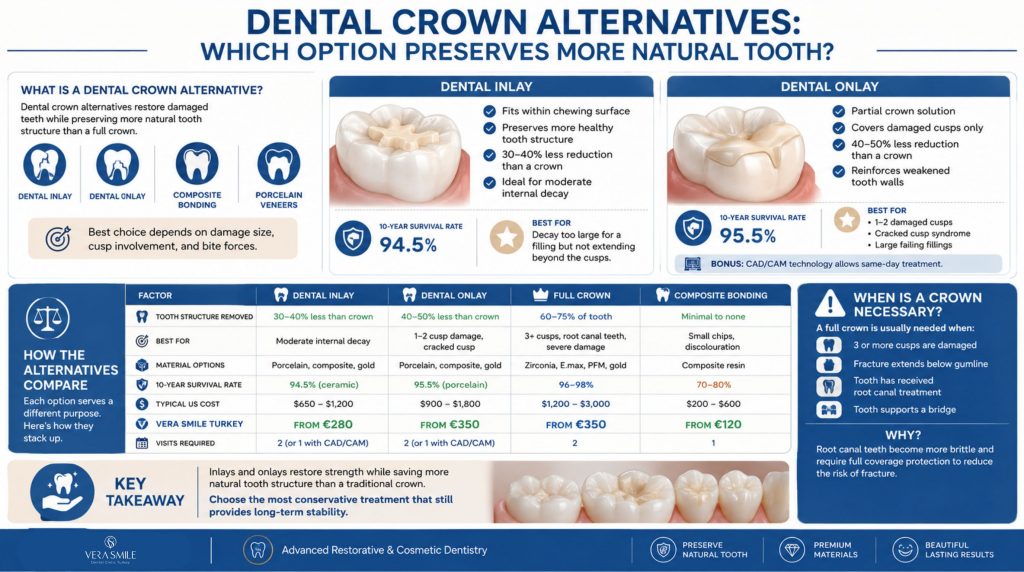
A dental inlay is a custom-made restoration that fits within the cusps of a back tooth, inside the chewing surface rather than over it. It requires 30-40% less tooth reduction than a full crown and is bonded in place with resin cement, creating a tight seal against secondary decay. Ceramic inlays show a 94.5% survival rate at 10 years (Quintessence International, 2018). They work best when decay is too large for a filling but does not reach beyond the cusps.
Think of an inlay as a filling’s more sophisticated sibling. A regular composite filling is packed directly into the cavity and cured in-chair. An inlay is fabricated in a lab (or milled by a CAD/CAM machine) and then bonded into the prepared cavity as a single solid unit.
What Is a Dental Onlay?
A dental onlay is a partial crown that covers one or more cusps of the tooth but not all four sides. It removes 40-50% less tooth structure than a full crown while restoring the biting surface and any damaged cusps. Porcelain onlays show a 95.5% survival rate at 10 years (Journal of Dentistry, 2020). An onlay is the correct choice when decay or a crack involves one to two cusps, enough to compromise the tooth structurally but not enough to justify a full crown.
A dental onlay is sometimes called a partial crown or a three-quarter crown. It extends beyond the cusps of the tooth, covering and protecting one or more of them, but stops before wrapping all the way around the tooth circumference.
The structural advantage is significant. Because it is bonded rather than cemented, an onlay reinforces the remaining tooth walls. A bonded ceramic onlay can increase the fracture resistance of a cracked tooth by up to 80%, which is why biomimetic dentists often prefer it over a full crown in cracked cusp cases.
Same-session ceramic onlays can be milled chairside with CAD/CAM systems using intraoral scanning and lithium disilicate (e.max) blocks, so the onlay is designed, milled, and bonded in one appointment rather than requiring a two-week temporary.
An onlay is the right call when one or two cusps are fractured or decayed beyond what an inlay can cover, when cracked cusp syndrome is present but the fracture has not reached the root, when a large old amalgam filling has cracked the surrounding tooth walls, or when you want to avoid a full crown preparation and preserve the maximum natural tooth structure.
How Do the Crown Alternatives Compare to a Crown?
Choose an onlay when damage is limited to one or two cusps and the tooth walls are intact. Choose a full crown when three or more cusps are involved, the fracture extends below the gumline, the tooth has had a root canal, or the tooth serves as a bridge abutment. The decision hinges on how much natural tooth structure can be preserved without compromising long-term stability. The table below breaks down each variable.
| Factor | Dental Inlay | Dental Onlay | Full Crown | Composite Bonding |
|---|---|---|---|---|
| Tooth structure removed | 30-40% less than crown | 40-50% less than crown | 60-75% of tooth | Minimal to none |
| Best for | Moderate internal decay | 1-2 cusp damage, cracked cusp | 3+ cusps, root canal teeth | Small chips, discolouration |
| Material options | Porcelain, composite, gold | Porcelain, composite, gold | Zirconia, E.max, PFM, gold | Composite resin |
| 10-year survival rate | 94.5% (ceramic) | 95.5% (porcelain) | 96-98% | 70-80% |
| Typical US cost | $650-$1,200 | $900-$1,800 | $1,200-$3,000 | $200-$600 |
| Vera Smile Turkey | From €280 | From €350 | From €350 | From €120 |
| Visits required | 2 (or 1 with CAD/CAM) | 2 (or 1 with CAD/CAM) | 2 | 1 |
A tooth that has had a root canal almost always needs a full crown, not an onlay. Root canal treatment removes the dental pulp and the internal blood supply, which makes the tooth brittle. Without the coronal protection a crown provides, a root-treated tooth is far more likely to fracture vertically, and a vertical root fracture is rarely restorable.
How Much Do Crown Alternatives Cost Compared to a Crown?
Dental inlays cost $650-$1,200 per tooth in the US, onlays cost $900-$1,800, and composite bonding costs $200-$600, while a full porcelain crown costs $1,200-$3,000. In Turkey, these restorations cost 65-80% less, with ceramic inlays from €280 and full zirconia crowns from €350, including consultation, digital scanning, and aftercare.
| Restoration | US Cost | UK Cost | Turkey | Saving vs US |
|---|---|---|---|---|
| Composite bonding | $200-$600 | £150-£400 | From €120 | Up to 80% |
| Large composite filling | $150-$400 | £100-£250 | From €80 | Up to 80% |
| Dental inlay (ceramic) | $650-$1,200 | £500-£900 | From €280 | Up to 75% |
| Dental onlay (porcelain) | $900-$1,800 | £700-£1,400 | From €350 | Up to 75% |
| Dental veneer | $1,000-$2,500 | £800-£1,800 | From €350 | Up to 80% |
| Zirconia crown (full) | $1,200-$3,000 | £900-£2,200 | From €350 | Up to 75% |
The dental crown cost is one of the main reasons patients explore alternatives, so it is worth understanding the full picture. The table below reflects current market rates.
Inlays and onlays cost more upfront than bonding or a filling, but their higher survival rates make them more cost-effective across a 10-15 year period.
Who Is Actually a Candidate for a Crown Alternative?
Whether a tooth can be restored using a conservative crown alternative depends heavily on six core clinical criteria. People who have or need:
- Damage extent: The decay or fracture must involve less than 50% of the chewing surface.
- Fracture location: The damage must stay within or above the gumline, safely avoiding the area below it.
- Pulp vitality: The nerve must be alive and healthy, with no history of or current need for a root canal.
- Enamel availability: Enough sound, natural enamel must remain for the resin bonding material to adhere properly.
- Bite load: The tooth must experience moderate forces; severe bruxism (teeth grinding) combined with a large damaged area will rule out alternatives.
- Aesthetic goal only: For front teeth, the underlying structure must be intact, meaning the treatment is strictly for cosmetic correction.
If three or more of these factors work against you, a full crown is likely the correct treatment. However, if you tick most of these boxes, there is a real conversation to be had about choosing a conservative approach first.
Why Do Dentists Prioritize Dental Crowns Rather Than The Alternatives?
Several reasons, some legitimate and some not, explain why crowns are recommended more often than biomimetic alternatives. Full crowns carry a higher fee per procedure ($1,200-$3,000 versus $900-$1,800 for onlays), require less precise technique, and have a longer track record. Some dentists lack training in the advanced ceramic bonding protocols needed for inlays and onlays. That said, crowns are genuinely the right treatment in many cases.
- Fee structure: a crown pays more than an onlay in most dental fee schedules, and significantly more than an inlay.
- Technique sensitivity: bonded ceramic onlays require precise margin preparation, immediate dentin sealing, careful isolation, and high-quality resin cement, which takes longer and is more demanding than a cemented crown preparation.
- Evidence base: full crowns have been placed for over 100 years with extensive outcome data, while bonded ceramic onlays have a strong but shorter track record.
- Genuine crown cases: a root canal-treated molar, a tooth with four fractured cusps, or a bridge anchor cannot reliably be treated with a partial restoration.
To protect yourself, ask your dentist what percentage of the tooth is damaged and whether an inlay or onlay was evaluated before the crown recommendation. If the answer is unclear, a second opinion from a dentist trained in biomimetic or conservative restorations is a reasonable step.
Can Composite Bonding Replace a Dental Crown?
Composite bonding can replace a crown only for minor aesthetic repairs to structurally intact teeth. It cannot support a fractured, heavily decayed, or root-treated tooth. Bonding is the most affordable option ($200-$600 per tooth in the US, from €120 in Turkey) and the fastest, completed in a single appointment with no drilling. Expected lifespan is 5-7 years before polishing or replacement is needed.
Composite bonding involves applying a tooth-coloured resin directly to the enamel surface and sculpting it into shape before curing with a blue LED light. No laboratory is involved, no impressions are taken, and in many cases no anaesthetic is needed. You can read more about how composite bonding is performed and maintained.
This makes bonding excellent for cosmetic fixes such as repairing small chips on front teeth, closing minor gaps between teeth (diastema closure), covering surface staining or discoloration that does not respond to whitening, and correcting slightly uneven edge lengths on anterior teeth. However, what bonding cannot do is protect a structurally compromised tooth. Composite resin simply does not have the fracture toughness of ceramic; on a molar absorbing 150–250 pounds of bite force per chew, a bonded composite will microcrack and fail within just a few years.
Can a Dental Veneer Replace a Crown?
A veneer covers only the front-facing (labial) surface and requires just 0.3-0.5mm of enamel removal, while a crown covers all surfaces and removes 1.5-2mm all around. Veneers are aesthetic restorations: they improve appearance but provide no structural protection. If the tooth is cracked, heavily filled, or root-treated, a veneer is not appropriate.
A veneer requires the removal of a wafer-thin layer of enamel from the front surface only. A crown requires grinding the tooth down on all sides, front, back, and both flanks, by 1.5 to 2 millimetres. That is a significant difference in permanent tooth structure lost.
A dental veneer is appropriate when the primary goal is purely aesthetic, such as correcting a tooth that is discolored, slightly misshapen, or mildly chipped. To qualify for this treatment, the underlying tooth must remain structurally intact, free of significant internal decay, active cracks, or large, old fillings.
Can a Large Filling Replace a Crown?
A large direct composite filling can replace a crown when decay or damage covers 20-40% of the tooth and the cusps are still intact. Modern bulk-fill composite resins and CAD/CAM ceramic block fillings perform far better than older materials. However, large direct fillings have a 10-year failure rate of approximately 15-20%, compared to 5% for ceramic onlays, making the onlay the more reliable option when budget allows.
Dentists once said that any cavity requiring more than half the tooth could not be reliably restored with a filling. That was true with older composite materials. Modern bulk-fill resins, formulated with reduced polymerisation shrinkage, and CEREC-milled ceramic blocks have changed that calculation.
For patients where a ceramic inlay or onlay is cost-prohibitive, a large direct composite filling with proper dentin bonding is a reasonable transitional restoration. It buys time, protects the tooth from further decay, and can be upgraded to a ceramic restoration later.
The important caveat: large composite fillings in posterior teeth fail more often under heavy bite loads. If a molar has already cracked once due to a large filling, packing more composite into the same tooth is unlikely to prevent another crack. In that scenario, an onlay or crown is the correct structural answer, not a third filling.
Biomimetic dentistry is a restorative philosophy that aims to reproduce the natural biomechanics of the tooth: the same flex, the same stress distribution, and the same bond strength between layers. Published data from the AACD indicates that these biomimetic treatment protocols reduce crown recommendation rates by up to 91% in eligible cases because the restorations are adhesively cemented, allowing them to become chemically and mechanically fused to the remaining tooth structure.
When Is There No Alternative to a Dental Crown?
A full dental crown is always required when a tooth has had a root canal treatment, when fracture lines extend below the gumline, when three or more cusps are damaged or missing, when the tooth serves as a bridge abutment, or when a vertical root fracture is present. In these situations, no conservative alternative provides adequate structural protection.
- Root canal-treated tooth: pulp removal makes the tooth brittle, and without full coronal coverage the risk of an unrestorable vertical root fracture is high.
- Fracture below the gumline: no bonded restoration can reliably seal a margin that sits beneath the bone or gum tissue, whereas crowns can be extended sub-gingivally.
- Three or more damaged cusps: when most of the chewing surface is compromised, a full crown distributes forces across the entire remaining root structure where an onlay cannot.
- A tooth supporting a dental bridge must withstand lateral as well as vertical forces, and only a full crown provides the retention and resistance a bridge anchor needs.
- Severe bruxism with major existing damage: heavy grinders generate 250+ pounds of force per square inch, and conservative restorations fail at much higher rates in these patients without additional protection.
Ultimately, while the appeal of conservative dentistry is clear, the longevity of your smile often depends on choosing the right tool for the specific level of damage. When a tooth faces the severe structural challenges mentioned above, a full crown remains the gold standard, providing the protection and stability necessary to prevent further degradation. If you are uncertain whether your specific situation requires a crown or could benefit from a more conservative alternative, consult with a dentist who specializes in restorative or biomimetic dentistry to discuss the best path forward for your long-term oral health.
FAQ
A ceramic onlay is the closest functional substitute for a crown when one or two cusps are damaged. It provides structural support, is bonded in place, lasts 10-15 years, and preserves 40-50% more natural tooth structure than a full crown. For smaller damage, a porcelain inlay performs similarly and costs less.
You can delay or sometimes avoid a crown by placing a large composite filling when damage covers 20-40% of the tooth. However, large fillings in back teeth have a higher long-term failure rate than ceramic inlays or onlays. They can be a practical short-term solution but are not equivalent in durability.
An onlay is better than a crown when it can do the job, meaning when damage is limited to one or two cusps and the remaining tooth structure is sound. The onlay preserves more natural tooth, is bonded for a stronger mechanical connection, and costs less. A crown is better when the tooth is heavily damaged or root-treated and needs full coronal protection.
Porcelain onlays bonded with modern resin cements show a 95.5% survival rate at 10 years (Journal of Dentistry, 2020). With good oral hygiene and regular dental reviews, ceramic onlays routinely last 15-20 years. Gold onlays can last 30 years or more, though they are rarely placed in visible areas.
Composite bonding is the cheapest alternative at $200-$600 in the US, but it suits only minor aesthetic repairs on intact teeth. A large composite filling is the cheapest structural option for decayed back teeth. Dental inlays and onlays cost more upfront but last significantly longer, making them more cost-effective over a 10-15 year period.
An inlay is ideal when a cavity or failed filling is too large for a standard restoration but leaves the tooth’s cusps and surrounding enamel intact. While standard ceramic options offer a precise, tooth-colored fit lasting 10–15 years, gold inlays remain the benchmark for longevity, often lasting over 30 years in non-aesthetic zones. Modern ceramic inlays, such as those milled from Ivoclar Vivadent blocks, combine the best of both worlds by delivering this exceptional durability alongside flawless, natural aesthetics.