
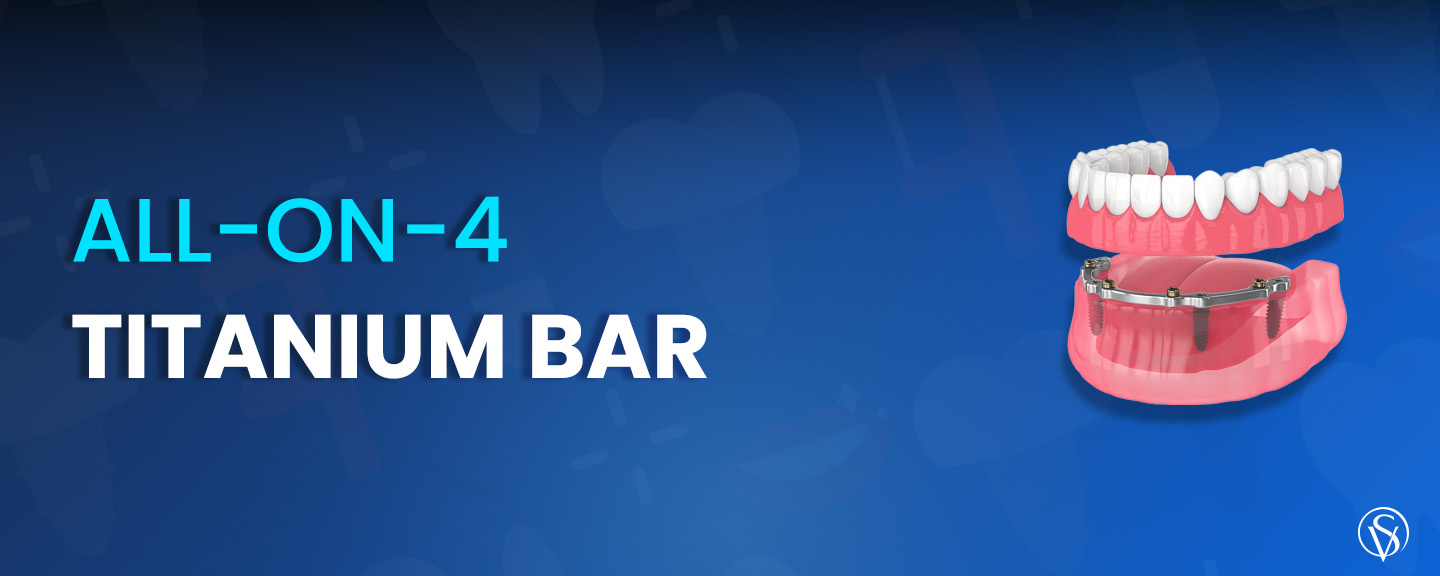
An all-on-4 titanium bar is the structural core of a fixed full-arch implant restoration. It connects four strategically placed implants and turns them into a single, stable unit that supports a full set of teeth. Patients never see the bar, but they feel its effect every time they chew, speak, or smile.
This component matters more than most people realize. The bar controls how bite forces spread across the implants. It affects speech clarity, hygiene access, fracture risk, and how natural the teeth feel over time. In clinical follow-ups, frameworks that distribute load evenly show up to 30–40% lower mechanical complication rates compared with poorly designed substructures.
From a treatment perspective, the titanium bar is what allows immediate loading to be predictable. Without it, placing fixed teeth within 24–72 hours would carry a much higher failure risk. That is why experienced implant teams treat the bar as a medical device, not just a lab component.
What Is an All-on-4 Titanium Bar?
An all-on-4 titanium bar is a custom-made metal framework that connects four dental implants into one rigid unit and supports a full set of fixed teeth in an all-on-4 dental implants restoration. Its main role is to splint the implants together so chewing forces are shared evenly rather than concentrated on a single implant. This load distribution reduces stress at the bone–implant interface and lowers the risk of implant failure, especially in cases where the back implants are placed at an angle.
Titanium is used because it is biocompatible, corrosion-resistant, and strong without being bulky, allowing the bar to remain rigid while staying comfortable for the patient. Clinical data shows that splinted implants experience significantly lower peak stress compared to unsplinted ones, which helps explain long-term survival rates above 95% in properly planned cases. When designed and milled with high precision, the bar fits passively on the implants, preventing screw loosening, fractures, and the clicking sensations patients report with poorly fitted frameworks.
What Is the Difference Between an Implant and a Titanium Bar?
A dental implant is the part placed inside the jawbone. It acts as an artificial tooth root and integrates with the bone through a process called osseointegration. Each implant is fixed, independent, and designed to transfer chewing forces directly into the bone. Its job is biological stability.
The all-on-4 titanium bar, by contrast, never enters the bone. It sits on top of the implants and connects them to each other. Its role is mechanical. The bar turns four separate implants into one unified structure, controlling how force moves across the arch and preventing overload on any single implant.
In full-arch restorations, implants alone are not enough. Without a bar, each implant would absorb stress individually, increasing the risk of bone loss, screw loosening, and fracture over time. The titanium bar solves this by spreading bite forces evenly and stabilizing the prosthetic teeth.
Why Is a Titanium Bar Used in All-on-4 Dental Implants?
A titanium bar is used in all-on-4 dental implants because it controls how biting forces move through the system. When a person bites or chews, pressure in the molar region commonly exceeds 200–300 newtons. If this force is absorbed by each dental implant individually, the risk of mechanical stress and biological complications increases. The titanium bar links all four implants together, allowing forces to spread across the entire arch instead of concentrating on the weakest point. This reduces micro-movement at the implant–bone interface and lowers the risk of bone loss, screw loosening, and implant fatigue over time.
Titanium is structurally suited for full-arch bars because it combines rigidity with resilience. It is strong enough to resist bending under repeated chewing loads, yet it has enough elasticity to absorb shock rather than transferring it directly to the bone. Its high strength-to-weight ratio allows the bar to remain thin without sacrificing stability, which improves comfort and preserves speech space. Titanium forms stable, long-lasting connections with implant interfaces and resists corrosion from saliva and dietary acids. Long-term clinical data shows that properly milled titanium bars have fracture rates below 1% and support predictable function for well over a decade when designed and fitted correctly.
How Does a Titanium Bar Function Within the All-on-4 Implant System?
Within the all-on-4 implant system, the titanium bar acts as the load-bearing core that stabilizes both the implants and the teeth above them. Once the four implants are placed and integrated, the bar is fixed onto the implant abutments with precision screws. From that point on, chewing forces no longer act on each implant separately. The bar spreads those forces across the entire structure, reducing stress peaks that damage bone or loosen components.
The bar is corrected for implant angulation. In all-on-4 cases, the back implants are tilted to avoid the sinus or nerve. The titanium bar aligns these angled implants into a level platform, allowing the prosthetic teeth to sit in a natural position. This alignment improves bite balance, speech, and comfort.
Equally important, the bar provides rigidity. Without it, the bridge would flex during chewing. Even small amounts of flex cause screw loosening or fractures over time. A properly designed titanium bar limits this movement to safe levels, keeping the system stable during daily use. In clinical practice, patients with well-fitted bars report fewer mechanical issues and more consistent bite comfort, even years after treatment.
How Does an All-on-4 Titanium Bar Work With Dental Implants?
In an all-on-4 system, the titanium bar sits directly on top of the dental implants and is secured using precision screws. Each implant acts as an anchor point in the bone, while the bar connects these anchors into a single rigid structure. This connection is engineered to be passive, meaning the bar rests on the implants without tension. A passive fit is critical. When the bar fits correctly, it does not pull or twist the implants during tightening, which protects the surrounding bone and reduces long-term complications.
Once fixed in place, the titanium bar becomes the foundation of the full-arch prosthesis. The prosthetic teeth are attached to the bar, not to the implants individually. This design allows the bar to stabilize the entire arch during chewing, speaking, and swallowing. Instead of the bridge flexing under pressure, the bar holds the shape of the arch and keeps bite forces balanced across all implants. Clinical follow-ups show that full-arch restorations supported by a rigid titanium bar have lower rates of screw loosening and fractures compared to designs without a unified framework. Over time, this stability is what allows patients to eat confidently without worrying about movement or discomfort.
What Are the Benefits of Using a Titanium Bar in All-on-4 Systems?
The primary benefit of a titanium bar in an all-on-4 system is long-term stability. By locking the implants together, the bar reduces stress on each implant and protects the surrounding bone. This is one reason why full-arch restorations with a titanium bar show higher survival rates than designs where implants work independently.
Another major advantage is predictable bite performance. A rigid titanium bar limits flex during chewing, which helps prevent screw loosening and fractures. Patients notice this as a “solid” feeling when eating, even with harder foods. In follow-up exams, cases with a well-fitted bar show fewer mechanical adjustments over time.
Titanium improves comfort and hygiene. Because it is strong without being bulky, the bar can be kept slim, leaving enough space for natural tongue movement and clear speech. Its smooth surface allows better access for cleaning around the prosthesis, reducing plaque buildup and inflammation risk. Clinics that monitor peri-implant health report lower soft-tissue complications when bar design allows proper hygiene access.
From a treatment standpoint, the titanium bar supports immediate loading. This means fixed teeth can be placed within days of surgery rather than months later. For patients, this reduces time without teeth and lowers the emotional stress linked to long treatment phases. The combination of structural reliability, patient comfort, and long-term performance makes the titanium bar a key component of successful all-on-4 care.
What Are the Risks of All-on-4 Titanium Bars?
An all-on-4 titanium bar is considered safe and predictable, but it is not risk-free. Most problems do not come from the material itself. They come from planning errors, poor fit, or long-term neglect.
The most common risk is lack of passive fit. If the bar does not seat naturally on the implants and needs force during tightening, it creates constant tension. Over time, this tension may lead to screw loosening, implant strain, or bone loss around one implant while the others remain stable. In clinical audits, non-passive bars account for a large share of mechanical complications seen within the first three years.
Another risk is poor load distribution due to design mistakes. A bar that is too thin, uneven, or poorly positioned concentrates biting forces instead of spreading them. This increases the chance of bar fracture or prosthetic tooth damage, in patients with strong bite forces or bruxism. Although titanium fracture rates are below 1% in properly designed bars, that number rises sharply when shortcuts are taken.
Hygiene-related issues occur. If the bar and prosthesis leave insufficient space for cleaning, plaque accumulation becomes likely. This leads to soft tissue inflammation and peri-implant bone loss. Patients who skip professional maintenance visits are at higher risk, even when the bar itself is well made.
Less commonly, patients report speech changes or pressure sensations in the early weeks. These relate to bar thickness or prosthetic contour rather than titanium itself and are corrected with minor adjustments.
The risks of all-on-4 titanium bars are mostly controllable. When digital planning, precise milling, and regular follow-up are in place, serious complications remain uncommon. The bar does not fail silently. Problems tend to show early, which allows intervention before implants are compromised.
Does the All-on-4 Titanium Bar Affect Speech?
No, an all-on-4 titanium bar does not permanently affect speech, but its design and position influence how the tongue moves and how sounds are formed. Speech issues appear in the early adaptation phase, not because of the titanium, but because the mouth is adjusting to a fixed full-arch prosthesis after years of tooth loss or removable dentures.
If the bar is designed too thick or placed too close to the palate or tongue space, patients may notice slight lisping or difficulty with “s” and “t” sounds. In most cases, this is temporary. Clinical observations show that the majority of patients adapt within 1 to 3 weeks as tongue muscles relearn positioning. When speech issues persist, they are resolved by reducing prosthetic bulk rather than altering the bar itself.
Well-designed titanium bars are kept slim and positioned to preserve natural speech space. In follow-up visits, patients with digitally planned bars report fewer speech complaints compared to older cast frameworks. From a practical standpoint, long-term speech problems linked to the titanium bar are rare and preventable with proper planning and adjustment.
Are There Any Complications Related to All-on-4 Titanium Bars?
Yes, complications occur, but they are uncommon and linked to design, fit, or maintenance rather than the titanium itself. The most frequent issue is screw loosening, which results from a bar that does not fit passively on the implants. When constant tension exists, it stresses screws and connections over time.
Another possible complication is uneven force distribution. If the bar is poorly designed or too thin in high-load areas, certain implants carry more pressure than others. This leads to localized bone loss or, in rare cases, bar fracture. Well-milled titanium bars have fracture rates below 1%, but that risk increases when shortcuts are taken in planning or fabrication.
Hygiene-related problems develop. Limited access for cleaning around the bar allows plaque buildup, increasing the risk of soft tissue inflammation and peri-implant disease. Regular professional maintenance significantly reduces this risk.
Most complications are detected early and corrected without implant loss. When planning, precision milling, and follow-up care are handled properly, serious long-term problems remain rare.
Is an All-on-4 Titanium Bar Safe for the Human Body?
Yes, an all-on-4 titanium bar is considered safe for the human body. Medical-grade titanium has been used in dentistry and orthopedic surgery for decades because it is biocompatible, meaning the body does not recognize it as a harmful substance. Once placed, titanium remains chemically stable and does not release toxic particles into surrounding tissues.
Titanium is hypoallergenic. True titanium allergies are extremely rare, with reported incidence rates well below 0.6% in clinical literature. Unlike nickel- or cobalt-based alloys, titanium does not trigger immune reactions in most patients. This makes it suitable even for individuals with known metal sensitivities.
From a biological standpoint, titanium integrates safely with implant components and remains isolated from soft tissue irritation when properly designed. It resists corrosion from saliva, food acids, and oral bacteria, which helps maintain a healthy environment around the implants.
How Long Does an All-on-4 Titanium Bar Last?
An all-on-4 titanium bar is designed to last decades, and in many cases, it lasts for the patient’s lifetime. Titanium does not degrade under normal oral conditions, and when the bar is properly milled, passively fitted, and maintained, structural failure is rare.
Framework survival rates above 98% at 10 years have been reported for full-arch implant restorations supported by titanium bars, based on long-term clinical follow-up studies (Malo P, de Araújo Nobre M, Lopes A. Clinical Oral Implants Research, Wiley, 2021). Most replacements are not due to bar failure but to changes in the prosthetic teeth, such as wear or chipping, which occur faster than the metal framework beneath them.
In real-world practice, bars that fail early point to planning or fabrication errors rather than material fatigue. Issues such as poor load distribution, excessive cantilever length, or untreated bruxism shorten lifespan. Patients who attend annual maintenance visits and use night guards when recommended tend to keep their original bar indefinitely.
The key factor is not time but stress control. When bite forces are managed and hygiene is maintained, the titanium bar remains stable long after the visible teeth may need renewal.
Is an All-on-4 Titanium Bar a Permanent Part of the Restoration?
Yes, the all-on-4 titanium bar is intended to be a permanent component of the restoration. It is designed to remain fixed on the implants for many years, for the patient’s lifetime. Titanium does not wear out under normal chewing forces, and it does not degrade in the oral environment.
While the bar itself is permanent, the teeth attached to it are not always. Over time, prosthetic teeth may need replacement due to normal wear, chipping, or aesthetic changes. In these cases, the teeth are removed while the titanium bar stays in place, provided it remains well fitted and free of mechanical issues.
A titanium bar is only replaced if there is a major design flaw, severe trauma, or repeated mechanical complications. When properly planned and maintained, most patients never need their bar changed, even after multiple prosthetic updates.
How Much Does an All-on-4 Titanium Bar Cost?
The cost of an all-on-4 titanium bar is built into the total full-arch treatment fee, but its value is underestimated. This component is not cosmetic. It is a precision-engineered medical framework that directly affects stability, comfort, and long-term success. Clinics that use CNC-milled titanium bars instead of cast alternatives tend to have lower complication rates, which is why pricing varies significantly between providers and countries.
In most cases, the titanium bar represents a small percentage of the overall treatment cost, yet it carries a large share of the mechanical responsibility.
| Region / Treatment Setting | Estimated Cost (€) | |
| Western Europe | €900 – €1,800 | High lab and digital planning costs |
| United Kingdom | €950 – €1,700 | Itemized separately |
| Turkey | €400 – €800 | Commonly included in full-arch packages (dental implants turkey) |
| Private high-end clinics | €1,500 – €2,000 | Fully digital, premium labs |
| Cast (non-milled) bar | €300 – €600 | Lower upfront cost, higher long-term risk |
Pricing depends on milling method, bar design, case complexity, and whether the bar is retrievable. In practice, patients who invest in a well-milled titanium bar tend to require fewer adjustments and experience fewer mechanical issues over time, which offsets the initial cost difference.
How Is an All-on-4 Titanium Bar Designed and Manufactured?
Designing an all-on-4 titanium bar starts with digital impressions, not physical molds. After implant placement, the clinic captures the exact implant positions using an intraoral scanner or a high-resolution photogrammetry system. These digital records measure implant angles and distances with accuracy down to microns, which is critical for achieving a passive fit. Traditional impressions distort at this stage; digital data does not.
Once the scan is complete, the bar is designed using CAD software. The technician adjusts thickness, curvature, screw access, and load zones based on bite force patterns and prosthetic space. This stage is where experience matters. A bar that looks correct on screen still fails clinically if load paths are ignored. Advanced designs reinforce high-stress areas while keeping tongue space clear.
Manufacturing is done through CAD/CAM milling, where the bar is carved from a single solid block of medical-grade titanium. This method produces a uniform structure with no internal porosity and extremely precise implant interfaces. Compared to traditional cast bars, milled bars show significantly lower distortion and far better fit accuracy.
Traditional bar fabrication relies on waxing, casting, and manual finishing. Each step introduces potential errors. Cast bars contain microscopic voids that weaken the structure over time. In long-term follow-ups, cast frameworks show higher rates of screw loosening and fracture compared to milled titanium bars.
In modern all-on-4 treatment, CAD/CAM milling has become the standard because it delivers consistency, strength, and predictability. The result is a bar that seats without tension, protects the implants, and remains stable under daily chewing forces for years.
What Is the Difference Between an All-on-4 Titanium Bar and a Full-Arch Prosthesis?
An all-on-4 titanium bar and a full-arch prosthesis are two different parts of the same restoration, but they serve very different purposes.
| Feature | All-on-4 Titanium Bar | Full-Arch Prosthesis |
| Position | Sits directly on the implants | Attaches on top of the bar |
| Visibility | Not visible to the patient | Fully visible (teeth and gums) |
| Main function | Structural support and force distribution | Chewing, speech, and aesthetics |
| Load handling | Absorbs and spreads bite forces | Transfers forces to the bar |
| Material | Medical-grade titanium | Acrylic, composite, or ceramic |
| Wear over time | Minimal, highly resistant | Normal wear, may chip or fade |
| Replacement need | Rare, lifetime | May need replacement after years |
| Patient interaction | Not felt during daily use | Felt during eating and speaking |
The titanium bar acts as the foundation of the system, while the full-arch prosthesis is the part that restores daily function and appearance.
Can an All-on-4 Treatment Be Done Without a Titanium Bar?
Yes, an all-on-4 treatment can be done without a titanium bar, but it comes with clear limitations and higher long-term risk. In bar-free designs, the full-arch prosthesis is attached directly to the implants using a monolithic acrylic or hybrid structure. This approach is sometimes used for temporary restorations or in cost-restricted cases.
The main issue is force control. Without a titanium bar, each implant absorbs chewing pressure more independently. This increases stress at the implant–bone interface and raises the risk of screw loosening, prosthetic fractures, and uneven bone loss. Clinical data shows that unsplinted full-arch designs have higher mechanical complication rates, especially after the first few years of function.
Bar-free solutions may be acceptable as short-term or provisional options, particularly during healing. However, for long-term fixed teeth, most experienced clinicians prefer a titanium bar because it stabilizes the system and protects the implants. In practices that track outcomes beyond five years, bar-supported restorations consistently show fewer repairs and better bite stability.
ISkipping the titanium bar is possible, but it shifts risk onto the implants and prosthesis. For patients who want durability, predictability, and fewer future interventions, the titanium bar remains the safer choice.