
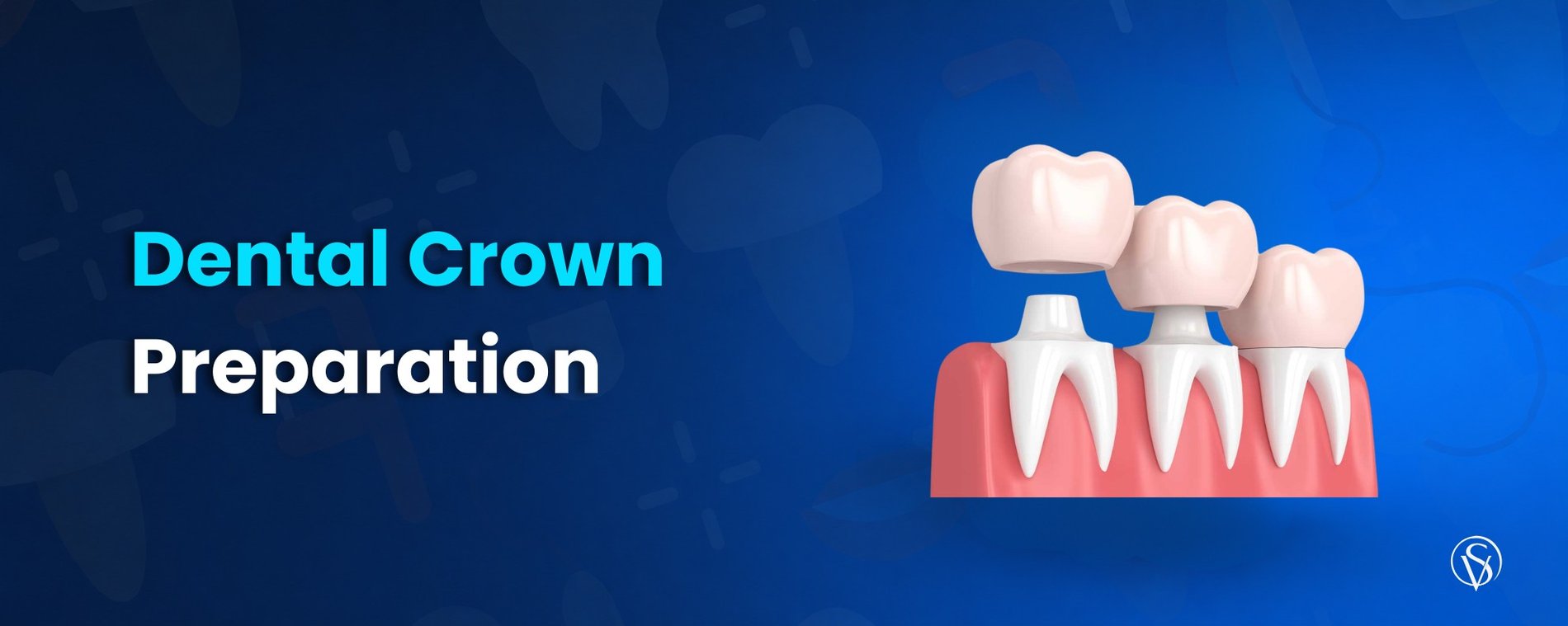
Dental crown preparation is the stage where a dentist reshapes a tooth so a crown can fit over it. It involves numbing the tooth, selecting the shade, removing decay, reducing a thin layer of the outer surface, shaping a defined margin, taking an impression or digital scan, and fitting a temporary crown. The amount of tooth removed is small, generally between 0.5 mm and 2 mm depending on the crown material. Preparation is done under local anaesthesia, so it is not painful during the procedure, though mild sensitivity can last a few days. The reshaped tooth is protected by a temporary crown for one to three weeks while the permanent crown is made. This page focuses on the preparation stage itself: why it is needed, how the tooth is reshaped step by step, how much structure is removed, the margin designs used, how over-preparation causes the “Turkey teeth” problem, how the temporary crown is made, whether it hurts, the risks, and how to care for the tooth between visits.
Key Points
- Crown preparation reshapes the tooth to make room for the crown; 0.5 mm to 2 mm of the outer surface is removed depending on the crown material.
- It is carried out under local anaesthesia and is not painful during the appointment; mild sensitivity can follow for a few days.
- The main margin designs are the chamfer, shoulder, feather edge, and bevel.
- Over-preparation, removing more healthy tooth than needed, is the root cause of the look nicknamed “Turkey teeth”; conservative, indication-based reduction avoids it.
- A temporary crown is made chairside during the same visit and protects the tooth for one to three weeks until the permanent crown is fitted.
- A prospective study recorded pulp complications in about 9% of prepared teeth over time, rising to 13% in teeth that were already restored.
What Is Dental Crown Preparation?
Dental crown preparation is the reshaping of a tooth so a crown can be placed over it. It is the first clinical stage of getting a crown, not the whole treatment, and it creates the space and shape the crown needs to seal and function. During preparation, the dentist removes decay, reduces a thin layer of the tooth surface, and shapes a clean finish line at the gum. This step is a routine part of restoring teeth with dental crowns and sets up the impression and final fitting that follow.
Why Is Tooth Preparation Necessary for a Dental Crown?
Tooth preparation is necessary because a crown needs both space and a retentive shape to bond securely and last. A crown fitted over an unprepared tooth would sit too bulky, disturb the bite, and fail to seal against decay. Preparation removes any decay or failing fillings, reduces the tooth to a stable core, and creates a defined margin so the crown edge meets the tooth cleanly. The goal is to remove only what the crown material requires, keeping as much healthy structure as possible while still allowing a precise fit.
How Is a Tooth Prepared for a Dental Crown?
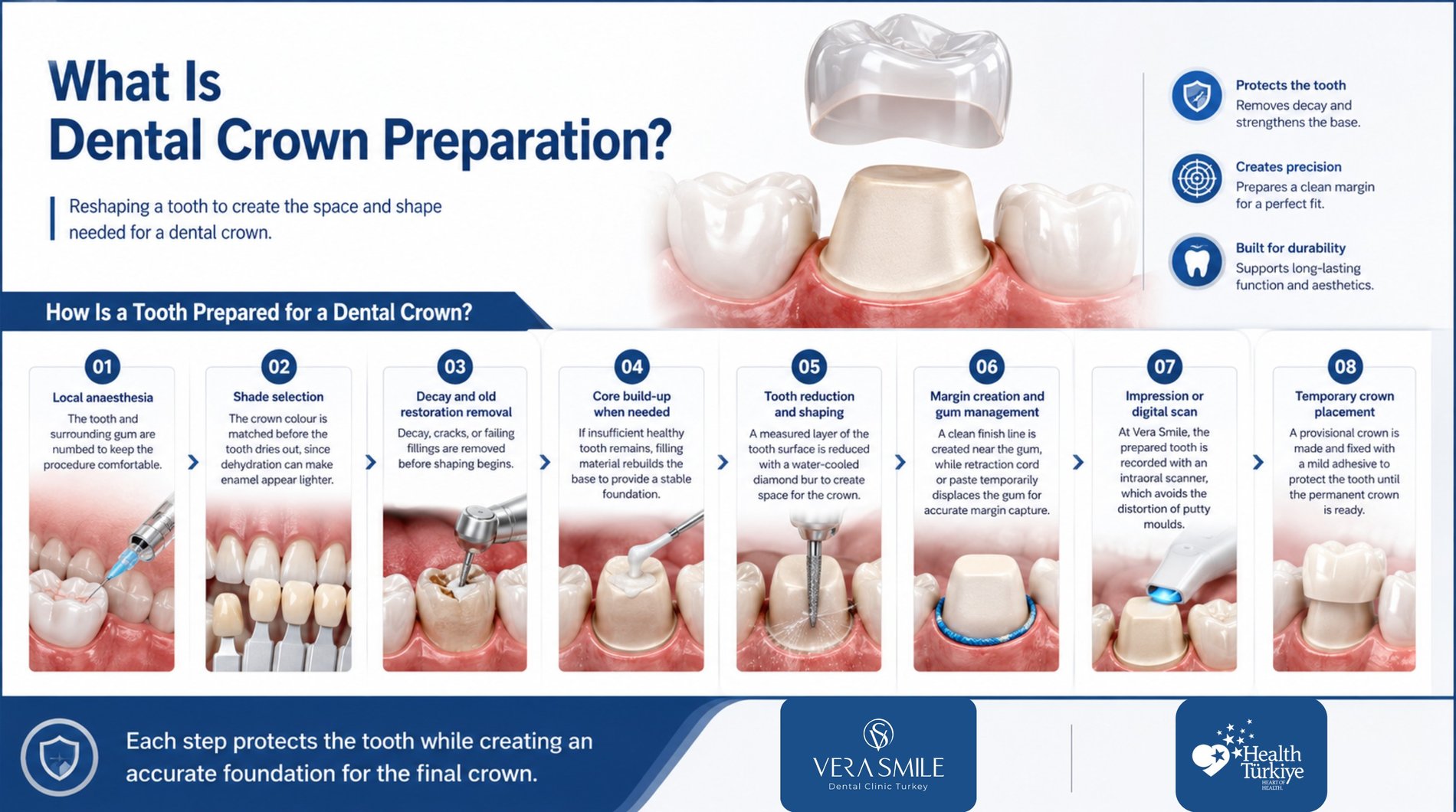
A tooth is prepared through a set sequence carried out in a single appointment. These steps run in order from numbing to the temporary crown:
- Local anaesthesia: The dentist numbs the tooth and surrounding gum so the procedure stays comfortable.
- Shade selection: The crown colour is matched to the natural teeth before the tooth dries out, since dehydrated enamel looks lighter and can distort the match.
- Decay and old restoration removal: Any decay, cracks, or failing fillings are cleared away before shaping begins.
- Core build-up when needed: If too little healthy tooth remains, a filling material rebuilds the base so the crown has a stable foundation.
- Tooth reduction and shaping: A measured, even layer of the outer tooth is reduced with a water-cooled diamond bur to create room for the crown.
- Margin creation and gum management: A clean finish line is shaped at the gum level, and a retraction cord or paste briefly displaces the gum so the margin is captured accurately.
- Impression or digital scan: At Vera Smile, the prepared tooth is recorded with an intraoral scanner, which avoids the distortion of putty moulds.
- Temporary crown placement: A provisional crown is made and fixed with a mild adhesive to protect the tooth until the permanent crown is ready.
Each step protects the tooth while building an accurate base for the final restoration.
How Much Tooth Is Removed During Crown Preparation?
The amount of tooth removed ranges from about 0.5 mm to 2 mm and depends on the crown material. For monolithic zirconia, dentists reduce roughly 0.5 mm to 1 mm on the axial (side) walls and 1 mm to 1.5 mm on the biting surface. Metal-ceramic (PFM) crowns need more room, around 1.2 mm on the sides and 1.5 mm to 2 mm on the biting surface, to hold both the metal core and the porcelain layer. Lithium disilicate (E-max) sits between these, at about 0.5 mm to 0.8 mm on the sides and 1 mm to 1.5 mm on the biting surface. Because the figures shift with each material, the crown is chosen before preparation begins. The different types of dental crowns each carry their own reduction requirements.
How Long Does Dental Crown Preparation Take?
A single-tooth preparation appointment runs about 50 to 90 minutes, covering numbing, shade selection, shaping, the impression or scan, and the temporary crown. Preparing several teeth in one session takes longer. The appointment can also extend if decay removal reveals a deeper problem or if the tooth needs a build-up before it can be shaped.
What Are the Types of Crown Preparation Margins?
Crown preparation margins are the finish-line designs shaped where the crown edge meets the tooth. The margin type is chosen to match the crown material and protect the gum.
- Chamfer margin: A rounded finish line that suits zirconia and metal-ceramic crowns and conserves tooth structure.
- Shoulder margin: A flat, right-angled ledge that gives all-ceramic crowns enough thickness for strength and a natural edge.
- Feather (knife) edge: A very thin margin used mainly with full-zirconia crowns, offering less defined support than a shoulder or chamfer.
- Bevelled margin: An angled finish sometimes added to metal or metal-ceramic crowns to improve the seal at the edge.
The right margin balances a precise seal against the health of the surrounding gum.
What Are Turkey Teeth and How Does Over-Preparation Cause Them?
“Turkey teeth” is a social-media nickname, not a dental procedure, for a row of very white, uniform crowns created by filing healthy teeth down to small pegs. The look comes from over-preparation, removing far more tooth than the crown needs, and the term points at the over-treatment rather than at any one country. The same aggressive approach has been recorded in clinics worldwide; it became linked to Turkey through the volume of low-cost cosmetic packages, not because of the location.
The clinical difference sits at the preparation stage. A crown caps the whole tooth and needs reduction on every surface; some estimates put full-crown preparation at roughly 63% to 72% of the visible tooth structure removed. A veneer, by contrast, removes only a thin front layer. When healthy teeth are cut to pegs for cosmetic uniformity, the enamel loss is permanent and the pulp is placed at higher risk, with aggressive preparation linked to pulp necrosis rates of about 3% to 15% over ten years. British Dental Association warnings and UK media investigations have followed patients returning with teeth reduced well beyond clinical need, and a BDA survey found most UK dentists had treated corrective cases after treatment abroad, with crowns the most common.
At Vera Smile, crowns are reserved for teeth that are decayed, fractured, or root-treated, where full coverage is the correct choice. For purely cosmetic goals on healthy teeth, conservative options such as dental veneers are considered before a crown, and reduction is kept to the material-specific minimum.
Warning: A crown on a healthy tooth for appearance alone means permanent, irreversible tooth loss. Be cautious of any plan that recommends full crowns across sound teeth or advertises a full-mouth result in three to four days, which leaves no time for careful preparation, laboratory work, or a try-in stage.
How Is a Temporary Crown Made and Why Is It Placed?
A temporary crown is a short-term cover made chairside during the same appointment, right after the tooth is prepared. The dentist often takes a mould or scan of the tooth before reduction, then uses it as a template. After preparation, tooth-coloured acrylic or resin is shaped inside that template over the prepared tooth, sets within minutes, and is trimmed and polished to fit the bite. It is fixed with a mild, easily removable cement so it can be taken off at the next visit without harming the prepared tooth.
A temporary crown is placed for several reasons during the wait for the permanent one.
- Protection: It shields the exposed inner tooth from sensitivity, bacteria, and physical damage.
- Position holding: It stops the prepared tooth and its neighbours from drifting, so the permanent crown still fits.
- Gum shaping: It keeps the gum contour stable around the margin for a clean final seal.
- Function and appearance: It lets you eat, speak, and smile while the laboratory makes the permanent crown.
How Long Can You Wear a Temporary Crown?
Most patients wear a temporary crown for one to three weeks while the laboratory makes the permanent crown. Because it is held by a weak cement, it can loosen if you bite hard or sticky foods, so it is a short-term cover rather than a lasting restoration. Wearing it far longer than planned raises the chance of it coming off or the tooth shifting.
Does Getting a Tooth Prepared for a Crown Hurt?
No, dental crown preparation does not hurt during the procedure. The tooth and gum are numbed with local anaesthesia, so you feel pressure and movement rather than pain. Once the numbness fades, mild sensitivity to hot, cold, and pressure can last a few days, which is a normal healing response. Sharp or lingering pain is not expected. Any discomfort that appears once the permanent crown is fitted is a separate matter, and pain after dental crown should be reported to your dentist so the cause can be checked.
What Are the Risks of Dental Crown Preparation?
Crown preparation is a safe, routine procedure, but reshaping a living tooth carries a few risks worth understanding before treatment.
- Tooth sensitivity: Reducing the outer layer can leave the tooth briefly sensitive to temperature and pressure.
- Pulp irritation or nerve damage: Heat and vibration during shaping can inflame the inner pulp. A prospective study in the International Endodontic Journal recorded pulp necrosis in about 9% of prepared teeth over time, rising to 13% in teeth that had already been restored compared with 5% in intact teeth.
- Gum irritation at the margin: A margin placed too close to the gum can cause inflammation if the area is hard to keep clean.
- Need for further treatment: If the pulp does not settle, the tooth may need root canal treatment before the crown is completed.
Warning: Sharp, throbbing, or worsening pain after preparation is not part of normal healing. It can signal pulp inflammation or a temporary crown sitting too high, and it should be assessed by your dentist promptly.
Careful, measured reduction, water cooling during shaping, and a well-fitted temporary crown keep these risks low.
How Much Does a Dental Crown Cost?
Tooth preparation is part of the overall crown fee, not a separate charge. Prices depend mainly on the crown material, the country, and the clinic. The table below compares average costs across common crown types and locations.
| Country | Porcelain Crown | Zirconia Crown | PFM Crown | Resin Crown |
| Turkey | €250 – €500 | €190 – €370 | €165 – €325 | €150 – €300 |
| USA | €920 – €1,380 | €1,100 – €2,300 | €920 – €1,470 | €735 – €920 |
| UK | €700 – €1,050 | €815 – €1,395 | €700 – €1,100 | €465 – €700 |
| Australia | €720 – €1,080 | €840 – €1,500 | €720 – €1,200 | €540 – €720 |
| India | €85 – €160 | €115 – €230 | €100 – €185 | €55 – €90 |
| Mexico | €275 – €550 | €365 – €730 | €320 – €640 | €180 – €365 |
Turkey offers the lowest prices among these countries while keeping to international material standards. Patients often compare the full dental crown cost before deciding where to treat.
How to Care for Your Tooth Between Preparation and the Permanent Crown
Protect the prepared tooth and its temporary crown during the one to three weeks before the permanent crown is fitted. The steps below keep the tooth stable and the gum healthy.
- Avoid hard and sticky foods: Skip nuts, ice, caramel, and chewing gum that can loosen or dislodge the temporary crown.
- Chew on the other side: Shift chewing to the opposite side of the mouth to reduce pressure on the prepared tooth.
- Clean gently around the crown: Brush softly and slide floss out sideways rather than lifting it up against the crown.
- Keep the appointment for the permanent crown: Wearing a temporary crown longer than planned raises the chance of it loosening or the tooth shifting.
- Contact the clinic if the temporary crown comes off: Call promptly so the tooth can be re-protected before the final fitting.
Warning: A lost or cracked temporary crown leaves the prepared tooth exposed to bacteria and shifting. Do not wait for the next scheduled visit; contact the clinic so the tooth is protected until the permanent crown is placed.
Steady care during this short window helps the permanent crown seat cleanly at the final appointment.
FAQ
A prepared tooth looks like a smaller peg or stub with smooth, rounded sides and a defined edge near the gum. Enough structure remains to support the crown, and a temporary crown covers it until the permanent one is placed.
No, crown preparation is not reversible. The enamel and tooth structure removed during shaping do not grow back, so a prepared tooth will always need a crown or another restoration to protect it. This is why the decision to reduce a healthy tooth is made carefully.
No, a standard crown cannot be fitted without reshaping the tooth. Full-coverage crowns need some reduction to seat correctly and seal against decay. Minimal-preparation options exist only for very specific situations and are not the same as a conventional crown.
Waiting too long lets the prepared tooth shift, the temporary crown loosen, or the gum grow over the margin, which can stop the permanent crown from fitting. A new impression or a repeat preparation may then be needed before the crown can be placed.
Yes, although it is uncommon. A cracked or lost temporary crown exposes the tooth to bacteria and can lead to sensitivity or infection. Keeping the temporary crown intact and the area clean lowers this risk.
Yes. Front teeth are shaped to preserve translucency and a natural edge, while back teeth are reduced to withstand heavier biting forces. The margin design and reduction depth are adjusted for each tooth position.