
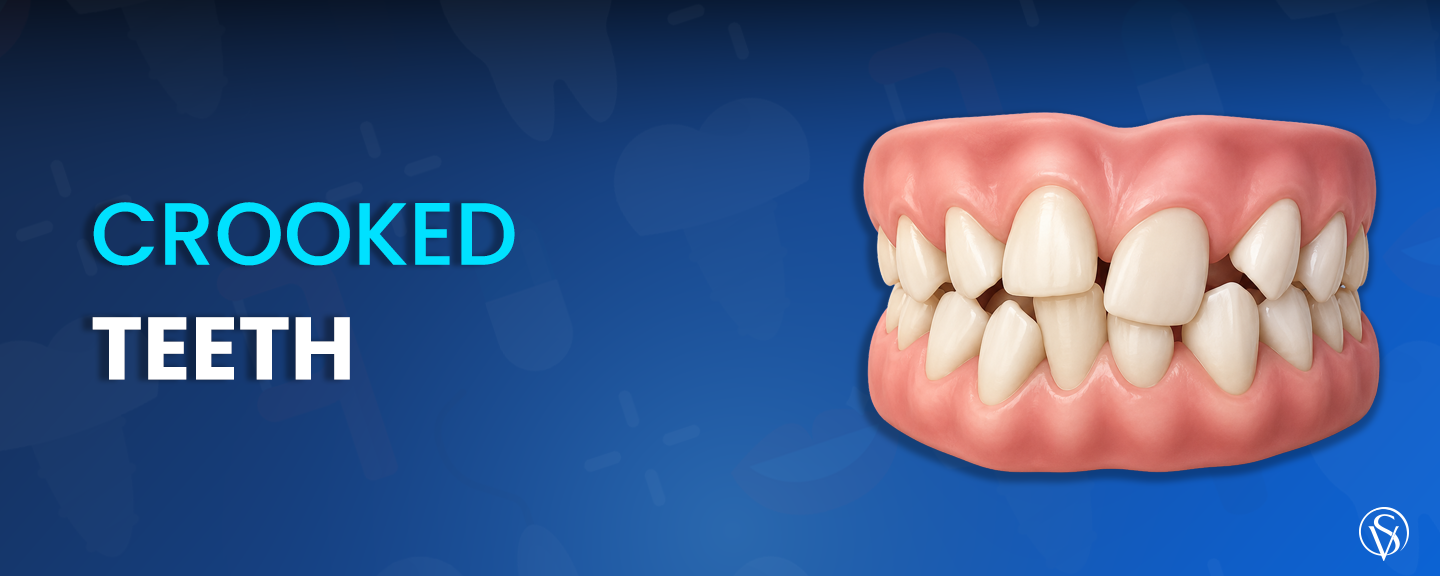
Crooked teeth are teeth that grow, erupt, or shift out of their normal alignment, a condition dentists group under malocclusion. They range from a single overlapping tooth to full crowding, spacing, and bite problems such as overbite, underbite, or crossbite. The cause is most often genetic, tied to a mismatch between tooth size and jaw size, though childhood habits and early tooth loss also contribute.
Beyond appearance, misalignment can raise the risk of decay, gum disease, and jaw strain, which makes correction a dental decision as well as a cosmetic one. The right treatment depends on the severity of the case rather than the appliance name: clear aligners and braces move teeth into position, while veneers cover mild irregularity. Cost, duration, and candidacy all follow from that starting point, and each is set at an examination rather than from a photograph.
Key Points
- Crooked teeth are a form of malocclusion, found in about 56% of people worldwide and in 39% to 93% of children and adolescents across studies.
- Genetics is the leading cause, followed by early loss of baby teeth, prolonged thumb sucking, mouth breathing, and teeth grinding.
- Misalignment is not only cosmetic, it raises the risk of tooth decay, gum disease, uneven wear, and jaw or joint strain.
- Clear aligners suit mild to moderate cases, braces handle every level including complex bites, and veneers camouflage minor irregularity without moving teeth.
- Braces average 18 to 24 months, clear aligners 12 to 18 months, and veneers 2 to 4 weeks across 2 to 3 visits.
- Case severity, not the appliance label, sets the cost, from a few thousand for aligners or braces to a per-tooth fee for veneers.
What Are Crooked Teeth?
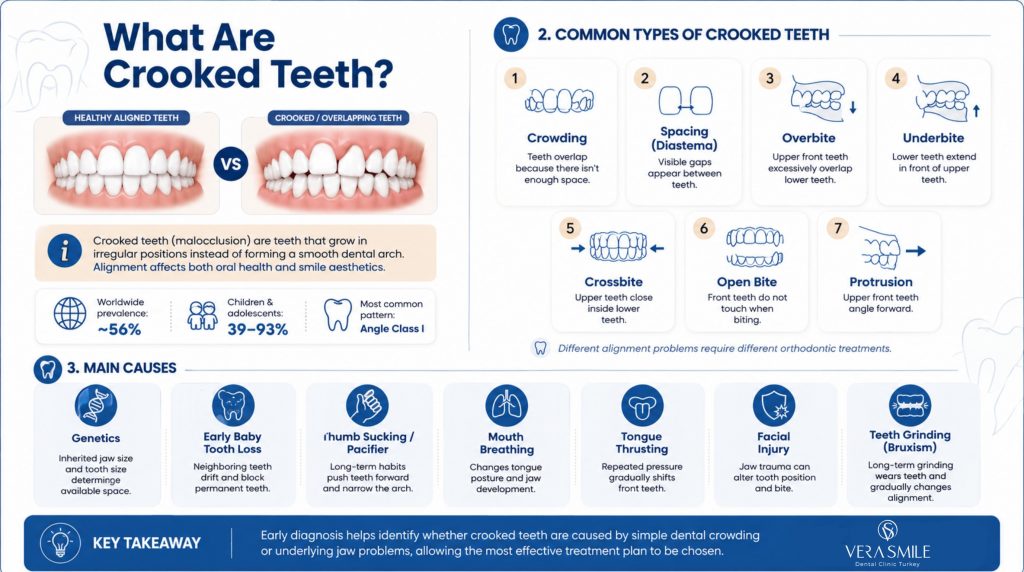
Crooked teeth are permanent or baby teeth that sit in an irregular position instead of a smooth, aligned arch, a presentation dentists classify as malocclusion. It is one of the most common oral conditions, with a worldwide prevalence of about 56% and reported rates between 39% and 93% in children and adolescents. The most frequent pattern is Angle Class I, where the overall bite relationship is broadly normal but individual teeth are rotated, tipped, or overlapping. Crooked teeth are therefore less a single defect than a spectrum, running from one twisted incisor to full-arch crowding.
Because the shape of the arch decides how teeth meet and how easily they can be cleaned, alignment shapes long-term oral health and not only the appearance of a smile. That link between position and function is the reason crooked teeth are assessed clinically before any cosmetic decision is made.
What Are the Common Types of Crooked or Misaligned Teeth?
Crooked teeth appear in several recognised patterns, each defined by how the teeth or jaws sit relative to one another:
- Crowding: Teeth overlap or twist when the jaw is too small to hold them in a straight line.
- Spacing (diastema): Gaps open between teeth when they are too small for the jaw or when a tooth is missing.
- Overbite: The upper front teeth extend too far over the lower front teeth.
- Underbite: The lower front teeth sit ahead of the upper front teeth.
- Crossbite: One or more upper teeth close inside the lower teeth instead of outside them.
- Open bite: The upper and lower front teeth do not touch when the back teeth are closed.
- Protrusion: The upper front teeth angle forward, a pattern often called buck teeth.
Each pattern responds differently to treatment, so crowding and spacing shift well with aligners or braces, while a skeletal problem such as a deep underbite may need braces or combined orthodontic and surgical planning. Identifying the exact pattern is the first clinical step, because it decides whether a case can truly be moved with an appliance or only masked on the surface.
What Causes Crooked Teeth?
Crooked teeth are caused mainly by genetics, with the remaining cases driven by habits and events that affect how the jaw and teeth develop. The common causes include:
- Genetics: Inherited jaw shape and tooth size are the strongest predictor, since a small jaw cannot line up larger teeth.
- Early loss of baby teeth: When a primary tooth is lost too soon, neighbouring teeth drift and block the adult tooth’s path.
- Prolonged thumb sucking or pacifier use: Sustained pressure past age three or four can push the front teeth forward and narrow the arch.
- Mouth breathing: Chronic open-mouth breathing alters tongue posture and can change how the upper jaw grows.
- Tongue thrusting: Repeated forward tongue pressure during swallowing pushes the front teeth out of line.
- Facial injury: A knock to the mouth or jaw can move teeth or disturb the bite.
- Teeth grinding: Long-term grinding, known as bruxism, wears the teeth and gradually shifts them.
Some of these causes are fixed at birth, but several are behavioural and can be reduced with early attention, which is why pediatric dental checks carry real value. Grinding is a clear example, because it worsens alignment over time, so a patient who clenches or grinds benefits from managing bruxism alongside any orthodontic plan.
Clinical Notes: In children whose jaws are still developing, interceptive orthodontics can guide growth before the permanent bite settles, sometimes reducing or avoiding later treatment. This window is widest between roughly ages 7 and 10, when the mix of baby and adult teeth still allows the arch to be influenced.
Are Crooked Teeth Bad for Your Health?
Yes. Crooked teeth are more than a cosmetic concern, because misalignment makes teeth harder to clean and changes how the bite spreads chewing force. The main health effects are:
- Higher decay risk: Overlapping teeth trap plaque in spots a brush and floss cannot reach.
- Gum disease: Bacteria that gather around crowded teeth inflame and, over time, damage the gums.
- Uneven tooth wear: A poor bite loads some teeth more than others, wearing enamel and edges early.
- Jaw strain: A misaligned bite forces the jaw muscles and joint to compensate, which can trigger pain and headaches.
- Speech difficulty: Gaps, an open bite, or protruding teeth can affect certain sounds.
- Reduced chewing efficiency: Teeth that do not meet properly break food down less well and add load to digestion.
- Self-consciousness: Visible misalignment can undercut confidence in social and professional settings.
Most of these effects ease once the teeth are aligned and the bite is balanced, so treatment works as prevention as much as it improves appearance. When jaw pain, clicking, or morning headaches travel with a bad bite, the strain may reach the joint itself, a pattern linked to TMJ disorder that a clinician should assess before treatment starts.
Clinical Notes: The patterns that raise decay and gum risk the most are deep crowding and crossbite, because both create tight, overlapping surfaces that resist cleaning. Patients with these patterns often show early gum inflammation even with careful brushing, which frequently settles once the teeth are aligned.
How Are Crooked Teeth Fixed?
Crooked teeth are fixed either by moving them into position with orthodontics or by covering mild irregularity with cosmetic dentistry, and the right route depends on how severe the misalignment is. The main options are:
- Metal braces: Fixed brackets and wires that correct every level of misalignment, including complex bites.
- Ceramic braces: The same mechanics as metal with tooth-coloured brackets that show less.
- Lingual braces: Braces bonded behind the teeth so they stay hidden from the front.
- Clear aligners: Removable, near-invisible trays that suit mild to moderate cases.
- Dental veneers: Thin shells bonded to the front of teeth that mask minor crookedness without moving it.
- Composite bonding: Tooth-coloured resin shaped onto teeth to disguise small gaps or irregularity.
- Dental crowns: Full-coverage restorations used when a crooked tooth is also damaged or heavily filled.
- Retainers: Appliances that hold teeth in place after treatment or manage very minor movement.
The dividing line is whether the teeth need to move or only look straighter, since orthodontics changes the real position of the teeth while veneers and bonding change only the surface. For genuine movement, most patients choose between clear aligners for mild to moderate cases and dental braces for anything more complex, whereas those whose teeth are only slightly uneven often prefer dental veneers for a faster cosmetic finish.
How Do the Main Treatment Options Compare?
The options differ most in the severity they handle, how long they take, and whether they keep the natural tooth intact. This comparison sets the four most common routes side by side.
| Option | Best for | Average treatment time | Effect on tooth structure | Cost level |
| Clear aligners | Mild to moderate crowding and spacing | 12-18 months | None, the teeth are moved | Mid to high |
| Metal or ceramic braces | All cases, including complex bites | 18-24 months | None, the teeth are moved | Low to mid |
| Dental veneers | Mild irregularity, cosmetic goal | 2-4 weeks | Enamel reshaped, irreversible | High per tooth |
| Dental crowns | Crooked teeth that are also damaged | 2-3 weeks | Tooth reduced, irreversible | High per tooth |
In practice, the decision follows the diagnosis: aligners and braces are the answer when the position or bite must change, while veneers and crowns are cosmetic shortcuts that fit only mild cases or teeth that need restoring in any event. Where a tooth is already broken or root-treated, dental crowns can straighten and protect it at the same time, but using them on a sound tooth removes healthy structure that never grows back.
Who Is a Good Candidate for Crooked Teeth Treatment?
Almost anyone with crooked teeth is a candidate for some form of treatment, and the right option depends on the health of the gums and bone, the severity of the case, and the patient’s age. The factors that decide suitability are:
- Severity of misalignment: Mild cases open the door to aligners or veneers, while severe crowding or bite problems point to braces.
- Age: Teeth move at any age, though denser adult bone means movement is slower than in a growing child.
- Gum and bone health: Teeth can only be moved safely through healthy, well-supported bone.
- Oral hygiene: Consistent cleaning is essential, because appliances and shifting teeth both raise plaque risk.
- Treatment goal: Wanting real tooth movement points to orthodontics, while wanting a fast cosmetic change points to veneers or bonding.
Candidacy is confirmed at a consultation with imaging, not from a photograph, because the bone and roots that decide safe movement cannot be seen from the outside. A patient who is unsuitable for one option is often a strong candidate for another, so the assessment is about matching the method to the mouth rather than passing or failing.
Clinical Notes: Active gum disease or untreated decay is treated before any orthodontic or cosmetic work, because moving or covering teeth over an unstable foundation invites failure. Severe crowding is not corrected with veneers alone, since masking badly misaligned teeth would need heavy, unnatural preparation, so these cases are aligned first with braces or aligners. A patient asking for a purely cosmetic fix to a functional bite problem is guided toward orthodontic correction instead.
How Much Does It Cost to Fix Crooked Teeth?
The cost of fixing crooked teeth is set by the method, the complexity of the case, and the country of treatment, and the country gap is wide: the same work costs a fraction in Turkey of the UK, German, or US price. This comparison sets the main treatments side by side in Euros.
| Treatment | Turkey | Germany | UK | USA |
| Metal braces | €750 – €1,400 | €2,000 – €4,000 | €2,100 – €4,100 | €2,800 – €6,400 |
| Ceramic braces | €1,050 – €1,850 | €2,500 – €5,000 | €3,000 – €5,300 | €3,700 – €7,800 |
| Lingual braces | €1,850 – €3,200 | €5,000 – €9,000 | €4,700 – €9,500 | €7,400 – €12,000 |
| Clear aligners | €1,800 – €3,500 | €4,000 – €6,000 | €4,500 – €6,500 | €3,700 – €7,800 |
| Porcelain veneers (per tooth) | €150 – €300 | €800 – €1,400 | €900 – €1,200 | €850 – €2,300 |
| Composite bonding (per tooth) | €80 – €150 | €200 – €500 | €180 – €470 | €250 – €1,400 |
The gap is driven by lower laboratory and clinic overheads in Turkey rather than by any difference in materials, since Turkish labs use the same ceramic brands as their European and US counterparts. For an international patient the figure that matters is the total after travel, so the saving on veneers or aligners stays substantial even once flights and a short stay are counted. Because orthodontic cases need more than one visit, aftercare is the deciding detail, which is why a structured post-treatment follow-up schedule matters, and a consultation at a dental clinic in Turkey can turn a specific case into an exact quote with its inclusions.
Tips for the Patients: What moves the total most is the number of teeth for veneers and the case complexity for orthodontics, not the country alone. Ask for an itemised quote that lists records, adjustments, retainers, and any follow-up visits, and confirm how reviews are handled once you return home, since orthodontic movement is checked over months rather than in a single appointment.
What Is the Treatment Process, Step by Step?
Straightening crooked teeth follows the same core path whatever the method: assessment, planning, active treatment, and retention. The process runs through these stages:
- Consultation and digital scan: The dentist examines the bite and takes X-rays and a 3D scan to map the teeth and roots.
- Diagnosis and treatment plan: The findings set the method, the sequence of movements, and the expected timeline.
- Appliance fitting or tooth preparation: Braces or aligners are fitted, or for veneers the teeth are lightly prepared and impressions taken.
- Adjustments and progress checks: Regular visits tighten wires or issue new trays and confirm the teeth are moving to plan.
- Retention: A retainer holds the corrected position once active treatment ends.
The planning stage carries the most weight, because a bite mapped accurately at the start avoids detours later in treatment. Many clinics now preview the finished result before anything is fitted, using digital smile design to model the target alignment so the patient can see and agree the outcome in advance.
Tips for the Patients: Keep aligners in for 20 to 22 hours a day, because any shortfall stalls the planned movement, and clean trays or brackets after every meal to protect the teeth underneath. Attend scheduled reviews on time, since missed adjustments stretch the overall timeline, and for fixed braces keep orthodontic relief wax on hand for any bracket that rubs the cheek.
How Long Does It Take to Straighten Crooked Teeth?
Straightening crooked teeth takes 2 to 4 weeks with veneers, 12 to 18 months with clear aligners, and 18 to 24 months with braces, with complex bites running to 30 months or more. Veneers are fastest because they cover rather than move teeth, while orthodontics works only at the pace the bone can safely remodel. Three factors set the exact length, which are case severity, patient age, and compliance, since younger patients move faster and aligner results depend on wearing the trays 20 to 22 hours a day. Mild crowding or spacing can finish in as little as 6 months with aligners, while a severe underbite or heavy crowding sits at the long end of every range.
The headline number matters less than the fit between method and case, because pushing teeth faster than the bone can adapt risks relapse and root damage. A realistic timeline, set at diagnosis and reviewed at each visit, is the most reliable guide to when treatment will finish.
Why Choose Vera Smile for Crooked Teeth Treatment?
Vera Smile treats crooked teeth across the full range of options, from clear aligners and braces to veneers, so the plan is matched to the case rather than to a single service. Every case begins with digital diagnostics and 3D planning, which means the target alignment is designed and approved before treatment starts. The clinic pairs the cost advantages of treatment in Turkey with structured aftercare, including a defined post-treatment follow-up schedule that continues after patients return home, so international patients are reviewed rather than left to manage alone once active treatment ends.
The result is a single point of care that covers assessment, treatment, and retention in one place, which keeps the plan consistent from the first scan to the final retainer. Patients unsure whether their case needs real movement or only cosmetic camouflage can start with an orthodontics assessment that maps the options before any commitment.
FAQ
No. Crooked teeth do not correct themselves, and untreated misalignment tends to drift further as the jaw ages and teeth settle. Any lasting change in position needs an appliance that applies controlled force, followed by a retainer to hold the result.
Yes. Teeth respond to orthodontic force at any age, so adults can straighten crooked teeth as effectively as teenagers, though denser adult bone can make treatment run a little longer. Clear aligners are a common adult choice because they are removable and hard to notice at work.
Yes, if a retainer is not worn. Teeth carry a natural tendency to drift back toward their old position, so retention is a permanent part of treatment rather than an optional extra. Wearing the retainer as directed keeps the corrected alignment stable for life.
Yes. A misaligned bite makes the jaw muscles and joint work unevenly, which can lead to headaches, facial pain, and clicking. When these symptoms persist, they may point to TMJ disorder, and correcting the bite is often part of relieving them.
No. Moving teeth without a dentist watching the roots and bone can cause loosening, gum recession, and permanent damage. Safe correction needs an in-person diagnosis and supervised force, which is why orthodontics is carried out under clinical review rather than by post.
No. Mild crookedness that does not affect cleaning, chewing, or the bite can be left safely if the patient is content with it, since the choice is then cosmetic. When misalignment traps plaque or strains the bite, treatment becomes a health matter, and a patient who wants a purely cosmetic change can consider dental veneers rather than orthodontics.