
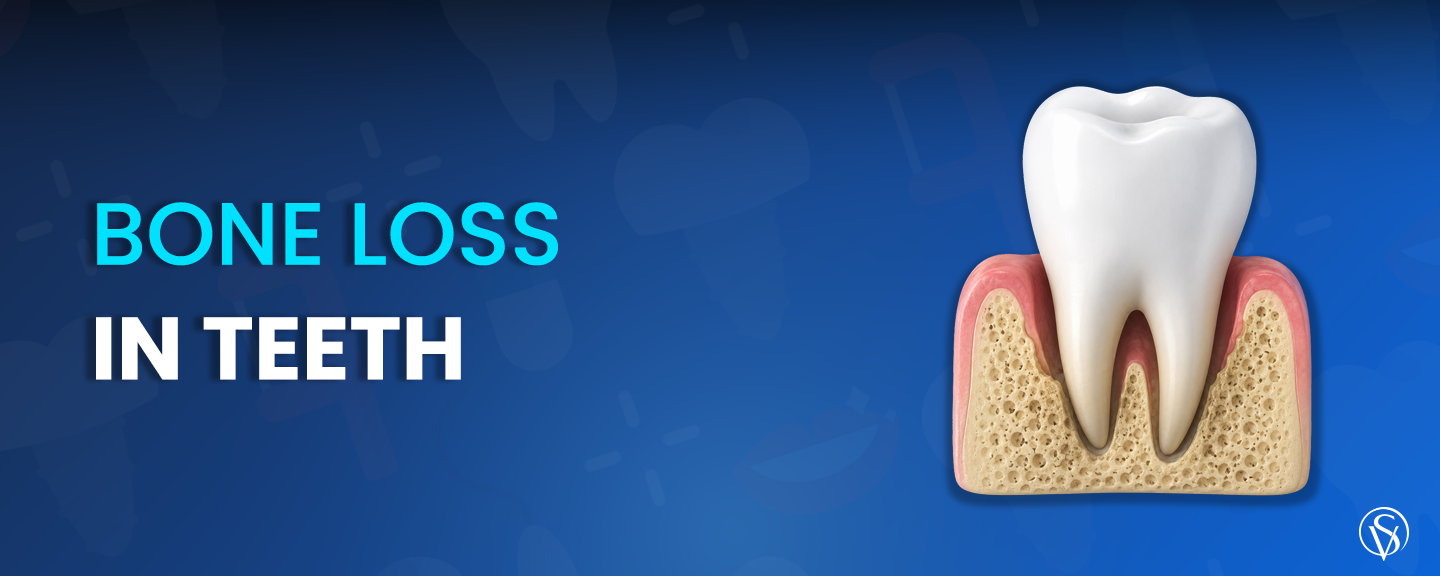
Bone loss in teeth is the gradual shrinking of the alveolar bone, the ridge of the jaw that holds tooth roots in place. It has two main drivers: chronic gum infection (periodontitis), which destroys the supporting bone, and tooth loss, which removes the chewing stimulation the bone needs to keep its density. In its early stages, it causes no pain and is visible only on a dental X-ray, so it often advances quietly before loose teeth, receding gums, or a changing bite appear.
Bone that is already gone does not regenerate on its own, though its progression can be halted, and lost volume can be rebuilt with a graft or replaced with a dental implant. The cause, warning signs, clinical stage, reversal options, implant candidacy, and treatment cost each shape how bone loss is managed, and recognising it early is what protects the remaining teeth.
Key Points:
- Early treatment and prompt replacement of missing teeth are what limit the damage.
- Bone loss is permanent once it occurs; treatment stops its progression but cannot undo it on its own.
- Left untreated, it leads to loose teeth, tooth loss, spreading infection, and bite collapse.
- The longer it goes, the more complex and costly the eventual repair becomes.
What Causes Bone Loss in Teeth?
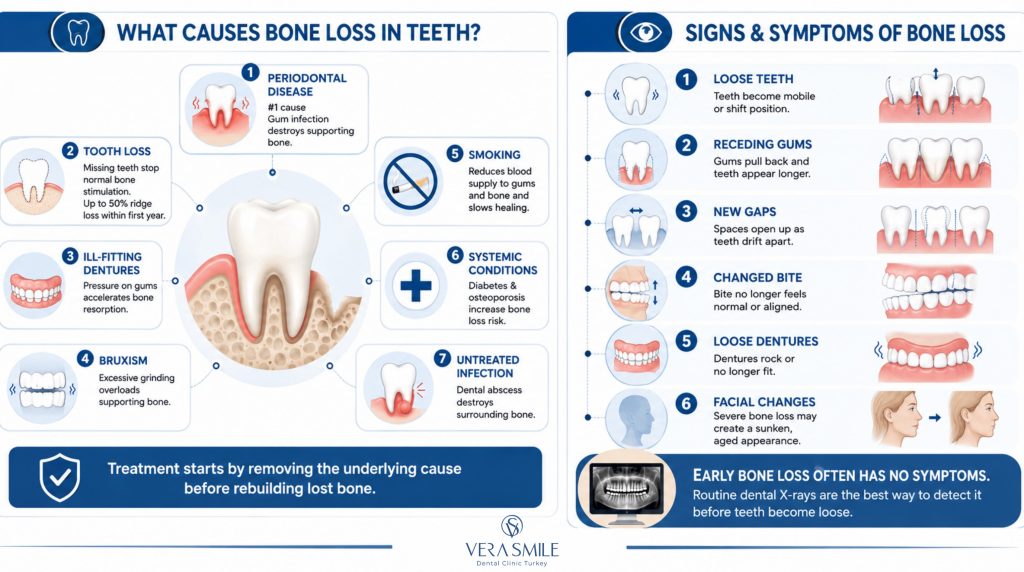
Bone loss in teeth is caused by anything that either infects the bone supporting the teeth or removes the mechanical stimulation that keeps it dense.The main causes are:
- Periodontal disease: Advanced gum disease is the most common cause of bone loss around teeth.
- Tooth loss or extraction: After a tooth is removed, the jaw can lose up to 50% of its ridge width within the first year, with two-thirds of that loss occurring in the first three months (Schropp et al.).
- Ill-fitting dentures: Removable dentures press on the gum without stimulating the bone beneath, which can speed up resorption over time.
- Bruxism (teeth grinding): Repeated overload places stress on the bone around affected teeth and can contribute to its breakdown.
- Smoking: Tobacco reduces blood flow to the gums and bone, worsening periodontal destruction and slowing healing.
- Systemic conditions: Uncontrolled diabetes and osteoporosis raise both the risk and the speed of bone loss.
- Untreated infection: A dental abscess or long-standing infection can destroy the bone surrounding the tooth root.
Since bone loss follows its cause, the treatment always starts with removing the driver. When the driver is gum disease, that means bringing the infection under control through periodontics before any rebuilding is attempted. When it follows the gap left by a tooth extraction, preserving or replacing the bone early limits how far the ridge collapses. And when grinding is the culprit, protecting the teeth from the overload of bruxism keeps the surrounding bone from breaking down further. Pinpointing which of these applies is the first real step toward stopping the loss.
In periodontal disease, bacteria trigger an inflammatory response that dissolves the alveolar bone; after a tooth is lost, the surrounding ridge resorbs because it no longer receives chewing forces. According to the CDC, about 42% of adults aged 30 and older have periodontitis, the leading cause of dental bone loss.
What Are the Signs and Symptoms of Bone Loss in Teeth?
The signs of bone loss in teeth range from invisible in early stages to clearly noticeable as it advances. Early loss is detected only on an X-ray, while later loss produces changes a person can see and feel. Common signs include:
- Loose or shifting teeth: As bone support decreases, teeth become mobile or drift out of their normal position.
- Receding gums: Gums pull back and teeth look longer as the bone beneath them recedes.
- New gaps between teeth: Spaces open up as teeth shift on a weakened foundation.
- A changed bite: Teeth meet differently when chewing, or the jaw feels misaligned.
- Dentures that no longer fit: A denture that becomes loose or rocks can signal ongoing ridge resorption.
- Facial changes in severe cases: Extensive bone loss can give the lower face a sunken, aged appearance.
Because early bone loss has no symptoms, routine dental X-rays are the most reliable way to catch it before teeth become loose. When visible signs do appear, ongoing receding gums or dentures that no longer fit are common late warnings that the bone underneath is still changing, and each is a reason to book a dental assessment.
Clinical Note: Bone loss is measured on radiographs, so a dentist can often spot it during a routine checkup before any symptom appears. Bitewing and periapical X-rays show the bone level around each tooth, while a CBCT scan gives a three-dimensional view when the picture is unclear. If you cannot remember when you last had a full set of dental X-rays, early bone loss may be going unmonitored.
What happens if bone loss in teeth is left untreated?
Untreated bone loss in teeth progresses until teeth loosen and are lost, and the damage widens the longer it is left. As the supporting bone keeps disappearing, the consequences build in stages:
- Tooth loss: Teeth lose their anchorage, become mobile, and eventually fall out or need extraction.
- Spreading infection: The periodontal bacteria driving the loss can extend to neighbouring teeth and deeper tissue.
- Bite collapse: As teeth shift and drop, the way the jaws meet changes, straining the remaining teeth.
- Harder, costlier repair: Rebuilding a badly resorbed jaw later needs grafting and more complex surgery than early treatment would.
Because the loss is permanent once it happens, acting early is what keeps the damage from cascading. Bone begins to shrink within months of losing a tooth, so ignoring missing teeth feeds the same resorption, and prompt treatment or replacement is what limits how far it spreads.
What Are the Stages of Bone Loss in Teeth?
Bone loss in teeth is graded by how far the bone has receded down the tooth root, measured on a dental X-ray. Dentists commonly use the 2017 AAP/EFP staging system, which links the amount of radiographic bone loss to disease severity and tooth-loss risk.
| Stage | Radiographic bone loss | What is happening | Common management |
| Stage I (initial) | Coronal third of the root, under 15% | Early attachment and bone loss, no teeth lost | Deep cleaning, improved home care |
| Stage II (moderate) | Coronal third, 15–33% | Established bone loss, gum pockets deepen | Scaling and root planing, monitoring |
| Stage III (severe) | Extends to the middle third of the root | Significant loss, up to four teeth at risk | Periodontal surgery, grafting, possible extractions |
| Stage IV (advanced) | Extends to the apical third of the root | Extensive loss, five or more teeth at risk, bite dysfunction | Complex rehabilitation, implants, full-arch solutions |
The earlier the stage, the more of the tooth’s support can be saved.
Can Bone Loss in Teeth Be Reversed?
Bone loss in teeth cannot reverse on its own, but the damage can be halted and the lost bone rebuilt or replaced through dental treatment. Removing the infection that drives periodontal bone loss stops further destruction, while bone grafting and guided tissue regeneration restore volume where it is missing, and implants replace teeth along with the stimulation the bone needs. Reported success rates for dental bone grafting range from about 90% to 98%, and implants placed in grafted bone survive at rates comparable to those in natural bone.
Acting early gives the best result, because halting bone loss is more predictable than rebuilding what is already gone. For active periodontal disease, starting with a thorough deep cleaning teeth stops the bacterial destruction before structural failure sets in, and where volume has already been lost, a dental bone graft rebuilds the foundation that supports natural teeth or future implants.
Can You Get Dental Implants With Bone Loss in Teeth?
Yes, bone loss rarely prevents dental implants, but many patients need the bone rebuilt or a specialised technique before placement. The right approach depends on how much bone remains. Mild loss may allow an implant to be placed directly, while moderate loss often calls for a bone graft first to create enough width and height. When bone loss sits in the upper back jaw and the sinus is too low, a sinus lift adds bone beneath the sinus floor so the implant can be anchored securely.
In severe cases where grafting is not enough, an implant can be anchored into the cheekbone with zygomatic implants instead of the jaw, and full-arch options such as all-on-4 dental implants use angled placement to avoid the most resorbed areas. A CBCT scan measures the remaining bone and decides which route is safe, since every dental implant needs enough surrounding bone to stay stable.
Clinical Note: Bone quantity is not the only factor in implant planning. Bone quality and the position of nerves and the sinus also shape the approach, which is why a CBCT scan is used to measure available bone in three dimensions and plan implant angle and length before surgery. When bone is borderline, placing the graft first and the implant a few months later is often safer than doing both in one session.
How Much Does Bone Loss Treatment Cost?
Treating bone loss in teeth costs from about $150 per quadrant for the deep cleaning that stops early loss to $1,000–$5,000 for a single implant once teeth must be replaced, with bone grafts falling in between. The procedures needed, and the total, depend on how advanced the loss is.
| Treatment | What it addresses | Approx. cost |
| Deep cleaning (scaling and root planing) | Stops infection-driven bone loss in early to moderate cases | $150–$400 per quadrant |
| Dental bone graft | Rebuilds lost bone volume per site | $250–$1,200 per site |
| Sinus lift | Adds bone in the upper back jaw for implants | $1,000–$3,000 |
| Single dental implant | Replaces a tooth and restores bone stimulation | $1,000–$5,000 (with crown) |
The earlier the stage, the lower the cost, because halting loss with a cleaning is far cheaper than the grafts, sinus lifts, and implants advanced loss requires. A consultation with X-rays or a CBCT scan is the only way to turn these general ranges into an exact figure.
How to Prevent Bone Loss in Teeth
Preventing bone loss in teeth means protecting the gums and jawbone before the damage becomes permanent. The most effective steps target the two main causes, gum infection and missing teeth.
- Treat gum disease early: Address bleeding gums and deep pockets before the infection reaches the bone.
- Keep professional cleanings on schedule: Regular scaling removes the tartar that fuels periodontal bone loss.
- Replace missing teeth promptly: An implant or restoration preserves the bone that would otherwise resorb after tooth loss.
- Quit smoking: Stopping tobacco improves blood flow to the gums and slows periodontal destruction.
- Manage diabetes and bone-density conditions: Controlling blood sugar and osteoporosis lowers the risk of rapid bone loss.
- Wear a night guard if you grind: Reducing the overload from bruxism protects the bone around stressed teeth.
Prevention is far easier than reversal. Consistent dental hygiene at home with professional teeth scaling and polishing on schedule removes the plaque and tartar that start most bone loss, and a mouth guard for grinding teeth protects the bone if you grind at night.
FAQ
Bone loss in teeth is diagnosed with dental X-rays or a CBCT scan, which show how far the bone has receded down the tooth root. Dentists also measure gum pocket depth with a probe, and pockets deeper than 3 mm point to bone involvement.
Bone loss in teeth is generally painless in its early and moderate stages, which is why it often goes unnoticed. Any pain tends to come from the gum infection or loose teeth that accompany advanced loss, rather than from the bone loss itself.
Yes, bone loss is a leading cause of tooth loss. Teeth depend on the alveolar bone for support, so once enough bone is destroyed they loosen and can fall out or require extraction.
Bone loss in teeth is not an inevitable part of aging; it results from disease or tooth loss rather than age alone. Older adults show higher rates because gum disease accumulates over the years, but healthy gums and bone can be maintained at any age.
The timeline varies with the cause and severity, from months in aggressive infections to many years in slow-progressing cases. After a tooth is extracted, the surrounding ridge can lose up to half its width within the first year, which is why prompt replacement matters.