
Missing teeth are natural teeth lost to decay, gum disease, injury, or a congenital condition, and dentistry groups the result under partial or complete edentulism. Tooth loss rarely stays a cosmetic issue. Once a tooth leaves its socket, the jawbone beneath it starts to shrink, neighbouring teeth drift into the gap, and the bite shifts, so dentists treat replacement as a functional decision rather than an appearance-only one. Edentulism affects a meaningful share of adults, and research on adults aged 50 and over reports overall rates above 10% in many populations.
Three main solutions replace missing teeth: dental implants, fixed bridges, and removable dentures, each suited to a different number of gaps, budget, and bone condition. Candidacy depends on jawbone volume, gum health, and general health rather than age alone. Prices differ sharply by country, and Turkey draws international patients because the same implant brands cost far less in Istanbul than in London or New York. The full journey, from the first scan to the final restoration, spans a single short trip for a bridge to several months when an implant needs to fuse with the bone.
Key Factors
- Missing teeth mean partial or complete edentulism, caused mainly by tooth decay, gum disease, dental trauma, or congenital absence.
- An untreated gap triggers jawbone loss, and the alveolar ridge can lose up to 50% of its width in the first year, two-thirds of it within three months.
- The three main ways to replace missing teeth are dental implants, fixed bridges, and removable dentures, with All-on-4 restoring a full arch.
- Dental implants are the only option that preserves the jawbone, and long-term reviews report 90% to 95% survival at 10 years in healthy patients.
- Candidacy depends on bone volume, gum health, and general health rather than age, and smoking raises implant failure risk by about 140%.
- Replacing a single implant with a crown costs around €450 to €1,000 in Turkey, against €2,300 to €4,600 in the USA.
- Treatment takes about a week for a bridge, two to three weeks for a denture, and three to six months for a standard implant.
What Are the Main Reasons of Missing Teeth?
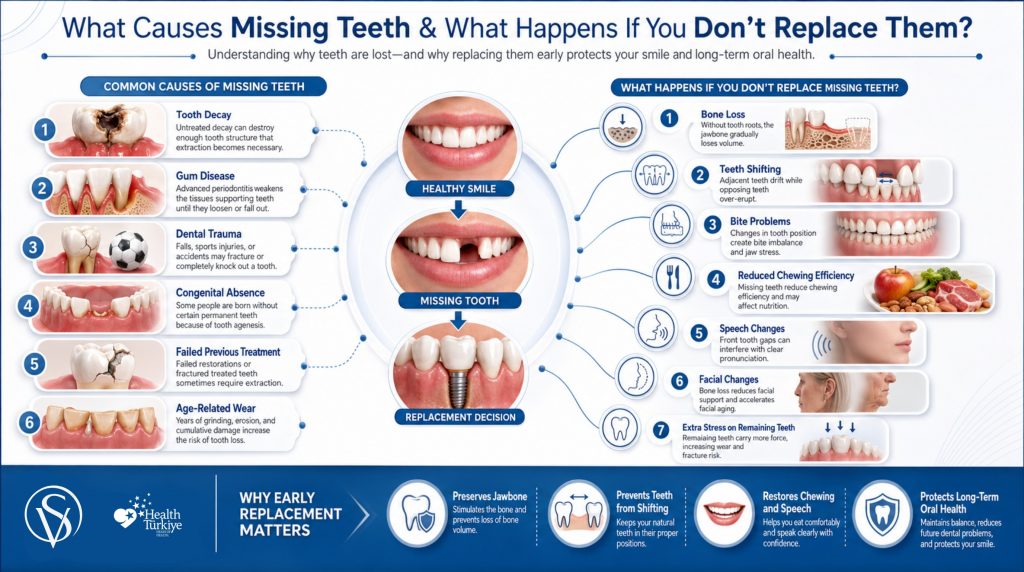
Missing teeth result mainly from untreated decay, advanced gum disease, physical trauma, and congenital absence. Adult tooth loss is rarely random, and it traces back to one of a small set of causes that shape the safest replacement plan. Some cause damage to the surrounding bone and gum before the tooth is even lost, which affects what comes next. The causes clinicians see most often are:
- Tooth Decay: Deep, untreated caries destroy enough tooth structure that the tooth can no longer be restored and has to be removed.
- Gum Disease: Advanced periodontics problems such as periodontitis break down the bone and ligament that hold teeth in place, loosening them until they fall out or need extraction.
- Dental Trauma: A fall, a sports injury, or an accident can fracture a tooth at the root or knock it out entirely.
- Congenital Absence: Some people never develop certain teeth because of hypodontia or tooth agenesis, leaving natural gaps from a young age.
- Failed Prior Treatment: A cracked crown, a fractured root-canal tooth, or a failed restoration sometimes leaves extraction as the only option.
- Age-Related Wear: Decades of grinding, erosion, and cumulative dental problems raise the risk of tooth loss in older adults.
Knowing the cause guides the next step, because each one leaves the mouth in a different state. Decay and trauma often affect a single tooth, while gum disease tends to threaten several teeth and the bone around them. Congenital absence often involves healthy surrounding bone, which can simplify replacement. Treating decay early can save a tooth long before it is lost, so knowing how to fix tooth decay matters as much as planning the replacement itself. A dentist assesses the cause first, then matches it to a replacement option that fits the remaining bone and gum health.
What Happens If You Don’t Replace Missing Teeth?
Leaving a gap untreated leads to jawbone loss, drifting teeth, bite problems, and changes to chewing, speech, and facial shape. The socket does not stay empty and stable. The body reabsorbs the unused bone, and the surrounding teeth respond to the space, so an untreated gap creates new problems over months and years. The main consequences of an untreated gap are:
- Bone Resorption: Without a root to stimulate it, the jawbone shrinks fast, and studies report the alveolar ridge can lose up to 50% of its width in the first year, with two-thirds of that loss in the first three months; a dental bone graft can rebuild lost volume when an implant is planned later.
- Teeth Shifting: Neighbouring teeth tilt into the gap and the opposing tooth over-erupts, which disrupts alignment across the whole arch.
- Bite Problems: As teeth move, the bite (occlusion) changes, which can overload some teeth and strain the jaw joint.
- Chewing and Nutrition: A gap reduces chewing efficiency and pushes people toward softer, less varied foods.
- Speech Changes: Front-tooth gaps affect how certain sounds are formed, altering clear speech.
- Facial Changes: Lost bone height reduces support for the lips and cheeks, which can make the lower face look collapsed or older.
- Strain on Remaining Teeth: The teeth that stay do more work, raising their risk of wear, fracture, and further loss.
Warning: Bone loss starts within weeks of losing a tooth, so delaying replacement can turn a straightforward implant into a case that first needs bone grafting and a longer treatment.
These effects compound rather than stay static, so the earlier a gap is addressed, the simpler the treatment. A single missing tooth left for years can require bone grafting and orthodontic correction before an implant is even possible. Prompt replacement protects the bone, keeps the remaining teeth in position, and preserves normal function. Dentists frame replacement as prevention, not only restoration.
What Does the Missing Teeth Treatment Process Involve?
Replacing a missing tooth follows a clear sequence of assessment, planning, any preparatory work, placement, healing, and the final restoration. The exact path depends on the option chosen, but most treatment plans move through the same core stages. For international patients, the clinic groups these stages into as few trips as the case allows. What to expect from start to finish is:
- Consultation and 3D Imaging: The dentist examines the mouth and takes a 3D scan to measure bone and plan the case.
- Treatment Planning: The clinic maps the option, the number of visits, and the timeline, often using digital smile design for visible teeth.
- Extraction or Bone Graft: Where a failing tooth remains or the bone is thin, the clinic removes the tooth or grafts the site before restoring the gap.
- Placement: The dentist places the implant, prepares the teeth for a bridge, or takes impressions for a denture.
- Healing and Osseointegration: An implant fuses with the jawbone over three to six months before the final tooth is fitted.
- Final Restoration: The permanent crown, bridge, or denture is fitted and adjusted for a comfortable bite.
- Follow-up: The clinic checks healing and function and gives aftercare instructions.
Each stage sets up the next, and skipping the groundwork risks the final result. A clinic that plans extractions and grafting properly avoids surprises later in treatment. For travellers, visits to Istanbul are arranged around the stages that must be done in the chair.
How Long Does It Take to Replace Missing Teeth?
The time needed ranges from a single visit for a bridge to several months for a standard implant. A traditional bridge takes two visits over about a week, and a denture takes a few fittings across two to three weeks. A standard implant runs longer because it needs three to six months for the bone to fuse before the final crown is attached. For patients who want to avoid the long wait, immediate dental implants can carry a temporary tooth on the same day as placement in suitable cases, with the permanent restoration fitted once healing is complete.
How Can You Replace Missing Teeth?
Dentists replace missing teeth with three core approaches, dental implants, dental bridges, and dentures, plus full-arch implant systems for extensive tooth loss. Each option restores something different: an implant rebuilds the root and crown, a bridge spans a gap using neighbouring teeth, and a denture rests on the gums. The right choice depends on how many teeth are missing, the state of the jawbone, and the budget. The main ways to replace missing teeth are:
- Dental Implants: A titanium post placed in the jaw acts as an artificial root and holds a crown, and dental implants are the only option that stimulates the bone the way a natural root does.
- Implant-Supported Bridge: Two or more implants anchor a fixed bridge across a larger gap without relying on natural teeth.
- Traditional Fixed Bridge: Crowns on the teeth either side of the gap support an artificial tooth in the middle, and a dental bridge suits one to three missing teeth in a row when the neighbouring teeth are strong.
- Removable Partial Dentures: A custom plate with artificial teeth clips onto the remaining teeth, and modern dentures offer an affordable, non-surgical way to fill several gaps.
- Complete Dentures: A full removable set replaces every tooth in an arch when no natural teeth remain.
- Full-Arch Solutions: Techniques such as all-on-4 dental implants restore a whole jaw on four implants, giving a fixed, non-removable result for edentulous patients.
The three approaches differ most in longevity, bone preservation, and cost. Choosing between them is a clinical conversation rather than a fixed rule, because the same gap can suit different options for different patients. A dentist weighs the number of gaps, the bone available, and the budget together before recommending one.
Which Tooth Replacement Options Are the Best for Missing Teeth?
Implants, bridges, and dentures compare across longevity, bone preservation, procedure, suitability, and cost. Implants lead on durability and are the only option that protects the jawbone, while bridges and dentures cost less upfront and avoid surgery. Relative cost is shown as a general tier from low to high. The options compare as follows:
| Option | Longevity | Jawbone Preservation | Procedure / Visits | Best For | Relative Cost |
| Dental implant | 15+ years, often lifelong | Yes, stimulates bone | Surgical, 3 to 6 months to complete | One or several missing teeth | High |
| Implant-supported bridge | 15+ years | Yes, at implant sites | Surgical, multi-stage | Several missing teeth in a row | High |
| Traditional fixed bridge | 5 to 15 years | No | Non-surgical, 2 visits over about a week | 1 to 3 teeth with healthy neighbours | Medium |
| Removable partial denture | 5 to 8 years | No | Non-surgical, several fittings | Multiple scattered gaps | Low |
| Complete denture | 5 to 8 years | No | Non-surgical, several fittings | A full arch, no natural teeth | Low |
| All-on-4 full arch | 15+ years | Yes, slows bone loss | Surgical, fixed teeth often same day | A full arch on a fixed solution | Medium to high |
The pattern is consistent: implants ask for a higher upfront investment and a surgical process but reward it with longevity and bone protection, while dentures and bridges cost less and avoid surgery at the expense of lifespan and bone support. Implant survival is well documented, with long-term reviews reporting around 90% to 95% at 10 years in healthy patients. A dentist weighs these trade-offs against your bone, gums, and budget before recommending one.
What Are the Best Replacement Options for One, Several, or All Missing Teeth?
The best option depends heavily on how many teeth are missing and where they sit in the mouth. A single gap, a run of gaps, scattered gaps, and a fully edentulous arch each point toward a different first-choice solution, which a clinical assessment then confirms. The best starting point for each case is:
- Single Tooth: A single dental implants treatment is the standard first choice, because it replaces one tooth without touching the healthy teeth beside it.
- Several Teeth in a Row: A fixed bridge or an implant-supported bridge restores a short span efficiently, with implants preferred when the neighbouring teeth are healthy and worth preserving.
- Multiple Scattered Gaps: A removable partial denture or a combination of implants fills gaps in different parts of the arch at a manageable cost.
- A Full Arch: A full mouth dental implants solution or an All-on-4 system replaces every tooth in a jaw with a fixed, stable result.
These are starting points, not final prescriptions, because bone volume and gum health can move a patient from one option to another. Someone missing a single tooth with severe bone loss may need grafting before an implant, while someone missing a full arch with good bone may qualify for fixed teeth in a single visit. The right plan comes from imaging and an in-person assessment.
Who Is a Candidate for Missing Teeth Replacement?
Most people with missing teeth are candidates for some form of replacement, and the potential candidates are:
- Adults With One or More Missing Teeth: Anyone missing a single tooth, several teeth, or a full arch can be restored with implants, a bridge, or dentures.
- People Who Lost Teeth to Decay, Gum Disease, or Injury: Once any active decay or gum disease is treated, the site can support a permanent replacement.
- Denture Wearers Wanting a Fixed Option: Current denture users often qualify to upgrade to implants or an implant-supported bridge for a more stable result.
- Patients With Enough Jawbone: Those with adequate bone proceed directly, and thin bone can be rebuilt with a graft or sinus lift before an implant.
- People in Reasonable General Health: Well-controlled health and a non-smoking status support faster healing and higher implant success.
- Adults of Any Age With Complete Jaw Growth: Age alone is no barrier, so older adults in good health remain strong candidates.
Clinical note: A responsible clinic treats active gum disease before placing implants and may delay or decline treatment for uncontrolled diabetes or heavy smoking, since these conditions lower success rates. Honest expectations at this stage protect the long-term result.
A candidacy assessment combines a 3D scan, a medical history review, and an examination of the remaining teeth and gums. Preparatory work such as grafting or gum treatment can open up options that would not be safe otherwise. The aim is a plan the mouth can support for years, not the fastest route to a finished tooth.
How Much Does It Cost to Replace Missing Teeth in Turkey?
Replacing missing teeth in Turkey costs far less than in the UK or USA, with single implants, bridges, and full-arch systems all priced well below Western European and American figures. The saving comes from lower operating costs, not lower-grade materials, and accredited Istanbul clinics use the same international implant brands as London or New York practices. The figures here are approximate market ranges converted to euros, and every quote depends on the individual plan. Approximate costs by option and country are:
| Option | UK | USA | Turkey |
| Single implant with crown | €2,400 to €4,100 | €2,300 to €4,600 | €450 to €1,000 |
| Traditional bridge (per unit) | €1,300 to €1,800 | €1,100 to €2,300 | €400 to €800 |
| Removable denture (per arch) | €700 to €2,350 | €1,000 to €2,800 | €250 to €700 |
| All-on-4 (per arch) | €11,700 to €29,000 | €12,000 to €28,000 | €3,000 to €5,000 |
Tips for patients: Ask for an itemised quote in writing before you travel, and confirm whether it covers the crown, the abutment, imaging, and any grafting, because a low headline price sometimes excludes these steps.
Several factors move a final quote within these ranges, including the implant brand, the number of teeth, and whether preparatory work such as grafting or extraction is needed. Turkey keeps prices low through lower labour and overhead costs while operating under Ministry of Health regulation, which is why the country has become a leading destination for dental implants in Turkey. A written treatment plan makes it clear what the total covers before any travel is booked.
Why Choose Vera Smile for Missing Teeth Treatment?
Vera Smile is a dental clinic in Istanbul, Turkey that restores missing teeth with implants, bridges, and dentures using leading global implant brands and digital imaging. The clinic is built to European standards under the wider Vera Clinic group, and it combines 3D scanning, guided planning, and in-house digital workflows to plan each case precisely. International patients receive a treatment plan and a clear price before they travel, so the full scope of the work is set out in advance. For missing teeth, that means a single point of care from the first scan through to the final fitted restoration.
Tip for patients: When comparing clinics abroad, confirm the post-treatment follow-up and guarantee before booking, including how remote check-ins and any repairs are handled once you return home.
Aftercare continues after patients fly home, with support arranged around each treatment plan. To start, book a free consultation with the team at a dental clinic in Turkey and share recent photos or X-rays for an assessment.
FAQ
Yes, you can get an implant years after losing a tooth, though the bone loss that follows extraction often means a bone graft is needed first. The jaw shrinks most in the first year, so long-standing gaps sometimes need grafting to rebuild enough bone to hold an implant securely.
There is no fixed limit, and a full arch of missing teeth can be replaced in a single treatment. Options such as All-on-4 restore an entire jaw on four implants, while individual implants, bridges, and partial dentures cover smaller numbers of gaps.
Replacing a missing tooth is not painful during treatment, because the area is fully numbed with local anaesthetic. Most patients report mild soreness for a few days after implant surgery, which is managed with standard pain relief.
Yes, replacing a missing back molar is recommended even though it is not visible when you smile. Molars carry most of the chewing load, and leaving the gap lets neighbouring and opposing teeth drift, which disrupts the bite over time.
Most patients can fly home a day or two after implant placement, once the dentist confirms healing is on track. The clinic schedules the flight home around the specific procedure, and short recovery advice is given before departure.
Coverage varies, and many standard plans pay part of a bridge or denture but limited amounts toward implants. Most UK and US insurance policies do not cover treatment received abroad, so patients travelling to Turkey pay directly and should check their policy before travelling.