
A tooth stain is a discoloration on the outer enamel or within the inner tooth structure, caused by pigment binding to the surface or by changes inside the dentin. Staining is distinct from general tooth discoloration and yellowing, which are handled as separate topics, so this page stays focused on stains themselves. Dentists sort tooth stains into two groups, extrinsic stains that sit on the surface and intrinsic stains held inside the tooth, and the two behave very differently during treatment.
The color of a stain often signals its origin, whether brown marks from coffee and tobacco, white patches from fluorosis, or a single dark tooth after injury. Surface stains lift with professional cleaning, while deeper intrinsic stains need bleaching or cosmetic work. For long-standing discoloration, professional teeth whitening is often the first clinical step before any restorative option is considered. Knowing your stain type is the fastest route to the right fix.
Key Factors:
- Tooth stains fall into two main types, extrinsic stains on the enamel surface and intrinsic stains inside the tooth, and each one calls for a different treatment (Watts & Addy, 2001).
- Stain color works as a diagnostic clue, since brown points to food and tobacco, black to chromogenic bacteria, white to early demineralization or fluorosis, and a single gray tooth to nerve damage.
- Most extrinsic stains are removed with professional scaling and polishing, while intrinsic stains need whitening or cosmetic restorations.
- Some intrinsic stains are permanent, including tetracycline staining from antibiotics taken during tooth development before age 8 (Sánchez et al., 2004).
- Prevention rests on limiting staining foods and drinks, avoiding tobacco, and keeping regular professional cleanings rather than relying on home remedies.
- A single darkening tooth, a stain paired with pain, or spreading white and brown patches can signal a dental problem and should be examined by a dentist.
What Is a Tooth Stain?
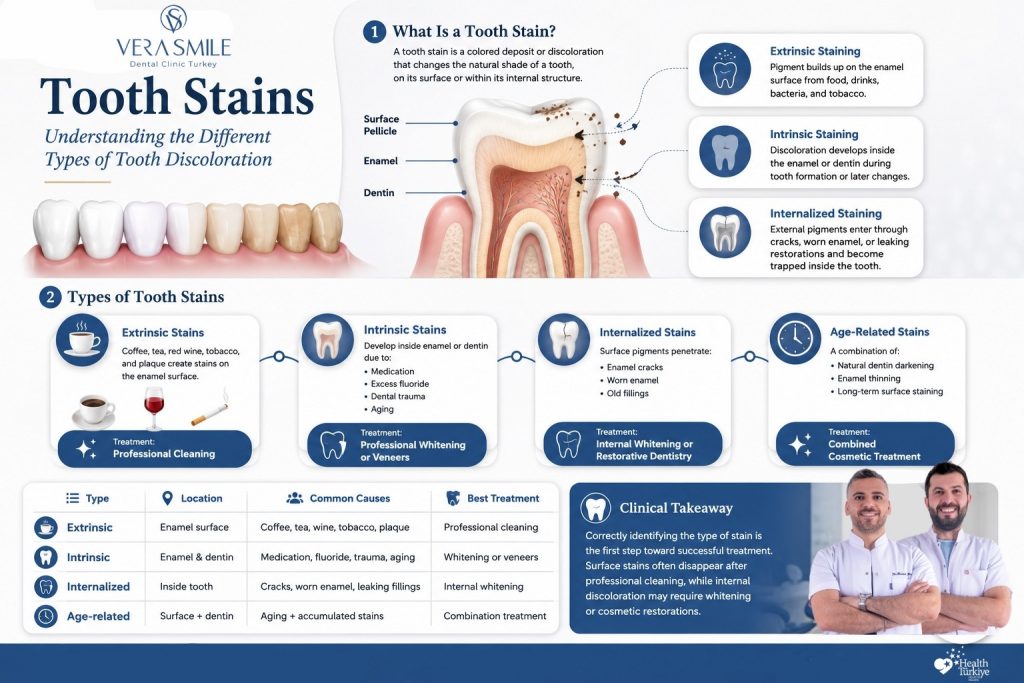
A tooth stain is a colored deposit or discoloration that changes the natural shade of a tooth, either on its surface or within its internal structure. On the surface, a thin protein layer called the acquired pellicle attracts pigment molecules from food, drink, and bacteria, which then bind to the enamel (Nathoo, 1997). Inside the tooth, discoloration develops when the dentin darkens or when pigment becomes locked into the tooth during its formation.
Dentists describe three mechanisms of staining (Sulieman, 2005). Extrinsic staining sits on the outer enamel and comes from external agents. Intrinsic staining is built into the enamel or dentin, often during development. Internalized staining happens when external pigment passes through cracks, defects, or old fillings and settles inside the tooth. This distinction matters because surface stains respond to cleaning, while internal discoloration needs bleaching or restorative treatment (Watts & Addy, 2001).
What Are the Types of Tooth Stains?
Tooth stains are grouped by where the pigment sits and how it got there. The two primary categories are extrinsic and intrinsic, with internalized and age-related staining recognized as further variations (Sulieman, 2005). Understanding the category is the first step in choosing an effective treatment, since surface and internal stains do not respond to the same methods. The following breakdown covers the main types a dentist looks for during an examination.
- Extrinsic Stains: These form on the outer enamel from colored substances such as coffee, tea, wine, and tobacco, and they respond to professional cleaning.
- Intrinsic Stains: These sit inside the enamel or dentin and develop from causes such as medication, fluoride, trauma, or aging, so they need whitening or cosmetic treatment rather than cleaning.
- Internalized Stains: These begin as external pigment that enters the tooth through cracks, worn enamel, or leaking restorations, producing an intrinsic-type appearance.
- Age-Related Stains: These combine years of surface staining with natural darkening of the dentin and thinning of the enamel that occurs over time.
Identifying the type narrows the treatment options quickly. An extrinsic stain may clear in a single cleaning, while an intrinsic stain can require weeks of whitening or a veneer. A correct classification at the start prevents wasted treatment and sets realistic expectations for the result.
What Are Different Tooth Stain Colors?
The color of a tooth stain is one of the strongest clues to its cause, which is why dentists pay close attention to shade during diagnosis. Some colors reflect harmless surface deposits, while others warn of decay, nerve damage, or a developmental defect. Matching the color to a likely cause helps direct the examination and the treatment plan. The list gives the most common stain colors and what each one tends to indicate.
- Yellow Stains: Yellowing points to aging and thinning enamel that exposes the darker dentin underneath, often combined with everyday dietary staining.
- Brown Stains: Brown marks come from coffee, tea, red wine, and tobacco, and can also signal tartar buildup or the early stages of tooth decay.
- White Stains: White spots indicate early demineralization from acid or plaque, or dental fluorosis caused by excess fluoride during enamel formation (Beltrán-Aguilar et al., 2010).
- Black Stains: A dark line near the gum is a classic sign of chromogenic bacteria that deposit iron salts, a pattern linked with a lower rate of decay (Janjua et al., 2022).
- Gray Stains: Grayish shades appear with tetracycline staining or when a single tooth loses its nerve after trauma and darkens from within.
- Orange or Green Stains: These reflect chromogenic bacteria and poor plaque control, and they are seen more often in children.
Color alone does not confirm a diagnosis, but it narrows the field. A uniform yellow across all teeth suggests aging or diet, while a single dark tooth or a spreading white patch calls for closer investigation. Reading the color correctly saves time and guides the right response.
What Causes Tooth Stains?
Tooth stains have many causes, and they divide cleanly along the extrinsic and intrinsic lines. Extrinsic causes act on the tooth surface after eruption, while intrinsic causes act on the tooth during its formation or from within. Sorting the cause into one of these groups tells a dentist whether cleaning will be enough or whether deeper treatment is required. The two subsections separate the surface causes from the internal ones.
What Causes Extrinsic Tooth Stains?
Extrinsic stains build up on the enamel from repeated contact with colored or staining agents. They are the most common and the most treatable form of staining, since they respond to professional cleaning and, in many cases, to whitening. The causes range from daily habits to specific products used in the mouth. The list covers the main sources a dentist checks first.
- Chromogenic Foods and Drinks: Coffee, tea, red wine, cola, dark berries, curry, and soy sauce carry pigments called chromogens that cling to the enamel.
- Tobacco: Tar and nicotine from smoking and chewing tobacco produce stubborn brown to black surface stains.
- Chromogenic Bacteria: Certain bacteria form a dark line of pigment near the gum, most often seen as black stain.
- Chlorhexidine and Some Mouthwashes: Long-term use of chlorhexidine and certain antiseptic rinses causes a brown film on the teeth.
- Poor Oral Hygiene and Tartar: Plaque and hardened tartar trap pigment against the tooth and hold stains in place.
- Iron Supplements: Liquid iron and some supplements can leave a black surface stain, especially in children.
Extrinsic stains are the most manageable form of staining, since they sit on the surface and respond well to professional cleaning. Identifying the exact source, whether a daily coffee habit, tobacco, or a staining mouthwash, is what keeps the stain from returning after treatment. A change in routine combined with a scaling and polishing session is often enough to restore the natural shade. When surface stains keep coming back despite good habits, a dentist checks for chromogenic bacteria or tartar as the hidden cause.
What Causes Intrinsic Tooth Stains?
Intrinsic stains form inside the tooth and cannot be brushed or polished away. They arise during tooth development, from medication or fluoride, or later from trauma and aging. Because the pigment is locked within the enamel or dentin, these stains need whitening or cosmetic treatment rather than cleaning. The list sets out the causes dentists see most.
- Tetracycline Antibiotics: When taken during tooth development, most often before age 8, tetracycline binds to calcium in the forming tooth and produces permanent yellow, gray, or brown bands that fluoresce under ultraviolet light (Sánchez et al., 2004; Tredwin et al., 2005).
- Dental Fluorosis: Too much fluoride during enamel formation creates white flecks or brown mottling, a condition that affected about 23% of people aged 6 to 49 in one national survey.
- Dental Trauma and Pulp Death: An injured tooth whose nerve dies often darkens to gray or brown from the inside, affecting one tooth in isolation.
- Enamel Defects: Developmental conditions such as enamel hypoplasia leave weak, discolored enamel that stains easily.
- Aging: Over the years the outer enamel thins and the inner dentin darkens, which shifts the whole tooth toward yellow.
- Internal Bleeding and Root Canal Materials: Blood breakdown products or some filling materials can seep into the tooth and cause internalized discoloration.
Pinpointing the cause shapes everything that follows. A surface habit may only need a change in routine and a cleaning, while a developmental or traumatic cause may need whitening, a veneer, or a crown. Accurate diagnosis is what separates a lasting result from a stain that returns.
Are Tooth Stains a Sign of a Dental Problem?
Most tooth stains are cosmetic, but some point to an underlying dental problem that needs treatment. Everyday brown and yellow staining from food, drink, and aging carries no health risk on its own. The concern arises when a stain reflects decay, tartar, or a dying nerve rather than simple surface pigment. Reading which protects both the appearance and the health of the tooth.
- Brown or dark spots in the grooves can be the first visible sign of tooth decay rather than a surface stain.
- A single tooth turning gray or dark often means the nerve inside has died and needs assessment.
- Heavy dark deposits along the gumline often signal tartar, which harbors bacteria and irritates the gums.
- Spreading white patches can indicate early demineralization that may progress to a cavity.
A stain that changes quickly, hurts, or affects only one tooth deserves professional attention. These patterns are less about appearance and more about the condition of the tooth and gum. Catching them early keeps a cosmetic issue from becoming a restorative one.
When Should You See a Dentist About Tooth Stains?
You should see a dentist when a stain appears suddenly, worsens, or comes with pain or gum changes. Cosmetic staining can wait for a routine visit, but warning signs should not. A prompt examination rules out decay and nerve damage before they spread.
Warning: A single tooth that darkens after a knock or injury may have a dying nerve and should be checked without delay, since an untreated non-vital tooth can lead to infection.
How Are Tooth Stains Removed?
Most tooth stains can be removed, though the method depends on whether the stain is extrinsic or intrinsic. Surface stains respond to professional cleaning and whitening, while stains locked inside the tooth need bleaching or cosmetic restorations to mask them (Watts & Addy, 2001; Joiner, 2006). The right choice follows directly from the diagnosis of stain type and cause. The main options a dentist offers, from the least to the most involved:
- Professional Cleaning: Scaling and polishing removes plaque, tartar, and most extrinsic stains in a single visit, and professional teeth scaling and polishing is the standard starting point for surface staining.
- Professional Whitening: Peroxide-based bleaching lightens yellowing, aging, and diet-related stains by several shades, though it has limited effect on deep intrinsic stains such as tetracycline.
- Enamel Microabrasion: A dentist removes a very thin layer of stained enamel to treat shallow white or brown fluorosis marks.
- Composite Bonding: Tooth-colored resin covers localized intrinsic stains in one appointment, and composite bonding is a conservative option when whitening is not enough.
- Dental Veneers: Thin ceramic shells mask deep, permanent, or uneven staining that does not respond to bleaching, and dental veneers are the preferred choice for severe tetracycline discoloration.
- Dental Crowns: A full crown restores a tooth that is both badly stained and structurally weak, such as a darkened non-vital tooth.
The best result starts with the simplest effective method. A cleaning and whitening often satisfy patients with surface and age-related stains, while intrinsic staining moves the plan toward bonding or veneers. Matching the treatment to the stain avoids over-treatment and keeps as much natural tooth as possible.
A patient from Vera Smile said:
“I had been hiding my smile for years because of the stains on my teeth. I tried whitening before, but the results never lasted or gave me the look I wanted. After getting porcelain veneers at Vera Smile, I finally have the bright, natural-looking smile I always hoped for. The whole experience was much easier than I expected, and now I smile with so much more confidence every day.”
Which Treatment Works for Which Type of Stain?
The common stain types to the treatment that suits them best, so expectations are set before treatment begins.
| Stain type | Recommended treatment | What to expect |
| Extrinsic (food, drink, tobacco) | Scaling and polishing, then whitening | Cleared in about 1 visit; upkeep needed |
| Yellow, age-related | Professional whitening | Lightens several shades; result is not permanent |
| Black stain (chromogenic bacteria) | Scaling and polishing | Can return if the bacteria persist |
| Tetracycline (intrinsic) | Veneers or bonding | Whitening rarely enough; masking preferred |
| Fluorosis (white or brown) | Microabrasion, bonding, or veneers | Choice depends on how deep the marks are |
| Single non-vital dark tooth | Internal bleaching or a crown | Root treatment is addressed first |
Extrinsic stains have the simplest path, while intrinsic stains move toward cosmetic restorations. A dentist confirms the stain type before committing to any single method.
How Can You Prevent Tooth Stains?
Preventing tooth stains is easier and cheaper than removing them, and it centers on limiting pigment exposure and keeping the enamel clean. Most extrinsic staining is avoidable with small daily changes and regular professional care. Prevention will not undo existing intrinsic stains, but it keeps new surface stains from forming and protects whitening results. Habits that make the biggest difference are:
- Limit Staining Drinks: Cut back on coffee, tea, red wine, and cola, and rinse with water afterward to clear pigment from the enamel.
- Use a Straw: Drinking staining beverages through a straw reduces contact between the liquid and the front teeth.
- Avoid Tobacco: Stopping smoking and chewing tobacco removes one of the strongest and most stubborn sources of staining.
- Brush and Floss Daily: Good plaque control stops pigment from settling and prevents the tartar that traps stains.
- Keep Regular Cleanings: Professional scaling every six to twelve months removes early stains before they set.
Consistency matters more than any single step. A patient who rinses after coffee, controls plaque, and attends regular cleanings keeps their teeth brighter for far longer. These habits also protect the results of any whitening treatment.
Tips for Patients: After professional whitening, avoiding deeply colored foods and drinks for the first two days helps the result hold, since the enamel is more absorbent during that window.
Which Foods and Drinks Stain Teeth the Most?
The strongest staining foods and drinks are dark, acidic, or rich in tannins. Acid softens the enamel and lets pigment penetrate more easily, which is why colored acidic drinks are the worst offenders. Cutting down on these, or rinsing after them, reduces new staining. The list ranks the most common culprits.
- Coffee and Tea: Both are high in tannins that bind pigment strongly to the enamel.
- Red Wine: Its acid and deep color combine to stain quickly.
- Cola and Dark Sodas: Acidic and pigmented, they stain and erode at the same time.
- Dark Berries and Sauces: Blueberries, beetroot, curry, and soy sauce leave visible marks.
Do Home Remedies Remove Tooth Stains?
No, home remedies do not remove stains the way professional treatment does, and some can damage the enamel. A few popular methods lighten surface stains slightly through mild abrasion, but none reach intrinsic discoloration, and several carry real risks. The evidence for the most viral remedies is weak, and dentists caution against daily use. The list reviews the common home methods and their drawbacks.
- Baking Soda: Mildly abrasive and able to reduce light surface stains, though it does not change the underlying tooth color and should not be scrubbed hard.
- Oil Pulling: Popular online but without solid evidence that it removes or prevents stains.
- Activated Charcoal: A literature review found insufficient evidence for its safety and whitening claims, and its abrasiveness can wear the enamel over time (Brooks et al., 2017).
- Hydrogen Peroxide Rinses: Low household concentrations offer little whitening and can irritate the gums if misused.
- Whitening Toothpaste: Helpful for maintaining results by lifting light surface stains, but unable to remove deep or intrinsic staining.
Warning: Activated charcoal and other highly abrasive home products can permanently wear down the enamel, and because enamel does not grow back, the exposed dentin can look more yellow and become more sensitive.
Home methods work best as maintenance, not as a cure. They may keep light stains at bay between dental visits, but they cannot match professional cleaning or whitening. For anything beyond a mild surface stain, a dental assessment is the safer route.
FAQ
Brushing removes plaque but cannot stop pigment from staining teeth or lighten intrinsic discoloration. Daily coffee, tea, tobacco, and aging still stain the enamel, and internal causes such as fluorosis or old antibiotics sit beyond the reach of a toothbrush. A professional cleaning and an assessment can identify what brushing is missing.
A single dark tooth most often means the nerve inside has died, often after an injury. As the tissue breaks down, it releases pigments that darken the tooth from within. This needs a dental examination, since the tooth may require root treatment before any cosmetic correction.
Yes, stains can return after whitening because the treatment lightens existing pigment but does not stop new staining. Coffee, tea, wine, and tobacco gradually re-darken the enamel. Good habits and regular cleanings extend the result, and occasional top-up whitening maintains it.
No, whitening toothpaste cannot remove deep or intrinsic stains. It works by gently lifting light surface stains through mild abrasives and low-level agents. Deep discoloration such as tetracycline staining needs professional whitening, bonding, or veneers.
It depends on the cause, since many childhood stains are removable while some are permanent. Surface stains from food, poor hygiene, or chromogenic bacteria clear with cleaning. Intrinsic stains from tetracycline before age 8 or from fluorosis are permanent and are addressed cosmetically once the adult teeth are in place (Sánchez et al., 2004).
Tartar itself is removable, but leaving it in place can lead to lasting discoloration and gum damage. Hardened tartar traps pigment and gives teeth a yellow or brown cast, and it can only be removed by professional scaling. Prompt cleaning prevents the staining and the gum disease that tartar encourages.
Beltrán-Aguilar, E. D., Barker, L., & Dye, B. A. (2010). Prevalence and severity of dental fluorosis in the United States, 1999–2004 (NCHS Data Brief No. 53). National Center for Health Statistics.
Brooks, J. K., Bashirelahi, N., & Reynolds, M. A. (2017). Charcoal and charcoal-based dentifrices: A literature review. Journal of the American Dental Association, 148(9), 661–670.
Janjua, U., Bahia, G., & Barry, S. (2022). Black staining: An overview for the general dental practitioner. British Dental Journal, 232(12), 857–860.
Joiner, A. (2006). The bleaching of teeth: A review of the literature. Journal of Dentistry, 34(7), 412–419.
Nathoo, S. A. (1997). The chemistry and mechanisms of extrinsic and intrinsic discoloration. Journal of the American Dental Association, 128(Suppl.), 6S–10S.
Sánchez, A. R., Rogers, R. S., & Sheridan, P. J. (2004). Tetracycline and other tetracycline-derivative staining of the teeth and oral cavity. International Journal of Dermatology, 43(10), 709–715.
Sulieman, M. (2005). An overview of tooth discoloration: Extrinsic, intrinsic and internalized stains. Dental Update, 32(8), 463–471.
Tredwin, C. J., Scully, C., & Bagan-Sebastian, J. V. (2005). Drug-induced disorders of teeth. Journal of Dental Research, 84(7), 596–602.
Watts, A., & Addy, M. (2001). Tooth discolouration and staining: A review of the literature. British Dental Journal, 190(6), 309–316.
Żyła, T., Kawala, B., Antoszewska-Smith, J., & Kawala, M. (2015). Black stain and dental caries: A review of the literature. BioMed Research International, 2015, 469392.