
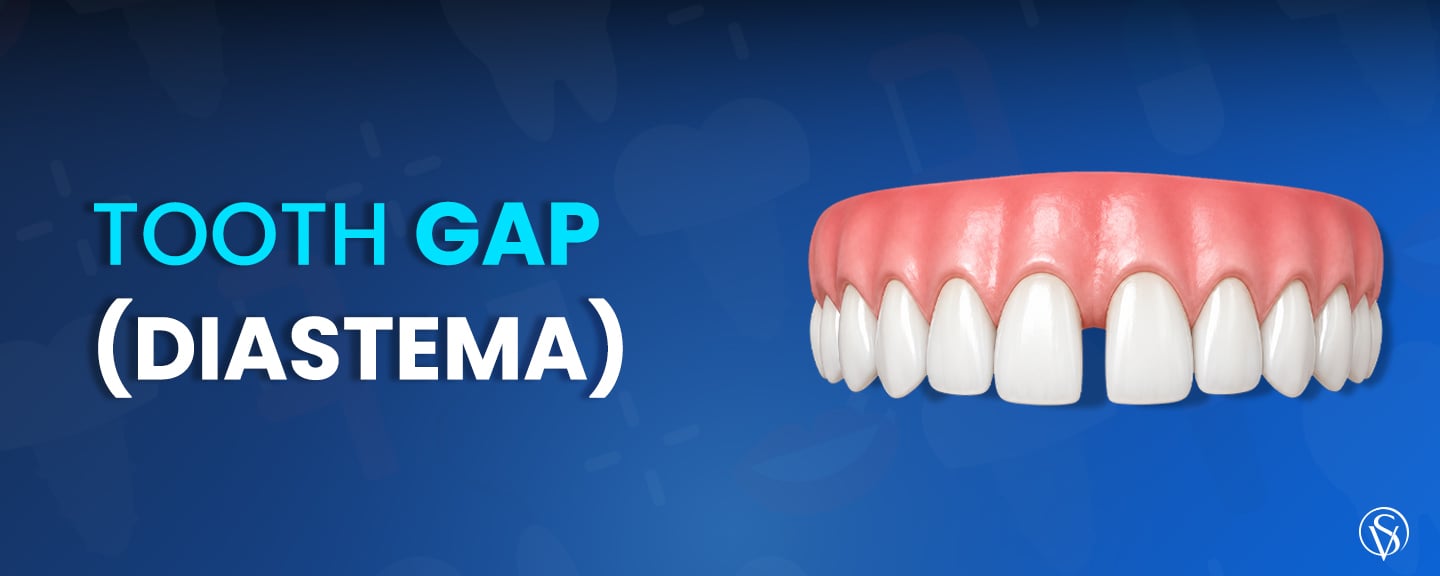
A tooth gap, known clinically as a diastema, is a visible space between two or more teeth, most often between the two upper front teeth. It is a descriptive finding rather than a disease, and in most people it carries no health risk. A space wider than 0.5 mm meets the clinical definition of a true diastema (Keene, 1963). Gaps are common in childhood and often close on their own as the adult teeth erupt, while gaps that persist into adulthood can be closed with composite bonding, veneers, clear aligners, or braces depending on the cause and the width of the space.
Treatment is elective in most cases, so the right option depends on why the gap formed and how wide it is. Small single gaps can be closed in one visit, while gaps linked to jaw size, missing teeth, or bite problems are better corrected with orthodontics. Costs range from a few hundred to several thousand euros across the methods, and prices in Turkey sit well below those in the UK, Western Europe, and the United States. A new gap that appears in adulthood should be checked, because it can be an early sign of gum disease.
Key Points
- A diastema is a space wider than 0.5 mm between two or more teeth, most often the upper central incisors.
- Gaps affect close to 98% of 6-year-olds but only around 7% of 12 to 18-year-olds, since most childhood gaps close naturally (Gkantidis et al., 2008).
- Common causes are a tooth-to-jaw size mismatch, an oversized labial frenum, missing or peg-shaped teeth, oral habits, and gum disease.
- The main treatments are composite bonding, dental veneers, clear aligners, and dental braces, chosen by gap size and cause.
- In Turkey, composite bonding starts near €100 to €250 per tooth, well below UK and US prices.
- A gap that forms in adulthood can signal periodontal disease and should be assessed by a dentist.
What Is a Tooth Gap (Diastema)?
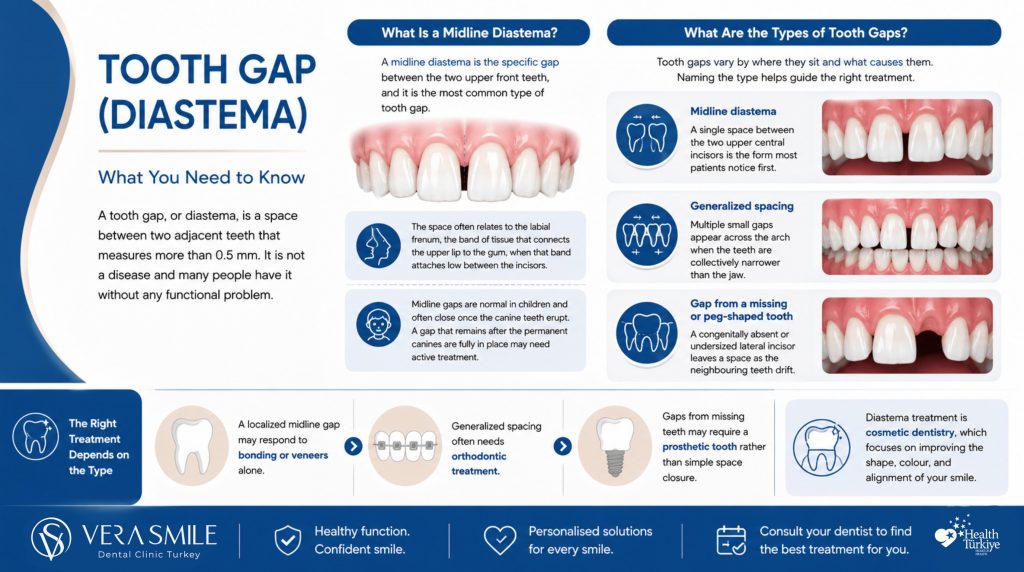
A tooth gap, or diastema, is a space between two adjacent teeth that measures more than 0.5 mm (Keene, 1963). The term describes any visible separation, though the most recognised form sits between the two upper central incisors. A diastema is not itself a disease, and many people keep a gap for life with no functional problem. It can appear as a single space, as several spaces across the arch, or as a gap left by a missing tooth. Closing a gap for appearance falls under cosmetic dentistry, which covers procedures that change the shape, colour, and alignment of the teeth, in the criteria used to assess dental problems.
What Is a Midline Diastema?
A midline diastema is the specific gap between the two upper front teeth, and it is the most common type of tooth gap. The space often relates to the labial frenum, the band of tissue that connects the upper lip to the gum, when that band attaches low between the incisors. Midline gaps are a normal stage of dental development in children and often close once the canine teeth erupt (Gkantidis et al., 2008). A gap that remains after the permanent canines are fully in place is the one that may need active treatment.
What Are the Types of Tooth Gaps?
Tooth gaps vary by where they sit and what causes them, and naming the type helps guide treatment. A single midline space is handled differently from spacing spread across the whole arch. A gap left by a missing tooth also needs a different plan from a gap between two healthy teeth. The main variations are:
- Midline diastema: A single space between the two upper central incisors is the form most patients notice first.
- Generalized spacing: Multiple small gaps appear across the arch when the teeth are collectively narrower than the jaw.
- Gap from a missing or peg-shaped tooth: A congenitally absent or undersized lateral incisor leaves a space as the neighbouring teeth drift (Gkantidis et al., 2008).
The right treatment depends heavily on which pattern is present. A localized midline gap may respond to bonding alone, while generalized spacing often needs orthodontics. Gaps from missing teeth may require a prosthetic tooth rather than simple space closure.
Is a Tooth Gap (Diastema) Genetic?
Often, yes. A common cause is a mismatch between tooth size and jaw size, and this pattern tends to run in families (Gkantidis et al., 2008). Inherited traits such as small or missing lateral incisors and jaw proportions all play a part. Non-genetic causes such as habits and gum disease can also create a gap, so heredity is one factor among several.
What Causes a Tooth Gap (Diastema)?
A tooth gap forms when the teeth do not fully fill the space available in the jaw, and the reasons are multifactorial (Gkantidis et al., 2008). Some causes are structural, such as a size mismatch between the teeth and the jaw, while others relate to soft tissue or habits. Identifying the cause matters because it decides whether the gap will stay closed after treatment. Each cause is:
- Tooth-to-jaw size discrepancy: Teeth that are collectively too small for the jaw leave spaces that do not close on their own, and this cause is often genetic.
- Oversized labial frenum: A thick or low-attaching frenum can hold the two front teeth apart and stop them from meeting (Edwards, 1977).
- Missing or peg-shaped teeth: Absent or undersized lateral incisors let the surrounding teeth drift and open a space.
- Oral habits: Thumb sucking, tongue thrusting, and lip biting push the front teeth forward and outward over time.
- Gum disease and bone loss: Advanced periodontal disease weakens the support around the teeth and lets them migrate apart (Brunsvold, 2005).
- Extra teeth or midline growths: A supernumerary tooth (mesiodens) or a cyst between the incisors can physically block the teeth from closing.
More than one factor is often present at the same time. A dentist checks the frenum, the bite, the gums, and an X-ray before deciding on treatment. This assessment separates a harmless developmental gap from one that signals an underlying problem.
Can a Tooth Gap Develop in Adulthood?
Yes. A gap can open in adulthood even when the teeth were previously straight. The most important cause is periodontal disease, where inflammation and bone loss let the front teeth drift apart in a pattern known as pathologic tooth migration (Brunsvold, 2005; Chasens, 1979). Tooth loss, an untreated tongue thrust, and habits such as tongue piercing can also create new spacing. A gap that grows over months, rather than one present since childhood, is the pattern that most warrants a dental check.
Warning: A tooth gap that newly appears or widens in adulthood can be an early sign of gum disease. Because bone loss is often painless in its early stages, it is worth having a new gap assessed promptly rather than treating it as a purely cosmetic change.
Does a Tooth Gap (Diastema) Need to Be Treated?
No. In most cases a diastema is a cosmetic feature and carries no health risk, so treatment is a personal choice (Gkantidis et al., 2008). A gap should be treated when it is caused by or linked to a problem, such as gum disease, a bite that traps food, or teeth drifting after a loss. Many people across different cultures view a front-tooth gap as an attractive feature and choose to keep it. The decision rests on the health of the teeth and gums first, and on personal preference second.
Clinic Note: At Vera Smile, a gap is assessed before any cosmetic plan is offered. The team first rules out active gum disease and bite problems, then discusses whether the patient wants the space closed at all. When a gap is healthy and the patient is happy with it, no treatment is recommended.
What Are the Treatment Options for a Tooth Gap (Diastema)?
Several treatments can close a tooth gap, and the best one depends on the size of the space and its cause. Minor gaps between healthy teeth respond to simple, same-visit methods, while wider gaps or bite issues need orthodontic movement. Gaps from missing teeth call for a replacement tooth rather than space closure alone. The main options are described as:
- Composite bonding: A tooth-coloured resin is added to the edges of the teeth to close small gaps in a single visit, and composite bonding removes little or no enamel.
- Dental veneers: Thin custom shells cover the front of the teeth to close wider or multiple gaps, and dental veneers also improve tooth shape and colour.
- Clear aligners: Removable transparent trays gradually move the teeth together, and clear aligners suit mild to moderate spacing without visible hardware.
- Dental braces: Fixed brackets and wires close larger gaps while correcting the bite, and dental braces handle cases that other methods cannot.
- Dental crowns: A crown can close a space when the tooth is also damaged or heavily restored, though it is rarely chosen for a healthy tooth.
- Frenectomy: Surgical release of an oversized frenum is combined with orthodontics when the frenum is the main cause, and the teeth are aligned before the frenum is trimmed (Edwards, 1977).
No single method is best for everyone. Bonding is the fastest and least expensive but the least durable, veneers give a lasting cosmetic result, and orthodontics addresses the underlying position of the teeth. The sections that follow compare these options and set out timing and cost.
How Are Small Gaps Closed With Composite Bonding?
Composite bonding closes a small gap by adding tooth-coloured resin to the adjacent sides of the teeth, making each tooth slightly wider until the space disappears. The dentist shapes the soft resin by hand, hardens it with a curing light, and polishes it, often finishing a single gap in under an hour and without drilling. Because little or no enamel is removed, the treatment is largely reversible, though the resin can chip or stain and needs replacing after several years. Composite bonding is best for gaps of a few millimetres between otherwise healthy teeth.
When Are Dental Veneers Used to Close a Tooth Gap?
Dental veneers are used to close a tooth gap when the patient wants a lasting cosmetic result or when several front teeth need reshaping at the same time. Thin porcelain or composite shells are bonded to the front of the teeth, widening them enough to close the space while also correcting shape and colour. Porcelain veneers resist staining and last 10 to 15 years or more, though they require removing a small amount of enamel and are not reversible. Veneers suit wider gaps or cases where bonding alone would look bulky.
Can Braces or Clear Aligners Close a Tooth Gap?
Yes. Both braces and clear aligners close a tooth gap by moving the actual teeth together rather than adding material, which treats the cause rather than masking it. Clear aligners use a series of removable transparent trays and suit mild to moderate spacing, while braces use fixed brackets and wires and handle larger gaps and bite problems. Orthodontic closure keeps the natural teeth untouched, but it takes months rather than a single visit and needs a retainer afterward to hold the result. This route is the right choice when the gap comes from tooth position rather than tooth size.
Which Treatment Is Best for Closing a Tooth Gap?
The best treatment depends on the gap size, whether the bite needs correcting, and how long the result should last. The comparison here sets the main options side by side.
| Method | Best for | Enamel removed | Reversible | Longevity |
| Composite bonding | Small single gaps | Little or none | Largely yes | 5 to 10 years |
| Dental veneers | Wider or multiple gaps | Small amount | No | 10 to 15+ years |
| Clear aligners | Mild to moderate spacing | None | Not applicable | Permanent with retainer |
| Dental braces | Large gaps and bite issues | None | Not applicable | Permanent with retainer |
Bonding wins on speed and price, veneers on lasting appearance, and orthodontics on correcting the underlying position of the teeth. A dentist matches the method to the cause found at examination.
How Long Does It Take to Close a Tooth Gap (Diastema)?
The time to close a tooth gap ranges from a single appointment to around two years, and the deciding factor is whether the teeth are reshaped or physically moved. Adding material, as in bonding and veneers, is fast because nothing has to migrate through bone. Moving teeth, as in aligner and brace treatment, is slower but corrects the position itself. A retainer is worn after any orthodontic closure to hold the result. The timeframes:
- Composite bonding: One visit, often 30 to 60 minutes per tooth.
- Dental veneers: About two visits across one to two weeks while the shells are made.
- Clear aligners: Around 6 to 12 months for mild to moderate spacing.
- Dental braces: Around 12 to 24 months for larger or more complex cases.
These estimates assume a healthy mouth at the start. Gum treatment or a frenectomy, when needed, adds time before the gap itself is closed. Aligner and brace durations also depend on how far the teeth must travel.
What Are the Risks of Not Treating a Tooth Gap (Diastema)?
Leaving a tooth gap untreated carries no health risk when the gap is a simple, healthy diastema, which is the case for most people. The concerns arise mainly when the gap has an underlying cause, such as gum disease or drifting teeth, that continues to progress if it is not addressed. In other words, the risk lies in the cause behind the gap rather than in the space itself. The main considerations are:
- Progression of gum disease: When a gap results from periodontal disease, leaving it untreated allows continued bone loss and loosening of the teeth (Brunsvold, 2005).
- Continued tooth drifting: An unaddressed underlying cause lets the teeth keep migrating, so the gap can widen over time in a pattern known as pathologic tooth migration (Chasens, 1979).
- Food trapping and hygiene problems: Some gaps trap food and plaque, which raises the risk of decay and gum inflammation if the area is not cleaned well.
- Bite and function issues: A gap linked to malocclusion can affect chewing and bite, and the underlying alignment problem persists while it is left untreated.
- Persistent speech effects: A front-tooth gap that contributes to a whistling sound or a slight lisp will remain if the space is not closed.
- Aesthetic and confidence impact: A visible gap makes some people self-conscious, which is not a medical risk but is a common reason patients seek treatment given the high aesthetic demand reported in the literature (Gkantidis et al., 2008).
None of these means every gap must be closed. A healthy, stable diastema can safely be left alone, while a gap tied to gum disease, drifting, or a bite problem is better assessed and managed early. The deciding factor is whether the gap is simply cosmetic or a sign of something active underneath.
Warning: Orthodontic gap closure reopens easily without retention. Wearing the prescribed retainer, often long term, is the single most important step in keeping the gap closed (Shashua & Årtun, 1999).
How Much Does Tooth Gap (Diastema) Treatment Cost?
The cost of closing a tooth gap depends on the method and the number of teeth involved, and prices in Turkey sit well below those in the UK, Western Europe, and the United States. The table sets out approximate euro ranges in Turkey against common figures abroad.
| Method | Approximate cost in Turkey | International range |
| Composite bonding | €100 to €250 per tooth | €300 to €700 per tooth |
| Dental veneers | €200 to €350 per tooth | €800 to €2,300 per tooth |
| Clear aligners | €1,500 to €3,000 full course | €3,000 to €6,400 full course |
| Dental braces | €1,000 to €3,000 full course | €3,200 to €7,400 full course |
These figures are market estimates for planning, not quotes, and the international ranges are converted to euros at approximate rates. The final price depends on the number of teeth and the complexity of the case, and a written quote from the clinic gives the exact cost for an individual gap.
Does Dental Insurance Cover Diastema Treatment?
Rarely. Closing a gap for appearance is treated as elective cosmetic work, which most insurance plans do not cover. Cover is more likely when the gap results from a medical problem, such as gum disease or tooth loss, and the treatment restores function. It is worth checking the exact terms with the insurer before treatment begins.
What Factors Affect the Cost of Closing a Tooth Gap?
Several factors move the price of gap closure up or down, even for the same method. Knowing them explains why two quotes can differ. The main factors:
- Number of teeth treated: Bonding or veneers on two teeth cost less than reshaping a full front row.
- Method and material: Porcelain costs more than composite, and orthodontics costs more than a single bonding session.
- Case complexity: A wide gap, a bite problem, or drifting after tooth loss needs more work than a simple midline space.
- Preparatory treatment: Gum treatment or a frenectomy, when required first, adds to the total.
The method itself is only part of the price. A simple midline gap is one of the least expensive cosmetic treatments, while a gap tied to alignment or gum problems costs more because it needs a fuller plan.
How Can You Keep a Tooth Gap From Coming Back?
A closed gap stays closed when the cause is addressed and the result is supported afterward. Relapse is common after orthodontics, so retention is central. Habits and gum health also matter. The main steps:
- Wear the retainer as directed: Keep to the retainer schedule after braces or aligners, because diastema gaps reopen without it (Shashua & Årtun, 1999).
- Maintain daily oral hygiene: Brush and floss to protect the gums and bone that hold the teeth in position.
- Treat gum disease early: Address bleeding or receding gums promptly, since periodontal bone loss lets teeth drift apart (Brunsvold, 2005).
- Break the underlying habit: Correct a tongue thrust or address a piercing that pushes the teeth apart.
- Attend follow-up reviews: Keep regular dental checks so any early movement is caught and managed.
Keeping a gap closed is mostly about supporting the correction rather than repeating it. A retainer combined with healthy gums holds the result for years.
Tips for Patients: Ask your dentist how long to wear your retainer and whether a fixed retainer behind the teeth suits you, since it removes the need to remember a removable one. If you notice a tooth starting to move again, book a review early rather than waiting for the gap to fully return.
FAQ
Yes, but mainly in children. Most midline gaps in the mixed-dentition stage close naturally once the permanent canine teeth erupt and push the front teeth together (Gkantidis et al., 2008). A gap that remains after the adult teeth are fully in place rarely closes without treatment. A gap that appears in adulthood will not self-correct and should be checked.
No. Home gap bands and similar do-it-yourself products can move teeth in uncontrolled ways and have caused tooth loss when the bands slip below the gum. Safe closure needs a dentist to identify the cause and control the movement or restoration. Attempting to close a gap without professional care risks damage that costs far more to repair.
Sometimes. A gap between the front teeth can contribute to a whistling sound or a slight lisp on certain sounds, though many people with a gap speak with no difficulty at all. Where speech is affected, closing the gap can help. A speech change alongside a new gap in adulthood is worth mentioning at a dental visit.
Yes, to a degree. Closing a gap widens the teeth on either side or moves them together, which changes the proportions of the front teeth and the overall smile line. A digital preview lets patients see the change before committing, so the result can be planned rather than guessed. Skilled treatment aims for natural proportions rather than simply erasing the space.
Brunsvold, M. A. (2005). Pathologic tooth migration. Journal of Periodontology, 76(6), 859–866.
Chasens, A. I. (1979). Periodontal disease, pathologic tooth migration, and adult orthodontics. New York Journal of Dentistry, 49, 40–43.
Edwards, J. G. (1977). The diastema, the frenum, the frenectomy: A clinical study. American Journal of Orthodontics, 71(5), 489–508.
Gkantidis, N., Kolokitha, O.-E., & Topouzelis, N. (2008). Management of maxillary midline diastema with emphasis on etiology. Journal of Clinical Pediatric Dentistry, 32(4), 265–272.
Keene, H. J. (1963). Distribution of diastemas in the dentition of man. American Journal of Physical Anthropology, 21(4), 437–441.
Shashua, D., & Årtun, J. (1999). Relapse after orthodontic correction of maxillary median diastema: A retrospective study. The Angle Orthodontist, 69(3), 257–263.