
Yellow teeth are teeth that have lost their bright natural shade because of surface stains, internal discoloration, or the natural thinning of enamel that reveals the darker dentin underneath. Most yellowing is cosmetic rather than a health problem, and it falls into two groups that matter for treatment. Extrinsic stains sit on the enamel from coffee, tea, red wine, and tobacco, while intrinsic stains form inside the tooth from aging, injury, fluorosis, or certain medications. Surface stains respond to professional cleaning and whitening, while deep internal stains often need bonding or veneers to mask them.
Whitening also has limits, since it cannot change the colour of crowns, veneers, or fillings. The right approach depends on what caused the colour change, which is why an examination comes first at a clinic where professionals observe the situation and guide about teeth whitening options . Early, surface-level yellowing is the simplest and cheapest to reverse, while long-standing internal stains take more involved cosmetic work.
Key Points
- Yellow teeth (tooth discoloration) come from surface (extrinsic) stains, internal (intrinsic) stains, or natural enamel thinning that exposes the darker dentin beneath.
- Extrinsic stains from coffee, tea, red wine, and tobacco sit on the enamel surface and respond well to professional cleaning and whitening.
- Intrinsic stains form inside the tooth from aging, trauma, fluorosis, or medications such as tetracycline, and lighten only with chemical bleaching or masking.
- Aging thins enamel and darkens dentin, so some yellowing is a normal part of getting older, not a sign of neglect.
- Whitening does not change the colour of crowns, veneers, or fillings, so existing restorations may need replacing to match a whitened shade.
- Professional in-office whitening works faster and lasts longer than whitening strips or natural home remedies, which help only mild surface stains.
What Does It Mean When Your Teeth Turn Yellow?
Yellow teeth means a change in the natural colour of the enamel or the dentin beneath it, most often from stain build-up or thinning enamel rather than surface dirt. Tooth colour comes mainly from how light passes through the translucent enamel and reflects off the yellowish dentin core. When enamel is thick and clean, teeth look bright and slightly white. As enamel thins with age or picks up pigment, more of the darker dentin shows through and the tooth reads as yellow. (Joiner, A. (2004). Tooth colour: A review of the literature. Journal of Dentistry, 32(Suppl. 1), 3–12.)
Dentists group these colour changes as extrinsic, intrinsic, or internalised, depending on where the change sits. The same condition is often called tooth discoloration, and the two terms describe the same visible result. Identifying where the colour sits is the starting point for choosing a treatment that can actually reach it.
Why Do Teeth Turn Yellow?
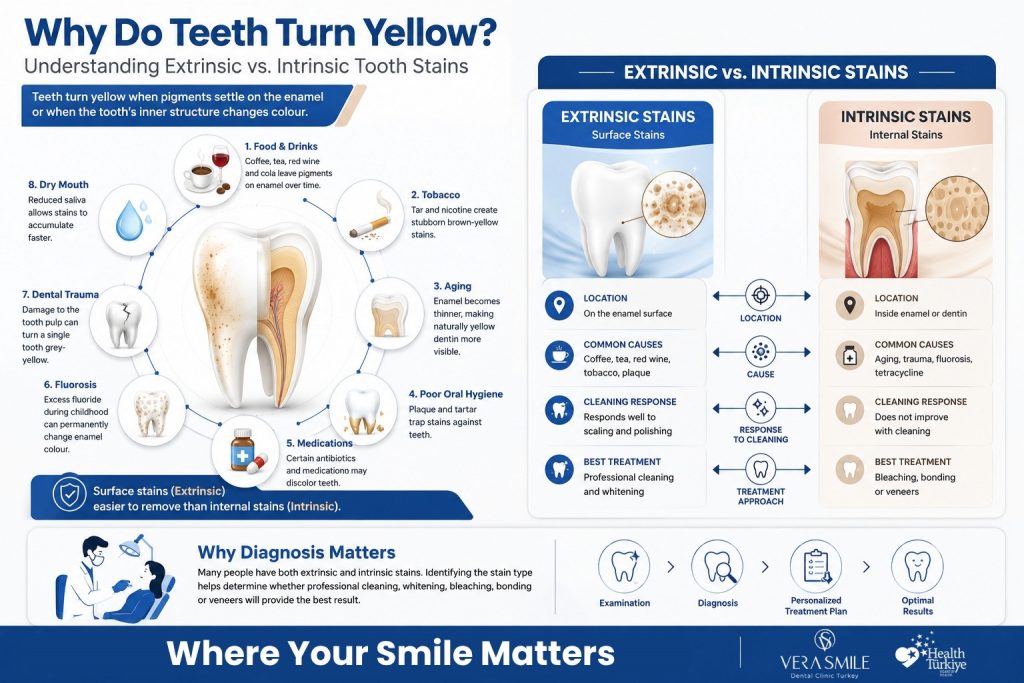
Teeth turn yellow when pigments settle on the enamel or when the tooth’s inner structure changes colour. Most cases trace back to everyday habits, aging, or specific medical and chemical exposures. The mechanism behind each cause decides whether cleaning, whitening, or restorative work will fix it. The most frequent causes fall into a few clear groups:
- Food and drink: Coffee, tea, red wine, and cola contain tannins and pigments that bind to the enamel surface and darken it over time.
- Tobacco: Tar and nicotine from cigarettes and chewing tobacco create stubborn brown-yellow stains that are among the hardest to remove.
- Aging: Enamel wears thinner each year, letting the naturally yellow dentin beneath show through more clearly.
- Poor oral hygiene: Plaque and tartar hold pigments against the tooth, so infrequent brushing and skipped cleanings speed up yellowing.
- Medications: Tetracycline and doxycycline can discolour developing teeth, and some antihistamines, blood-pressure drugs, and antipsychotics can darken adult teeth.
- Fluorosis: Too much fluoride during childhood tooth development leaves white or brown-yellow mottling inside the enamel.
- Dental trauma: A knock to a tooth can damage the pulp and turn a single tooth grey-yellow from the inside.
- Dry mouth: Low saliva flow reduces natural cleansing, so stains and plaque build up faster.
Extrinsic causes such as food, tobacco, and plaque affect the surface and are the easiest to treat. Intrinsic causes such as aging, medication, fluorosis, and trauma change the tooth from within and need a different approach. Knowing which category applies avoids wasted effort on treatments that cannot reach the stain. A dental examination is the reliable way to tell them apart. (Watts, A., & Addy, M. (2001). Tooth discolouration and staining: A review of the literature. British Dental Journal, 190(6), 309–316.)
What Is the Difference Between Extrinsic and Intrinsic Stains?
The difference between the two is where the colour change sits. Extrinsic stains lie on the outer enamel and come from pigments in food, drink, and tobacco, so they can be lifted by cleaning or whitening. Intrinsic stains lie inside the enamel or dentin and resist surface cleaning, which means they need bleaching or masking to improve.
| Aspect | Extrinsic stains | Intrinsic stains |
|---|---|---|
| Location | On the enamel surface | Inside the enamel or dentin |
| Common causes | Coffee, tea, red wine, tobacco, plaque | Aging, trauma, fluorosis, tetracycline |
| Response to cleaning | Lifts with scaling and polishing | Does not respond to cleaning |
| Best treatment | Professional cleaning and whitening | Bleaching, bonding, or veneers |
Extrinsic stains are shallower, more common, and far simpler to reverse. Intrinsic stains are set into the tooth and often need cosmetic work when bleaching is not enough. Many people have a mix of both, which is why treatment is planned only after the type is confirmed. Correct diagnosis of the stain type directly shapes the outcome.(Sulieman, M. (2005). An overview of tooth discoloration: Extrinsic, intrinsic and internalized stains. Dental Update, 32(8), 463–471.)
Clinic Note: At Vera Smile, the stain type is identified during the initial examination before any whitening is offered, because surface stains and internal stains call for different treatments.
Are Yellow Teeth a Sign of Poor Oral Health?
No. Yellow teeth are mostly cosmetic and not a sign of disease, though in some cases they point to an underlying problem. Colour changes from aging, genetics, and enamel thickness are normal and unrelated to how well someone cares for their teeth. Yellowing driven by heavy plaque and tartar is different, since it reflects a hygiene gap that also raises the risk of decay and gum disease.
The pattern matters more than the shade. Even gradual yellowing across all teeth is a cosmetic concern, while a sudden change or a single darkened tooth can signal something clinical.
Warning: Sudden darkening of one tooth, or yellowing that comes with pain, swelling, or sensitivity, can signal decay, trauma, or a dying nerve and should be examined promptly.
How to Get Rid of Yellow Teeth
Yes. Most yellow teeth can be lightened, and the right method depends on whether the stain sits on the surface or inside the tooth. Surface stains respond to cleaning and whitening, while deep internal stains often need cosmetic work to mask them. Peroxide-based whitening is safe and effective when the manufacturer’s instructions are followed, with mild, short-lived sensitivity as the main side effect. The main options run from a simple cleaning to permanent restorations.
- Professional cleaning: A session of teeth scaling and polishing removes plaque, tartar, and many surface stains, and it is the first step for extrinsic yellowing.
- Professional whitening: In-office teeth whitening uses hydrogen or carbamide peroxide to lighten enamel and works on surface stains and some internal ones, though it leaves restorations unchanged.
- Composite bonding: When bleaching cannot reach a permanent internal stain, composite bonding covers the tooth with a shade-matched resin and often needs a touch-up every 5 to 7 years.
- Dental veneers: For severe or fixed discoloration, dental veneers are thin shells bonded to the front of the teeth for a lasting colour change.
The strongest result usually starts with a cleaning, then whitening for stains that respond to it. Teeth that stay discoloured after whitening are candidates for bonding or veneers. Because whitening cannot lighten crowns, veneers, or fillings, any existing restorations are checked for colour match first. A dentist can map the fastest route for a given set of teeth. (Carey, C. M. (2014). Tooth whitening: What we now know. Journal of Evidence-Based Dental Practice, 14(Suppl.), 70–76.)
Tips for Patients: Book a cleaning first, since removing plaque and tartar can reveal a brighter shade on its own and lets any whitening gel work evenly.
Do Whitening Strips Work on Yellow Teeth?
Yes. Whitening strips can lighten mild surface stains, but they act more slowly and less deeply than in-office treatment. Clinical research shows that peroxide whitening strips produce measurable shade improvement with good tolerability. Over-the-counter teeth whitening strips use a lower peroxide dose than professional gels, so they take longer to work and fade sooner. They suit extrinsic stains and do little for deep intrinsic discoloration. (Gerlach, R. W., & Zhou, X. (2001). Vital bleaching with whitening strips: A summary of clinical research on effectiveness and tolerability. The Journal of Contemporary Dental Practice, 2(3), 1–16.)
Can You Whiten Yellow Teeth Naturally at Home?
No. Natural home remedies cannot reliably whiten teeth, and abrasive ones can wear down enamel. Charcoal powders, baking-soda scrubs, and acidic fruit rubs lack strong evidence, and the abrasive or acidic versions risk thinning enamel and making teeth look more yellow. The evidence-based route to a lasting colour change is peroxide-based whitening under guidance. Gentle habits grouped as natural teeth whitening, such as cutting back on staining drinks and brushing well, prevent new stains more than they remove old ones.
Warning: Abrasive home methods such as charcoal powder or baking-soda scrubs can permanently thin enamel and leave teeth looking more yellow over time.
How to Prevent Teeth From Turning Yellow
Preventing yellow teeth means limiting the pigments that stain enamel and keeping the surface clean. Most prevention targets extrinsic stains, since intrinsic causes such as aging and medication are harder to control. Consistent daily habits matter more than any single product. A short routine keeps most surface staining at bay.
- Limit staining drinks such as coffee, tea, red wine, and cola, or sip them through a straw.
- Rinse your mouth with water after pigmented drinks to wash away colour before it sets.
- Brush twice a day and floss once to stop plaque from trapping stains.
- Quit tobacco, since tar and nicotine cause some of the most stubborn stains.
- Schedule a professional cleaning at regular intervals to remove tartar and surface stains.
- Treat dry mouth with your dentist’s guidance, because low saliva speeds up staining.
These habits slow new staining but cannot reverse discoloration that has already set in. Teeth that are already yellow need cleaning, whitening, or restorative work to improve. Pairing good habits with regular dental visits keeps results stable after any whitening. Prevention remains the cheapest part of keeping teeth bright.
Tips for Patients: Wait about 30 minutes after acidic drinks before brushing, because enamel softens briefly and early brushing can wear it away.
When Should You See a Dentist About Yellow Teeth?
See a dentist if home care and over-the-counter products do not improve the colour, if a single tooth darkens, or if yellowing comes with pain or sensitivity. A dental visit separates harmless cosmetic yellowing from stains that signal decay, trauma, or a nerve problem. At Vera Smile in Istanbul, the first step is an examination and shade assessment that identifies the stain type and matches it to the right treatment, whether that is a cleaning, whitening, or a cosmetic option. The same visit confirms whether existing restorations will affect the final colour.
FAQ
Brushing removes fresh surface film but cannot lift stains already bound to the enamel or the natural yellow of dentin showing through thinning enamel. That controls how to brush your teeth with new plaque, yet coffee, tea, tobacco, and aging still darken teeth over time. A professional cleaning followed by whitening reaches what a toothbrush cannot.
No. Whitening toothpaste lifts some surface stains with mild abrasives but cannot change the deeper colour of the tooth. It helps maintain results after professional whitening more than it produces a visible change on its own.
Yes. General yellowing is mostly cosmetic, but a localised yellow-brown or dark spot on a single tooth can cause early decay that needs a dentist’s check. Colour change paired with pain, sensitivity, or a rough patch is a stronger warning sign.
Yes. Peroxide-based whitening does not damage enamel when it follows professional or manufacturer guidance, and the common side effects of mild sensitivity and gum irritation are short-lived (Carey, 2014). Overuse or unsupervised high-strength products raise the risk of irritation.
Yellowing after braces often comes from plaque that built up around the brackets where brushing was harder, sometimes leaving stains or white spots once the braces come off. A cleaning, and whitening after the enamel settles, evens out the colour. Good hygiene during treatment lowers the chance of it happening.
No. Whitening gels change only natural enamel and have no effect on the colour of crowns, veneers, or fillings. If you whiten your natural teeth, existing restorations may need replacing to match the new shade.