
Most people brush their teeth every day, but far fewer do it correctly. There is a significant gap between going through the motions and actually brushing in a way that protects your oral health. Technique, timing, tool choice, and consistency all play a role, and getting even one of these wrong can quietly undermine your efforts over months and years.
Proper brushing is about much more than just fresh breath. It is one of the most reliable and cost-effective habits you can build for your overall health. Every time you brush correctly, you are removing plaque, a sticky film of bacteria that forms on your teeth within hours of eating. Left undisturbed, that plaque produces acids that erode enamel, inflame the gums, and eventually contribute to cavities, gum disease, and even tooth loss.
What many people do not realise is that poor brushing habits can cause active harm, not just passive neglect. Brushing too hard wears down enamel and pushes gums away from the tooth surface. Brushing too quickly leaves plaque in hard-to-reach areas. Using the wrong toothbrush or rinsing immediately after brushing can reduce the protective effects of fluoride. These are not rare mistakes; they are habits that dentists see every day.
Why Is Brushing Your Teeth Important for Oral Health?
Brushing your teeth is the primary defense against oral disease because it consistently removes plaque before it can cause permanent damage to your teeth and gums. By clearing away this sticky film of bacteria, you effectively prevent the onset of cavities, gum disease, and the hardening of plaque into tartar.
The process is vital since every time you eat or drink, bacteria in your mouth feed on sugars to produce harmful acids. Consequently, these acids attack your tooth enamel and irritate the surrounding gum tissue, leading to sensitivity and inflammation. If plaque is not removed through regular brushing, it eventually mineralizes into tartar, a hard substance that can only be removed by a professional dentist.
Furthermore, maintaining a consistent brushing routine does more than just protect your enamel; it significantly reduces bad breath by eliminating the bacteria responsible for odors. In addition to these local benefits, good oral hygiene serves as a critical foundation for your overall systemic health, as chronic oral inflammation can impact the rest of your body.
How Does Brushing Protect Teeth and Gums?
Brushing protects your oral health by disrupting the formation of plaque, a sticky bacterial film that causes both tooth decay and gum disease. By physically removing these microorganisms twice a day, you prevent the production of harmful acids and the buildup of tartar, which are the leading causes of dental complications.
The protective process is essential because every time you consume food or drink, bacteria in your mouth feed on sugars to produce acids. Consequently, these acids gradually erode your tooth enamel, leading to cavities. Furthermore, if plaque is not cleared away, it eventually mineralizes into tartar, a hardened substance that can only be removed by a dental professional. Brushing consistently ensures that this film is broken down before it has the chance to harden and cause permanent damage to the tooth structure.
What Happens If You Don’t Brush Your Teeth Properly?
Skipping or rushing through brushing allows plaque to accumulate quickly. Within 24 to 48 hours, plaque can begin to calcify into tartar, particularly along the gumline and between teeth. Once tartar forms, no amount of brushing at home will remove it.
Over time, the consequences stack up. Cavities develop as enamel breaks down, gums become inflamed and may bleed, and bad breath becomes persistent. In more advanced cases, gum recession, tooth mobility, and even tooth loss can occur. There is also growing evidence linking chronic oral infections to broader health problems, making poor brushing habits a risk factor that extends well beyond the mouth.
How Often Should You Brush Your Teeth?
Most dentists recommend brushing twice a day, once in the morning and once before bed, a frequency supported by decades of clinical guidance and established as the standard for healthy adults. This routine is designed to consistently remove the plaque that accumulates on tooth surfaces throughout the day. By maintaining this schedule, individuals can effectively manage bacterial buildup and protect their long-term oral health.
Brushing at night is particularly vital because saliva production, which naturally helps neutralize acids and rinse away debris, drops significantly during sleep. Going to bed without brushing gives bacteria hours of uninterrupted time to damage the enamel in an environment where the mouth’s natural defenses are lowered. Conversely, morning brushing serves to clear out the bacteria that have multiplied overnight and freshens the breath before starting the day.
How Should You Brush Your Teeth Step by Step?
Knowing the correct technique makes a real difference. The Bass brushing method is one of the most widely recommended approaches by dental professionals, as it effectively cleans the gumline where plaque tends to accumulate most. Here is how to do it properly:
- Positioning the toothbrush: Hold your toothbrush with a relaxed grip, as you would hold a pen. This naturally limits the pressure you apply and gives you better control over the bristles.
- Brushing angle: Angle the brush at approximately 45 degrees toward the gumline. This allows the bristles to reach just beneath the gum margin, where plaque buildup is most problematic.
- Gumline cleaning: Using small, gentle circular or back-and-forth strokes, work along the gumline on the outer surfaces of your upper and lower teeth. Do not scrub; a gentle motion is more effective and less damaging to the gums.
- Front teeth: For the inner surfaces of your front teeth, tilt the brush vertically and use short up-and-down strokes. This angle lets you access the curved surface more effectively.
- Back teeth: Pay extra attention to your molars and premolars. These teeth have grooves and pits where food and bacteria collect, and they are easy to rush over. Spend a few extra seconds on each side.
- Chewing surfaces: Use short, scrubbing strokes on the flat biting surfaces of your back teeth, where food debris tends to settle.
- Tongue cleaning: After finishing your teeth, brush your tongue from back to front. The tongue harbors a significant amount of bacteria and contributes considerably to bad breath. A few gentle strokes are enough.
The entire process should take a minimum of two minutes. Using a timer or an electric toothbrush with a built-in timer can help you stay on track. Most people overestimate how long they brush; two minutes can feel surprisingly long until you get used to it.
How to Choose the Best Toothbrush for You
Whether you use a manual or electric toothbrush, the most important factor is the bristle type. Dentists consistently recommend soft-bristled toothbrushes, as medium or hard bristles can wear down enamel and irritate the gums over time, even when used with good intentions.
The head size also matters. A smaller head allows you to maneuver into tight spots and reach the back of the mouth more easily. For most adults, a compact or small-headed toothbrush provides better coverage than a large one.
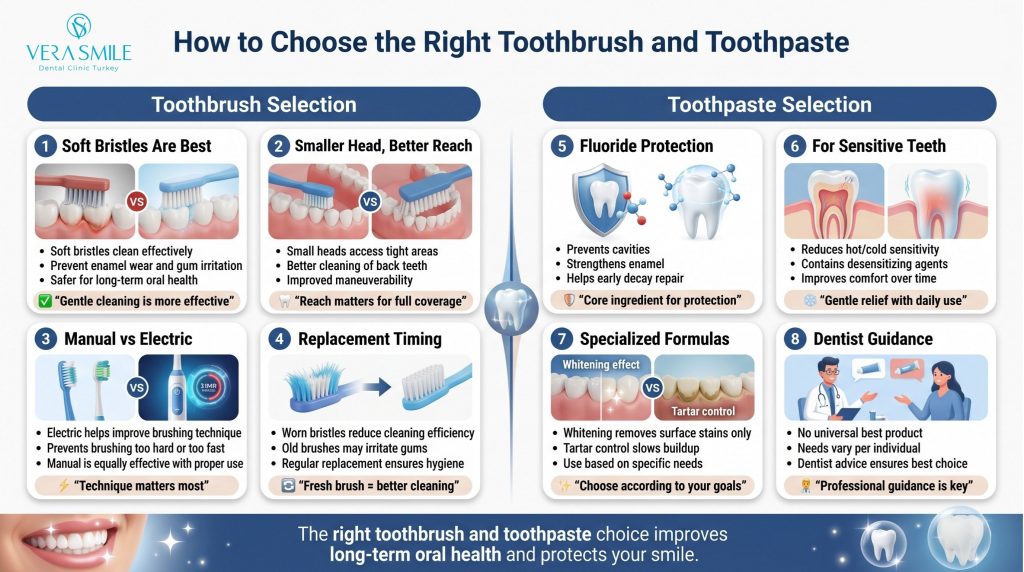
Electric toothbrushes have an edge for people who tend to brush too hard or too quickly. Many models include pressure sensors and built-in timers, which can help develop better brushing habits. Studies suggest that oscillating-rotating electric toothbrushes may remove slightly more plaque than manual brushing, though a manual toothbrush used correctly is equally effective for most people.
Regardless of which type you choose, replace your toothbrush or brush head every three to four months, or sooner if the bristles appear frayed. Worn bristles are significantly less effective at cleaning and may irritate the gums.
How to Choose the Best Toothpaste for You
Fluoride toothpaste is the gold standard for cavity prevention. Fluoride strengthens enamel and helps reverse the earliest stages of tooth decay, making it a key ingredient in any toothpaste intended for general use. Most dental associations worldwide recommend fluoride toothpaste for adults and children over two years of age.
Beyond fluoride, the right toothpaste depends on your individual needs. If you experience sensitivity to hot or cold foods, a sensitivity-focused toothpaste with potassium nitrate or stannous fluoride can help desensitize nerve endings over time. If tartar buildup is a concern, a tartar-control formula may slow its accumulation, though it cannot remove existing deposits.
What Are the Most Common Tooth Brushing Mistakes?
Even people who brush consistently can unknowingly undermine their efforts with common habits that reduce effectiveness or cause damage. Here are the mistakes to watch for:
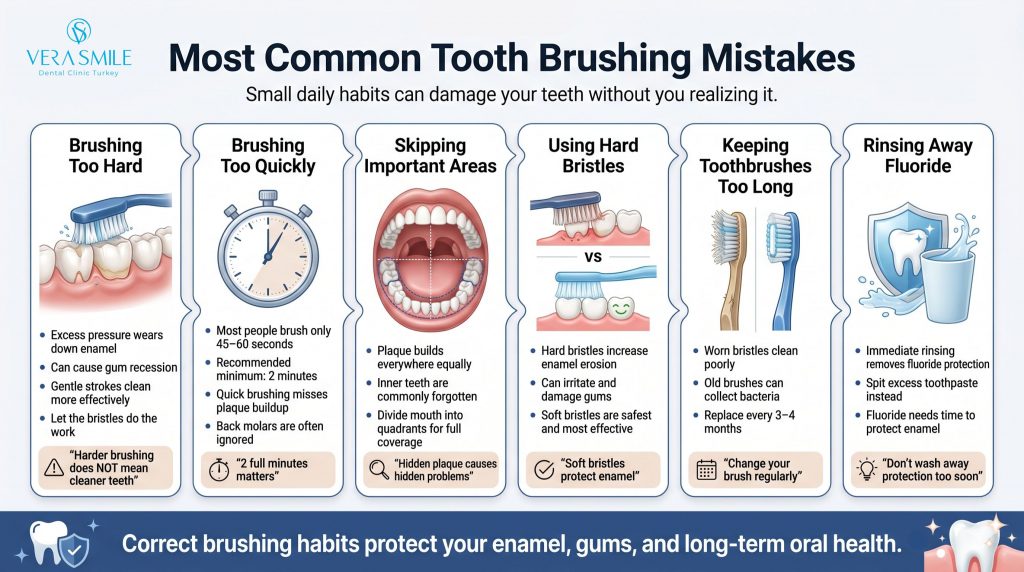
- Brushing too hard: Applying excessive pressure does not clean teeth better; it wears down enamel and pushes gum tissue away from the tooth surface over time. Let the bristles do the work with light, controlled strokes.
- Brushing too quickly: Two minutes is the minimum recommended time, yet most people brush for only 45 to 60 seconds. Rushing means certain areas, especially the backs of the molars, are routinely missed.
- Skipping hard-to-reach areas: The inner surfaces of the lower front teeth and the very back molars are frequently overlooked. Plaque in these areas builds up just as quickly, so consciously working through each quadrant of the mouth helps ensure complete coverage.
- Using the wrong toothbrush: A toothbrush with hard or medium bristles may feel like it is cleaning more thoroughly, but it increases the risk of enamel erosion and gum recession. Always choose soft bristles.
- Not replacing the toothbrush regularly: Bristles lose their effectiveness as they wear down and fray. An old toothbrush cleans less efficiently and can harbor bacteria. Replacing it every three to four months is a simple habit with a real impact.
- Rinsing immediately after brushing: Rinsing your mouth with water right after brushing washes away the concentrated fluoride that toothpaste leaves on your teeth. Spitting out excess toothpaste without rinsing, or using only a small sip of water, allows fluoride to continue protecting your enamel for longer.
Addressing even one or two of these habits can meaningfully improve your both oral and dental hygiene outcomes.
Is Brushing Teeth Different for Different Age Groups?
Oral care needs shift across life stages, and brushing routines should reflect those changes.
For adults, the standard twice-daily routine with a soft-bristled brush and fluoride toothpaste covers the basics. Stress, diet, medications, and lifestyle factors such as smoking can all affect oral health, so adult brushing should be part of a broader approach that includes regular dental checkups and awareness of any changes in the mouth.
For children, a pea-sized amount of fluoride toothpaste is appropriate from ages three to six, and a smear is recommended for younger toddlers. Making brushing a consistent, positive routine early on establishes habits that last a lifetime.
Seniors face a unique set of oral health challenges. Gum recession, dry mouth from medications, and reduced dexterity can all make thorough brushing more difficult. Electric toothbrushes with ergonomic handles can be especially helpful for older adults who find gripping a manual brush painful or tiring.
How Should You Brush Teeth With Dental Work or Oral Conditions?
Dental work such as braces, veneers, implants, root canals, and tooth fillings each come with slightly different considerations. Braces create numerous small spaces where food and plaque accumulate around brackets and wires, requiring more careful brushing from multiple angles; an orthodontic or interproximal brush can help reach these areas. Veneers and crowns should be brushed gently with non-abrasive toothpaste to preserve their surface. Dental implants do not decay, but the surrounding gum tissue is still vulnerable to inflammation, so brushing carefully around the implant base is essential. Teeth that have undergone root canal treatment or have existing fillings should be brushed normally, though your dentist should be informed if you notice any sensitivity or changes around a restoration.
People with sensitive teeth or gum disease need to approach brushing with extra care. Sensitive teeth benefit from a soft-bristled brush, gentle pressure, and a desensitizing toothpaste used consistently over time. For those managing gum disease, thorough brushing along the gumline becomes even more important; your dentist or periodontist may recommend a specific brushing frequency or technique as part of a broader gum disease treatment plan.
Should You Floss or Use Mouthwash Before or After Brushing?
The order of your oral care routine can influence its effectiveness. Most dental professionals suggest flossing before brushing rather than after. Flossing first loosens food particles and plaque from between the teeth and along the gumline, which brushing can then sweep away. It also allows fluoride from your toothpaste to reach the spaces between teeth more effectively.
Mouthwash timing depends on the type you use. Fluoride mouthwash is generally most effective when used at a separate time from brushing, such as after a meal when you are not going to brush, since using it immediately after brushing may rinse away the fluoride from your toothpaste. Antibacterial mouthwashes, on the other hand, can be used after brushing and flossing to help reduce bacteria that remain after mechanical cleaning.
Mouthwash is a helpful supplement, not a replacement for brushing or flossing. It reaches areas that are difficult to clean mechanically, but it cannot remove plaque physically the way a toothbrush and floss can.
FAQ
Yes, brushing more than three times a day or using excessive force can cause enamel erosion and gum recession over time. Twice a day with proper technique is ideal for most people. If you feel compelled to brush more frequently, consider speaking with your dentist to rule out underlying sensitivities or anxieties around oral hygiene.
Wetting your toothbrush before applying toothpaste is largely a matter of personal preference. A slightly damp brush can make the toothpaste spread more easily, but it does not significantly affect cleaning performance. Avoid soaking the brush, as excess water can dilute the toothpaste and reduce the concentration of fluoride.
Whitening toothpastes are generally safe when used as directed, but they contain abrasive agents that, if overused, can gradually wear down enamel, particularly in people with sensitive teeth. Using a whitening toothpaste a few times per week rather than exclusively, and pairing it with a fluoride toothpaste for daily use, can reduce the risk of sensitivity or surface damage.
Some bleeding when you first begin a consistent brushing routine is common and usually resolves within a week or two as gum inflammation reduces. However, persistent bleeding despite regular brushing and flossing can be a sign of gum disease and warrants a visit to your dentist. Avoid brushing harder in response to bleeding; gentle, thorough brushing is the appropriate response.
If your teeth feel rough or unclean after brushing, the most likely explanation is that plaque or tartar has built up in areas your toothbrush is not reaching effectively. Reviewing your technique, spending more time on the back teeth and inner surfaces, and adding daily flossing can make a noticeable difference. If the feeling persists, a professional teeth cleaning can remove hardened deposits that brushing alone cannot address.