
Natural teeth whitening is one of the most searched topics in dentistry, yet most advice online mixes evidence-based methods with remedies that either do nothing or actively damage enamel. Baking soda, oil pulling, activated charcoal, strawberries, coconut oil, banana peels, turmeric, and dozens of other DIY techniques are all promoted as whitening solutions, but they do not produce the same results, work through the same mechanisms, or carry the same risks. Some can help remove surface stains, some improve oral hygiene without changing tooth colour, and others create the illusion of whitening while gradually eroding enamel. Understanding which category each method belongs to is the difference between making teeth look brighter and making them weaker. While natural remedies can improve surface brightness within limits, they cannot deliver the same shade change as professional teeth whitening treatments. Results of several studies examines what each natural method can realistically achieve, where its limitations begin, and which popular whitening claims are supported by science.
What Is Natural Teeth Whitening?
Natural teeth whitening refers to approaches that do not use synthetic peroxide-based bleaching agents (hydrogen peroxide or carbamide peroxide). The category includes abrasive polishing (baking soda, charcoal), antimicrobial oral hygiene (oil pulling, coconut oil), enzymatic or acid-based claims (strawberries, malic acid), and nutrient-based claims (banana peel, turmeric).
Some natural whitening products also include nano-hydroxyapatite (n-HAp) and CPP-ACP (casein phosphopeptide-amorphous calcium phosphate), mineral-based compounds that remineralise enamel and can improve tooth brightness without peroxide.
What Is the Difference Between Intrinsic and Extrinsic Stains in Natural Teeth Whitening?
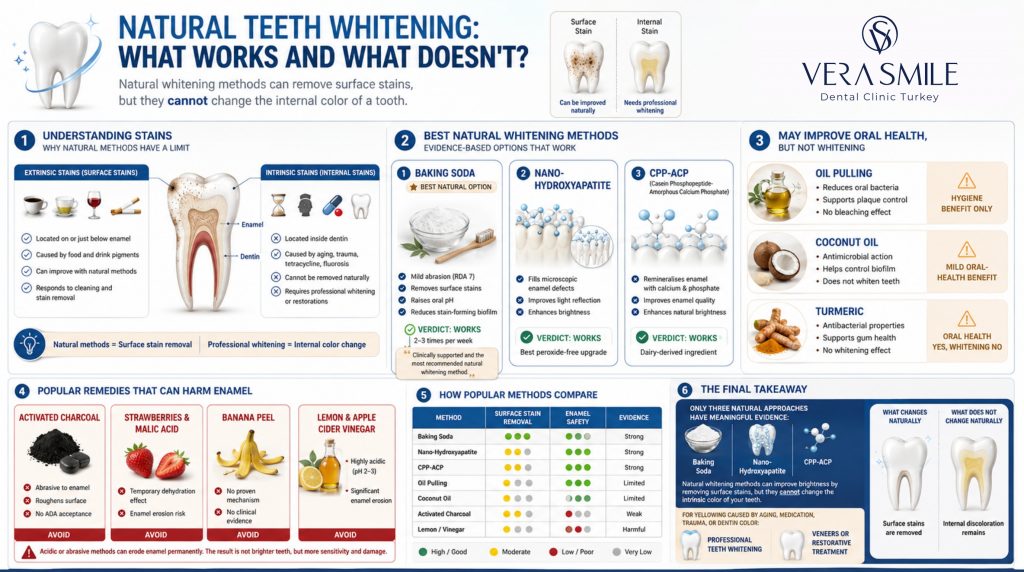
Every natural whitening method is limited to extrinsic stains, which are surface discolorations caused by coffee, tea, wine, tobacco, and food pigments that sit on or just below the enamel surface. No natural method alters intrinsic tooth shade, which is the colour of the dentin visible through the enamel. Intrinsic whitening requires peroxide to penetrate enamel and oxidise chromogen molecules inside the tooth structure.
This is the ceiling on natural whitening. If teeth are naturally yellow, grey, or stained from tetracycline or fluorosis, no natural remedy will change that. Natural methods can remove surface deposits and slow future staining, but they cannot bleach the tooth from the inside.
What Is the Best Method for Natural Teeth Whitening?
The best method for natural teeth whitening is baking soda. It is also the go-to recommendation from the cosmetic dentists at Vera Smile.
“if you want one thing you can do at home tonight that actually has evidence behind it, it’s baking soda. Two to three times a week, not every day. What makes it work is not just the mild abrasion, it’s the alkalinity. Baking soda raises the pH in your mouth and makes it much harder for the stain-forming biofilm to stick. That said, it removes surface staining. If the yellow comes from inside the tooth, from your dentin, baking soda cannot touch that. That is what professional whitening is for.“
Dt. Mumin Manassra, Vera Smile
The comparison below summarises every common method, its mechanism, and a clear verdict.
| Method | Mechanism / What It Does | Verdict |
|---|---|---|
| Baking soda | Mild abrasion (RDA 7) removes extrinsic stains; alkaline pH disrupts stain biofilm | ✓ Works. Safest natural abrasive. 2 to 3x/week max. |
| Oil pulling | Lauric acid reduces oral bacteria; stimulates saliva; reduces plaque staining | ✓ Oral hygiene benefit. Not a bleach. Useful adjunct. |
| Nano-hydroxyapatite | Integrates into enamel surface; fills micro-cracks; improves light reflection | ✓ Best peroxide-free upgrade. Works. Safe for all. |
| CPP-ACP | Remineralises enamel via calcium/phosphate delivery; improves surface quality | ✓ Works for enamel health and brightness. Dairy-derived. |
| Coconut oil | Antimicrobial; lauric acid disrupts plaque biofilm | ✓ Mild hygiene benefit. No bleaching. |
| Hydrogen peroxide (3% DIY) | Genuine bleaching via free radical oxidation | ~ Mechanism works but uncontrolled. Use formulated strips instead. |
| Activated charcoal | Abrasion removes extrinsic stains; damages enamel surface | ✗ Avoid. Not ADA approved. Long-term enamel damage. |
| Strawberries / malic acid | Temporary dehydration illusion; citric acid erodes enamel | ✗ Avoid. Net harm to enamel. |
| Banana peel | No mechanism; enamel does not absorb minerals from rubbed food | ✗ No effect. No evidence. |
| Turmeric | Antibacterial benefit (curcumin); no bleaching mechanism | ~ Oral health yes. Whitening no. Stains composite. |
| Lemon / apple cider vinegar | High acid content; temporary dehydration illusion | ✗ Avoid. pH 2 to 3 causes significant enamel erosion. |
In short, only baking soda, nano-hydroxyapatite, and CPP-ACP have evidence for genuine brightness improvement, and none of them changes intrinsic shade.
What Is Baking Soda for Natural Teeth Whitening?
Sodium bicarbonate (baking soda) is the best-evidenced natural whitening agent. Its clinical record is decades long and its safety profile is well characterised. It works, within limits.
How Does Baking Soda Whiten Teeth?
Baking soda whitens through two mechanisms. First, its mild alkalinity neutralises acidic plaque biofilm on the tooth surface, disrupting the environment in which stain-forming bacteria thrive. Second, its physical structure of soft, irregular crystals acts as a gentle abrasive that scrubs away extrinsic stain deposits without the hardness to scratch enamel.
Baking soda’s hardness is approximately equal to that of dentin (Mohs 2.5) and lower than enamel (Mohs 5). This matters because abrasive damage requires the abrasive to be harder than the surface it contacts, so baking soda cannot scratch enamel. It can scratch softer cementum on exposed root surfaces, which is relevant for patients with gum recession.
What Is the RDA Score for Baking Soda?
RDA (Relative Dentin Abrasivity) measures how much a substance erodes dentinal tissue in standardised testing. The ISO safety ceiling is 250. Baking soda has an intrinsic RDA of approximately 7, the lowest of any common whitening abrasive. For comparison, many whitening toothpastes containing hydrated silica range from 70 to 150. (“Baking soda as an abrasive in toothpastes: Mechanism of action and safety and effectiveness considerations”, Journal of the American Dental Association, 2017)
The caveat is that formulated baking soda toothpastes often include hydrated silica alongside the sodium bicarbonate to improve cleaning. This raises the combined RDA to 35 to 134 in commercial products, still within safety limits, but higher than baking soda alone.
EVIDENCE RATING✓ Works. Removes extrinsic stains. Safe for enamel at normal use. Does not change intrinsic shade. Brush with baking soda paste 2 to 3 times per week maximum; daily use on exposed root surfaces is not recommended.
Does Oil Pulling Really Work for Natural Teeth Whitening?
No. Oil pulling has genuine oral health benefits but does not whiten teeth by bleaching. It is an Ayurvedic practice involving swishing vegetable oil (most commonly coconut oil) around the mouth for 10 to 20 minutes.
A 2020 systematic review found benefits for plaque and gingivitis reduction but scant proof for direct whitening. A 2024 meta-analysis in the International Journal of Dental Hygiene (Wiley, doi:10.1111/idh.12725) showed oil pulling reduced plaque and gingivitis comparably to chlorhexidine mouthwash, a meaningful finding for oral hygiene, but not for whitening.
Any perceived whitening from oil pulling is indirect: cleaner teeth with less plaque stain less quickly. It is plaque removal, not pigment oxidation.
What Is the Lauric Acid Mechanism in Oil Pulling?
Coconut oil is 45 to 50% lauric acid, a medium-chain fatty acid with documented antimicrobial properties. When swished against gum tissue and around tooth surfaces, lauric acid disrupts the lipid bilayer of bacterial cell walls, causing them to fragment. This reduces total oral bacterial load and plaque accumulation. (“The effect of oil pulling with coconut oil to improve dental hygiene and oral health: A systematic review”, BMC Oral Health, 2020)
A secondary mechanism is mechanical salivary stimulation. The sustained chewing-like motion of oil pulling for 15 to 20 minutes increases salivary flow, which is the body’s primary natural tooth-cleaning and remineralisation agent. More saliva means faster clearance of staining compounds from tooth surfaces.
EVIDENCE RATING✓ Improves oral hygiene. Does not bleach. Use as a complement to brushing, not a replacement. Spit into a bin, not a drain, because coconut oil solidifies and blocks pipes.
Does Coconut Oil Whiten Teeth Separately from Oil Pulling?
No. Applying coconut oil directly to teeth as a paste or on a toothbrush has the same mechanism and evidence base as oil pulling. The active component is still lauric acid, which reduces plaque and bacteria but does not bleach.
Coconut oil has no abrasive particles, so it removes no staining through mechanical action. Any cleaning effect comes from its antimicrobial properties disrupting the biofilm that holds stain compounds to tooth surfaces.
EVIDENCE RATING✓ Mild oral hygiene benefit. No whitening mechanism. Safe to use. Better benefit from swishing (oil pulling) than from topical application.
What Is Activated Charcoal for Natural Teeth Whitening?
Activated charcoal is porous carbon processed to have an extremely high surface area per gram. The premise for whitening is that this surface area adsorbs staining pigments, lifting them off tooth enamel. In reality, the whitening effect observed in users comes almost entirely from abrasion, not adsorption.
Why Does Charcoal Appear to Whiten Teeth?
Activated charcoal is considerably harder and more abrasive than baking soda. It removes extrinsic stains effectively, but at the cost of enamel surface roughness. A 2024 in vitro study using scanning electron microscopy showed that enamel samples brushed with activated charcoal toothpaste exhibited significantly increased surface roughness compared to controls. A rougher enamel surface paradoxically stains more easily over time and reflects light less uniformly, making teeth appear more yellow in the medium term. (In Vitro Evaluation of Tooth Enamel Abrasion and Roughness Using Toothpaste with and Without Activated Charcoal: An SEM Analysis, PubMed PMC12563918)
The ADA has not granted its Seal of Acceptance to any charcoal-based dental product. No charcoal whitening product meets the ADA’s standards for safety and effectiveness, and its official position is that charcoal toothpaste may be too abrasive for regular use.
EVIDENCE RATING✗ Do not use. Short-term stain removal at the cost of enamel microstructure damage. The ADA does not endorse any charcoal dental product. After regular charcoal toothpaste use, ask a dentist to check enamel surface integrity.
What Are Strawberries and Malic Acid for Teeth Whitening?
The strawberry whitening claim rests on malic acid, a naturally occurring organic acid that some sources describe as a gentle bleaching agent. This claim is misleading on two fronts.
First, malic acid is not a bleaching agent in the chemical sense. It does not oxidise chromogen molecules inside enamel. Any apparent whitening comes purely from temporary surface acidity, which dehydrates the outermost enamel layer and makes teeth appear momentarily lighter, the same dehydration illusion seen after some professional treatments.
Second, and more important, strawberries also contain citric acid, which causes enamel dissolution. A strawberry-baking soda mixture reduced enamel surface hardness by up to 10% in direct measurement. (Archives of Oral Biology, cited in multiple systematic reviews on natural whitening methods)
A 2023 in vitro head-to-head study in PMC compared multiple natural methods against professional peroxide whitening on extracted teeth. (In vitro comparison of natural tooth-whitening remedies and professional tooth-whitening systems, PMC10024105) Natural methods including strawberry paste produced minimal colour change, while professional bleaching produced significantly greater and lasting whitening.
EVIDENCE RATING✗ Avoid. Temporary dehydration illusion, not whitening. Citric acid erodes enamel. The perceived result lasts hours, while the enamel microstructure damage accumulates.
What Is Banana Peel Whitening for Teeth?
Banana peel whitening involves rubbing the inside of a banana peel on teeth for 2 minutes daily, with the claim that potassium, magnesium, and manganese in the peel remineralise and whiten enamel. None of this is how enamel works, even though the method draws roughly 250 searches a month.
Tooth enamel is a dense, highly mineralised crystalline structure (96% hydroxyapatite by weight). It does not absorb minerals from food rubbed against its outer surface. Nutrient absorption from topical food contact is not a mechanism that exists in enamel biology, because the crystals are tightly packed and do not function as an uptake surface for dietary minerals.
A 2022 study in the Brazilian Dental Journal compared banana peel, activated charcoal, and turmeric for whitening efficacy on bovine teeth, and none produced measurable whitening. (Popular natural products used to whiten teeth lack whitening efficacy, Brazilian Dental Journal, 2022)
EVIDENCE RATING✗ No effect. No mechanism, no clinical evidence. It causes no harm either. It is just not useful.
What Is Turmeric for Teeth Whitening?
Turmeric (Curcuma longa) does not whiten teeth, despite being a popular DIY recipe. Curcumin, its active compound, has well-documented antibacterial and anti-inflammatory properties. Applied to the oral mucosa, it reduces gingival inflammation and may inhibit Streptococcus mutans, a primary cariogenic bacterium, which makes it a useful oral health and dental hygiene adjunct.
For whitening specifically, no clinical study has demonstrated that turmeric whitens teeth. The 2022 Brazilian Dental Journal study cited above found no measurable whitening from turmeric on bovine teeth. The perceived effect reported anecdotally is likely from the abrasive carrier (usually baking soda in DIY recipes) rather than the curcumin itself.
The real risk is that curcumin stains deeply. Used as a paste without thorough rinsing, it will permanently stain composite resin restorations and any porous ceramic. It will not stain intact enamel permanently because enamel is non-porous, but staining composite bonding with turmeric is irreversible without replacing the restoration.
EVIDENCE RATING~ Oral health yes, whitening no. Anti-inflammatory and antibacterial benefits are real. Whitening benefit is not demonstrated. Avoid if you have composite resin fillings or bonding in visible areas.
Is DIY Hydrogen Peroxide a Natural Teeth Whitening Method?
No. Drugstore hydrogen peroxide (3%) is sometimes listed in natural whitening guides, but it is a manufactured compound, not a natural substance. It does, however, whiten teeth through a genuine bleaching mechanism: free radical oxidation of chromogen molecules in enamel and dentin.
At 3%, the whitening effect is slow and modest. The side effect profile includes gum irritation and tooth sensitivity, particularly if used undiluted. The ADA recommends against unsupervised use of hydrogen peroxide directly from drugstore bottles for whitening, because the concentration and contact time are uncontrolled compared to formulated whitening products.
For peroxide-based whitening without professional supervision, a formulated 6 to 10% hydrogen peroxide whitening strip is a safer and more effective route than DIY drugstore peroxide.
What Actually Works Without Peroxide?
Three ingredients with strong evidence get almost no attention in natural whitening discussions because they are not traditional remedies, they are modern dental science applied without peroxide. The list below covers each one.
- Nano-hydroxyapatite (n-HAp): A synthetic form of the mineral that makes up 96% of enamel, with 20 to 80 nanometre particles that fill micro-cracks and surface irregularities to produce measurable optical brightness without bleaching, reduce sensitivity, and remain safe for pregnancy, children, and patients with active gum disease.
- CPP-ACP (casein phosphopeptide-amorphous calcium phosphate): Derived from milk casein, it delivers bioavailable calcium and phosphate to drive enamel remineralisation, improves surface optical quality, and reduces sensitivity, though it is unsuitable for patients with dairy or milk protein allergies.
- Xylitol: A five-carbon sugar alcohol that Streptococcus mutans cannot ferment, so consistent use starves the primary acid-producing bacteria and reduces the acidic environment in which enamel demineralises and staining biofilm forms, preventing future staining rather than whitening directly.
None of these three bleaches the tooth, but each keeps enamel healthier and brighter than peroxide-free traditional remedies do.
How Long Does It Take to Whiten Teeth Naturally?
Noticeable surface stain reduction takes 2 to 4 weeks with baking soda toothpaste used 2 to 3 times per week. Nano-hydroxyapatite produces surface brightness improvements over 4 to 8 weeks of daily use. Neither produces the dramatic shade change achievable in days with professional peroxide whitening, because natural methods are maintenance, not transformation.
The timeline depends on the type and depth of staining, how consistently the method is used, and dietary habits such as coffee, tea, red wine, and tobacco that re-deposit stain. Surface stains from recent dietary intake clear fastest, while years of accumulated tobacco or coffee staining take the full window or longer. Intrinsic discolouration does not respond to any of these timelines, because natural methods never reach it.
Is Natural Teeth Whitening Safe?
Natural teeth whitening is safe for most people when the method is non-abrasive or low-abrasive and acid-free. Baking soda (2 to 3 times per week), nano-hydroxyapatite, CPP-ACP, xylitol, and oil pulling are safe for routine use, while charcoal and acidic methods such as strawberries, lemon, and vinegar damage enamel and should be avoided. Safety changes for specific groups, covered below.
Is Natural Teeth Whitening Safe During Pregnancy?
Yes, for specific methods. Peroxide-based whitening, including all strips, trays, and in-office treatments, is not recommended during pregnancy due to the absence of long-term human safety data on fetal exposure to hydrogen peroxide and carbamide peroxide, so only natural and mineral-based options should be used. Baking soda toothpaste is safe 2 to 3 times per week to lift surface stains and neutralise acid, provided it is kept off exposed root surfaces. Nano-hydroxyapatite toothpaste is safe for daily use and improves surface brightness, reduces sensitivity, and supports enamel health with no systemic absorption. Xylitol gum or pastilles are safe throughout pregnancy and reduce Streptococcus mutans load, which also protects the baby from early colonisation, while oil pulling reduces plaque without systemic absorption but is best avoided in the first trimester if nausea makes sustained swishing uncomfortable.
Charcoal whitening (enamel risk), strawberry or citric acid methods (enamel erosion), and any peroxide-based product regardless of concentration should be avoided throughout pregnancy.
Is Natural Teeth Whitening Safe for Kids?
Yes, with the right products. Peroxide whitening is not recommended for children under 16 because the dental pulp chamber is proportionally larger, so peroxide reaches living pulp tissue faster and at higher relative concentrations. For children, natural methods are the only appropriate options, and whitening in this context means managing surface staining, not shade change. Children’s baking soda toothpaste is safe from age 2 and up with mild abrasion and no systemic concern, and xylitol-containing gum, toothpaste, and lollipops reduce Streptococcus mutans colonisation, which is critical in children because early colonisation sets the stage for lifelong decay risk. Nano-hydroxyapatite toothpaste is safe for children and outperforms fluoride-only options for remineralisation in some recent studies.
Regular professional cleaning resolves most visible discolouration without any whitening product, since most yellow in children’s teeth is plaque staining or the natural yellow tone of newly erupted permanent teeth.
What Are the Alternatives to Natural Teeth Whitening?
The alternatives to natural teeth whitening are professional in-office whitening, veneers, and composite bonding. Natural methods manage surface staining only and cannot change the natural shade of dentin, remove intrinsic staining from tetracycline, fluorosis, or trauma, whiten naturally grey teeth, or produce the 2 to 8 shade change achievable with professional bleaching. When surface stain removal does not reach the target shade, one of the following options is required.
- In-office whitening: Professional teeth whitening uses controlled-concentration peroxide to oxidise chromogens inside the tooth and achieve a 2 to 8 shade change that no natural method can reach.
- Veneers: Thin porcelain or composite veneers cover the front surface of teeth to correct shade, shape, and intrinsic discolouration that bleaching cannot lift, such as tetracycline staining.
- Composite bonding: Composite bonding applies tooth-coloured resin directly to the tooth to mask discolouration and reshape teeth in a single visit without removing healthy enamel.
The right alternative depends on whether the discolouration is on the surface or inside the tooth, and whether the goal is shade change alone or correction of shape and contour as well.
Why Vera Smile for Teeth Whitening?
Natural whitening methods are a solid foundation for oral hygiene and surface stain management, and for patients in Turkey who want intrinsic shade change of 2 to 8 shades lighter, Vera Smile‘s professional whitening delivers what natural methods cannot.
Vera Smile’s teeth whitening in Turkey protocol in Istanbul begins with a sensitivity assessment and a two-week desensitising programme before treatment. All sessions use a liquid dam to protect gum tissue, and post-session nano-hydroxyapatite is applied to begin immediate remineralisation. International patients receive a written aftercare and remote follow-up plan before leaving Turkey, so results are monitored after the treatment journey ends. For patients where whitening is not appropriate (intrinsic staining, tetracycline, heavy discolouration), porcelain veneers and composite bonding achieve the shade correction whitening cannot.
FAQ
Both remove extrinsic stains through abrasion, but baking soda is far safer. Baking soda has an RDA of 7, within safe limits and below enamel hardness, while activated charcoal has significantly higher abrasivity and increases enamel surface roughness in SEM studies. The ADA does not endorse charcoal products, whereas baking soda dentifrices fall within ADA-accepted safety parameters.
No, and both cause enamel erosion. Lemon juice has a pH of approximately 2.0 to 2.5 and apple cider vinegar is pH 2.5 to 3.0, while enamel begins to dissolve below pH 5.5. Any apparent whitening is a temporary dehydration effect, and the acid damage to enamel is cumulative and permanent, so both should be kept off tooth surfaces.
Yes, and it is recommended for maintenance. After professional whitening, baking soda 2 to 3 times per week and daily nano-hydroxyapatite toothpaste help control new extrinsic staining and extend results. These methods do not interfere with the treated shade and support enamel health between or after sessions.
No, standard fluoride toothpaste does not bleach teeth. Fluoride strengthens enamel and helps prevent decay, and any brightness comes from routine removal of surface plaque, not from a whitening mechanism. For peroxide-free brightness, a nano-hydroxyapatite or low-RDA whitening toothpaste is the more relevant choice.