
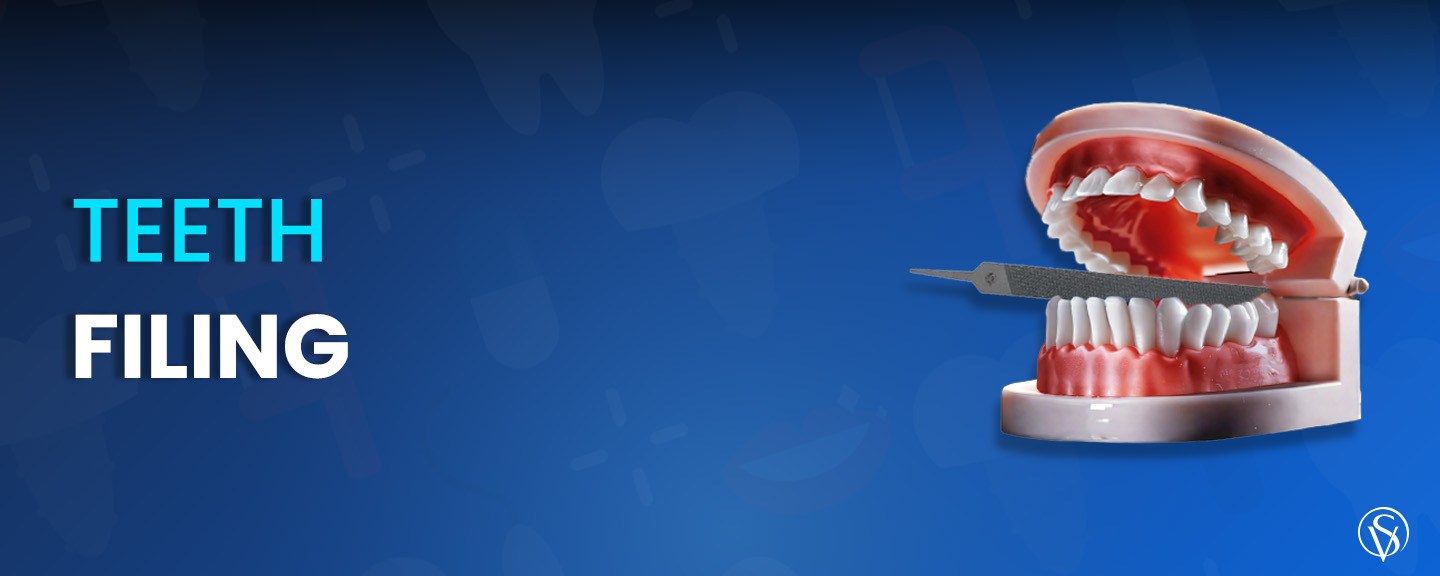
Teeth filing, known as enameloplasty or tooth contouring, is a cosmetic dental procedure where a dentist gently reshapes the outer surface of a tooth. It is usually done to smooth rough edges, reduce minor overlaps, or make teeth look more even. The procedure involves removing very small amounts of enamel, less than a millimeter.
Teeth filing is considered safe only in specific cases. It is suitable when teeth are healthy, enamel thickness is sufficient, and the correction needed is minimal. Dentists commonly use it for slightly uneven tooth edges, small chips, or minor length differences. The procedure is quick, painless, and completed in a single visit without anesthesia.
However, teeth filing is not reversible, and this is where safety concerns arise. Enamel does not grow back. If too much enamel is removed, it can lead to tooth sensitivity, increased risk of cavities, or long-term structural weakness. Problems usually occur when filing is done aggressively, repeatedly, or without proper diagnosis.
In responsible practice, dentists assess enamel thickness, bite alignment, and tooth health before recommending teeth filing. When performed conservatively and for the right reasons, teeth filing is safe. When used as a shortcut for major cosmetic changes, it can cause permanent damage. The key factor is case selection, not the procedure itself.
What Is Teeth Filing and Why Do Dentists Do It?
Teeth filing is a conservative cosmetic dental procedure used to slightly reshape the outer surface of a tooth. Dentists remove very small amounts of enamel to smooth sharp edges, correct minor unevenness, or improve symmetry. It is commonly used for small chips, uneven tooth lengths, or rough enamel edges that catch on the tongue or lips. The goal is refinement, not transformation.
The terms teeth filing and teeth shaving are used interchangeably online, but they do not mean the same thing clinically. Teeth filing refers to minimal, controlled enamel adjustment performed for subtle corrections. Teeth shaving is a non-clinical term that suggests excessive enamel removal, which is not a standard or safe dental practice. Ethical dentists avoid aggressive enamel reduction and only remove what is necessary to achieve a small, functional improvement.
Dentists recommend teeth filing when it solves a problem without invasive treatment. It is chosen instead of veneers or orthodontics for very minor issues, but only when enamel thickness and bite alignment allow it. When used correctly, teeth filing is a precise, low-risk procedure, not a shortcut for major cosmetic changes.
How Much Enamel Is Removed During Teeth Filing?
Teeth filing involves removing a very small amount of enamel, but the exact amount matters. Human enamel thickness varies by tooth and location. On average, enamel is 2–2.5 mm thick on biting edges, around 1–1.5 mm on the front surface, and much thinner near the gum line. This natural variation is why filing is only appropriate in carefully selected cases.
In safe teeth filing procedures, dentists remove 0.2 to 0.5 mm of enamel, and less. This amount is enough to smooth edges or correct slight irregularities without exposing the underlying dentin. Removing more than this increases the risk of sensitivity and structural compromise.
Responsible dentists assess enamel thickness, tooth shape, and bite alignment before filing. They avoid repeated filing over time. Teeth filing is safe only when enamel removal stays within strict limits and is done once, not as a routine cosmetic fix.
What Happens If Too Much Enamel Is Removed?
Removing too much enamel causes permanent structural weakening of the tooth. Enamel is the hardest tissue in the human body, but once it is reduced beyond safe limits, the tooth loses its natural protection. This makes the tooth more vulnerable to cracks, chipping, and accelerated wear, under normal chewing forces.
Another common consequence is tooth sensitivity. When enamel becomes too thin, temperature changes and acidic foods reach the underlying dentin more easily, causing sharp discomfort. Over time, excessive enamel loss increases the risk of cavities, staining, and bite imbalance, since the tooth no longer distributes pressure evenly. These risks are long term and irreversible, which is why dentists limit teeth filing to very minor adjustments and avoid repeated or aggressive enamel reduction.
How Do Dentists Decide How Much Tooth Can Be Filed Safely?
Dentists determine safe enamel removal through clinical measurement and structured planning, not visual estimation. The decision is guided by the factors below.
- Enamel Measurement: Dentists assess enamel thickness and tooth anatomy using clinical examination, magnification, and imaging such as X-rays or intraoral scans. Areas with naturally thinner enamel, near the gum line, are carefully protected.
- Tooth Condition Assessment: Existing wear, cracks, fillings, or restorations reduce how much enamel can be safely filed. Teeth that already show signs of erosion or damage are usually excluded from filing altogether.
- Digital Planning: When teeth filing is part of orthodontic treatment, it is planned digitally as interproximal reduction (IPR). Systems used in aligner treatments calculate exact reduction amounts per tooth, limited to 0.2–0.3 mm, ensuring enamel stays within safe biological limits.
- Bite Force Analysis: Dentists evaluate bite pressure and contact points before filing. Teeth that absorb heavy chewing forces require more enamel protection, even if they appear suitable cosmetically.
These steps ensure teeth filing is performed conservatively and only when it supports long-term dental health.
Can Teeth Filing Make Teeth Weaker Years Later?
Yes, teeth filing can make teeth weaker years later if too much enamel is removed or if filing is performed more than once. Enamel is permanent and does not regenerate, so every reduction slightly lowers the tooth’s natural defense against pressure, acids, and temperature changes. While a single, conservative filing may not cause immediate problems, cumulative enamel loss over time can thin the protective layer enough to increase the risk of sensitivity, faster wear, cracking, and long-term structural weakness. This is why responsible dentists limit teeth filing to minimal, one-time adjustments and avoid repeating the procedure unless it is clinically necessary.
How Many Times Can Teeth Be Safely Filed in a Lifetime?
Teeth cannot be safely filed an unlimited number of times. Teeth filing is not a repeatable cosmetic procedure because each session permanently removes enamel, and enamel does not regenerate. Even when small amounts are taken off, the loss adds up over time.
From a conservative dentistry perspective, teeth filing is recommended once, or very rarely twice, and only when the initial adjustment is minimal. Repeated filing increases the risk of thinning enamel to the point where the tooth becomes sensitive, weak, or prone to damage. This is why ethical dentists avoid using filing as a routine solution and reserve it for specific, low-risk cases where the long-term impact on tooth structure remains minimal.
Can Teeth Filing Cause Sensitivity Months Later?
Yes, teeth filing can cause sensitivity months later, even if the teeth felt normal immediately after the procedure. Sensitivity does not always appear right away because enamel loss affects how teeth respond over time. Immediate sensitivity occurs when enamel is reduced close to the dentin layer and is felt soon after filing.
Delayed sensitivity develops more gradually as thinner enamel allows heat, cold, acids, and brushing forces to reach the dentin more easily. Persistent or worsening sensitivity months later can signal a problem such as excessive enamel removal or increased bite stress on the filed area, and it requires professional treatment.
Is Teeth Filing Permanent or Reversible?
Yes. Teeth filing is permanent and not reversible because enamel does not regenerate. Once enamel is removed, the body cannot replace it, regardless of age, diet, or dental care. This makes every enamel adjustment a lifelong change to the tooth.
Because enamel loss is permanent, teeth filing has long-term implications for future treatments. Teeth with reduced enamel may be more sensitive and require protective measures later, such as bonding, veneers, or crowns, especially if additional wear occurs over time. Filing limits how much enamel remains available for future cosmetic or restorative procedures. For this reason, responsible dentists approach teeth filing conservatively and only recommend it when the benefits clearly outweigh the long-term risks.
Can Teeth Filing Change My Bite or Jaw Alignment?
Yes, teeth filing can change your bite in certain situations, even when the changes seem small. While minor enamel adjustments cause only micro-changes, these can still affect how teeth meet under pressure.
Small enamel reductions can alter contact points between teeth, on biting edges. In many cases, these micro-changes are harmless. When filing is done on multiple teeth or on teeth that guide the bite, it can shift occlusion, meaning how the upper and lower teeth fit together. Changes in occlusion may lead to uneven pressure, tooth wear, or jaw discomfort over time.
This is why occlusion matters. Dentists assess bite patterns before filing to ensure that enamel removal does not interfere with chewing forces or jaw movement. Without proper bite analysis, even a minor cosmetic adjustment can create functional problems. Responsible dentists limit filing to areas that do not control bite guidance and avoid enamel reduction when there is any risk to jaw balance or long-term comfort.
Why Do Dentists Sometimes File Teeth Unevenly on Purpose?
Teeth are not meant to be perfectly symmetrical; they are meant to work in balance with the bite. Dentists sometimes file teeth unevenly on purpose to maintain bite harmony, not to create visual symmetry. Small differences in tooth shape help distribute chewing forces evenly and prevent overload on a single tooth.
Chasing perfect visual symmetry actually causes problems. If teeth are filed to look identical without considering how they meet during chewing, it disrupts function. Dentists prioritize how teeth contact and guide the jaw over how evenly they appear in a mirror. This is why slight asymmetry is preserved or even intentionally created during filing.
In conservative dentistry, function comes before appearance. Uneven filing is used to protect teeth, joints, and muscles over time, ensuring comfort and stability rather than short-term cosmetic perfection.
Is Teeth Filing Different for Front Teeth Compared to Side Teeth?
Yes, teeth filing is handled very differently for front teeth and side teeth because they serve different roles. Front teeth are mainly involved in appearance and guiding the bite, while side teeth handle chewing force and load distribution.
Filing on front teeth is aesthetic and limited to smoothing edges, correcting small chips, or adjusting length for symmetry. Because these teeth are visible, changes must be minimal and carefully planned to avoid altering how the bite is guided. Over-filing front teeth can affect speech, aesthetics, and bite direction.
Filing on side teeth is primarily functional and carries higher risk. These teeth absorb strong chewing forces, and even small enamel reductions change how pressure is distributed across the jaw. Filing side teeth without proper bite analysis increases the risk of uneven wear, sensitivity, and jaw discomfort.
For this reason, dentists are far more conservative with side teeth and only file them when there is a clear functional reason. Tooth type matters because the risk profile is different, even when the enamel removal looks small.
Who Should Never Have Teeth Filing?
Teeth filing is not suitable for certain patients because even minimal enamel removal leads to long-term damage.
- Naturally Thin Enamel: Patients with thin enamel have less protective tooth structure. Removing any additional enamel increases the risk of sensitivity and wear.
- Existing Tooth Sensitivity: Sensitivity signals already reduced enamel. Filing worsen discomfort and expose dentin further.
- Acid Erosion or Reflux Damage: Acid wear from diet or gastric reflux weakens enamel. Filing on eroded teeth accelerates breakdown and decay.
- Heavy Grinding or Clenching (Bruxism): Teeth exposed to strong bite forces rely on enamel for protection. Filing increases the risk of cracks and fractures.
- History of Repeated Cosmetic Filing: Each filing permanently removes enamel. Repeated procedures compound enamel loss and raise the risk of structural failure.
In these situations, dentists recommend non-invasive alternatives to protect long-term tooth health.
Why Do Some Dentists Refuse to File Teeth?
Some dentists refuse to file teeth because doing no harm comes before cosmetic demands. Teeth filing permanently removes enamel, and when the risks outweigh the benefits, ethical dentists choose not to proceed, even if the patient requests it. This refusal is a sign of professional responsibility, not limitation.
Dentists decline filing when they see red flags in patient requests. These include demands for repeated filing, major shape changes through enamel reduction, or filing on teeth with thin enamel, existing sensitivity, or heavy bite pressure. Requests driven by trends or social media comparisons rather than clinical need are treated cautiously.
In conservative dentistry, refusal protects the patient’s long-term oral health. Dentists who say no are prioritizing structural integrity, bite stability, and future treatment options, even when it means turning down a cosmetic procedure.
Why Filing Teeth at Home Is Extremely Dangerous
A recent TikTok trend has shown people filing their teeth at home using nail files, metal tools, or sandpaper to fix uneven edges. This practice is medically unsafe and causes permanent damage within minutes.
- No Clinical Assessment: Unlike dentists, individuals cannot evaluate enamel thickness, bite pressure, tooth anatomy, or dentin proximity. Without this information, enamel removal becomes guesswork.
- Uncontrolled Enamel Loss: At-home filing removes far more than 0.5 mm of enamel, which is well beyond safe limits. This exposes dentin and permanently weakens the tooth.
- Immediate and Long-Term Damage: Common consequences include severe sensitivity, rapid decay, cracks, and fractures. Many patients later require crowns or root canal treatment to manage damage caused by home filing.
- Irreversible Effects: Once enamel is removed, it cannot be regenerated or repaired. Any correction after damage requires restorative dentistry, not cosmetic adjustment.
If a cosmetic issue seems small enough to fix at home, it is small enough not to need filing at all. Teeth filing should only be performed by a dentist, after proper examination and with strict limits on enamel removal.
How Is Teeth Filing Different When It’s Done for Invisalign?
Teeth filing done for Invisalign is clinically different from cosmetic filing. In orthodontics, the procedure is called interproximal reduction (IPR), and it is performed to create space for tooth movement, not to change how teeth look.
With cosmetic filing, dentists adjust visible edges or surfaces to improve appearance. The amount removed is estimated clinically and kept minimal. With IPR, enamel reduction is digitally planned in advance. Invisalign software calculates exactly how much enamel is needed per tooth, limited to 0.2–0.3 mm, and specifies where it is safely removed between teeth.
This digital planning makes Invisalign-related filing more controlled and predictable. Dentists follow a predefined plan that considers tooth position, enamel thickness, and final bite alignment. The goal is function and alignment, not aesthetics.
Does Teeth Filing Affect Future Invisalign or Veneers?
Yes, teeth filing affects future Invisalign or veneer treatment, which is why treatment sequencing matters. Enamel removed today cannot be replaced later, and this limits how much adjustment is available for future cosmetic or orthodontic work.
When filing is done before Invisalign, it reduces the amount of enamel available for planned interproximal reduction (IPR), limiting how teeth move safely. When filing is done before veneers, it can thin enamel to the point where veneer bonding becomes less predictable, increasing the risk of sensitivity or weaker adhesion.
This is why dentists plan treatments in the correct order. If Invisalign or veneers are likely in the future, enamel reduction is kept to an absolute minimum or postponed entirely. Proper planning protects long-term options and prevents filing from becoming an obstacle to more comprehensive treatments later.
How Much Does Teeth Filing Cost Around the World?
Teeth filing costs vary by country due to clinical practice standards, labor costs, and whether the procedure is cosmetic or orthodontic. Below is a practical comparison, starting with Turkey.
| Country / Region | Cosmetic Teeth Filing (Private) | Notes |
| Turkey | €30 – €100 per tooth | Bundled with cosmetic dentistry or Invisalign |
| UK | €60 – €240 per tooth | NHS covers filing only when medically necessary |
| USA | €90 – €275 per tooth | Higher fees in major cities and specialist clinics |
| Western Europe | €60 – €250 per tooth | Germany, France, Netherlands at the higher end |
| Eastern Europe | €40 – €120 per tooth | Mostly private cosmetic clinics |
| Mexico | €35 – €110 per tooth | Common in dental tourism settings |
| India | €20 – €75 per tooth | Low-cost private clinics |
When teeth filing is performed as interproximal reduction (IPR) during Invisalign or aligner treatment, it is included in the total orthodontic fee and not billed separately.
The important point is that price differences matter far less than how conservatively enamel is removed and whether bite forces are properly assessed, as these determine long-term safety.
Are There Safer Alternatives to Teeth Filing?
Yes, in many situations, safer alternatives to teeth filing exist, when enamel preservation and long-term stability are priorities. These options are chosen based on how much correction is needed and the condition of the natural tooth.
- Composite Bonding: A safer option when visible shape changes are needed without removing enamel. Bonding adds material to the tooth, making it reversible and adjustable over time.
- Veneers: Used when broader cosmetic improvement is required, such as color correction or reshaping multiple teeth. Veneers are chosen when filing would be insufficient or unsafe.
- Orthodontics: The safest option for alignment, spacing, and bite issues. Teeth are moved rather than reshaped. In some cases, minimal enamel reduction is planned digitally, but correction is achieved through controlled tooth movement.
Each option carries different risks and benefits, and the safest choice depends on the clinical situation, not speed or cost alone.
When Is Composite Bonding a Safer Option?
Composite bonding is safer when visible shape changes are needed without removing enamel. By adding material rather than removing it, bonding allows dentists to close small gaps, rebuild edges, and correct minor defects. It is reversible and adjustable, making it preferable when filing would remove too much enamel.
When Are Veneers More Appropriate Than Teeth Filing?
Veneers are more appropriate when the goal involves color correction, proportion changes, or broader aesthetic improvements. They are chosen when filing or bonding alone cannot deliver a stable or natural result. Although veneers require tooth preparation, they provide predictable outcomes when planned conservatively.
When Is Orthodontic Treatment the Better Solution?
Orthodontics, including Invisalign, is the better choice when teeth need realignment or bite correction. Instead of reshaping teeth, orthodontics moves them into position. In some cases, minimal enamel reduction is planned digitally, but alignment is achieved through movement, not cosmetic alteration.
When Is Teeth Filing the Right Choice?
Teeth filing is appropriate only when the correction needed is very small. It is used to smooth rough edges, fix tiny chips, or make slight length adjustments when enamel thickness is sufficient. Because enamel removal is permanent, filing is not suitable for alignment problems, spacing issues, or noticeable shape changes.
What Do Teeth Filing Before and After Results Really Look Like?
Teeth filing before and after results are subtle, not dramatic. The most noticeable improvements are smoother edges, slightly more even tooth lengths, and small refinements to shape. Filing makes teeth look cleaner and more polished, when minor chips or rough enamel are present.
What teeth filing cannot change is just as important. It cannot significantly straighten teeth, fix major crowding, close large gaps, or change tooth color. Filing cannot correct bite problems or replace orthodontic or restorative treatment. When patients expect major cosmetic changes from filing alone, the result feels underwhelming or leads to over-filing.In responsible dentistry, successful teeth filing results are those that look natural and go largely unnoticed. The goal is refinement, not transformation, and staying within those limits protects long-term tooth health.