
After veneers are bonded, eat soft, lukewarm foods for the first 24 to 48 hours and keep hard, sticky, acidic and deeply pigmented foods off the plate while the adhesive interface and the gum margin settle. Scrambled eggs, yoghurt, soup at room temperature, mashed vegetables, soft pasta, banana and well cooked fish are all safe choices in that window. The restriction is temporary for permanently bonded ceramic veneers, and much stricter for temporary veneers, which are held with weak provisional cement for the days between preparation and final fitting.
The reasoning behind each rule matters more than the food list itself. Local anaesthetic removes the protective reflex that stops you biting your cheek or overloading a tooth, resin cement continues to reach its final strength after the appointment, and freshly trimmed gum tissue is sensitive to acid and heat. Once those three variables resolve, a normal diet returns. The habits that shorten veneer lifespan are not single meals but repeated mechanical and chemical loading over years.
Key Points
- Soft food and lukewarm drinks cover the first 24 to 48 hours, and the strict phase exists mainly because anaesthesia removes protective reflexes rather than because the bond is fragile.
- Temporary veneers need a far stricter diet than final veneers, because provisional cement is designed to release and a dislodged temporary can delay the final fitting.
- Ceramic itself does not absorb stain, but the resin cement line at the margin and any composite surface can discolour, which is why coffee, red wine and dark sauces are limited in the first days.
- Lithium disilicate resists coffee staining better than zirconia reinforced lithium silicate and translucent zirconia in laboratory testing (Elkhishen et al., 2022).
- Parafunction is the dominant long-term risk, with a 7.7 times greater failure risk recorded in patients with bruxism, and marginal discoloration significantly worse in smokers (Beier et al., 2012).
- Porcelain laminate veneers reach a 10-year cumulative survival rate of 95.5% across 6,500 restorations, so diet discipline protects an outcome that is already highly predictable (Alenezi et al., 2021).
What Can You Eat Immediately After Veneers Are Bonded?
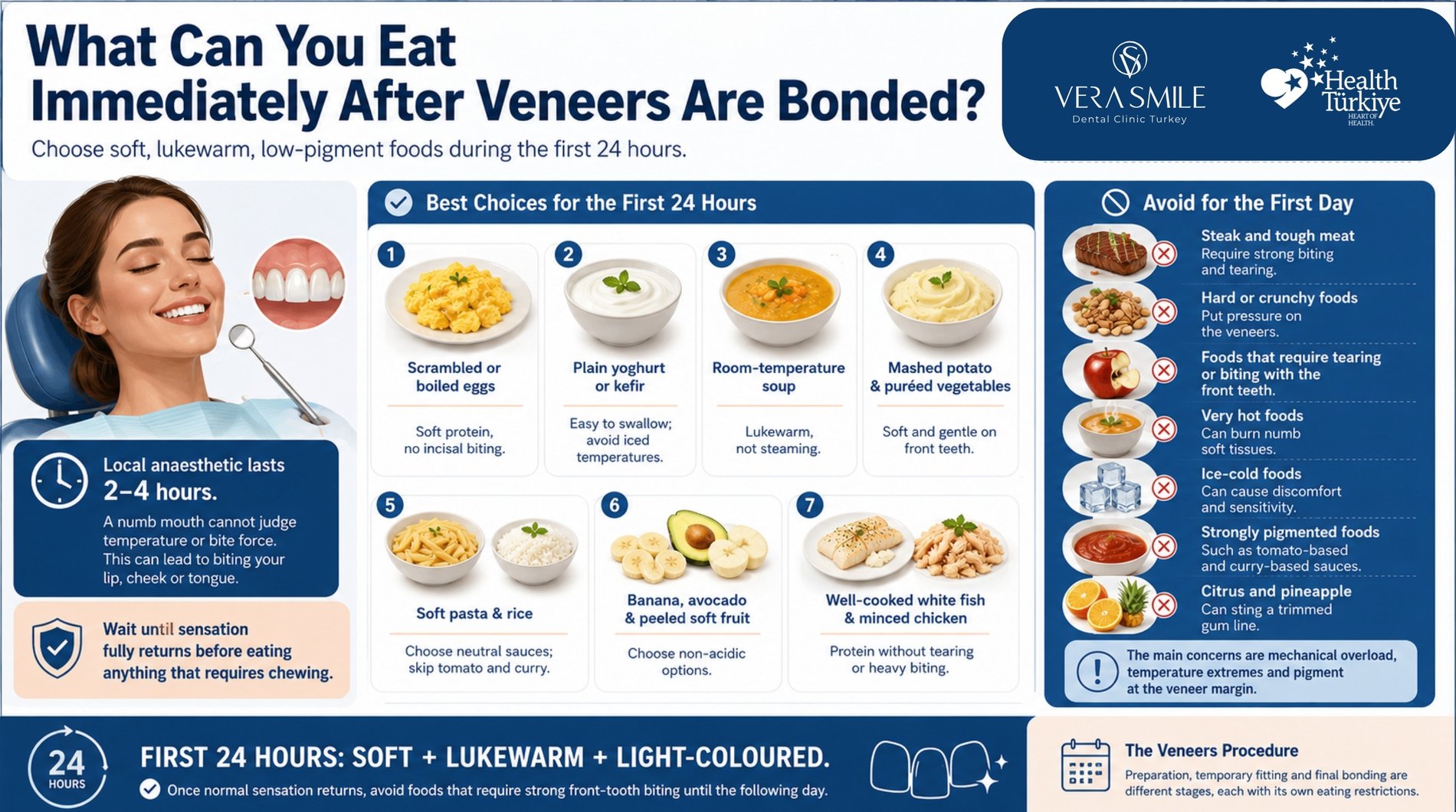
Soft, lukewarm, low-pigment food is the correct choice for the first day. The bond between enamel, resin cement and ceramic is functional the moment the light curing is finished, so the restriction is not about bond strength. It exists because local anaesthetic leaves the lip, cheek and tongue numb for 2 to 4 hours, and a numb mouth cannot judge temperature or bite force. Waiting until sensation fully returns before eating anything that needs chewing prevents soft tissue injury.
The safest options in the first 24 hours share three features, being soft texture, neutral temperature and light colour. Each of the following works well as a first meal after treatment.
- Scrambled or boiled eggs: Soft protein that needs no incisal biting and holds no strong pigment.
- Plain yoghurt and kefir: Cool but not iced, easy to swallow, and helpful if the gum margin feels tender.
- Room temperature soup: Lentil or vegetable soup served lukewarm rather than steaming avoids thermal stress on freshly treated teeth.
- Mashed potato and puréed vegetables: Full nutrition with no load on the front teeth.
- Soft pasta and rice: Neutral in colour, provided tomato-based and curry-based sauces are left for later.
- Banana, avocado and peeled soft fruit: Non-acidic, unlike citrus and pineapple, which sting a trimmed gum line.
- Well cooked white fish and minced chicken: Protein without the tearing action that steak requires.
These foods carry a patient through the first day comfortably without touching the two real risks, which are mechanical overload and pigment uptake at the margin. Anything that must be torn, cracked or bitten with the front teeth waits until the following day. Anything served very hot or straight from ice waits for the same reason. The veneers procedure runs across preparation, temporary fitting and final bonding, and each of those stages carries a different eating restriction rather than one blanket rule.
Why Does Food Temperature Matter in the First Days?
Extreme temperature matters because the tooth, the cement and the ceramic expand and contract at different rates. Coffee at 65 °C followed by iced water creates a rapid thermal swing across the adhesive interface, and thermocycling of exactly this kind is what laboratory studies use to age veneer margins artificially. In the mouth the effect of one hot drink is negligible, but freshly prepared teeth are often mildly sensitive and the discomfort is a useful signal. Lukewarm drinks for the first 48 hours remove both the sensitivity and the stress.
Clinic Note: Sensitivity to cold in the first two weeks after veneer placement is expected when preparation has stayed within enamel, and it settles without intervention. Sensitivity that sharpens after two weeks, or a bite that feels high on one tooth, is checked rather than waited out, since an unadjusted contact concentrates force on a single veneer.
Which Foods and Drinks Should You Avoid After Veneers?
Hard, sticky, acidic and strongly pigmented items are the four categories to restrict. The hard and sticky foods threaten the veneer mechanically, and the acidic and pigmented foods act on the cement line and the surrounding enamel chemically. In the first week all four are avoided, and in the long term three of the four return to normal consumption with sensible technique.
The list is short and each item has a specific mechanism behind it.
- Hard nuts, boiled sweets and ice: Point loading on a thin ceramic edge is the classic cause of chipping, and ceramic fracture accounted for 44.83% of all veneer failures in long-term follow-up (Beier et al., 2012).
- Crusty bread, apples and corn on the cob: These require an incisal tearing action that loads the exact edge where veneers are thinnest.
- Toffee, caramel and chewing gum: Sticky food pulls at the margin and can dislodge a temporary veneer outright.
- Coffee, black tea, red wine and cola: Pigment settles into the resin cement line rather than the ceramic surface, and cola adds an acid challenge at a pH near 2.7.
- Turmeric, curry, soy sauce and tomato paste: Deeply coloured sauces are the most underestimated source of early marginal staining.
- Citrus, vinegar and pickles: Acid softens exposed enamel around the veneer and irritates a recently trimmed gum margin.
- Alcohol and alcohol-based mouthwash: Alcohol can soften the resin matrix of the cement over repeated exposure and is avoided in the first week.
Nothing on this list is banned permanently except habitual ice chewing and using the front teeth as tools. Coffee, wine and curry return once the margin has fully sealed, ideally with water rinsing afterwards. A tooth stain forms when pigment penetrates a porous surface, which is why the cement line and any composite facing take up colour while glazed ceramic stays unaffected.
Do Coffee and Red Wine Actually Stain Veneers?
No. Glazed ceramic does not absorb pigment the way natural enamel does, so the veneer surface itself stays stable. What discolours is the thin band of resin cement at the margin and any composite material used for a bonded restoration. Laboratory work on ceramic laminate veneers immersed in coffee solution found that both the ceramic type and the cement type influenced colour change, with lithium disilicate proving more resistant than zirconia reinforced lithium silicate and translucent zirconia (Elkhishen et al., 2022). The types of veneers differ in exactly this property, so material choice sets the ceiling on how much stain resistance a patient can expect.
Composite veneers behave differently, because the resin surface is porous compared with glazed ceramic and takes up pigment across the whole facing. Patients treated with composite bonding need stricter lifelong pigment control than patients with porcelain.
How Does the Diet Differ Between Temporary and Permanent Veneers?
Temporary veneers demand a much stricter diet than final veneers, because the two are held in place for opposite purposes. Provisional cement is formulated to be removed easily at the next appointment, while final resin cement is designed to be permanent.
| Aspect | Temporary veneers | Permanently bonded veneers |
| Cement type | Weak provisional cement, designed to release | Light-cured or dual-cured resin cement |
| Duration of restriction | Entire wearing period, often 5 to 10 days | 24 to 48 hours for most patients |
| Hard food | Avoided completely | Normal after the first week, excluding ice and nut shells |
| Sticky food | Highest risk of dislodgement | Low risk, still limited early |
| Flossing | Slide out sideways, never snap upward | Normal technique once the margin is comfortable |
| Staining foods | Highly absorbent acrylic surface, strict avoidance | Limited for the first 3 to 4 days |
The practical conclusion is that the strictest phase of the whole treatment happens before the veneers are even final. A dislodged temporary exposes prepared enamel, causes sensitivity and can delay the fitting appointment, which matters a great deal for patients travelling on a fixed schedule.
When Can You Return to a Normal Diet After Veneers?
Most patients eat normally again after 48 hours, with full confidence in the restoration by the end of the first week. The timeline is driven by soft tissue healing and marginal sealing rather than by the cement, which reaches functional strength during the appointment itself. The phases run as follows.
- First 2 to 4 hours: Nothing solid until the anaesthetic has completely worn off, with cool water only.
- First 24 hours: Soft, lukewarm, low-pigment food, no biting with the front teeth.
- 24 to 48 hours: Softer solids reintroduced, with hard and sticky items still excluded.
- Day 3 to day 7: Normal texture returns gradually, and pigmented drinks are reintroduced with a water rinse afterwards.
- After 1 week: Unrestricted diet apart from the permanent exclusions, which are ice, nut shells, and opening packaging with the teeth.
- After 2 weeks: Residual cold sensitivity should have resolved, and a persisting symptom is reviewed rather than tolerated.
This timeline assumes preparation stayed within enamel and the gums were healthy at the start. Patients with existing gum inflammation, exposed dentine or a night grinding habit progress more slowly and need a longer soft phase. Dental veneers are planned around these variables at the assessment stage, which is why the soft phase is set per patient rather than by a fixed number of days.
How to Protect Veneers Long Term Through Diet and Habits
Long-term veneer protection comes from seven habits rather than from permanent dietary restriction, because the evidence on failure points at parafunction and technique rather than at food.
- Wear the night guard if grinding is diagnosed. Patients with bruxism carried a 7.7 times greater risk of failure over an observation period of up to 20 years, which makes splint compliance the single strongest protective factor (Beier et al., 2012).
- Cut hard food instead of biting it. Apples, carrots and crusty bread are sliced and chewed on the back teeth, keeping load away from the thinnest ceramic edge.
- Stop using the teeth as tools. Opening bottles, cutting thread and biting nails apply force in directions ceramic cannot tolerate.
- Quit smoking or expect a visible margin. Marginal discoloration was significantly worse in smokers across the same 20-year follow-up (Beier et al., 2012).
- Rinse with water after pigmented drinks. A rinse removes surface pigment before it settles into the resin cement line.
- Use a straw for cola and iced coffee. This cuts both acid and pigment contact with the front teeth in a single step.
- Keep professional cleaning to schedule. Veneers maintenance sets the recall interval and the polishing protocol used on restored surfaces, which differ from those used on natural enamel.
None of these steps removes food the patient enjoys. A longitudinal study of 323 porcelain laminate veneers found failures concentrated in bruxism patients who did not wear their occlusal splint, not in patients with a particular diet (Granell-Ruíz et al., 2014).
Tips for Patients: Keep a soft food kit ready before the appointment, containing yoghurt, eggs, soup, mashed vegetables and banana. Patients who plan meals in advance rarely break the first 48 hours by accident, and most reported early chips trace back to an unplanned meal rather than to a clinical problem.
What Should Patients Eat After Getting Veneers?
Patients treated in Turkey follow the same timeline, with two additions related to travel. Treatment is completed across a single trip of 5 to 7 days, which means the strict temporary veneer phase falls in the middle of the stay rather than at home. Hotel breakfast buffets in Istanbul make this easier than patients expect, since eggs, yoghurt, soft cheese, soup and cooked vegetables are standard. Turkish tea and Turkish coffee are the two items that need active avoidance in the first days, because both are strongly pigmented and served hot.
The second addition concerns the flight home. Final fitting, bite adjustment and polishing are completed before departure, and the last clinic visit is the moment to raise any high contact or persistent sensitivity. Cabin pressure does not affect bonded ceramic, so no dietary change is needed for the flight itself, though a soft in-flight meal is more comfortable if the fitting was the same day. Patients who choose veneers in Turkey compress preparation, temporary wear and final bonding into a single trip of 5 to 7 days, so the strict provisional phase falls entirely within the stay.
FAQ
Yes, after the first 3 to 4 days. Coffee does not stain glazed ceramic, but pigment can settle into the resin cement line while the margin is still sealing. Drinking it lukewarm rather than very hot in the first 48 hours and rinsing with water afterwards keeps the margin clean.
Yes, once the veneers are final and the first week has passed. Gum is avoided entirely with temporary veneers, because sticky traction is the most common cause of a dislodged provisional. Sugar-free gum after the healing phase carries no risk to bonded ceramic.
Yes, with a change in technique. Steak is cut into small pieces and chewed on the back teeth rather than torn with the front teeth, since incisal tearing loads the thinnest edge of the veneer. This applies permanently, not only during healing.
Yes, in the sense that alcohol can soften the resin matrix of the cement over repeated exposure. Alcohol and alcohol-based mouthwash are avoided in the first week, and alcohol-free mouthwash is the safer long-term choice for patients who rinse daily.
No. Temporary veneers are held with cement designed to release easily, so hard, sticky and chewy food is avoided for the whole wearing period. Flossing is done by sliding the floss out sideways rather than snapping it upward past the margin.
No on the ceramic surface, but yes at the margin and on composite facings. Deeply pigmented sauces are among the most common causes of early marginal discoloration and are left out of the diet for the first week. Rinsing immediately after eating them limits contact time thereafter.
Alenezi, A., Alsweed, M., Alsidrani, S., & Chrcanovic, B. R. (2021). Long-term survival and complication rates of porcelain laminate veneers in clinical studies: A systematic review. Journal of Clinical Medicine, 10(5), 1074.
Beier, U. S., Kapferer, I., Burtscher, D., & Dumfahrt, H. (2012). Clinical performance of porcelain laminate veneers for up to 20 years. International Journal of Prosthodontics, 25(1), 79-85.
Elkhishen, E. A., Al-Zordk, W., Hassouna, M., Elsherbini, A., & Sakrana, A. A. (2022). Effect of ceramic and resin cement type on color stability and translucency of ceramic laminate veneers for diastema closure: An in vitro study. Scientific Reports, 12, 22082.
Granell-Ruíz, M., Agustín-Panadero, R., Fons-Font, A., Román-Rodríguez, J. L., & Solá-Ruíz, M. F. (2014). Influence of bruxism on survival of porcelain laminate veneers. Medicina Oral, Patología Oral y Cirugía Bucal, 19(5), e426-e432.