
Dental visits are safe during pregnancy, in every trimester, and a routine check-up plus cleaning is recommended rather than postponed. Treatment of active disease is also safe, and the strongest evidence comes from a multicentre randomised trial in which 351 of 823 pregnant women received complete essential dental treatment at 13 to 21 weeks with no increase in adverse pregnancy outcomes or medical events (Michalowicz et al., 2008). Radiographs and local anaesthesia are part of that safety picture rather than exceptions to it. What does change during pregnancy is scheduling, positioning, drug selection, and which elective work is worth deferring.
The second trimester is the preferred window for planned treatment, though this is a comfort decision more than a safety one. Nausea has settled for most women, lying back for a longer appointment is still tolerable, and the appointment can be completed without interruption. Urgent problems are treated whenever they appear, because an untreated infection carries a real risk while the treatment itself carries a measured and very small one. The pattern that causes harm is avoidance, and that pattern is common in Turkey, where 68.7% of surveyed mothers reported an oral health problem during pregnancy while only 13.7% saw a dentist (Özen et al., 2012).
Key Points
- Essential dental treatment during the second trimester produced no increase in serious adverse pregnancy outcomes across 823 randomised women, which is the highest level of evidence available on this question (Michalowicz et al., 2008).
- The foetal dose from a dental radiograph is between 0.009 and 6.9 μGy without shielding and between 0.005 and 2.1 μGy with a lead apron, thousands of times under any threshold associated with harm (Kelaranta et al., 2016).
- Dental local anaesthetic showed no teratogenic signal in 210 exposed pregnancies, of which 112 (53%) were exposed during the first trimester, compared with 794 unexposed pregnancies (Hagai et al., 2015).
- Gum inflammation rises through pregnancy without a matching rise in plaque, so bleeding gums reflect a hormonal amplification of the existing plaque response rather than a sudden collapse in brushing quality (Figuero et al., 2013).
- The developing baby does not draw calcium out of the mother’s teeth, yet 73% of Turkish mothers surveyed believed it does and 43% accepted the phrase “a tooth for a baby” as fact (Özen et al., 2012).
- Adverse birth outcomes rose from 12.0% to 30.5% across increasing periodontal treatment need in 3,576 Turkish women, which makes gum health a screening priority even though treatment trials have not consistently reproduced a protective effect (Toygar et al., 2007; Michalowicz et al., 2013).
Are Dental Visits Safe During Pregnancy?
Yes. Dental examination, cleaning, and the treatment of active dental disease are safe throughout pregnancy, and every major obstetric and dental body now states this in the same terms.
The evidence is not theoretical. In the Obstetrics and Periodontal Therapy Trial, 823 women with periodontitis were randomised, and the 351 who completed essential dental treatment during the second trimester showed no excess of serious adverse pregnancy outcomes or medical events compared with those who did not (Michalowicz et al., 2008). Guidance from the American College of Obstetricians and Gynecologists (2013) states that conditions requiring immediate care, including periodontal treatment, endodontic treatment, extractions, and restoration of untreated decay, can be managed at any point in pregnancy.
The remaining hesitation is rarely clinical. It comes from the patient, from family advice, and sometimes from clinicians without recent training in obstetric care. That hesitation has a measurable cost, since decay and infection progress on their own schedule and a small procedure at 16 weeks becomes a larger one at 34 weeks.
Warning: Facial swelling, a spreading dental infection, or a dental abscess is treated as an emergency during pregnancy and is never postponed to a later trimester. Untreated odontogenic infection can lead to systemic illness, fever, and hospital admission, and the risk of leaving it far exceeds the risk of treating it.
Which Trimester Is Best for Dental Treatment?
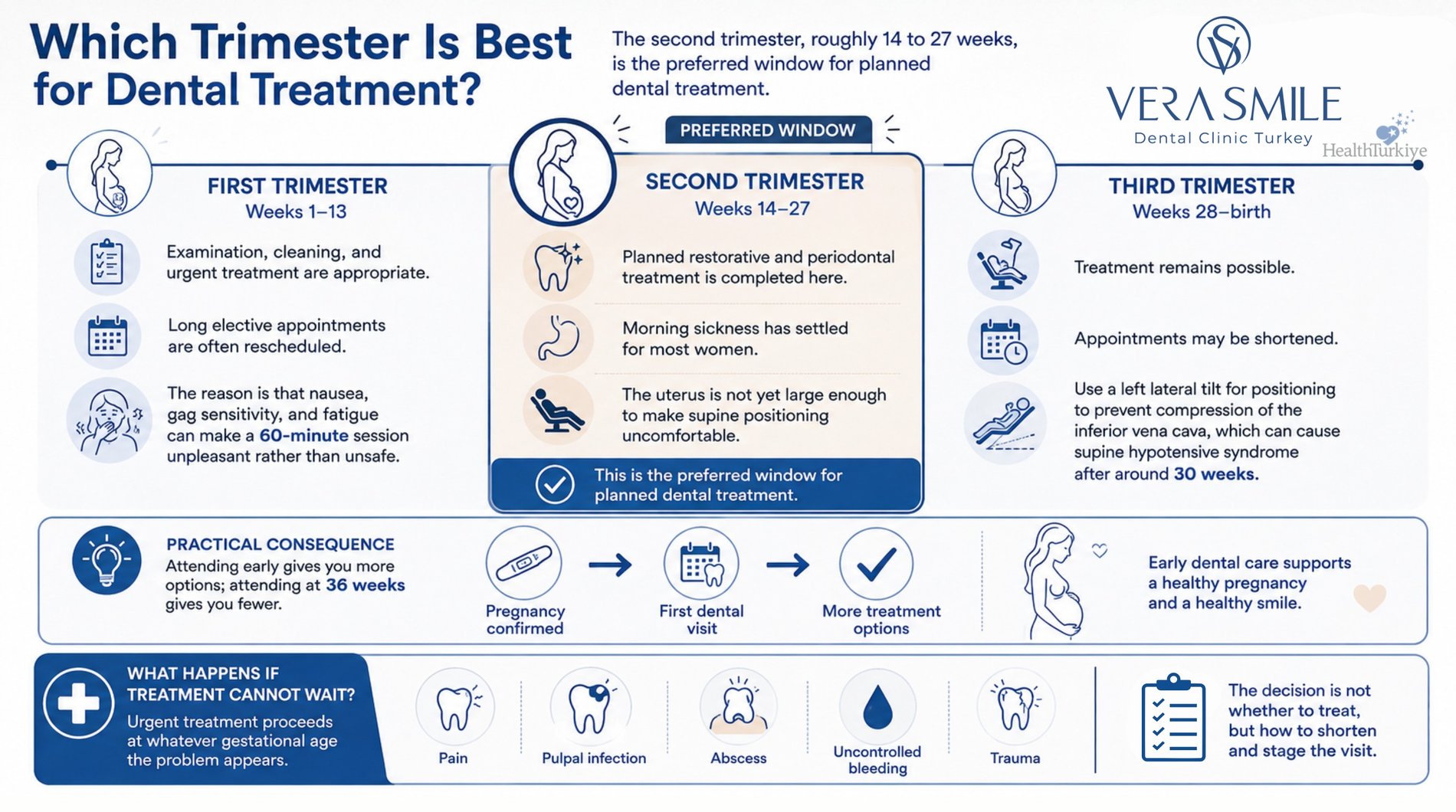
The second trimester, roughly 14 to 27 weeks, is the preferred window for planned dental treatment. The reasoning is practical rather than protective, and each trimester carries its own considerations.
- First trimester (weeks 1 to 13): Examination, cleaning, and urgent treatment are appropriate, while long elective appointments are often rescheduled because nausea, gag sensitivity, and fatigue make a 60 minute session unpleasant rather than unsafe.
- Second trimester (weeks 14 to 27): Planned restorative and periodontal treatment is completed here, since morning sickness has settled for most women and the uterus is not yet large enough to make supine positioning uncomfortable.
- Third trimester (weeks 28 to birth): Treatment remains possible, with appointments shortened and the patient positioned with a left lateral tilt to prevent compression of the inferior vena cava, which can cause supine hypotensive syndrome after around 30 weeks.
The practical consequence is that a woman who attends early has options, and a woman who attends at 36 weeks has fewer. This is the single strongest argument for a first dental visit as soon as pregnancy is confirmed, alongside the first prenatal appointment.
What Happens If Treatment Cannot Wait?
Urgent treatment proceeds at whatever gestational age the problem appears, with adjustments to appointment length and positioning rather than to the treatment itself. Pain, pulpal infection, abscess, uncontrolled bleeding, and trauma are all treated on presentation. The clinical decision is not whether to treat but how to shorten and stage the visit.
Which Dental Treatments Can Be Done During Pregnancy?
Preventive and disease-controlling treatment can all be carried out during pregnancy, and delaying any of it converts a simple problem into a complex one. The following procedures are performed routinely on pregnant patients.
- Examination and diagnosis: A full assessment with a periodontal chart and necessary radiographs establishes what needs treating now and what can be planned for after delivery.
- Professional cleaning: Teeth scaling and polishing removes the plaque and calculus that hormonal changes amplify, and it is the single most useful appointment a pregnant patient can attend.
- Fillings: Composite restorations are placed as normal, and treating a cavity at 18 weeks avoids pulpal involvement at 32 weeks.
- Root canal treatment: Root canal treatment is preferable to leaving an infected pulp in place, and it is performed with local anaesthesia and radiographic control.
- Extractions: Tooth extraction is carried out when a tooth cannot be saved, most comfortably in the second trimester.
- Periodontal treatment: Non-surgical treatment of gum disease is completed during pregnancy, and it improves bleeding, comfort, and daily cleaning ability.
None of these procedures requires special equipment or an unusual protocol. What they require is a clinician who knows the drug list, the positioning rules, and the gestational age.
Which Treatments Are Postponed Until After Delivery?
Elective and cosmetic treatment is deferred, both because it carries no urgency and because the safety data behind some of it is thin. The distinction is disease versus appearance.
- Whitening: Teeth whitening is postponed because peroxide exposure during pregnancy has not been studied adequately, and no clinical benefit justifies proceeding without that data.
- Veneers and elective crowns: Dental veneers involve irreversible preparation and multiple long appointments, and shade and soft tissue outcomes are better assessed once gingival inflammation has resolved after delivery.
- Implant surgery: Dental implants during pregnancy are deferred as elective surgery, since the site can be preserved and the procedure planned for the postpartum period.
- Elective sedation: Conscious sedation and nitrous oxide are avoided for elective work, and anxiety is managed with shorter appointments and local anaesthesia instead.
- Full mouth rehabilitation: Extensive prosthetic planning is staged after delivery, because the treatment span exceeds what a pregnancy timeline accommodates comfortably.
Postponing this work is not caution for its own sake. A cosmetic result planned around inflamed gums and a changing bite is a worse result, so the delay improves the outcome as well as the safety margin.
How Treatment Timing Works Across the Trimesters
The table sets out how each treatment category maps onto gestational age in practice.
| Treatment | First trimester | Second trimester | Third trimester |
| Examination and radiographs | Yes | Yes | Yes |
| Scaling and polishing | Yes | Preferred | Yes, shorter visits |
| Fillings | Urgent cases | Preferred | Yes, shorter visits |
| Root canal treatment | Urgent cases | Preferred | Yes, shorter visits |
| Extraction | Urgent cases | Preferred | Case by case |
| Periodontal treatment | Yes | Preferred | Yes, shorter visits |
| Whitening, veneers, implants | Postponed | Postponed | Postponed |
This table is set as a comfort and staging guide rather than a set of restrictions. Nothing in the first column is unsafe, and the word “urgent” reflects the value of avoiding a long elective appointment during peak nausea.
Are Dental X-Rays and Local Anaesthesia Safe During Pregnancy?
Yes. Both are safe, and both are among the most misunderstood parts of dental care in pregnancy. The doses and exposures involved sit orders of magnitude under anything associated with foetal harm, and this has been quantified rather than assumed.
How Much Radiation Reaches the Baby?
Foetal dose from dental imaging, including cone beam CT, ranges from 0.009 to 6.9 μGy without shielding and drops to 0.005 to 2.1 μGy with a lead apron (Kelaranta et al., 2016). Thresholds for radiation effects on the foetus are several thousand times higher, and the beam is directed at the head rather than the abdomen. Current American Dental Association guidance goes further and states that abdominal and thyroid shielding is no longer required for dental radiography, which is more recent than the “safe with shielding” phrasing still repeated elsewhere.
Which Local Anaesthetics and Medicines Are Used?
Local anaesthesia is used during pregnancy without modification to technique. In a prospective cohort, 210 pregnancies exposed to dental local anaesthetics, 112 (53%) of them during the first trimester, showed no increase in major anomalies against 794 unexposed pregnancies (Hagai et al., 2015). Prescribing after treatment is where care is needed, and it is agreed with the obstetrician.
- Local anaesthetic: Lidocaine with a low adrenaline concentration is the preferred agent, with careful aspiration to avoid intravascular injection.
- Pain relief: Paracetamol is first line, and non-steroidal anti-inflammatory drugs are avoided from 20 weeks onward because of effects on foetal renal function and the ductus arteriosus.
- Antibiotics: Penicillins and cephalosporins are the standard choice when infection requires them.
- Avoided drugs: Tetracyclines are avoided because they cause permanent discolouration of developing teeth, and routine opioid prescribing is avoided.
Clinic Note: At Vera Smile, a pregnant patient’s file records gestational age at every appointment, and elective treatment plans are written with the obstetrician’s confirmation attached. Appointments after 30 weeks are booked at 30 minutes with left lateral positioning, and any prescription is confirmed with the treating obstetrician before it is issued rather than after.
How Does Pregnancy Affect the Gums and Teeth?
Pregnancy changes the gingival response to plaque, and it changes the oral environment through vomiting and altered eating patterns. It does not change the composition of the teeth themselves.
- Pregnancy gingivitis: Gingival inflammation increases significantly through the second and third trimesters without a matching increase in plaque levels, which means the same plaque produces more bleeding and swelling (Figuero et al., 2013). Gingivitis that begins in pregnancy resolves with cleaning and consistent home care rather than resolving on its own.
- Pregnancy epulis: A localised vascular overgrowth on the gum, also called pregnancy granuloma, occurs in up to 5% of pregnancies, bleeds easily, and regresses after delivery in most cases without excision (Steinberg et al., 2013).
- Acid erosion: Repeated vomiting exposes enamel to gastric acid, and dental erosion develops on the palatal surfaces of the upper front teeth where the acid pools.
- Increased decay risk: More frequent eating, carbohydrate cravings, and interrupted brushing raise the risk of a new tooth cavity, and the mechanism is behavioural rather than hormonal.
- Tooth mobility: Slight looseness of otherwise healthy teeth can occur from changes in the periodontal ligament and generally reverses after delivery.
Each of these has a clear management path, and none of them justifies avoiding the dentist. The one that needs the fastest attention is bleeding that does not settle within two weeks of a professional cleaning, because that points to periodontitis rather than gingivitis.
Tips for Patients: Do not brush immediately after vomiting, because softened enamel abrades under the brush. Rinse with water or a teaspoon of sodium bicarbonate in a glass of water, wait 30 minutes, then brush. If toothpaste triggers nausea, switch to a bland non-mint fluoride paste and brush with a smaller brush head.
Does the Baby Take Calcium From the Mother’s Teeth?
No. Enamel and dentine are not a metabolically available calcium reserve, and mineral is not withdrawn from erupted teeth to supply the foetus. Skeletal calcium can be mobilised during pregnancy and lactation, but teeth are not part of that exchange. This matters because the belief drives fatalism about dental loss, and it is widespread in Turkey, where 73% of surveyed mothers believed calcium is drawn from their teeth and 43% endorsed the idea of losing one tooth per child (Özen et al., 2012). Teeth are lost during pregnancy for the same reasons they are lost at any other time, which are untreated decay and untreated gum disease. Dental hygiene maintained through the pregnancy prevents that outcome.
Can Gum Disease During Pregnancy Affect the Baby?
Untreated gum disease is associated with adverse birth outcomes, and the association is consistent while the causal link remains unproven. In a cohort of 3,576 Turkish women, adverse birth outcome rates rose from 12.0% at the lowest periodontal treatment need to 16.6% and then 30.5% at the highest, and low birth weight rose from 4.6% to 14.6% across the same categories (Toygar et al., 2007). The proposed mechanism is systemic inflammatory load and the passage of periodontal pathogens and their products into the circulation.
The honest counterweight is that treating periodontitis during pregnancy has not reliably reduced preterm birth in intervention trials, and reviews of those trials describe the effect as inconsistent (Michalowicz et al., 2013). The clinical position that follows is straightforward. Treat gum disease during pregnancy because it protects the mother’s teeth, comfort, and long-term periodontal support, and treat it early rather than expecting it to prevent preterm birth on its own. Periodontics assessment at the first visit identifies which patients need more than a single cleaning.
How to Care for Teeth at Home During Pregnancy
Home care carries more weight during pregnancy than at any other time, because the gingival response to plaque is amplified. Follow these steps in order.
- Brush twice daily with a fluoride toothpaste containing at least 1,450 ppm fluoride, using a soft brush and light pressure on inflamed gums.
- Clean between the teeth once daily with floss or an interdental brush, and expect some bleeding in the first week as inflammation settles.
- Rinse with water or a sodium bicarbonate solution after vomiting, and wait 30 minutes before brushing.
- Limit the frequency of sugary snacks rather than only the quantity, since each exposure restarts the acid cycle regardless of portion size.
- Book a cleaning appointment in the second trimester, and a second one if bleeding persists.
- Report any facial swelling, throbbing pain, or gum lump to the clinic on the day it appears.
None of these steps requires a special pregnancy product. Consistency during the weeks when nausea and fatigue make brushing unappealing is what determines the outcome.
How Dental Care During Pregnancy Works in Turkey
In Turkey, dental care during pregnancy follows the same clinical standards as elsewhere, with the addition that many patients travelling to Istanbul are combining treatment with a journey. That changes the planning rather than the dentistry. Local patients are seen for a check-up as soon as pregnancy is confirmed, with treatment scheduled into the second trimester and a cleaning arranged for the third if bleeding persists.
For international patients, the timing question is the flight rather than the treatment. Most airlines restrict travel from around 28 to 36 weeks depending on the carrier and whether the pregnancy is single or multiple, and a medical certificate is often required in that window. Elective cosmetic treatment is not a reason to travel while pregnant, and a patient who asks for a smile makeover at 24 weeks is advised to defer rather than encouraged to book. Where treatment is genuinely needed and the patient is already in Turkey, it is completed in the shortest number of visits possible, with a written summary provided for the obstetrician and the patient’s dentist at home. Vera Smile operates as part of the Vera Clinic group in Istanbul, and any pregnant patient’s treatment plan is confirmed with her obstetrician before the first appointment.
FAQ
Yes. A cleaning is safe and appropriate in the first trimester, and it is the visit most worth keeping. If nausea makes a long appointment difficult, the cleaning can be split across two shorter sessions.
No. Dental local anaesthetic showed no increase in major anomalies across 210 exposed pregnancies compared with 794 unexposed pregnancies (Hagai et al., 2015). Adequate anaesthesia is preferable to a painful procedure, since pain and stress carry their own physiological cost.
Not for a routine examination or cleaning. For extractions, surgery, or any prescription, the clinic contacts the obstetrician to confirm that there are no pregnancy-specific complications such as hypertensive disorders, gestational diabetes, or a history of preterm labour.
An untreated dental infection carries a greater risk than its treatment, because the systemic inflammatory and febrile response from a spreading infection is a recognised concern during pregnancy. Facial swelling or spreading pain is treated the day it appears.
The first visit is scheduled at around 12 months of age, or within six months of the first tooth appearing. Pediatric dentistry assessment at that age is preventive, and treating the mother’s own untreated decay before birth reduces the bacterial load the infant is exposed to afterwards.
Whitening is generally deferred until breastfeeding has ended, since peroxide exposure during lactation has not been studied adequately. Professional cleaning and stain removal achieve a visible improvement in the meantime without that uncertainty.
American College of Obstetricians and Gynecologists. (2013, reaffirmed 2025). Oral health care during pregnancy and through the lifespan (Committee Opinion No. 569). Washington, DC.
American Dental Association. (2025). Pregnancy. ADA Oral Health Topics.
Figuero, E., Carrillo-de-Albornoz, A., Martín, C., Tobías, A., & Herrera, D. (2013). Effect of pregnancy on gingival inflammation in systemically healthy women. A systematic review. Journal of Clinical Periodontology, 40(5), 457-473.
Hagai, A., Diav-Citrin, O., Shechtman, S., & Ornoy, A. (2015). Pregnancy outcome after in utero exposure to local anesthetics as part of dental treatment. A prospective comparative cohort study. Journal of the American Dental Association, 146(8), 572-580.
Kelaranta, A., Ekholm, M., Toroi, P., & Kortesniemi, M. (2016). Radiation exposure to foetus and breasts from dental X-ray examinations. Effect of lead shields. Dentomaxillofacial Radiology, 45(1), 20150095.
Michalowicz, B. S., DiAngelis, A. J., Novak, M. J., Buchanan, W., Papapanou, P. N., Mitchell, D. A., Curran, A. E., Lupo, V. R., Ferguson, J. E., Bofill, J., Matseoane, S., Deinard, A. S., & Rogers, T. B. (2008). Examining the safety of dental treatment in pregnant women. Journal of the American Dental Association, 139(6), 685-695.
Michalowicz, B. S., Gustafsson, A., Thumbigere-Math, V., & Buhlin, K. (2013). The effects of periodontal treatment on pregnancy outcomes. Journal of Periodontology, 84(4 Suppl), S195-S208.
Özen, B., Özer, L., Başak, F., Altun, C., & Açıkel, C. (2012). Turkish women’s self-reported knowledge and behavior towards oral health during pregnancy. Medical Principles and Practice, 21(4), 318-322.
Steinberg, B. J., Hilton, I. V., Iida, H., & Samelson, R. (2013). Oral health and dental care during pregnancy. Dental Clinics of North America, 57(2), 195-210.
Toygar, H. U., Seydaoglu, G., Kurklu, S., Guzeldemir, E., & Arpak, N. (2007). Periodontal health and adverse pregnancy outcome in 3,576 Turkish women. Journal of Periodontology, 78(11), 2081-2094.