
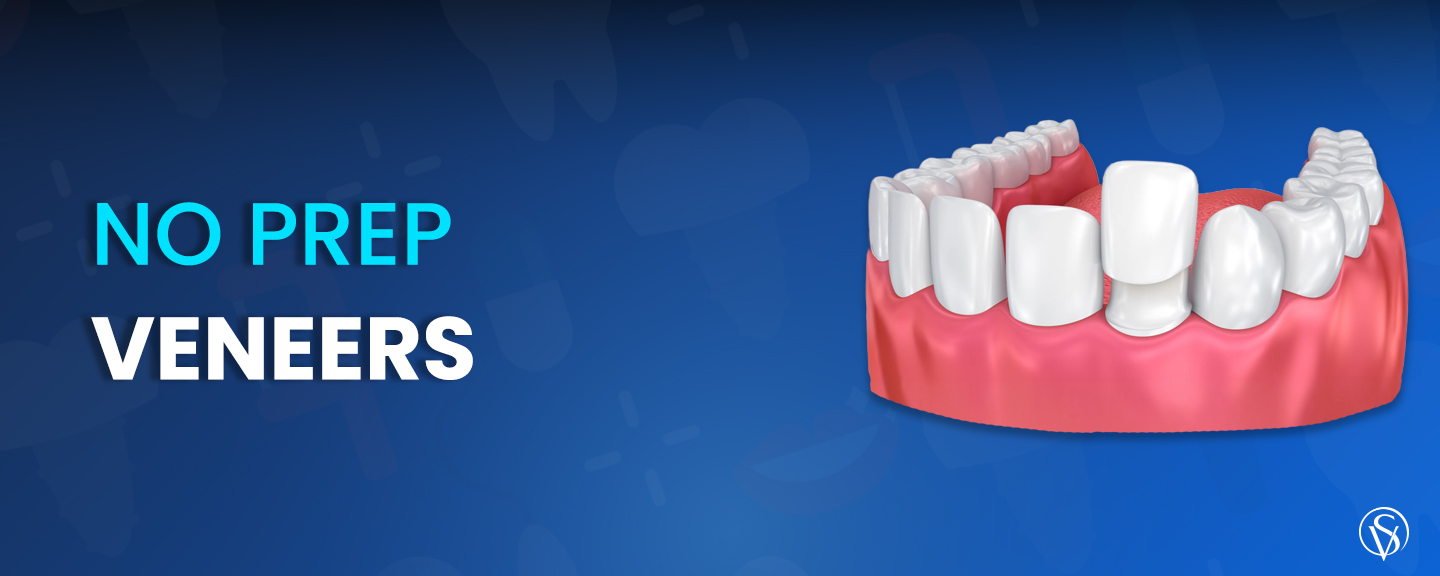
No-prep veneers are ultra-thin porcelain shells bonded directly over the natural tooth with little or no enamel reduction, placing them within minimally invasive cosmetic dentistry. The aim is to improve tooth shape, proportion, and brightness while preserving healthy enamel. They appeal to patients who want a conservative alternative to traditional porcelain veneers, though the clinical indication is narrower than marketing suggests: success depends on enamel quality, bite position, tooth size, gum stability, and underlying shade, and the wrong anatomy produces bulky contours, opaque aesthetics, or an unstable bite.
Cost varies widely by country, from roughly €200 to €2,000 per tooth, with Turkey at the lower end of that range. When case selection is accurate, no-prep veneers deliver highly aesthetic, enamel-preserving results with minimal recovery. When the case falls outside the correct envelope, dental veneers, composite bonding, or clear aligners give more predictable long-term outcomes.
What Are No-Prep Veneers?
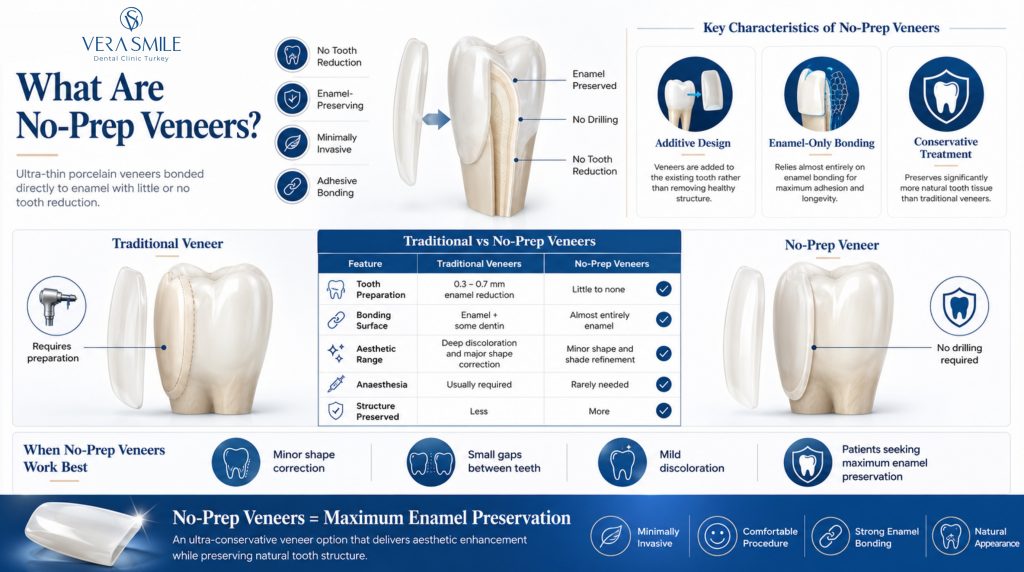
No-prep veneers are thin ceramic laminates bonded directly to enamel without removing tooth structure, with branded systems such as Lumineers the most widely recognised examples. They are minimally invasive by design and rely entirely on adhesive bonding to enamel rather than mechanical retention.
Three traits define the category. The geometry is additive, since the veneer is added on top of the tooth rather than carved into it. Bonding is enamel-only, because adhesion is strongest and most predictable to enamel, which is why these cases require an intact enamel layer. The protocol is conservative, preserving more natural tooth structure than traditional porcelain veneers, which require 0.3–0.7 mm of enamel reduction.
No-prep veneers are one option within the wider range of porcelain veneers, alongside feldspathic, lithium disilicate, zirconia, composite, hybrid, minimal-prep, temporary, and palatal types, each suited to a different clinical and aesthetic need.
What Are the Advantages of No-Prep Veneers?
No-prep veneers offer four main advantages: tissue conservation, on-paper reversibility, injection-free comfort, and faster chair time.
- Tissue conservation: Zero enamel removal preserves the strongest tissue layer in the mouth and supports long-term tooth health.
- Reversibility on paper: Removing the veneer leaves the tooth largely intact, though some surface etching remains.
- Comfortable visits: Most bonding visits are completed without injection.
- Faster chair time: A 6–10 unit case completes in 60–90 minutes of bonding, against 90–150 minutes for traditional veneers.
The appeal of no-prep veneers lies in their conservative approach, allowing aesthetic improvements while preserving as much natural tooth structure as possible. For suitable candidates, they can provide a comfortable and efficient treatment experience with minimal intervention.
Do no-prep veneers damage your natural teeth?
No, no-prep veneers remove no enamel, which preserves the strongest tissue layer in the mouth and supports long-term tooth health. The tooth structure stays intact beneath the porcelain throughout treatment.
What Are the Limitations of No-Prep Veneers?
The main limitations are bulkiness on prominent teeth, limited shade masking, and no correction for misalignment.
- Bulkiness on prominent teeth: Adding material without removing any over-contours front teeth, which feel large to the tongue and look thick in profile.
- Limited shade masking: Partly translucent porcelain lets a dark substrate show through.
- No correction for misalignment: Crowded or rotated teeth need preparation or clear aligners first for a clean result.
Reversibility is more nuanced than the marketing suggests: removing a bonded ultra-thin veneer means grinding through the porcelain, which leaves micro-roughness on the enamel. The tooth survives intact, but the surface is no longer pristine.
How Do No-Prep Veneers Differ from Traditional Veneers?
The core difference is preparation: traditional porcelain veneers remove 0.3–0.7 mm of enamel before bonding, while no-prep veneers add ultra-thin porcelain over a nearly untouched surface. The two approaches diverge across preparation, bonding, aesthetics, and comfort, as the table shows.
| Feature | Traditional porcelain veneers | No-prep veneers |
|---|---|---|
| Tooth preparation | 0.3–0.7 mm enamel reduction | Little to none |
| Bonding surface | Enamel and some dentin | Almost entirely enamel |
| Aesthetic range | Deep discolouration, large shape change | Minor shape and shade refinement |
| Anaesthesia | Local | Rarely needed |
| Structure preserved | Less | More (minimally invasive) |
Traditional veneers handle larger transformations; no-prep veneers win on tissue preservation and comfort within a narrower aesthetic range.
What Is the No-Prep Veneer Procedure Timeline?
Most no-prep cases complete in two to three visits over 2–3 weeks, following the standard veneer timeline. The phases below run from consultation to a two-week review.
| Phase | Duration | What Happens |
|---|---|---|
| Consultation and digital scan | 45–60 min | Photos, scans, smile design preview |
| Diagnostic wax-up or 3D mock-up | 5–10 days lab | Patient previews the proposed result |
| Lab fabrication | 1–3 weeks | Pressed or CAD/CAM-milled shells |
| Bonding visit | 60–120 min | Try-in, isolation, etch, bond, polish |
| Two-week review | 20–30 min | Bite check, photo update, hygiene plan |
Clinics with in-house CAD/CAM compress this into a single day for selected cases, and international patients in Turkey combine diagnostics and bonding into a single 5–7 day stay.
What Diagnostics Are Required Before No-Prep Veneers?
No-prep veneers require four checks before bonding: enamel thickness imaging, screening for hidden decay or cracks, occlusion analysis, and confirmation of periodontal stability. Because the treatment preserves nearly all enamel, the diagnostic phase predicts success more than in traditional protocols.
- Enamel thickness: Bitewing X-rays and intraoral imaging assess enamel quality across the front teeth, since thin or compromised enamel reduces bonding predictability.
- Hidden decay or cracks: Periapical imaging screens for decay, fractures, and failing restorations that a visual exam misses.
- Occlusion and bite clearance: Digital occlusion analysis checks whether the added porcelain thickness interferes with speech, chewing, or edge-to-edge function.
- Periodontal stability: Healthy, non-receding gum tissue is required for clean margins and lasting aesthetics, so inflammation is treated first.
A complete no-prep diagnostic assessment takes 45–75 minutes and remains one of the strongest predictors of long-term success.
What Is the No-Prep Veneer Procedure Timeline?
Most no-prep cases complete in two to three visits over 2–3 weeks, following the standard veneer timeline. The phases below run from consultation to a two-week review.
| Phase | Duration | What Happens |
|---|---|---|
| Consultation and digital scan | 45–60 min | Photos, scans, smile design preview |
| Diagnostic wax-up or 3D mock-up | 5–10 days lab | Patient previews the proposed result |
| Lab fabrication | 1–3 weeks | Pressed or CAD/CAM-milled shells |
| Bonding visit | 60–120 min | Try-in, isolation, etch, bond, polish |
| Two-week review | 20–30 min | Bite check, photo update, hygiene plan |
Clinics with in-house CAD/CAM compress this into a single day for selected cases, and international patients in Turkey combine diagnostics and bonding into a single 5–7 day stay.
How Much Tooth Preparation Is Involved?
Tooth preparation ranges from none for composite and no-prep veneers to 1.5–2.0 mm for a full crown, and the amount directly affects preservation, bonding, recovery, and aesthetic flexibility. The table compares reduction, anaesthesia, and lifespan across common cosmetic restorations.
| Restoration Type | Tooth Reduction | Anaesthesia | Lifespan |
|---|---|---|---|
| Composite veneers | 0 mm | Rarely needed | 4–8 years |
| No-prep veneers | 0 mm | Rarely needed | 8–12 years |
| Minimal-prep veneers | 0.1–0.3 mm | Optional | 10–15 years |
| Traditional porcelain veneers | 0.3–0.7 mm | Local | 10–20 years |
| Full porcelain crown | 1.5–2.0 mm | Local | 10–15 years |
Less reduction preserves more enamel and shortens recovery, but it also narrows how much shape and shade change the restoration can deliver.
How Does the Bonding Behavior Change for No-Prep Veneers?
Without preparation, the veneer bonds entirely to enamel, which improves retention but limits shade masking. Enamel adhesion is more predictable than dentin adhesion, so retention is strong, but thin porcelain does not block a dark substrate, so a no-prep veneer over a discoloured tooth shows the underlying stain. For heavy intrinsic discolouration, traditional porcelain veneers or dental crowns give a more predictable aesthetic result.
Do no-prep veneers hurt?
No, the procedure is rarely painful and most bonding visits are completed without injection, because the enamel surface stays largely untouched. Patients may feel mild pressure during try-in and bonding, but the absence of drilling means anaesthesia is rarely needed.
How Long Do No-Prep Veneers Last?
No-prep veneers last 8–12 years on intact enamel with proper maintenance, with survival depending more on the bonding substrate than on the brand. Published survival data supports this range, in line with Layton and Walton’s 21-year feldspathic porcelain veneer analysis (Layton & Walton, International Journal of Prosthodontics, 2012). An enamel-bonded no-prep veneer outperforms a traditional veneer bonded to a mix of enamel and dentin in long-term retention, as documented in Magne and Belser’s Bonded Porcelain Restorations in the Anterior Dentition (Quintessence Publishing). The table sets out survival by patient scenario.
| Patient Scenario | Expected Lifespan | Failure Mode |
|---|---|---|
| Intact enamel and light bite forces | 10–12 years | Marginal staining |
| Mild enamel wear and normal occlusion | 8–10 years | Edge chipping |
| Bruxism without nightguard | 3–6 years | Fracture, debond |
| Existing composite under veneer | 4–7 years | Adhesive failure |
Composite veneers, sometimes confused with no-prep porcelain because both are minimally invasive, run shorter at 4-8 years, and any no-prep case under heavy grinding without a nightguard fails far sooner.
Are no-prep veneers reversible?
Yes, on paper. Removing a bonded ultra-thin veneer leaves the underlying tooth largely intact, but grinding through the porcelain leaves micro-roughness on the enamel, so the surface is no longer pristine.
How Much Do No-Prep Veneers Cost?
No-prep veneers run roughly €200 to €2,000 per tooth worldwide, with Turkey at the lower end and the US, UK, and Australia at the top. Pricing splits sharply between Turkey and Western markets, reflecting lower clinic overheads, lab costs, and currency differences.
| Region | Porcelain Veneer | Composite Veneer | Zirconia Veneer |
|---|---|---|---|
| Turkey | €250 | €175 | €250 |
| Ireland | €800 | €350 | €900 |
| United Kingdom | €800 | €350 | €850 |
| United States | €950 | €450 | €1,100 |
| Dubai | €650 | €300 | €700 |
A full-arch case of 10 veneers in Turkey runs €2,500 to €4,500, against €8,000 to €12,000 in the UK or US, before brand licensing and lab grade are factored in.
What Drives the Cost of No-Prep Veneers?
Per-tooth price is driven mainly by brand licensing, lab location, dentist credentials, the number of units, the diagnostic workflow, and material grade.
- Brand licensing: Branded systems such as Lumineers carry a licensing fee that lifts case cost above unbranded ultra-thin laminates.
- Lab location: US-fabricated cases cost more than European or Turkish labs because of currency exposure and shipping.
- Dentist credentials: Clinicians trained in Digital Smile Design and advanced cosmetic protocols charge a premium.
- Number of units: Per-tooth cost falls on full-arch cases compared with single-tooth work.
- Diagnostic workflow: Wax-ups, mock-ups, and 3D smile previews add to the case fee.
- Material grade: Pressed lithium disilicate ultra-thins cost more than feldspathic porcelain or composite shells.
These factors can create significant price differences between countries, but a lower price does not mean lower-quality treatment.
What Hidden Costs Should You Plan For?
The headline price excludes diagnostics, follow-up, and replacement reserves, which add 15–25 percent to the full project. The table compares the main extras in Turkey against US and UK ranges.
| Hidden Cost | Range (Turkey) | Range (US/UK) |
|---|---|---|
| Initial consultation and X-rays | €40–€90 | €150–€280 |
| Diagnostic wax-up or DSD mock-up | €150–€400 | €350–€700 |
| Pre-treatment whitening | €120–€300 | €300–€650 |
| Nightguard (post-bonding) | €80–€180 | €200–€450 |
| Replacement reserve (per veneer over lifespan) | €250–€500 | €800–€1,500 |
| Travel and accommodation (international cases) | €500–€1,200 | N/A |
A realistic 10-tooth no-prep porcelain budget in Turkey, including diagnostics and a nightguard, lands between €3,000 and €5,500 for general veneer cost.
Self-Qualification Checklist
Patients meeting four or more of the criteria below fall inside the no-prep envelope.
| Thin porcelain does not mask darker substrates |
|---|
| Adhesion to enamel outperforms adhesion to composite |
| Additive geometry adds proportion without reduction |
| Additive geometry adds proportion without reduction |
| Prevents premature occlusal failure |
| Margins stay sealed at the gumline |
| Thin porcelain does not correct alignment |
Patients meeting fewer than four are better served by traditional porcelain veneers, composite bonding, or clear aligners first; where no-prep is contraindicated, composite bonding or traditional veneers reach the same aesthetic goal with better predictability.
Who Is the Right Candidate for No-Prep Veneers?
The right candidates have small or undersized teeth, a light natural shade, intact enamel, stable occlusion, and a need for minor refinement rather than a major transformation. Because ultra-thin porcelain relies on additive bonding, the treatment suits favourable anatomy; patients outside it do better with traditional veneers, composite bonding, or clear aligners.
- Small or undersized teeth: Teeth lacking width or volume respond well because the veneer builds outward without bulky contours.
- Light natural tooth shade: Partly translucent porcelain blends cleanly on lighter shades and holds colour stability.
- Intact enamel: Strong enamel supports predictable adhesion and retention.
- Minor cosmetic refinement: Small asymmetries, mild spacing, or limited edge irregularities fit the envelope better than major transformations.
- Enamel-preservation priority: Younger patients building a long-term restorative timeline choose no-prep to delay irreversible preparation.
No-prep veneers offer a conservative way to enhance a smile, but they deliver the best results when the patient’s natural tooth shape, colour, and alignment already provide a strong foundation. A thorough clinical evaluation is the key step in determining whether this minimally invasive approach is the right choice.
Do No-Prep Veneers Work for Patients Over 60?
Yes. Age alone does not prevent successful treatment. Patients over 60 with healthy enamel, stable gums, and balanced bite function often match the outcomes of younger patients, while cases with gum recession, worn enamel, or extensive restorations may need minimal-prep or traditional porcelain veneers instead.
Are No-Prep Veneers Safe During Pregnancy?
Yes, though elective veneer treatment is generally postponed until after pregnancy where possible. If treatment is necessary, the second trimester is considered the safest window, with X-rays limited to essential diagnostics, and most cosmetic dentists advise waiting until the postpartum period for non-urgent work.
When Are No-Prep Veneers a Poor Choice?
No-prep veneers are a poor choice for crowded or rotated teeth, severe discolouration, advanced wear, or heavy bruxism.
- Crowded or rotated teeth: Adding porcelain over prominent teeth creates excess thickness and unnatural contours.
- Severe discolouration: Deep intrinsic stains, tetracycline discolouration, or fluorosis stay visible beneath thin porcelain.
- Advanced wear or structural damage: Teeth needing major length or reinforcement need traditional porcelain veneers or dental crowns.
- Heavy bruxism: Grinding forces stress thin ceramic and raise fracture risk without long-term splint use.
No-prep veneers are not suitable for every smile and may produce compromised aesthetic or functional outcomes when significant colour correction, alignment changes, or structural restoration are required. In these cases, alternative treatments such as traditional veneers, crowns, or orthodontic solutions often provide more predictable long-term results.
Should Patients with Active Gum Disease Get No-Prep Veneers?
No. Active periodontitis is a contraindication. The European Society of Cosmetic Dentistry calls for inflammation control before any veneer placement (ESCD, 2023), with a standard buffer of 8–12 weeks of periodontal treatment to confirm pocket stability and bleeding-on-probing below 10 percent.
Are No-Prep Veneers Combined with Other Treatments?
Yes. No-prep veneers are frequently combined with complementary cosmetic and restorative treatments within a broader smile plan. Because ultra-thin porcelain works best in a selective range, dentists often improve alignment, shade, or gum symmetry first. Common partners are teeth whitening, clear aligners, composite bonding, and gum contouring, with whitening completed before fabrication so the porcelain matches the brighter shade.
How Do You Time Whitening Around No-Prep Veneers?
Whiten the natural teeth first, then match the porcelain to the lifted shade. Pre-veneer whitening is the recommended sequence, with a 2–4 week interval between the final whitening session and bonding to allow enamel rehydration and shade stabilisation. The teeth whitening plan is coordinated within the same treatment timeline.
Are No-Prep Veneers Used After Orthodontic Treatment?
Yes, no-prep veneers are a common finishing layer after Invisalign or fixed braces. Once the teeth sit in their corrected position, the porcelain refines shape, colour, and edge harmony without erasing the orthodontic result. The recommended window is 3–6 months after retainers begin, to confirm stability before bonding.
Where Do Clear Aligners Fit in the Sequence?
Clear aligners come before veneers whenever the underlying alignment is off. The standard sequence is clear aligners (4–12 months) followed by 3–6 months of retention before no-prep veneers are bonded. Reversing the order risks veneer fracture during ongoing tooth movement.
Will No-Prep Porcelain Sit Alongside Composite Bonding?
Yes. Mixed plans place no-prep porcelain on the front six teeth and composite bonding on premolars or canines for budget reasons. Porcelain-to-enamel bond strength exceeds composite-to-enamel, which makes porcelain the preferred choice for the most visible teeth.
How Do No-Prep Veneers Behave on Existing Crowns, Bridges, or Fillings?
No-prep veneers do not bond reliably to crowns or bridges, and they lose adhesion over existing fillings. Mixed restorative cases place no-prep porcelain on natural teeth and rely on careful shade matching at the visible margins. Patients with fillings on the front six teeth see a 30–40 percent drop in long-term adhesive performance, consistent with Van Meerbeek and colleagues’ enamel-versus-dentin adhesion comparison (Van Meerbeek et al., Journal of Adhesive Dentistry, 2020).
How Do No-Prep Veneers Compare with Snap-On or Press-On Alternatives?
No-prep veneers are permanently bonded porcelain that lasts 8–12 years and handles full bite force, while snap-on and press-on alternatives are removable resin appliances that last 1–3 years and suit soft foods only. Two non-bonded products look similar but work differently, as the table shows.
| Feature | No-Prep Porcelain Veneers | Snap-On / Press-On Veneers |
|---|---|---|
| Attachment | Permanently bonded with resin cement | Removable, snaps over teeth |
| Material | Pressed or milled porcelain | Acrylic or thermoplastic resin |
| Lifespan | 8–12 years | 1–3 years |
| Eating function | Full bite force | Soft foods only |
| Aesthetic quality | High translucency, lifelike | Bulky, uniform sheen |
| Cost (per arch, Turkey) | €2,500–€4,500 | €400–€800 |
| Reversible | On paper, with surface etching residue | Fully removable |
Snap-on and press-on options suit short-term events or tight budgets; they are not a long-term aesthetic solution and read to most observers as a removable appliance.
Where Do No-Prep Veneers Fit in a Smile Makeover?
Within a Hollywood Smile plan, no-prep veneers handle additive length on worn teeth, single-tooth corrections, and conservative cases for younger patients, often paired with pre-veneer whitening.
- Worn or short anterior teeth: Cases needing added length without reducing existing structure.
- Single-tooth corrections: Situations where preserving the neighbouring teeth is a priority.
- Younger long-term plans: Patients who want to delay irreversible preparation.
- Whitening-plus-veneer cases: Where pre-veneer whitening lifts the substrate to a shade thin porcelain handles cleanly.
For Hollywood Smile cases needing shade correction, length addition, and reshaping in one phase, traditional porcelain veneers or dental crowns outperform no-prep veneers on aesthetic predictability.
How Should You Care for No-Prep Veneers?
No-prep veneers last longest with gentle brushing, nightly flossing, a nightguard for any grinding, and regular professional checks.
- Brush gently: Use a soft-bristle brush twice daily with a non-abrasive fluoride toothpaste.
- Floss nightly: Floss or use an interdental brush each night to prevent margin staining at the gumline.
- Wear a nightguard: A nightguard is non-negotiable for any history of bruxism on thin porcelain.
- Clean professionally: Book six-month cleanings with non-abrasive polishing paste.
- Check occlusion yearly: An annual bite check catches early wear or marginal lifting.
Avoid biting hard objects, opening packaging with the front teeth, and chewing ice, since the thinner profile makes ultra-thins less forgiving than traditional veneers.
What Happens If a No-Prep Veneer Fails?
If a no-prep veneer fails, an intact debond is rebonded in one short visit, while a fracture requires a full replacement.
What If the Veneer Detaches Intact?
An intact debond is rebonded in a single 30–45 minute visit. The dentist cleans residual cement off the tooth, etches both surfaces with phosphoric acid, and rebonds with fresh resin cement. Debond rates run 2–5 percent over the first five years, documented by Calamia and Calamia in their 25-year porcelain laminate veneer review (Calamia & Calamia, Dental Clinics of North America, 2007).
What If the Veneer Fractures?
A fractured veneer needs replacement, not repair. Composite repair on broken porcelain is a temporary fix that fails within 12–18 months, so the replacement repeats the original sequence of scan, lab fabrication, and rebonding.
What Should You Do Before the Dental Visit After Dental Veneers Failure?
After a veneer detaches, protect the tooth and book a same-week visit.
- Save the veneer: Keep it in a clean container and do not try to glue it back at home.
- Protect the tooth: Avoid eating on the affected tooth to prevent damage to the exposed enamel.
- Book quickly: Schedule a same-week appointment to stop the unprotected tooth from shifting.
Acting quickly after a veneer detaches can help prevent additional damage and improve the chances of a straightforward repair. Until you see your dentist, the goal is simply to protect both the tooth and the detached veneer from further harm.
Do No-Prep Veneers Affect Speech, Eating, or Sensation?
Yes, though most patients adjust within days. Because no-prep veneers slightly change the front-tooth contour, speech, bite sensation, and tongue contact adapt gradually at first, and fricatives such as S, F, and V may feel different for about 3–7 days. Eating normalises within a week, temperature sensitivity stays uncommon because the enamel is preserved, and patients often describe the surface as smoother than natural enamel. Those with naturally prominent upper teeth notice the added thickness more than patients with worn or undersized teeth.
Why Do Patients Choose Vera Smile for No-Prep Veneers?
International patients choose Vera Smile for no-prep veneers for a combination of clinical and logistical reasons. The clinic operates under authorisation from the Republic of Turkey Ministry of Health and follows Slow Dentistry Global Network protocols, with longer appointment times, structured isolation, and patient-centred pacing. Cosmetic veneer cases are planned through digital smile analysis and supported by an on-site dental laboratory, which keeps the clinician and ceramic team in close contact throughout fabrication.
International patients receive dedicated coordination covering hotel planning, airport transfers, scheduling, and aftercare. Most no-prep veneer cases are completed within 5–7 days in Istanbul, followed by post-treatment guidance, occlusal protection, and structured follow-up after patients return home.
FAQ
Yes, though lower-arch no-prep veneers are more demanding than upper-arch work. Lower front teeth offer a smaller enamel bonding surface and absorb greater vertical bite pressure, which raises the risk of edge chipping and fracture. They also show less during smiling and speech, so most smile-makeover plans prioritise the upper arch first and add lower veneers when visible lower teeth, incisal wear, or asymmetry affect overall balance.
Yes, Lumineers is a branded no-prep system and the most widely recognised example on the market. The term no-prep describes the category, and Lumineers is one product within it.
No, thin porcelain adds material without correcting position, so crowded or rotated teeth need preparation or clear aligners first. Adding porcelain over prominent teeth otherwise creates excess thickness and unnatural contours.
Yes, well-selected cases use high-translucency porcelain that looks lifelike, unlike the bulky, uniform sheen of removable snap-on or press-on appliances. A natural result depends on accurate case selection, especially a light underlying shade.
Most cosmetic cases cover the front six teeth, the area most visible when smiling, while a full-arch case runs to about 10 units. The exact number depends on how many teeth show in the smile line and which ones need shape or shade correction.
Yes, though the porcelain itself resists staining; discolouration appears mainly at the margins where the veneer meets the tooth. Nightly flossing or interdental cleaning at the gumline prevents most margin staining.