
Dental veneers reshape the visible surface of the teeth to improve colour, symmetry, and alignment. Through treatments such as porcelain veneers, dentists modify the thickness, length, and edge position of the front teeth. These small structural changes influence the way the tongue and airflow interact with the teeth during speech.
Teeth play a direct role in speech articulation. Several consonant sounds form through controlled contact between the tongue, lips, and the edges of the upper front teeth. When the surface or position of these teeth changes, the tongue briefly adjusts to a new reference point during pronunciation.
For that reason, a small number of patients notice a temporary lisp after veneer placement. The sound difference appears most clearly with “S” or “Z” sounds because these rely on precise airflow between the tongue and the incisal edges of the teeth.
In most situations, the change represents a short adaptation period rather than a lasting speech problem. As the tongue learns the new tooth contours, pronunciation stabilizes and speech returns to its normal pattern.
Why Can Veneers Affect Speech?
Speech relies on a delicate interaction between the tongue, lips, teeth, and the movement of air through the mouth. The upper front teeth serve as structural guides that shape airflow and help define how consonant sounds form.
When veneers are placed, the surface contour, length, and thickness of the front teeth change slightly. Even subtle modifications influence how the tongue positions itself during articulation. Because the tongue relies on the edges of the teeth as a reference point, a new tooth surface creates a short adjustment period for pronunciation.
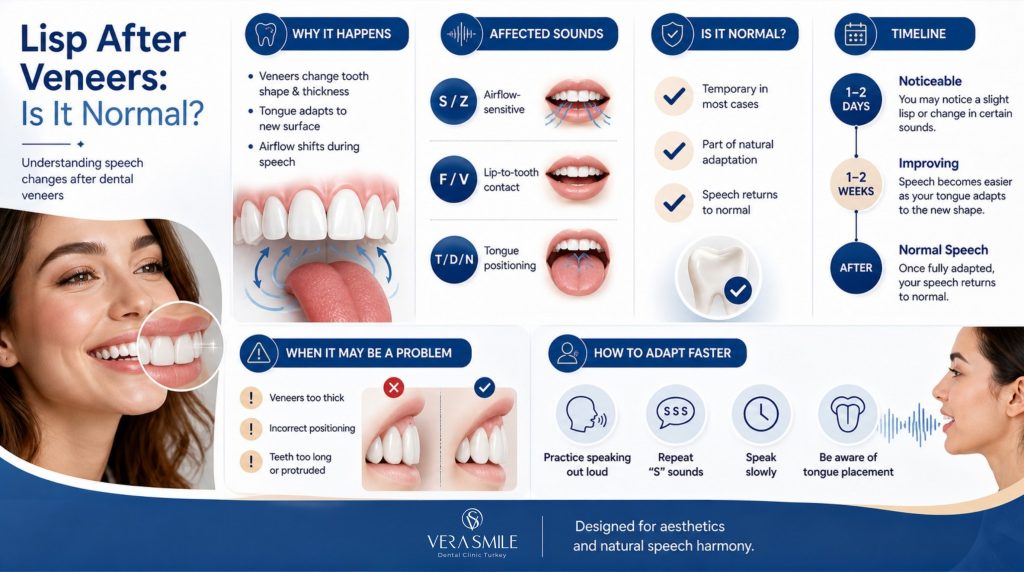
Certain consonants depend directly on this relationship. “S” and “Z” sounds require a narrow air channel between the tongue and the front teeth. “F” and “V” sounds involve contact between the upper teeth and the lower lip. “T,” “D,” and “N” sounds form when the tongue touches the area just behind the upper teeth. When veneers reshape these surfaces, speech mechanics shift slightly until the mouth adapts.
What Role Do Teeth Play in Speech Production?
The upper front teeth function as stable landmarks during speech. The tongue positions itself relative to these teeth to control the direction and pressure of airflow.
During articulation, the tongue approaches different areas of the mouth depending on the sound being produced. Some sounds require the tongue to hover just behind the teeth, while others involve direct contact with the tooth edges or the ridge behind them. These contact points determine how air exits the mouth and therefore shape the final sound.
Because veneers alter the contours of the tooth surface, the tongue temporarily recalibrates its position. This adjustment phase explains the brief pronunciation changes that some patients notice after cosmetic dental treatment.
How Do “S” and “Z” Sounds Change After Veneers?
“S” and “Z” sounds represent some of the most sensitive consonants in dental phonetics. These sounds depend on a precise relationship between the tongue, the upper front teeth, and the direction of airflow leaving the mouth. When veneers reshape the front teeth, this relationship changes slightly, which explains why pronunciation differences appear during the early adjustment period.
- Airflow Between the Teeth: “S” and “Z” sounds belong to the group known as sibilant sounds. These consonants form when a narrow stream of airflow passes between the tongue and the upper front teeth. The tongue shapes a small channel that directs air toward the tooth edges. A stable airflow stream produces the sharp sound characteristic of these letters.
- Incisal Edge Position: The incisal edges of the upper front teeth guide this airflow. Their position determines how close the tongue sits during pronunciation. Veneers change the surface contour, thickness, or length of these edges. This alteration shifts the relationship between the tongue and the tooth surface, which influences how air leaves the mouth.
- Lisp Formation: A lisp appears when the airflow spreads rather than traveling through a narrow channel. After veneer placement, the tongue searches for the new reference points created by the restorations. During this adjustment phase, the sound of “S” and “Z” loses some sharpness. As the tongue adapts to the new tooth contours, the airflow channel stabilizes and the pronunciation regains clarity.
How Do Veneers Influence “F” and “V” Sounds?
“F” and “V” belong to a group called labiodental sounds. Their pronunciation depends on precise contact between the upper front teeth and the lower lip. Since veneers reshape the front teeth, this contact point shifts slightly during the first days after treatment.
- Upper Teeth-Lower Lip Contact: During pronunciation, the lower lip rises to touch the incisal edges of the upper front teeth. Air passes between the lip and the teeth to create the distinct friction sound heard in “F” and “V.”
- Incisal Edge Position: The edge position of the upper teeth determines where the lower lip touches during articulation. Veneers alter the surface contour, length, or projection of these teeth. This change shifts the contact point between the lip and the teeth.
- Speech Adjustment Phase: During the first days after veneer placement, the lower lip adapts to the new tooth surface. The mouth learns the updated contact point between the lip and teeth, and pronunciation stabilizes as articulation patterns adjust.
How Do Veneers Influence “T,” “D,” and “N” Sounds?
“T,” “D,” and “N” belong to a group known as alveolar consonants. These sounds form when the tongue touches the area just behind the upper front teeth. Because veneers reshape the front tooth surface and edge position, the reference point used during articulation shifts slightly during the early adjustment phase.
- Tongue–Tooth Contact: During pronunciation, the tip of the tongue rises to meet the ridge located directly behind the upper front teeth. This brief contact blocks airflow and releases it quickly to create the clear sound of “T,” “D,” and “N.”
- Tooth Edge Reference Point: The incisal edges of the upper teeth guide where the tongue positions itself before touching the ridge behind them. Veneers change the shape, length, or projection of these teeth, which alters the spatial reference the tongue uses during articulation.
- Speech Adjustment Phase: After veneer placement, the tongue recalibrates its position relative to the updated tooth surface. During this period, pronunciation of “T,” “D,” and “N” sounds feels slightly unfamiliar. As the tongue adapts to the new tooth contours, articulation stabilizes and speech returns to its natural clarity.
Is a Lisp After Veneers Normal?
Yes. A short-term lisp after veneers represents a common speech adjustment following changes to the front tooth surface. Veneers reshape the length, thickness, and edge position of the teeth. These structural modifications shift the reference points the tongue uses during pronunciation.
Speech relies on precise coordination between the tongue, teeth, and airflow. When veneers alter the contour of the upper front teeth, the tongue encounters a slightly different surface during articulation. This difference influences the airflow channel that forms sounds such as “S” and “Z.”
During the first days after treatment, the tongue learns the new tooth contours created by the restorations. This adaptation phase explains why some patients notice mild pronunciation differences or a soft lisp-like sound in certain words. As the tongue adjusts to the updated tooth structure, the airflow pattern stabilizes and speech returns to its natural rhythm.
Why Does Speech Change Immediately After Veneer Treatment?
Speech changes appear right after veneer placement because the mouth adapts to a new tooth surface. Veneers modify the shape, thickness, and edge position of the front teeth. These structural adjustments influence how the tongue, teeth, and airflow interact during pronunciation.
- Altered Tooth Surface: Veneers create a new outer contour for the front teeth. The incisal edges and tooth surface guide how the tongue approaches the teeth during speech. When this surface changes, the tongue encounters a different reference point during articulation.
- Tongue Positioning: The tongue relies on the position of the upper front teeth to guide pronunciation. After veneer placement, the tongue recalibrates its position relative to the new tooth contours. This short adjustment phase influences the clarity of certain consonant sounds.
- Airflow Modification: Speech sounds depend on controlled airflow passing between the tongue and the teeth. A change in tooth projection or surface angle alters how air travels through the mouth. As the tongue adapts to the updated tooth structure, the airflow channel stabilizes and pronunciation returns to its normal pattern.
Do Temporary Veneers Affect Speech More Than Final Veneers?
Yes. Temporary veneers influence speech more than the final restorations. During the dental veneers procedure, temporary restorations protect the prepared teeth while the permanent veneers are fabricated in the laboratory. Their design differs from the final restorations, which explains the stronger effect on pronunciation.
- Greater Thickness: Temporary veneers contain a bulkier structure compared with final porcelain restorations. This extra thickness changes the distance between the tongue and the front teeth, which influences articulation during speech.
- Rougher Edges: The edges of temporary restorations appear less refined than the polished edges of permanent veneers. The incisal edge contour guides airflow and tongue movement, so a rougher edge affects pronunciation more noticeably.
- More Noticeable Speech Changes: Speech differences stand out more during the temporary phase because the mouth adapts to a transitional tooth shape. Once the permanent veneers are placed, the contours become thinner and smoother, which allows the tongue and airflow patterns to stabilize more easily.
How Long Does a Lisp Last After Veneers?
A temporary lisp after veneers lasts a short period while the mouth adjusts to the new tooth contours. Veneers modify the incisal edge position, surface thickness, and front tooth projection, which influences how the tongue directs airflow during speech. As the tongue adapts to these updated reference points, pronunciation stabilizes.
- First 24–48 Hours: During the first two days, the tongue encounters a new tooth surface during articulation. Sounds that depend on precise airflow, such as “S” and “Z,” feel unfamiliar because the tongue has not yet calibrated its position relative to the new tooth edges.
- One to Two Weeks: Within the following days, the tongue muscles adapt to the updated tooth contours. The airflow channel between the tongue and the front teeth becomes more precise. Pronunciation gradually returns to its natural rhythm as articulation patterns adjust.
- When Speech Fully Stabilizes: After the adjustment period, speech reaches a stable pattern. The tongue, teeth, and airflow mechanics work together in a coordinated way, and the temporary lisp-like sound disappears as the mouth fully adapts to the veneer structure.
When Does a Lisp After Veneers Indicate a Design Issue?
A short adjustment period after veneer placement represents a normal stage of speech adaptation. When a lisp persists beyond the expected adjustment phase, the cause may relate to the design, thickness, or positioning of the veneers. Speech depends on a stable relationship between the tongue, incisal edges, and the path of airflow leaving the mouth. Changes that extend beyond natural tooth proportions interfere with this balance and affect articulation.
- Excessive Veneer Thickness: Veneers with excessive surface thickness push the front tooth contour outward. This change reduces the space between the tongue and the upper teeth, which disrupts the narrow airflow channel required for clear consonant sounds. The tongue struggles to find a stable reference point during articulation, which results in a persistent lisp-like sound.
- Incorrect Incisal Edge Position: The incisal edges guide the direction of airflow during pronunciation. When veneer edges extend too far forward or downward, the tongue loses its natural reference point. Air escapes across a wider surface instead of forming a narrow stream, which affects the clarity of sibilant sounds such as “S” and “Z.”
- Tooth Length Changes and Airflow Disruption: Changes in tooth length influence how air exits the mouth during speech. Veneers that extend the upper front teeth beyond natural proportions redirect the airflow trajectory and interfere with precise articulation. During a comprehensive smile design or Smile Makeover, dentists evaluate both aesthetics and phonetics to maintain balanced tooth length and stable speech mechanics.
How Do Dentists Prevent Speech Problems with Veneers?
Dentists design veneers with attention to both aesthetic harmony and speech function. Clear pronunciation depends on the relationship between the tongue, incisal edges, and the direction of airflow during articulation. Modern cosmetic dentistry uses several evaluation steps to verify that the new tooth contours support natural speech before the final veneers are placed.
- Smile Design Planning: Treatment planning begins with a detailed smile analysis that evaluates tooth length, edge position, and the relationship between the upper teeth and the lower lip. This stage ensures that the planned veneer contours respect natural speech mechanics.
- Temporary Mock-Up Evaluation: A temporary mock-up allows the patient to experience the proposed tooth shape before the final restorations. Speaking with the mock-up reveals how the tongue, teeth, and airflow interact with the new tooth contours.
- Phonetic Testing During Try-In: Dentists evaluate pronunciation during the try-in stage by asking patients to pronounce words containing “S,” “F,” and “V” sounds. These sounds reveal how airflow travels across the incisal edges and whether articulation remains clear.
- Surface and Edge Adjustments: If speech differences appear during testing, the dentist refines the veneer thickness, incisal edge position, or tooth length. Small adjustments restore balanced airflow and stable tongue positioning, which supports clear pronunciation after veneer placement.
How Can You Adjust to Speaking with Veneers?
Speech adapts as the tongue, teeth, and airflow patterns adjust to the new tooth contours created by veneers. During the first days after treatment, articulation feels unfamiliar because the tongue reference points shift slightly. Simple speaking exercises and awareness of tongue positioning support faster adaptation and clearer pronunciation.
- Speech Adaptation Exercises: Targeted speaking exercises help the mouth adjust to the new tooth edges and airflow patterns.
- Reading aloud – Continuous speech practice trains the tongue to recognize the updated tooth contours.
- Repeating “S” sounds – Words such as “see,” “sun,” and “smile” strengthen control of the airflow channel used for sibilant sounds.
- Slow articulation – Speaking slowly increases awareness of tongue placement and improves pronunciation precision.
- Reading aloud – Continuous speech practice trains the tongue to recognize the updated tooth contours.
- Tongue Position Awareness: Clear speech depends on the correct relationship between the tongue tip and the upper front teeth. The tongue rests close to the incisal edges during many consonant sounds. Conscious attention to this position improves articulation as the mouth adapts to the new tooth structure.
- Follow-Up Adjustments: If pronunciation differences persist, a dentist evaluates the veneer surface, edge contour, and tooth length. Minor refinements to the veneer edges restore balanced airflow direction and stabilize speech mechanics.
Do Veneers Affect Speech Permanently?
No. Veneers do not cause permanent changes in speech when designed with correct tooth proportions, incisal edge position, and surface contours. A short adaptation phase occurs after placement because the tongue learns the updated reference points created by the new tooth surface.
Speech relies on coordination between the tongue, front teeth, and the direction of airflow leaving the mouth. When veneers reshape the front teeth, this coordination adjusts for a brief period. As the tongue adapts to the updated contours, articulation returns to its natural pattern.
Professional treatment planning ensures that veneers support both aesthetic balance and phonetic function. During consultation, dentists evaluate tooth shape, edge position, and smile proportions before treatment begins. Patients who explore treatment options often review details such as the overall veneers cost along with the design process to understand how veneers improve both appearance and functional harmony.
Do Porcelain Veneers Make Everyone Lisp?
No. Most patients experience no lasting change in speech after receiving porcelain veneers. These restorations are designed to replicate the natural shape, thickness, and edge position of healthy teeth. When veneers follow correct dental proportions, the tongue, teeth, and airflow maintain their normal relationship during pronunciation.
A short adjustment period occurs in some cases because the tongue learns the new tooth contours created by the veneers. This phase influences sounds that rely on precise airflow, such as “S” and “Z.” As the tongue adapts to the updated surfaces, articulation returns to its familiar pattern.
Careful veneer design plays a key role in preventing speech disturbances. Dentists evaluate tooth length, incisal edge position, and lip contact points during treatment planning to ensure that the restorations support both natural pronunciation and aesthetic harmony.
Why Do I Whistle When Speaking After Veneers?
A whistling sound during speech appears when airflow escapes through a narrow gap between the tongue and the front teeth. Veneers reshape the incisal edges and the surface contour of the teeth, which changes how air travels through the mouth during pronunciation.
This sound appears most clearly with sibilant consonants such as “S” and “Z.” These sounds require a controlled stream of air directed across the edges of the upper front teeth. When the airflow passes through a tighter or differently angled channel, the escaping air produces a whistle-like sound instead of a soft consonant.
The whistling effect reflects a short speech adaptation phase. The tongue searches for the correct position relative to the new tooth contours. As the tongue finds the updated reference points along the incisal edges, the airflow stream stabilizes and the whistling sound disappears.
Can Veneers Change the Way “S” Sounds?
Yes. Veneers reshape the incisal edges and the surface contour of the upper front teeth, which influences how airflow travels during pronunciation. The “S” sound depends on a narrow stream of air passing between the tongue and the edges of the front teeth. When the tooth surface changes, the tongue encounters a new reference point during articulation.
During the first days after veneer placement, the airflow channel between the tongue and the upper teeth shifts slightly. This change influences the sharpness of the “S” sound, which may resemble a soft lisp until the mouth adapts.
As the tongue position adjusts to the new tooth contours, the airflow stream becomes more focused. Once this adjustment occurs, the pronunciation of “S” sounds returns to its natural clarity.
Do Temporary Veneers Cause More Speech Problems?
Yes. Temporary veneers influence speech more than the final restorations because their shape and surface finish differ from permanent veneers. These provisional restorations protect the prepared teeth while the laboratory fabricates the final veneers, which results in a slightly different tooth contour during this stage.
Temporary veneers contain greater material thickness, which changes the distance between the tongue and the upper front teeth. This shift alters the airflow channel used for consonant sounds such as “S” and “Z.” The incisal edges of temporary restorations appear less refined as well, which influences how the tongue approaches the teeth during pronunciation.
Speech differences during this phase reflect the mouth adapting to a transitional tooth shape. Once the permanent veneers replace the temporary restorations, the edges become thinner and smoother, and the relationship between the tongue, teeth, and airflow stabilizes.
Does Veneer Thickness Affect Pronunciation?
Yes. The thickness of a veneer influences how the tongue, front teeth, and airflow interact during speech. When the veneer surface projects farther outward than the natural tooth contour, the tongue position shifts during articulation.
Many consonant sounds depend on a narrow airflow channel between the tongue and the incisal edges of the upper teeth. Greater veneer thickness changes this spacing and alters the direction of the airflow stream. This shift affects the clarity of sounds such as “S,” “Z,” “F,” and “V.”
Proper veneer design restores natural tooth proportions and preserves the correct distance between the tongue and the front teeth. With balanced thickness and accurate edge positioning, speech maintains its natural articulation pattern.
Can a Dentist Fix Speech Problems Caused by Veneers?
Yes. A dentist fixes speech problems related to veneers through careful evaluation of the tooth contours, incisal edges, and the direction of airflow during pronunciation. Clear speech depends on a balanced relationship between the tongue, front teeth, and the path of air leaving the mouth.
During examination, the dentist observes how the tongue interacts with the veneer surface while the patient pronounces sounds such as “S,” “F,” and “V.” These sounds reveal whether the edge position, veneer thickness, or tooth length interferes with normal articulation.
Small refinements to the veneer edges or the surface contour restore the correct airflow channel and improve pronunciation clarity. Through these adjustments, the relationship between the tongue, teeth, and airflow mechanics returns to a stable and natural speech pattern.