
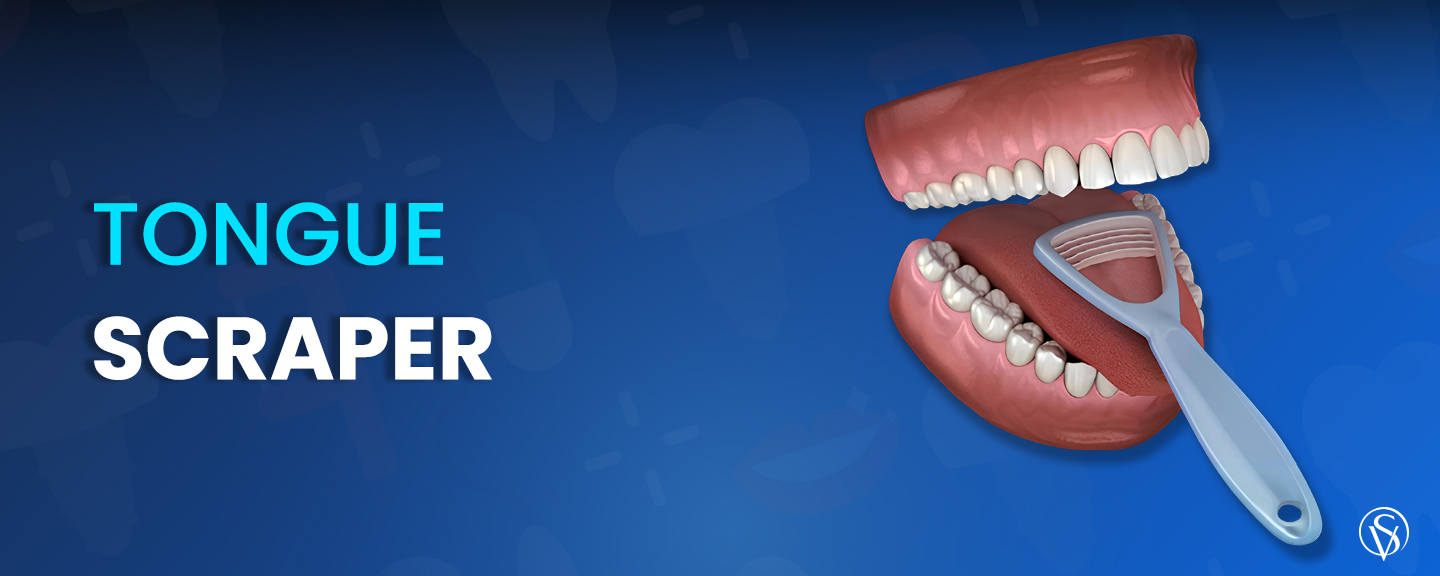
Most people brush twice a day, floss regularly, and rinse with mouthwash; yet still struggle with persistent bad breath or a coated tongue. The missing piece is often the tongue itself. A tongue scraper is a simple, inexpensive oral hygiene tool specifically designed to remove the layer of bacteria, dead cells, and food debris that accumulates on the tongue’s surface every day.
While toothbrushing tackles teeth and gums, the tongue is home to a significant portion of the oral bacteria that contribute to bad breath (halitosis) and poor oral health. Despite this, tongue cleaning is one of the most overlooked steps in daily dental routines.
In this comprehensive guide, Vera Smile walks you through everything you need to know about tongue scrapers, from how they work and why they matter, to choosing the right one and using it safely.
What Is a Tongue Scraper?
A tongue scraper is a dental hygiene tool used to gently remove the biofilm, a soft, whitish coating, that builds up on the surface of the tongue. This coating consists of bacteria, fungi, dead cells, food particles, and other debris that settle into the small crevices between the tongue’s papillae (the tiny bumps on the surface).
Unlike a toothbrush, which is designed primarily to clean smooth enamel surfaces and grooves, a tongue scraper is ergonomically shaped to glide across the tongue’s broader, textured surface in a single motion. Most tongue scrapers are U-shaped or flat-edged tools that allow users to apply even pressure across the full width of the tongue.
Regular tongue cleaning is a recognized component of comprehensive oral hygiene. Dentists and oral health professionals increasingly recommend it as a complement to brushing and flossing, not a replacement.
What Materials Are Tongue Scrapers Made From?
Tongue scrapers are available in a variety of materials, each with its own properties in terms of durability, hygiene, and comfort. The most common options include:
- Stainless Steel: The most popular choice among dental professionals. Durable, easy to sanitize, rust-resistant, and long-lasting. Its firm but smooth edge is highly effective at removing tongue coating.
- Copper: Valued in Ayurvedic traditions for centuries. Copper has natural antimicrobial properties that may inhibit bacterial growth on the scraper itself between uses.
- Plastic: Lightweight, affordable, and widely available. Less durable than metal options and may need replacing more frequently to prevent bacterial buildup in micro-scratches.
- Silicone: Softer and more flexible than metal or hard plastic. A good option for those with a sensitive gag reflex or those new to tongue scraping. Gentle on tongue tissue.
- Biodegradable / Bamboo: An eco-friendly alternative gaining popularity. Suitable for those looking to reduce plastic waste in their oral hygiene routine.
No matter which material you choose, the most important factor is consistency. A stainless steel scraper used daily will always outperform a copper one used occasionally. Choose the material that fits your lifestyle, budget, and comfort level, and make tongue cleaning a non-negotiable part of your morning routine. If you are unsure which option is right for you, the team at Vera Smile is happy to help you find the best fit for your oral health needs.
How Does a Tongue Scraper Differ from a Toothbrush?
While a toothbrush can make contact with the tongue’s surface, its design is optimized for scrubbing teeth, not for sweeping a flat, mucous-covered surface efficiently. The bristles of a toothbrush can redistribute bacteria across the tongue rather than physically removing it.
A tongue scraper, by contrast, works on a pull-and-collect principle. Its edge draws the biofilm forward in one smooth stroke, lifting and removing the coating rather than dispersing it. This mechanical difference means significantly more debris is removed per pass with a scraper compared to a brush.
Think of it this way: using a toothbrush on your tongue is like cleaning a countertop with a sponge, it spreads the mess around. A tongue scraper acts more like a squeegee, collecting and removing the film in one motion.
Why Should You Use a Tongue Scraper Daily?
The tongue is a warm, moist, and textured surface; an ideal environment for microbial colonization. Hundreds of species of bacteria live in the mouth, and a large proportion of them reside on the tongue. Without daily tongue cleaning, this microbial load accumulates, contributing to a range of oral health issues.
Adding a tongue scraper to your morning routine takes less than 30 seconds and delivers measurable benefits to your breath, taste sensation, and overall oral hygiene.
What Happens If You Don’t Clean Your Tongue?
Neglecting the tongue allows a thick biofilm to develop, consisting of volatile sulfur compounds (VSCs), bacteria, and dead epithelial cells. Over time, this can lead to:
- Chronic bad breath (halitosis), the most immediate and noticeable consequence
- A visibly white, yellow, or brown coating on the tongue’s surface
- Reduced taste sensitivity, as the coating can block taste receptors
- Increased bacterial load in the mouth, which may contribute to tooth decay and gum disease
- Potential oral infections if harmful bacteria proliferate unchecked
A study published in the Journal of Periodontology found that the dorsal surface of the tongue is one of the primary reservoirs for oral pathogens. Leaving this reservoir unaddressed undermines even the most diligent brushing and flossing routine.
How Does Tongue Cleaning Improve Oral Health?
Daily tongue cleaning provides several well-documented oral health benefits:
- Reduces bacterial load: Physically removes bacteria before they can multiply or transfer to teeth and gums
- Improves taste perception: Removing the coating allows taste buds to function more efficiently, often enhancing flavor sensitivity
- Freshens breath: Eliminates the primary source of VSC-producing bacteria responsible for bad breath
- Supports gum health: Fewer bacteria in the mouth means less chance of harmful species migrating to the gum line
- Promotes mindful oral hygiene: Regular tongue scraping encourages a more thorough approach to the entire oral cavity
When combined with proper brushing, flossing, and regular dental visits, tongue cleaning forms a key part of a complete preventive oral care routine.
Can a Tongue Scraper Help Prevent Bad Breath?
Yes, and this is one of the most well-supported benefits of tongue scraping. The majority of cases of bad breath (halitosis) originate in the mouth, and the tongue is the primary site. Anaerobic bacteria that live in the tongue’s coating break down proteins and produce volatile sulfur compounds (VSCs) — the compounds responsible for the characteristic odor of bad breath.
Tongue scrapers directly target and remove this bacterial coating, reducing VSC production at its source. Clinical research has consistently shown that tongue scraping is more effective at reducing VSC levels than tongue brushing alone.
For patients dealing with persistent bad breath, a tongue scraper is often one of the first recommendations dental professionals make. It is a non-invasive, cost-effective, and proven intervention.
How Does a Tongue Scraper Work?
The mechanism behind tongue scraping is straightforward: the scraper’s edge is placed at the back of the tongue and drawn forward toward the tip, collecting and removing the soft biofilm along the way. This motion is repeated two to three times, rinsing the scraper between strokes to clear the collected debris.
The key to the scraper’s effectiveness lies in the physical removal of the biofilm, not just disrupting or redistributing it. This distinguishes tongue scraping from tongue brushing or rinsing alone.
How Does Tongue Scraping Reduce Bacteria and Toxins?
The tongue’s papillae create an intricate surface with many small grooves and folds where bacteria and debris can accumulate. This biofilm is not just a cosmetic concern, it is a living community of microorganisms actively producing compounds that affect breath quality and oral pH.
Tongue scraping works by mechanically disrupting and physically removing this biofilm in a way that rinsing cannot. When you scrape the tongue, you are not just dislodging surface-level debris, you are stripping away a structured layer of bacteria and their metabolic byproducts, including the VSCs and toxins that contribute to halitosis and potential tissue irritation.
Consistent daily scraping prevents the biofilm from reaching the thickness at which it begins to significantly impact oral health, keeping bacterial populations in check between dental visits.
What Do Studies Say About Tongue Scraping and Halitosis?
The scientific evidence supporting tongue scraping for halitosis management is robust. Several key findings from clinical research include:
- A study in the Journal of Clinical Periodontology found that tongue scrapers reduced VSC levels by approximately 75%, significantly more than toothbrushing the tongue, which reduced VSCs by only about 45%.
- Research published in the International Journal of Dental Hygiene concluded that tongue scraping was more effective than tongue brushing in reducing Mutans streptococci and Lactobacillus counts, two bacteria associated with tooth decay.
- A Cochrane review examining tongue cleaning and halitosis found moderate evidence that tongue scrapers or cleaners have a small but statistically significant effect on short-term organoleptic breath scores (how breath smells to an assessor).
While tongue scraping alone may not fully eliminate halitosis caused by systemic conditions (such as gastrointestinal or respiratory issues), it remains a first-line intervention for the most common, orally derived form of bad breath.
Is Tongue Scraping Better Than Brushing the Tongue?
The evidence consistently favors tongue scraping over tongue brushing when it comes to biofilm removal and VSC reduction. As mentioned, tongue scraping removes the coating more completely because the flat or slightly curved edge of the scraper makes full-width contact with the tongue surface.
That said, the two approaches are not mutually exclusive. Some dental professionals suggest that for maximum benefit, patients can first brush the tongue lightly to loosen debris, then follow with a tongue scraper to remove it. This combination approach may be particularly useful for those with a thick tongue coating.
In practice, most people find that a tongue scraper alone, used consistently each morning, provides excellent results without the need to add tongue brushing as a separate step.
What Are the Step-by-Step Instructions for Tongue Scraping?
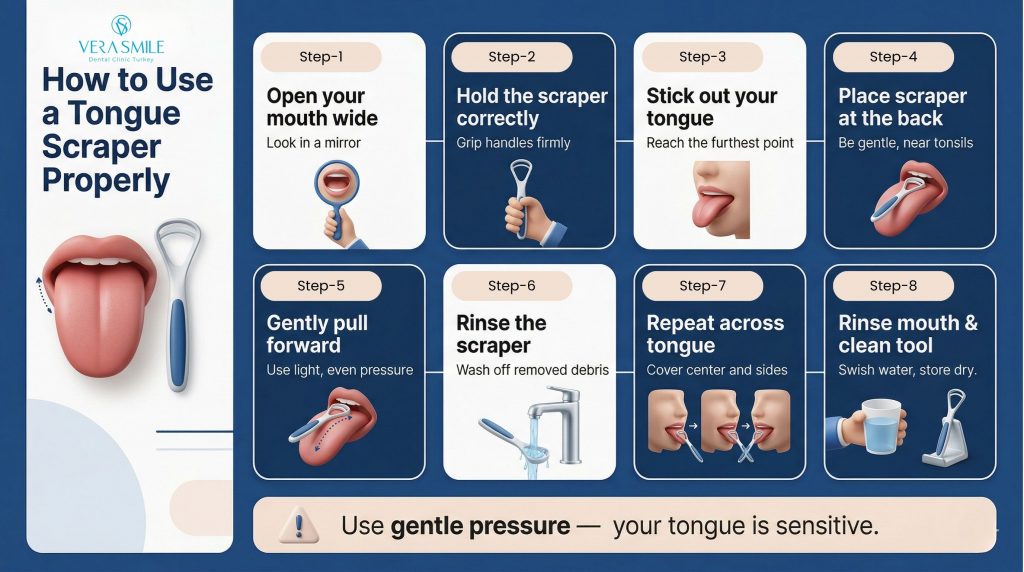
Using a tongue scraper correctly is simple and takes under a minute. Follow these steps for the best results:
- Stand in front of a mirror and open your mouth wide.
- Hold the tongue scraper by its handles on each side (for U-shaped scrapers) or by the handle (for single-handle designs).
- Extend your tongue fully and place the scraper as far back on the tongue as is comfortable, without triggering your gag reflex.
- Apply gentle but firm pressure and draw the scraper forward toward the tip of the tongue in one smooth motion.
- Rinse the scraper under running water to remove the collected debris.
- Repeat two to three times, covering the entire surface of the tongue: center, left side, and right side.
- Rinse your mouth with water or mouthwash after scraping.
- Clean the tongue scraper thoroughly before storing.
Always use gentle pressure. The tongue is sensitive tissue, and excessive force is unnecessary and can cause minor irritation or discomfort.
How Often Should You Clean Your Tongue?
For most people, once a day, ideally in the morning before eating or drinking, is sufficient for maintaining a clean, healthy tongue. Morning is the optimal time because bacteria accumulate overnight while saliva production slows during sleep.
Should you use it before or after brushing?
The order is a matter of personal preference, but many dental professionals recommend scraping before brushing. This removes the bulk of the bacterial coating first, so that subsequent brushing and rinsing clears away any residual debris rather than redistributing it around the mouth.
Can you use a tongue scraper every day?
Yes, you can. Daily use is both safe and recommended. There is no evidence that daily tongue scraping causes harm when done with appropriate pressure. In fact, consistency is key to its effectiveness; the benefits of tongue cleaning are cumulative, improving over weeks of regular practice.
Can Tongue Scraping Damage Taste Buds?
When used correctly with appropriate pressure, tongue scraping does not damage taste buds. The taste buds are located within the papillae and are well-protected structures. The biofilm targeted by the scraper sits on top of and between the papillae, not within the taste buds themselves.
In fact, the opposite is true: removing the coating that sits over taste buds tends to improve taste sensitivity. Many people report that food and drink tastes more vivid after establishing a regular tongue scraping habit, a direct result of unblocking the taste receptors.
The only scenario in which taste buds could be irritated is through excessive force or repeated harsh scraping. Using a gentle, even stroke eliminates this risk entirely.
Are There Alternatives to Tongue Scrapers?
If a tongue scraper is not available or a person finds it uncomfortable, there are alternative approaches to tongue cleaning, though none are as effective as a dedicated tongue scraper. Understanding the limitations of each alternative helps in making an informed choice about your oral care routine.
The good news is that oral hygiene is rarely an all-or-nothing situation. If you are between scrapers, sensitive to the tool, or simply exploring your options, the alternatives below can still contribute meaningfully to a cleaner tongue and fresher breath, as long as their limitations are understood.
1. Toothbrush (Manual or Electric) The most accessible alternative. Using the bristle side, or the textured pad on the back of some brush heads, can dislodge surface debris from the tongue. However, bristles tend to redistribute bacteria rather than remove it, making this a less thorough option than scraping.
2. Mouthwash An antibacterial rinse can temporarily reduce the bacterial load on the tongue and freshen breath. It reaches areas that tools cannot, but it has no mechanical action, meaning it cannot physically lift and remove the biofilm the way a scraper does. Best used as a complement, not a substitute.
3. Gauze or a Soft Cloth Wrapping a piece of gauze or a damp washcloth around a finger and wiping the tongue is a low-tech option sometimes used for infants or patients who cannot tolerate a scraper. It removes some surface debris but offers limited reach and consistency.
4. Oil Pulling An ancient practice involving swishing a tablespoon of oil (typically coconut or sesame) around the mouth for several minutes. Some users report fresher breath and a cleaner-feeling tongue. While clinical evidence remains limited, it poses no harm when practiced correctly alongside standard oral hygiene.
5. Tongue Cleaning Sprays or Gels Some oral care brands offer sprays or enzymatic gels designed to break down the tongue’s biofilm chemically. These can be a useful supplement for people who cannot tolerate physical cleaning tools, but they lack the mechanical removal action that makes scraping so effective.
Every alternative on this list has a role to play, but none replaces the simplicity and proven effectiveness of a dedicated tongue scraper. If discomfort or sensitivity has been the barrier, starting with a soft silicone scraper and using gentle pressure is almost always a workable solution. Small adjustments to technique can make tongue scraping comfortable for the vast majority of people, and the benefits to your breath and oral health are well worth the effort. When in doubt, speak to your dentist, at Vera Smile, we are always happy to help you find an approach that works for you.
Can Mouthwash Replace Tongue Cleaning?
Mouthwash is a valuable adjunct to oral hygiene, it can reach areas that brushing misses, reduce bacterial load, and temporarily freshen breath. However, it is not an effective substitute for physical tongue cleaning.
Rinsing with mouthwash does not mechanically remove the biofilm from the tongue’s surface. Antibacterial mouthwashes (such as those containing chlorhexidine or cetylpyridinium chloride) can reduce bacterial counts temporarily, but they cannot lift and remove the structured coating the way a scraper does.
Think of mouthwash as a complement to tongue scraping, not a replacement. Used together, they provide both mechanical removal and chemical antibacterial action for optimal breath freshness.
Is a Tongue Scraper Better Than a Toothbrush?
For the specific purpose of cleaning the tongue, yes, a dedicated tongue scraper outperforms a toothbrush. The physics of the tools explain the difference: a scraper collects and removes the biofilm, whereas a toothbrush’s bristle design disperses it.
That said, a toothbrush remains the superior tool for cleaning tooth surfaces, the gum line, and areas between teeth. The two tools serve different purposes and ideally should both be part of a complete oral hygiene routine.
For those who want a simpler routine, some toothbrushes include a tongue-cleaning pad or ridges on the back of the brush head. These are an improvement over using only the bristle side on the tongue, but they still do not match the efficacy of a dedicated scraper.
Do Electric Toothbrushes Clean the Tongue Effectively?
Electric toothbrushes are highly effective at removing plaque from teeth and may be slightly better than manual brushing when applied to the tongue. The oscillating or sonic action can help dislodge some surface debris. However, the fundamental limitation remains: bristles are not designed to collect and remove biofilm from the tongue’s broad, textured surface.
Some electric toothbrush brands offer interchangeable tongue-cleaning heads, which perform better than standard brush heads. Even so, clinical evidence still supports the dedicated tongue scraper as the most effective tool specifically for tongue cleaning.
If convenience is a priority, using the back of your electric toothbrush head on your tongue is better than nothing, but pairing it with a tongue scraper will deliver noticeably better results.
What Are the Different Types of Tongue Scrapers?
Tongue scrapers come in several designs and materials, each suited to different preferences and needs. Here is an overview of the main types available:
- Stainless Steel U-Shaped Scrapers: The gold standard. Durable, easy to clean, and highly effective. Basically a loop or U-shaped design held at both ends. Suitable for most adults and long-lasting with proper care.
- Copper Scrapers: Traditional and antimicrobial. Favored in Ayurvedic medicine. Slightly softer than stainless steel, requiring gentle handling to avoid bending. Develops a patina over time but remains hygienic.
- Plastic Single-Handle Scrapers: Lightweight and inexpensive. Often designed with a single ergonomic handle and a flat or slightly curved scraping edge. Good for travel. Replace every 3-4 months or when the edge shows wear.
- Silicone or Rubber Scrapers: The softest option. Ideal for beginners, children, or people with a sensitive gag reflex. The flexibility can make the scraping action slightly less firm, but it is a comfortable introduction to tongue cleaning.
- Combination Toothbrush/Scraper Tools: Some products integrate a scraping surface on the reverse of the brush head. Convenient for those who prefer fewer items in their routine, though generally less effective than dedicated scrapers.
- Biodegradable / Bamboo Scrapers: An environmentally conscious option. Increasingly available with BPA-free plastic or compostable components. A sustainable choice for eco-minded consumers.
How Do You Choose the Right Tongue Scraper?
The right tongue scraper is the one you will actually use consistently. That said, there are several practical factors to consider when making your selection:
Material: If durability and hygiene are priorities, stainless steel or copper are the best choices. For comfort and ease of use, silicone is gentler. Plastic is a budget-friendly option but requires more frequent replacement.
Design: U-shaped or loop scrapers tend to cover more of the tongue’s width in a single pass, making them more efficient. Single-handle designs may offer more control and are often easier to maneuver around the back of the tongue.
Gag sensitivity: If you have a strong gag reflex, start with a softer, more flexible silicone scraper and begin scraping from the middle of the tongue rather than the very back.
Ease of cleaning: Metal scrapers are the easiest to sanitize thoroughly. Look for smooth edges without crevices where bacteria could collect on the scraper itself.
Sustainability: For those prioritizing environmental impact, bamboo or biodegradable options are a responsible choice without significant compromise in performance.
When in doubt, asking your dentist or dental hygienist for a recommendation based on your specific oral health profile is always a good idea. At Vera Smile, our team is happy to guide patients toward the tools best suited to their individual needs.
Are There Any Risks of Using a Tongue Scraper?
Tongue scraping is a safe practice for the vast majority of people when done correctly. The risks are minimal and are almost always related to incorrect technique rather than the tool itself.
Can It Cause Gag Reflex or Irritation?
The gag reflex is the most commonly cited concern with tongue scraping. Placing any object toward the back of the throat naturally stimulates this reflex in some people. However, with practice and the right technique, most individuals find that their tolerance improves significantly within a few days.
To minimize gag reflex sensitivity: start by placing the scraper only as far back as is comfortable; gradually work further back as you become accustomed to the sensation; breathe slowly through your nose during scraping; and consider using a softer silicone scraper initially.
Minor tongue soreness or sensitivity is possible if excessive pressure is used, particularly on the first few uses. This resolves quickly and is easily prevented by using gentle, even strokes. The tongue should never feel scraped raw; if it does, reduce the pressure immediately.
Who Should Avoid Tongue Scraping?
Tongue scraping is not appropriate for everyone. You should avoid tongue scraping or consult a healthcare professional first if you:
- Have open sores, ulcers, or wounds on the tongue or in the mouth
- Are recovering from oral surgery or a dental procedure affecting the tongue or soft tissues
- Have a condition causing thinning or fragile oral mucosa
- Experience recurring tongue bleeding without a known cause
- Are a young child who cannot safely control the motion of the scraper
If you are unsure whether tongue scraping is suitable for you given your medical or dental history, a quick consultation with your dentist will provide clarity. Preventive care decisions should always account for your individual health context.
How Do You Clean and Maintain a Tongue Scraper?
Proper hygiene of the tongue scraper itself is essential; a dirty scraper defeats the purpose of the exercise. Follow these maintenance guidelines:
- Rinse the scraper under warm running water after every use to remove collected debris.
- Use mild soap and a soft brush to clean the scraper thoroughly at least once a week (more frequently for plastic scrapers).
- Rinse the scraper with hot water after washing to help kill any residual bacteria.
- Allow the scraper to air dry completely before storing, moisture encourages microbial growth.
- Store the scraper in a clean, dry location, not lying flat on a potentially contaminated bathroom surface.
- Inspect the scraper regularly for signs of wear, corrosion, or damage. Damaged edges can irritate tongue tissue.
When to replace: Plastic scrapers should be replaced every 3-4 months. Stainless steel and copper scrapers can last for years with proper care. Replace any scraper immediately if it shows signs of rust, significant discoloration, or physical damage to the scraping edge.
How Does Tongue Health Reflect Overall Health?
The tongue is sometimes described as a window to your overall health, and with good reason. Changes in the tongue’s color, texture, coating, or surface can signal a range of systemic conditions, nutritional deficiencies, and oral health issues. Our comprehensive guide to a healthy tongue explores these indicators in detail, but a few important connections are worth highlighting here.
A healthy tongue should be pink, moist, and covered with small papillae. Deviations from this can indicate:
- A thick white coating: May suggest oral candidiasis (thrush), dehydration, or poor oral hygiene
- A bright red tongue: Can be a sign of nutritional deficiencies, particularly B vitamins and iron
- A yellow coating: Often associated with gastrointestinal issues or liver conditions
- Black hairy tongue: A benign but striking discoloration often caused by antibiotic use, tobacco, or certain foods
- Smooth, glossy tongue: May indicate iron deficiency anemia or vitamin B12 deficiency
Regular tongue cleaning not only keeps these conditions from being masked by debris, it also helps you notice changes in your tongue’s appearance more readily, enabling earlier intervention when something needs professional attention.
When Should You See a Dentist?
While a tongue scraper is an effective tool for daily maintenance, it is not a diagnostic or treatment device. The tongue reveals more about your health than most people realize, and knowing when to act on what you see is just as important as keeping it clean. If you want to understand what a healthy tongue should look like and how to read the signs it gives you, our guide to tongue health is a helpful place to start.
That said, certain changes go beyond what daily scraping can address. You should schedule a dental appointment if you notice any of the following:
- Persistent white, yellow, or brown coating that does not clear with regular scraping
- Unusual patches, lumps, or lesions on the tongue that last more than two weeks
- Persistent bad breath that does not improve with improved oral hygiene practices
- Pain, burning sensation, or numbness in the tongue
- Sudden or unexplained changes in tongue color
- Bleeding from the tongue without an obvious cause
These signs may warrant further investigation for conditions ranging from nutritional deficiencies to oral infections or, in rare cases, more serious pathology. A tongue scraper can help you maintain a cleaner oral environment day to day, but it cannot diagnose, treat, or replace the trained eye of a dental professional. Early detection is always preferable, and your dentist is best placed to assess, advise, and put your mind at ease.
How Can Vera Smile Help Improve Your Oral Health?
At Vera Smile, we believe that great oral health starts with knowledge, and that the most powerful dental tool is an informed patient. A tongue scraper is a small investment with a significant return: fresher breath, a cleaner mouth, and a stronger foundation for overall oral health.
Our team of dental professionals provides thorough preventive care consultations that go beyond teeth and gums. We assess the full oral environment (including tongue health) and offer personalized guidance on the oral hygiene tools and habits that will work best for each individual patient at Vera Smile.
Whether you are establishing a new oral hygiene routine, managing persistent bad breath, or simply looking to optimize your dental health, Vera Smile is here to support you at every step. We combine evidence-based preventive dentistry with a patient-centered approach, ensuring that each visit is informative, comfortable, and tailored to your needs.
Good oral health does not happen by accident, it is built through consistent daily habits and the right professional guidance. We invite you to make tongue cleaning a part of your routine and to reach out to our team whenever you have questions about your oral health.
Make Tongue Cleaning Part of Your Daily Routine
A tongue scraper is one of the simplest, most evidence-backed additions you can make to your oral hygiene routine. By removing the bacterial coating that accumulates on the tongue each day, you directly address the most common cause of bad breath, support healthier gums and teeth, and gain a clearer picture of your overall oral health.
The benefits are immediate and cumulative: fresher breath from the very first use, improved taste perception within days, and a measurably cleaner oral environment over time. When combined with regular brushing, flossing, and professional dental check-ups, tongue scraping completes a comprehensive approach to preventive oral care.
If you have never tried a tongue scraper before, there has never been a better time to start. Choose a quality tool, build the habit, and notice the difference it makes. And if you have questions about your tongue health, persistent bad breath, or any other aspect of your oral hygiene, the team at Vera Smile is always ready to help.