
Teeth regrowth drugs and natural ways are the two main categories of approaches aimed at regenerating tooth tissue instead of replacing it with prosthetics.
Teeth regrowth drugs are pharmaceutical agents, including monoclonal antibodies and stem cell therapies, that work with the body’s biological pathways to develop new teeth or dental tissues.
Natural ways are non-pharmaceutical methods, such as fluoride, hydroxyapatite, and dietary practices, that remineralize early enamel damage and support existing tooth structure.
The two categories differ in scope. Drugs are being developed to regenerate whole teeth and have entered human clinical trials, with congenital tooth agenesis as the first target population. Natural methods cannot regrow lost adult teeth but can restore minerals to early enamel lesions and slow decay progression. Unlike dental implants, which place a titanium fixture into the jaw, both drug-based and natural approaches work with the body’s existing biology rather than artificial replacement.
What Are Teeth Regrowth Treatments?
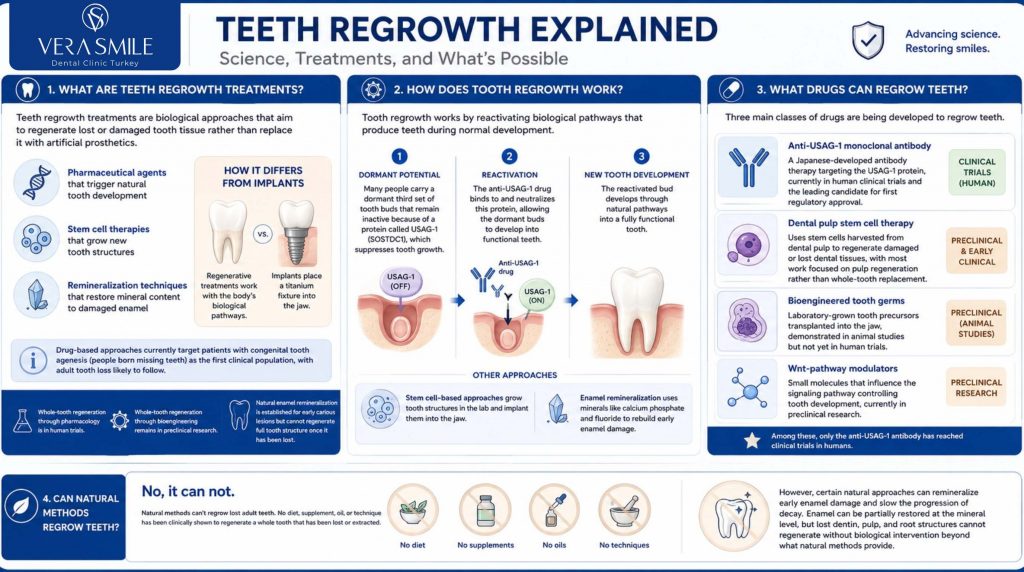
Teeth regrowth treatments are biological approaches that aim to regenerate lost or damaged tooth tissue rather than replace it with artificial prosthetics. The category includes pharmaceutical agents that trigger natural tooth development, stem cell therapies that grow new tooth structures, and remineralization techniques that restore mineral content to damaged enamel.
Unlike implants, which place a titanium fixture into the jaw, regenerative treatments work with the body’s existing biological pathways. Drug-based approaches currently target patients with congenital tooth agenesis (people born missing teeth) as the first clinical population, with adult tooth loss likely to follow. Whole-tooth regeneration through pharmacology is in human trials. Whole-tooth regeneration through bioengineering remains in preclinical research. Natural enamel remineralization is established for early carious lesions but cannot regenerate full tooth structure once it has been lost.
How Does Tooth Regrowth Work?
Tooth regrowth works by reactivating biological pathways that produce teeth during normal development. Humans develop two natural sets of teeth, baby and adult, but the genetic program for producing teeth does not fully shut down. Many people carry a dormant third set of tooth buds that remain inactive because of a protein called USAG-1 (also known as SOSTDC1), which suppresses tooth growth.
The anti-USAG-1 drug works by binding to and neutralizing this protein, allowing the dormant buds to develop into functional teeth. A separate research direction involves growing teeth from stem cells in laboratory conditions and implanting the resulting tooth germs into the jaw. A third approach, enamel remineralization, uses minerals like calcium phosphate and fluoride to rebuild crystalline structure in early enamel damage. Each mechanism targets a different stage and type of tooth loss.
What Drugs Can Regrow Teeth?
Three classes of drugs are being developed to regrow teeth: monoclonal antibodies that block tooth-growth suppressors, stem cell-based regenerative therapies, and small molecules under earlier investigation. The most advanced candidate is an anti-USAG-1 monoclonal antibody, with stem cell approaches following behind in preclinical and early clinical research.
- Anti-USAG-1 monoclonal antibody: A Japanese-developed antibody therapy targeting the USAG-1 protein, currently in human clinical trials and the leading candidate for first regulatory approval.
- Dental pulp stem cell therapy: Uses stem cells harvested from dental pulp to regenerate damaged or lost dental tissues, with most work focused on pulp regeneration rather than whole-tooth replacement.
- Bioengineered tooth germs: Laboratory-grown tooth precursors transplanted into the jaw, demonstrated in animal studies but not yet in human trials.
- Wnt-pathway modulators: Small molecules that influence the signaling pathway controlling tooth development, currently in preclinical research.
Among these, only the anti-USAG-1 antibody has reached clinical trials in humans. For deeper detail on the leading candidate, see our coverage of the anti-USAG-1 antibody drug.
What Is the Anti-USAG-1 Antibody Drug?
The anti-USAG-1 antibody drug is a biologic medication developed by Toregem Biopharma in collaboration with Kyoto University and Kitano Hospital, designed to block the USAG-1 protein and allow dormant tooth buds to develop into functional teeth. It is administered as an injection.
The initial trial population is patients with congenital anodontia or oligodontia, conditions where one or more permanent teeth fail to develop. If safety and efficacy are confirmed in this population, indications may broaden to include patients with acquired tooth loss. Animal studies in mice and ferrets demonstrated successful tooth regrowth, including in subjects that had lost teeth due to disease or extraction. The drug works systemically rather than at a local site, which raises specific safety considerations the trials are designed to assess.
How Do Stem Cell Tooth Therapies Work?
Stem cell tooth therapies use undifferentiated cells, often harvested from dental pulp or extracted wisdom teeth, to regenerate dental tissues. The most clinically advanced application is dental pulp regeneration, where stem cells are placed into a treated root canal to restore living tissue inside a damaged tooth.
Whole-tooth regeneration through stem cells remains in preclinical research. Japanese teams have grown bioengineered tooth germs from cell cultures and transplanted them into animal jaws, where they developed into functional teeth with normal occlusion. Human application is technically more complex because of the longer development period and the need to position teeth correctly within an adult arch.
Can Natural Methods Regrow Teeth?
No, it can not. Natural methods can’t regrow lost adult teeth. No diet, supplement, oil, or technique has been clinically shown to regenerate a whole tooth that has been lost or extracted. However, certain natural approaches can remineralize early enamel damage and slow the progression of decay. Enamel can be partially restored at the mineral level, but lost dentin, pulp, and root structures cannot regenerate without biological intervention beyond what natural methods provide.
Among popular natural approaches, oil pulling with coconut or sesame oil may reduce oral bacteria load but does not regrow teeth or reverse cavities of any depth. Adequate vitamin K2 and vitamin D intake supports calcium metabolism and bone health, including jawbone density, without regenerating lost tooth structure. Hydroxyapatite toothpaste provides mineral building blocks that can remineralize very early enamel lesions but cannot rebuild cavities or restore broken teeth. Fluoride application strengthens remaining enamel and aids remineralization of early lesions, an effect supported by extensive clinical evidence. Bone broth and mineral-rich diets support overall oral and skeletal health but have no demonstrated effect on regenerating extracted teeth. Folk remedies such as comfrey and eggshell powder are frequently promoted online with no clinical evidence for tooth regeneration.
How to Strengthen Teeth Naturally
Strengthening teeth naturally means preserving existing tooth structure, remineralizing early damage, and reducing the conditions that lead to decay. The most effective methods are well-supported by clinical evidence and form the basis of preventive dentistry worldwide. The following practices have measurable effects on enamel integrity and overall oral health.
- Use fluoride toothpaste twice daily: Fluoride is incorporated into enamel as fluorapatite, which is more acid-resistant than the original mineral structure.
- Add hydroxyapatite toothpaste for mineral support: Nano-hydroxyapatite particles deposit into early demineralized areas, supporting enamel restoration.
- Consume adequate calcium and phosphate: Dairy products, leafy greens, and fortified alternatives supply the minerals enamel uses for self-repair.
- Maintain vitamin D levels: Vitamin D enables calcium absorption and supports both tooth and jawbone mineralization.
- Reduce acidic and sugary intake: Soft drinks, citrus juices, and frequent snacking lower mouth pH and dissolve enamel minerals faster than they can be replaced.
- Stay hydrated for saliva flow: Saliva neutralizes acids and delivers minerals to enamel surfaces, making hydration a direct factor in dental health.
- Use xylitol gum after meals: Xylitol reduces cavity-forming bacteria and stimulates saliva flow, supporting natural remineralization.
- Request professional fluoride application: In-office fluoride varnish delivers higher concentrations than over-the-counter products and is supported for both adults and children at risk of decay.
These practices preserve and remineralize teeth at the structural level achievable through nutrition and hygiene. They do not substitute for restorative or regenerative treatment when tooth loss has already occurred.
Who Is a Candidate for Teeth Regrowth Treatment?
Initial candidates for teeth regrowth drugs are patients with congenital tooth agenesis, a group of conditions present from birth where one or more permanent teeth never develop. These populations were chosen for first trials because the unmet medical need is high and the regulatory case for benefit versus risk is clearer. Eligibility is expected to expand over time as safety data accumulates.
- Anodontia patients: Individuals born without any teeth, a rare congenital condition often associated with ectodermal dysplasia syndromes.
- Oligodontia patients: Individuals born missing six or more permanent teeth, excluding wisdom teeth.
- Hypodontia patients: Individuals born missing one to five permanent teeth, the most common form of congenital tooth agenesis.
- Adults with single tooth loss (anticipated): Likely to become eligible in later phases once safety and dose protocols are confirmed in the initial population.
- Patients with adequate jawbone: Sufficient bone is required for new teeth to anchor properly, which may exclude patients with severe long-term edentulism and resorption.
- Patients without contraindicating systemic conditions: Uncontrolled autoimmune disease, active cancer, or other conditions affecting immune response may exclude patients from biologic therapies of this type.
Final eligibility criteria are defined within each clinical trial protocol and may differ once the drug reaches general approval.
When Will Teeth Regrowth Drugs Be Available?
Teeth regrowth drugs are not expected to be commercially available before the late 2020s at the earliest. The anti-USAG-1 antibody, currently the most advanced candidate, entered human clinical trials in Japan in 2024 and must complete a multi-phase regulatory pathway before approval. Other candidates remain in preclinical or earlier stages.
- Phase 1 (safety) trials: The anti-USAG-1 antibody began Phase 1 trials in Japan in 2024, focused on safety in adult patients with congenital tooth agenesis.
- Phase 2 (efficacy) trials: Expected to follow Phase 1 completion, testing whether the drug produces measurable tooth development in target patients.
- Phase 3 (large-scale) trials: Required for regulatory submission, comparing the drug against current standards of care.
- Regulatory approval pathway: Japan’s PMDA is expected to issue the first approval if trials succeed, with US FDA and EU EMA approvals following on separate timelines.
- Initial market availability: Developer statements have referenced approximately 2030 as a target for first market availability, contingent on trial outcomes.
- Broader indications: Expansion from congenital to acquired tooth loss is expected to take additional years beyond initial approval.
These timelines are projections subject to trial results and regulatory review. Delays are common in biologic drug development.
What Are the Risks and Limitations of Teeth Regrowth Treatment?
Teeth regrowth treatments carry both known and theoretical risks, and current human safety data is limited to early-phase trials. The biologic nature of these drugs introduces immune-related and developmental risks that traditional dental procedures do not present.
- Immune response to antibody therapy: Monoclonal antibody treatments can trigger immune reactions ranging from mild infusion reactions to more serious immune events.
- Off-target tooth growth: Animal studies have indicated potential for tooth development in unintended sites; trial protocols monitor for this risk.
- Occlusion and bite alignment issues: New teeth must integrate with existing dentition; misalignment may require orthodontic correction.
- Unknown long-term effects: Long-term outcomes beyond a few years post-treatment are not established for any current candidate.
- Pregnancy and breastfeeding restrictions: Biologic drugs of this type are likely contraindicated during pregnancy and lactation pending further data.
- Not suitable for severe bone loss: Patients with substantial jawbone resorption may not be able to anchor newly developed teeth without prior bone grafting.
- Cost and insurance coverage gaps: Early market pricing is likely high and unlikely to be covered by standard dental insurance plans in the first years post-launch.
These limitations explain why teeth regrowth drugs are unlikely to immediately replace dental implants or other established treatments, even after approval.
How Much Will Teeth Regrowth Drugs Cost?
The anti-USAG-1 antibody drug TRG035 does not yet have a publicly announced price. Toregem BioPharma has not disclosed projected per-patient costs, and no independent analyst figures have been published. TRG035 was granted orphan drug designation by Japan’s Ministry of Health, Labour and Welfare in September 2025, which provides regulatory incentives but does not set market pricing (source: Toregem BioPharma, September 2025). Patients should expect early-launch pricing characteristic of biologic therapies, which generally enter the market at substantially higher cost than established dental treatments.
Current alternatives in Turkey are significantly more affordable than in Western markets. A single dental implant in Turkey ranges from $400 to $1,200, while All-on-4 packages cost between $2,100 and $6,000 per arch, compared with an average of $30,000 in the United States (source: Bookimed, April 2026). Single implant pricing in the United Kingdom ranges between £2,000 and £5,000, and in the United States between $3,000 and $6,000. Full-mouth implant packages in Turkey start from $1,600 and reach $12,000 or more for premium All-on-6 systems using brands such as Straumann or Nobel Biocare (source: Dentatur, April 2026).
What Are the Alternatives for Teeth Regrowth?
While teeth regrowth drugs remain in trials, several established treatments restore function and appearance for patients with tooth loss today. The comparison below evaluates each option on cost, longevity, procedure invasiveness, and suitability for different patient situations.
| Option | Cost (Turkey, USD) | Longevity | Invasiveness | Best For |
| Single dental implant | $400 to $1,000 | 20+ years (often lifetime) | Surgical | Single tooth loss with adequate bone |
| All-on-4 full arch | $3,500 to $7,000 per arch | 15 to 20+ years | Surgical | Full arch loss; preserves bone |
| Fixed bridge | $300 to $800 per unit | 10 to 15 years | Moderate (requires preparation of adjacent teeth) | Single or small gap with healthy adjacent teeth |
| Removable partial denture | $300 to $800 | 5 to 10 years | Non-surgical | Multiple tooth loss, budget-sensitive cases |
| Full denture | $400 to $1,500 | 5 to 10 years | Non-surgical | Complete tooth loss, non-surgical preference |
Dental implants remain the most durable and bone-preserving option currently available. Patients planning long-term should weigh implant longevity against waiting for regenerative therapies that may not reach the market for several years.
How to Prepare for Future Teeth Regrowth Treatment
Patients who hope to benefit from teeth regrowth drugs when they reach market should focus on preserving the anatomical conditions those drugs will require. Jawbone preservation is the most important factor, since regenerative therapies need adequate bone volume to anchor new teeth.
- Treat tooth loss promptly: Empty tooth sockets begin to resorb within months; early intervention preserves bone for future treatment options.
- Consider bone-preserving implants: Modern implants stimulate the jawbone and prevent the resorption that occurs after extraction without replacement.
- Address periodontal disease: Active gum disease causes ongoing bone loss that may disqualify patients from future regenerative treatments.
- Maintain detailed dental records: Imaging, treatment history, and bite records support future treatment planning and eligibility assessment.
- Monitor clinical trial registries: Patients with congenital tooth agenesis or other priority indications can track enrollment opportunities through national trial registries.
- Avoid extractions when restoration is possible: Saving a natural tooth, even through endodontic treatment, preserves the socket and bone for future options.
- Stay current with general oral health: Good systemic and oral health improves eligibility for any biologic therapy.
These steps protect future treatment options without requiring any commitment to a specific therapy in advance.
FAQ’s
Baby teeth cannot grow back as adults because each baby tooth is replaced by a single corresponding permanent tooth, and once that permanent tooth is lost no natural replacement follows. The dormant tooth buds targeted by anti-USAG-1 drugs are a separate third set that exists in some individuals, not regrown baby teeth.
No one has yet successfully regrown a permanent tooth outside of a research or clinical trial setting. Animal studies have produced functional new teeth using anti-USAG-1 antibodies and bioengineered tooth germs, but human regrowth of a full functional tooth has not been confirmed in published clinical results as of 2026.
Teeth regrowth drugs are designed to develop teeth from dormant tooth buds, not to regrow extracted wisdom teeth. Once a wisdom tooth has been removed, current drug candidates would not regenerate it in that position. Future therapies may address acquired tooth loss in any location, but wisdom teeth are not a target indication for current trials.
Teeth do not regrow naturally after a cavity is filled. The filling material replaces lost tooth structure with a synthetic restoration. Surrounding healthy enamel can be supported through fluoride, hydroxyapatite, and good oral hygiene, but the filled cavity itself remains a restoration rather than regrown tissue.
Teeth regrowth drugs are unlikely to fully replace dental implants in the early years after launch. Implants will remain faster, more predictable, and less expensive than regenerative treatments initially. Replacement may follow over decades as regrowth treatments become safer, more accessible, and lower in cost, but implants are expected to remain a primary treatment option for many years.